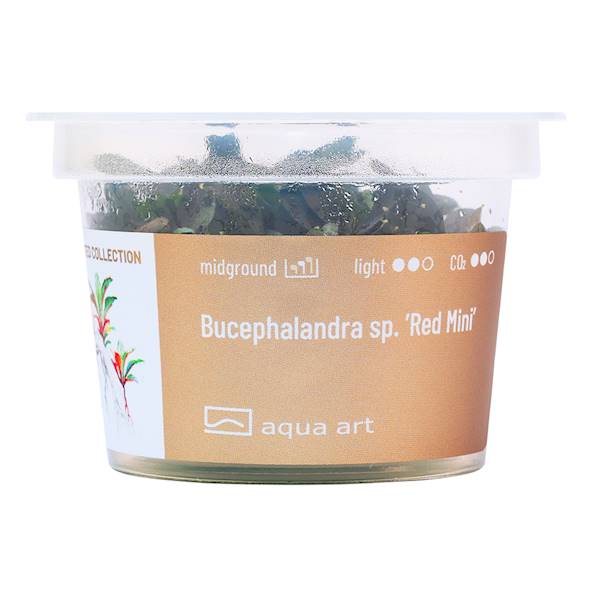
Product information "Ludwigia ovalis Invitro aquarium plant"
Ludwigia ovalis invitro cup
This plant, with a characteristic oval leaf
oval leaf shape in orange-pink color, is easy to grow and an interesting addition to the aquarium.
interesting addition to the aquarium. The leaves are slightly smaller
than those of the popular Repens variety. Due to their rapid growth
the clumps must be trimmed and thinned out regularly to prevent excessive growth.
prevent excessive growth. The original shape of the leaf blade
makes it an attractive addition to the plant composition in the aquarium.
aquarium.
To use this plant, remove it from the cup and rinse the gel.
cup and rinse the gel thoroughly under running water.
Then divide it into small clumps of 1-2 cm and plant them at short intervals.
them at short intervals. As it grows, it will form a
form a uniform group of adult plants.
This plant
comes from in vitro cultivation and is free from snails, parasites and algae.
and algae. High-quality gel was used as a medium, so it will establish itself
quickly establish itself in the aquarium.
Light requirement: medium to intensive
Optimum temperature: 10 to 28 °C
Water values: soft to hard
pH value: 4 to 7
CO2 and nutrients: recommended
Propagation: cuttings
Composition
Feeding recommendation
Technical details
Size information
0 of 0 reviews
Give us a rating!
Share your experience with the product with other customers.
Login
No reviews found. Go ahead and share your findings with others.
Ludwigia ovalis invitro cup
This plant, with a characteristic oval leaf
oval leaf shape in orange-pink color, is easy to grow and an interesting addition to the aquarium.
interesting addition to the aquarium. The leaves are slightly smaller
than those of the popular Repens variety. Due to their rapid growth
the clumps must be trimmed and thinned out regularly to prevent excessive growth.
prevent excessive growth. The original shape of the leaf blade
makes it an attractive addition to the plant composition in the aquarium.
aquarium.To use this plant, remove it from the cup and rinse the gel.
cup and rinse the gel thoroughly under running water.
Then divide it into small clumps of 1-2 cm and plant them at short intervals.
them at short intervals. As it grows, it will form a
form a uniform group of adult plants.This plant
comes from in vitro cultivation and is free from snails, parasites and algae.
and algae. High-quality gel was used as a medium, so it will establish itself
quickly establish itself in the aquarium.
Light requirement: medium to intensive
Optimum temperature: 10 to 28 °C
Water values: soft to hard
pH value: 4 to 7
CO2 and nutrients: recommended
Propagation: cuttings
Ludwigia ovalis invitro cup
This plant, with a characteristic oval leaf
oval leaf shape in orange-pink color, is easy to grow and an interesting addition to the aquarium.
interesting addition to the aquarium. The leaves are slightly smaller
than those of the popular Repens variety. Due to their rapid growth
the clumps must be trimmed and thinned out regularly to prevent excessive growth.
prevent excessive growth. The original shape of the leaf blade
makes it an attractive addition to the plant composition in the aquarium.
aquarium.To use this plant, remove it from the cup and rinse the gel.
cup and rinse the gel thoroughly under running water.
Then divide it into small clumps of 1-2 cm and plant them at short intervals.
them at short intervals. As it grows, it will form a
form a uniform group of adult plants.This plant
comes from in vitro cultivation and is free from snails, parasites and algae.
and algae. High-quality gel was used as a medium, so it will establish itself
quickly establish itself in the aquarium.
Light requirement: medium to intensive
Optimum temperature: 10 to 28 °C
Water values: soft to hard
pH value: 4 to 7
CO2 and nutrients: recommended
Propagation: cuttings
🌿 Proserpinaca palustris - Decorative aquarium plant with serrated foliage
Structure and color for the middle to background layout
Proserpinaca palustris from Aqua Art is an unusual aquarium plant with finely toothed, fern-like leaves that can take on a fascinating copper-orange coloration in good light. It grows upright and gives the aquascape a special depth effect and structure thanks to its unique texture.
In well-lit tanks with a CO₂ supply, it develops vibrant colors and healthy growth. Its eye-catching appearance makes it ideal as an accent plant in the middle or background.
✅ Advantages at a glance
Unique leaf shape with serrated foliage
Color gradient from green to copper-orange in strong light
Ideal for structured middle and background design
Demanding, but very decorative under optimal conditions
Grown in vitro - free from snails and pesticides
Particularly striking in layouts with contrasting plants
📋 Product details
Name: Proserpinaca palustris
Origin: North and South America
Type: Stem plant
Growth height: approx. 20-40 cm
Light requirement: medium to high
CO₂ supply: recommended to necessary
Growth: medium
Propagation: Cuttings after pruning
Delivery form: In vitro cup (sterile)
Manufacturer: Aqua Art
💡 Zoo Roco tip
Proserpinaca palustris looks particularly impressive when planted in groups and combined with fine-leaved plants such as Myriophyllum or Rotala. Strong light and regular micronutrient fertilization are crucial for intensive colouring.
With Proserpinaca palustris from Aqua Art, you can add variety, color and structure to your aquascape - ideal for sophisticated layouts with character.Customers also searched for: Proserpinaca palustris, Aqua Art, structure-rich aquarium plant, stem plant aquarium, serrated leaves, InVitro plant aquarium, aquascaping plant, buy Proserpinaca, reddish aquarium plant, background plant aquarium
🌿 Hygrophila sp. 'Araguaia' InVitro Reddish-brown accent plant with unique growth habit
Hygrophila sp. 'Araguaia' from Aqua Art is a particularly attractive, compact stem plant with a reddish-bronze color and finely branched growth. It is ideal for the foreground to midground and provides structured contrasts and warm color accents in aquascapes.
This plant is one of the slow-growing Hygrophila species and can be easily shaped and thickened by regular pruning. Supplied as an in-vitro plant, it is free from algae, snails and pesticides - ideal for shrimp tanks and sensitive aquariums.✅ Advantages at a glance:
Compact Hygrophila with reddish-bronze leaves
InVitro - sterile, snail-free & pesticide-free
Ideal for the foreground or middle ground
Slow-growing - easy to shape and grow bushy
Good effect with strong lighting & CO₂ supply
Very decorative in natural aquariums and layouts with contrasting colors📋 Product details:
Name: Hygrophila sp. 'Araguaia'
Type: Stem plant
Placement: Foreground to midground
Growth height: approx. 5-15 cm
Light requirement: medium to high
CO₂ supply: recommended
Growth: slow
Delivery form: In vitro cup (sterile cultivated)
Manufacturer: Aqua Art💡 Zoo Roco tip:
Combine Hygrophila 'Araguaia' with light green plants such as Micranthemum or Hydrocotyle sp. 'Japan'
- to show off the darker coloring particularly well. For a
dense carpet, regular pruning is recommended.Hygrophila 'Araguaia' provides subtle color accents and fine structure in the lower section of the aquarium - ideal for sophisticated layouts and harmonious plant design.
Ludwigia sphaerocarpa 'Pilosa' InVitro Red accent plant for aquascaping
Ludwigia sphaerocarpa 'Pilosa' is a decorative and rare stem plant with a particularly intense red coloration and fine leaf structure - a real eye-catcher for any natural aquarium. This variety is ideal for the mid to background area and adds color depth and contrast to groups of green plants.
As an Aqua Art in vitro plant, it is free from snails, algae and pesticides, making it perfect for shrimp tanks and sensitive aquariums. With good lighting and CO₂ supply, it develops its full color intensity and grows vigorously but controllably.✅ Advantages at a glance:
Intensely red-colored stem plant with a fine texture
Grown in vitro - sterile, free from harmful substances
Ideal for color contrasts in the middle or background
Safe for shrimps and sensitive aquariums
Grows compact & controllable with good care📋 Product details:
Name: Ludwigia sphaerocarpa 'Pilosa'
Type: Stem plant
Placement: Middle to background
Growth height: approx. 20-40 cm
Light requirement: medium to high
CO₂ supply: recommended
Color effect: red to reddish-green
Growth: medium
Delivery form: In vitro cup (sterile cultivation)
Manufacturer: Aqua Art💡 Zoo Roco tip:
For strong red coloration, the plant should be kept under intensive lighting and regularly supplied with iron and micronutrients. A good supply of CO₂ also has a positive effect on growth and color.Ludwigia sphaerocarpa 'Pilosa' from Aqua Art brings structure, contrast and an intense play of colors to the aquarium - perfect for modern aquascaping layouts.
Invitro aquarium plant Rotala rotundifoliaColorful stem plant for the background
Rotala rotundifolia is one of the most popular stem plants in the aquarium hobby - versatile, easy to care for and particularly attractive thanks to its delicate, round leaves. Depending on the light intensity and nutrient supply, it develops a vibrant green to bright red, adding lively color accents to any aquarium layout.
The in vitro version is grown under sterile conditions and is therefore free from algae, snails and pesticides - ideal for sensitive aquariums, especially shrimp tanks. Fast-growing and adaptable, Rotala rotundifolia is ideal for the mid to background and harmonizes wonderfully with other fine stem plants in the natural aquarium.
Advantages at a glance:
✅ Changes color depending on the light - from green to red
✅ Fast-growing & ideal for dense groups of plants
✅ InVitro - guaranteed free from harmful substances & snails
✅ Safe for shrimps & sensitive tanks
✅ Perfect for aquascaping & classic plant aquariumsProduct details:
Name: Rotala rotundifolia
Type: Stem plant
Position in aquarium: Middle to background
Growth height: approx. 30-50 cm
Light requirement: Medium to high
CO₂ supply: Recommended for more intense colorationTemperature: 22 - 28°C
Delivery form: In vitro cup (grown sterile)
Color effect: Green to reddish, depending on light & nutrients
Invitro aquarium plant Bacopa myriophylloidesDelicate aquarium plant for the background
Bacopa myriophylloides is an elegant stem plant with delicate, finely pinnate leaves - a real eye-catcher for the background of your aquarium. Its special structure brings lightness and movement to the layout and is ideal for aquascaping and natural aquariums.
As a high-quality in vitro plant, it is free from algae, snails and pesticides, making it particularly safe for shrimps and sensitive tanks. With good lighting and CO₂ supply, Bacopa myriophylloides grows compactly and healthily - with a beautiful, delicate appearance.
Advantages at a glance:
✅ Delicate stem plant with feathery leaves
✅ Ideal for the background & textured layouts
✅ InVitro - sterile, pesticide-free & shrimp-safe
✅ Healthy growth with light & CO₂ addition
✅ Perfect for aquascaping & natural aquariumsProduct details:
Name: Bacopa myriophylloides
Type: Stem plant
Location in the aquarium: Background
Growth height: approx. 30-50 cm
Light requirement: Medium to high
CO₂ supply: Recommended
Delivery form: In vitro cup (grown sterile)
Special feature: Very fine, decorative leaf structure
InVitro Ammania senegalensis from Aqua ArtThe Ammania senegalensis InVitro from Aqua Art is an impressive aquarium plant with intense red coloration that is a real eye-catcher, especially in the middle and background of your aquarium. Thanks to InVitro cultivation, you get a 100 % sterile, pesticide-free plant that is also ideal for sensitive shrimps and aquascaping projects.
With sufficient light, nutrients and CO₂, Ammania senegalensis develops strong, red stems and oval leaves - perfect for colorful contrasts in plant aquariums.
Advantages at a glance:
✅ Bright red stem plant for the middle & background
✅ InVitro - free from algae, snails & pesticides
✅ Safe for shrimps & sensitive aquarium inhabitants
✅ Ideal for aquascaping & natural aquariums
✅ Fast-growing with good lighting & CO₂ supplementationProduct details:
Name: Ammania senegalensis
Origin: Africa
Type: Stem plant
Position in the aquarium: Middle to background
Growth height: approx. 20-40 cm
Light requirement: Medium to high
CO₂ supply: Recommended
Delivery form: In vitro cup (lab-grown, sterile)Planting: The plant must be removed from the cup and thoroughly
rinsed thoroughly from the gel under running water. This is best done
best done by placing the plant in a container with lukewarm water.
lukewarm water. Most of the gel will then fall off by itself. Divide
the contents of the cup into 1-2 cm clumps and place these a short distance apart in the
then place them a short distance apart in the substrate or on the selected
objects.
Micranthemum umbrosum
Micranthemum Umbrosum is a light green stem plant with small round leaves. Depending on how it is pruned, it is suitable for both the foreground and background of the aquarium. Difficulty of cultivation: easy Light requirement: medium, to high CO₂ requirement: medium Height of the adult plant: 20 cm Growth: fast Temperature: 22-26 °C Placement in the aquarium: Second level Origin: North and Central America Cup diameter: 6 cm Micranthemum Umbrosum (Round-leaved meadowfoam) is a naturally occurring plant in North and Central America. It grows both in water and in marshy areas. It is prized by aquarists for its unique appearance.
The plant forms long stems with paired, alternate, small, round, light green leaves. It has a fairly well developed root system. It needs regular pruning and is easy to shape into a desired form. It is propagated vegetatively by cutting off the shoot tips and planting them in the ground.
It likes water with a hardness of 2-12°N, a pH of 5.5-7.7 and a temperature of 24-26°C. It is sensitive to trypaflavin and can be damaged by snails. It has fairly high light requirements. With insufficient light, it pulls upward, and distinct gaps can be seen between the leaves. With sufficient light, it forms dense clumps that are pleasing to the aquarist's eye.Micranthemum umbrosum is usually placed in the background of the aquarium, but it also looks good in the foreground when cut short. It does not require absolute CO₂ fertilization, but grows much faster in its presence. When growing this plant, pay special attention to the proper concentration of iron in the aquarium water..
Planting:The plant must be removed from the cup and thoroughly rinsed from the gel under running water. This is best done by placing the plant in a container of lukewarm water. Most of the gel will then fall off by itself. Divide the contents of the cup into 1-2 cm lumps and then set them at intervals of 1 to 2 cm.
Limnophila aromaticaLimnophila Aromatica (fragrant limnophilia) is a beautiful plant for the second or third level. It turns purple under intense light.Difficulty of cultivation: moderate Light requirement: medium CO₂ requirement: medium Adult plant height: up to 50 cm Growth: moderate Temperature: 22-28°C Placement in aquarium: second or third level Origin: Asia Cup diameter: 6 cm Limnophila Aromatica (fragrant Limnophila, rice paddy weed) is a plant that has earned a place in aquariums around the world due to its unique appearance and leaf color. It is native to Asia, where it usually grows in rice paddies or swamps near water. It does well after the end of the rainy season in a dry place in a still moist, sandy soil. At high temperatures, the plant flowers, forms fruit, and then dies. Traditionally used as a spice, especially in Vietnamese cuisine. Its flavor is reminiscent of cumin and lemon. Currently, the plant can also be found in America and Australia.Limnophilia Aromatica is a stalk plant that produces lance-shaped leaves with serrated edges. Their color depends on the intensity of light. If the plant has little access to light, its leaves are green. If the light is strong, the entire top of the plant is intense red and the leaves are purple on the underside.
In aquariums, plant it in the second or third level, leaving a distance of 1.5 cm between cuttings. It grows quite fast, its optimal pH is 6-7. It tolerates temperatures between 15 and 30 °C, but it is better to avoid extreme temperatures and keep it between 22 and 28 °C. In aquariums it is propagated by cutting and planting young plants that form on the stems or from the tips. The plant does not require absolute CO₂ fertilization, but grows much faster with CO₂ addition.
To achieve the desired intense red-purple color of the leaves, the plant must be strongly illuminated. In addition, attention must be paid to the correct water parameters in the aquarium, especially the optimal iron, nitrate and phosphate content, so that the plant can absorb the nutrients from the water column. Due to its strongly developed root system, the plant grows best in active media.Planting: The plant must be removed from the cup and thoroughly rinsed from the gel under running water. This is best done by placing the plant in a container of lukewarm water. Most of the gel will then fall off by itself. Divide the contents of the cup into 1-2 cm lumps and then set them at intervals of 1 to 2 cm.
Ludwigia sp. 'Super Mini Red'Ludwigia sp. Super Mini Red' is a fast growing red plant for the second or third level in the aquarium. It is easy to propagate and does not require strong lighting. This plant grows in the soil and on decoration.Difficulty of cultivation: mediumLight requirement: mediumCO₂ requirement: mediumHeight of adult plant: 10-25 cmGrowth rate: mediumTemperature: 20-28°C Placement in aquarium: second or third level.
Origin: Cultivar (cultivated variety) Cup diameter: 6 cm Ludwigia sp. 'Super Mini Red' is the smallest of the red-leaved Ludwigia varieties. It has fine and delicate dark red leaves. A particularly decorative aquarium plant. Depending on tank size, it is suitable for the middle or third level of the aquarium. It is popular for arrangements in Dutch and natural style aquariums. The leaf blade is about 2 cm long and 1.5 cm wide. The plant does not have excessive requirements. It grows even in moderate light, although the red color then becomes less intense.
The plant can be planted in the ground or on decorations. When attached to the roots, it forms fanciful compositions, reminiscent of treetops. In this form of cultivation should not forget about the additional application of liquid fertilizer. The best growth results are obtained when planted in a fertile substrate. Under good conditions it spreads quickly.Ludwigia sp. Super Mini Red' has many lovers thanks to its extremely intense red color. It discolors easily and quickly under strong light conditions. In this way, it becomes an incredibly eye-catching design element in their aquarium. Due to its rapid growth, it must be regularly cut back and trimmed.
It does well in the strong spots of an arrangement, in the second or third row. The Super Mini Red variety does not require CO₂ and grows in the water column even with low light intensity and low fertilizer levels. Therefore, it is a suitable plant for beginners in plant aquaristics. However, it is important to remember that the best growing results can be achieved with appropriate lighting and additional carbon dioxide addition. It grows in both hard and soft water with pH between 5.5 and 7.5.
It does not require complicated care. Frequent pruning and good growing conditions will ensure beautiful, dense plants. It can grow up to 25 cm tall. As with most stems, the cut tips of the plants can be replanted in the ground. The plant will form side shoots at the cut.Planting:The plant must be removed from the cup and thoroughly rinsed from the gel under running water. This is best done by placing the plant in a container of lukewarm water. Most of the gel will then fall off by itself. Divide the contents of the cup into 1-2 cm lumps and then set them at intervals of 1 to 2 cm.
Rotala Rotundifolia 'Green'
Rotala Rotundifolia 'Green' (Round-leaved Rotala) is a mid-ground plant. It is characterized by fast growth and moderate light requirements. The color is usually light green.Difficulty of growing: easy Light requirements: medium CO₂ requirements: not necessary Height of mature plant: 50-60 cm Growth: fast Temperature: 20-28°C Placement in aquarium: third level Origin: South Asia, Southeast Asia Cup diameter 6 cm The natural range of the round-leaved Rotalas (Rotala rotundifolia) is South, Southeast and East Asia. It has been spread by humans to Australia, the United States and Brazil, among other places. She is thus already almost a globetrotter.Rotala rotundifolia 'Green' is very similar to Rotala rotundifolia, but its leaves remain bright green even in bright light.
This plant is characterized by its fast growth and its tendency to spread profusely, especially when regularly pruned. It tolerates medium light levels, but the higher the light, the more intense the plant's growth and colors. If left to grow freely, it reaches a length of 30-60 cm, cutting off access to light to the lower parts, where it begins to lose its leaves. Under favorable conditions, if left uncontrolled, it can dominate an entire tank, especially if it is a tank with a small capacity. Once it reaches the surface of the water, it begins to float on it. It does not need additional carbon dioxide fertilization unless you want to accelerate its growth even more.
It is tolerant of pH and water hardness, although like most plants, it cannot tolerate extremes.
It tolerates temperatures between 20 and 28 °C, but thrives better in the upper end of this range. It can grow in both an active and a poor substrate, but in this case it is advisable to fertilize under the roots. In well-lit, CO2-fertilized aquariums, it may require additional fertilization with macronutrients due to its rapid growth. Otherwise, it will lose its color and the leaves will become smaller. Rotala rotundifolia is propagated in the aquarium by cutting off stem pieces and placing them in a selected spot in the substrate. When transplanted to a new tank, it will need some time to acclimate and grow faster.Planting: The plant must be removed from the cup and thoroughly rinsed from the gel under running water. This is best done by placing the plant in a container of lukewarm water. Most of the gel will then fall off by itself. Divide the contents of the cup into 1-2 cm lumps and then place them at a small distance into the substrate.
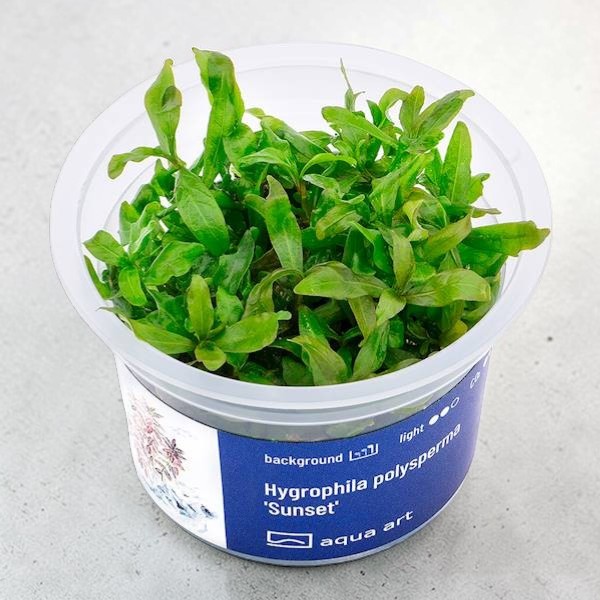
Hygrophila polysperma (Indian water lily)
max. growth height
- 50 cm
Country of origin
India, Sri Lanka and Thailand
Suitability
Discus aquariumCommunity aquarium
Type
Stem plant
Family
Acanthaceae
Genus
Hygrophila
Propagation
Cuttings
Growth rate
fast
pH
5 - 9
Water hardness
10 - 30 °dh
Notes
Cut back regularly.
Hygrophila polysperma is one of the "easiest" plants in the aquarium hobby. Even under the worst conditions, it can continue to grow to some extent. If the growing conditions are improved, the plant naturally thrives much better. With good lighting, the tips of its shoots turn a reddish brown colour. It grows very quickly, so it needs to be cut back more often than other stem plants. Highly recommended for initial planting and as an algae preventative.
Ludwigia sp. 'Super Mini Red'Ludwigia sp. Super Mini Red' is a fast growing red plant for the second or third level in the aquarium. It is easy to propagate and does not require strong lighting. This plant grows in the soil and on decoration.Difficulty of cultivation: mediumLight requirement: mediumCO₂ requirement: mediumHeight of adult plant: 10-25 cmGrowth rate: mediumTemperature: 20-28°C Placement in aquarium: second or third level.
Origin: Cultivar (cultivated variety) Cup diameter: 6 cm Ludwigia sp. 'Super Mini Red' is the smallest of the red-leaved Ludwigia varieties. It has fine and delicate dark red leaves. A particularly decorative aquarium plant. Depending on tank size, it is suitable for the middle or third level of the aquarium. It is popular for arrangements in Dutch and natural style aquariums. The leaf blade is about 2 cm long and 1.5 cm wide. The plant does not have excessive requirements. It grows even in moderate light, although the red color then becomes less intense.
The plant can be planted in the ground or on decorations. When attached to the roots, it forms fanciful compositions, reminiscent of treetops. In this form of cultivation should not forget about the additional application of liquid fertilizer. The best growth results are obtained when planted in a fertile substrate. Under good conditions it spreads quickly.Ludwigia sp. Super Mini Red' has many lovers thanks to its extremely intense red color. It discolors easily and quickly under strong light conditions. In this way, it becomes an incredibly eye-catching design element in their aquarium. Due to its rapid growth, it must be regularly cut back and trimmed.
It does well in the strong spots of an arrangement, in the second or third row. The Super Mini Red variety does not require CO₂ and grows in the water column even with low light intensity and low fertilizer levels. Therefore, it is a suitable plant for beginners in plant aquaristics. However, it is important to remember that the best growing results can be achieved with appropriate lighting and additional carbon dioxide addition. It grows in both hard and soft water with pH between 5.5 and 7.5.
It does not require complicated care. Frequent pruning and good growing conditions will ensure beautiful, dense plants. It can grow up to 25 cm tall. As with most stems, the cut tips of the plants can be replanted in the ground. The plant will form side shoots at the cut.Planting:The plant must be removed from the cup and thoroughly rinsed from the gel under running water. This is best done by placing the plant in a container of lukewarm water. Most of the gel will then fall off by itself. Divide the contents of the cup into 1-2 cm lumps and then set them at intervals of 1 to 2 cm.
Limnophila hippuridoide-InVitro
Limnophila hippuridoide is an elegant stem plant that provides height, structure and lively color nuances in the background of the aquarium. Its fine, densely arranged leaves give the layout a soft, natural look and add movement to the overall picture.
Depending on the light conditions, the plant develops attractive plays of color ranging from fresh green to warm orange and red tones, creating exciting contrasts in the aquascape. It grows quickly and is ideal for creating dense groups of plants or concealing technical elements in the background.
With moderate care requirements, this species is adaptable and rewards a good supply of nutrients with strong, healthy growth.Advantages at a glance:
Attractive background plant with filigree structure
Color variations from green to orange-red possible
Fast growth for dense groups of plants
Ideal for creating depth in aquascaping
Cultivated in vitro - free from snails and algae
Product details:
Name: Limnophila hippuridoide
Type: Background plant
Growth height: up to 45 cm
Light requirement: medium to high
CO₂ supply: recommended
Growth: fast
Propagation: via side shoots or top cuttings
Delivery form: InVitro cup (sterile cultivated)
Manufacturer: Aqua Art
Hygrophila pinnatifida - aquarium plant from India
max. growth height
- 40 cm
Country of origin
India
Suitability
Aquascaping, community aquarium, NanoCube
Type
Stem plant
Family
Acanthaceae
Genus
Hygrophila
Propagation
Side shoots
Growth rate
medium
pH
5 - 8
Water hardness
5 - 12 °dh
Notes
Can also grow on stones or roots, which is rather untypical for a stem plant.
A new species from India with an unusual character. It has only been on the market for a few years and is increasingly being planted in fascinating landscapes. On the one hand, its leaves are very attractive, ranging from rusty brown to olive green, on the other hand, the leaf shape is beautifully pinnately divided. In combination with simply shaped plants, the expression of this ornamental leaf shape is intensified. Another special feature is the ability to grow on stones and roots – completely atypical for a stem plant.
Variant:
air pump 100 - 100l/hour
|
Variant (1):
air pump 100 - 100l/hour
EHEIM Air pump
There are 3 models with pump capacities of 100, 200 (2 x 100) and 400 (2 x 200) l/h, with the smallest model featuring one and the two larger models each featuring two separately adjustable air outlets. Accordingly, one or two EHEIM air diffusers are included in the scope of delivery. The air flow can be adjusted directly on the unit for each air outlet, as well as on each diffuser. This allows you to adjust the bubble pattern entirely to your taste and requirements.
By the way: Vibration-inhibiting rubber edges also contribute to the smooth running. The air pump stands quietly on these and does not “wander”. Or you can hang it on the wall. A special bracket is provided for this purpose.
Advantages of the EHEIM air pump
3 models, suitable for all common aquarium sizes
Very quiet operation
Long service life, best quality
Air volume per air outlet individually adjustable on the device
Additional adjustment of air volume and bubble pattern on the diffuser
Fully equipped with:
- Diffuser: air pump 100 = 1x; air pump 200, 400 2x each - Air hose: air pump 100 = 1 m; air pump 200, 400 2 m each
(diffusers also available separately as accessories)
Anti-vibration rubber edges
Bracket for wall mounting
Air diffuser with replaceable fleece (Art. 7400030)
Ludwigia ovalis invitro cup
This plant, with a characteristic oval leaf
oval leaf shape in orange-pink color, is easy to grow and an interesting addition to the aquarium.
interesting addition to the aquarium. The leaves are slightly smaller
than those of the popular Repens variety. Due to their rapid growth
the clumps must be trimmed and thinned out regularly to prevent excessive growth.
prevent excessive growth. The original shape of the leaf blade
makes it an attractive addition to the plant composition in the aquarium.
aquarium.To use this plant, remove it from the cup and rinse the gel.
cup and rinse the gel thoroughly under running water.
Then divide it into small clumps of 1-2 cm and plant them at short intervals.
them at short intervals. As it grows, it will form a
form a uniform group of adult plants.This plant
comes from in vitro cultivation and is free from snails, parasites and algae.
and algae. High-quality gel was used as a medium, so it will establish itself
quickly establish itself in the aquarium.
Light requirement: medium to intensive
Optimum temperature: 10 to 28 °C
Water values: soft to hard
pH value: 4 to 7
CO2 and nutrients: recommended
Propagation: cuttings
Myriophyllum sp. 'Guyana
Myriophyllum sp. 'Guyana is a dense plant for the second and third levels of an aquarium. It forms a dense green wall in the back of a small tank and provides an excellent hiding place for small, shy fish and shrimp species.Difficulty of growing: moderately demandingLight requirements: mediumCO₂ requirements: mediumHeight of mature plant: up to 30 cmGrowth: mediumTemperature: 23-27 °CPlacement in aquarium: Background or midground plantOrigin: South AmericaCup diameter 6 cm"Guyana" is an interesting cultivar of a coneflower well known to aquarists. It attains a very intense green coloration and forms a dense forest in the aquarium. It has beautiful decorative narrow leaves. Unique to it is that the plant remains bright green even in above-average light, while other paddlers turn red.
Also, it grows relatively slowly and has short stems that branch easily. Thanks to its compact growth, it does well in nano aquariums. Guyana plant contrasts well with red plants, especially when planted as background for them.It requires fertilization with micro and macro elements, and it is also worth feeding it with CO₂ in gaseous form. It does not need a very fertile substrate, as it takes up most of its nutrients from groundwater. However, if you put fertilizer capsules or tablets under its roots, the plant will also benefit.
You can propagate Myriophyllum very easily by cutting the plant to a length of about 5 cm and planting a new shoot in the substrate. The plant quickly sprouts new roots and begins to climb upwards.The delicate leafy leaves of the plant form a very dense clump in the aquarium, which immediately catches the eye.
Myriophyllum sp. 'Guyana' is an ideal plant for aquarists who love nano tanks and delicate plants. The stems branch very easily and thicken into a showy thicket. Frequent shortening aids the branching process. In elaborately designed cubes, it is a real eye-catcher.In larger aquariums, there is a risk that Myriophyllum is hardly visible in the midst of larger-than-life plants, unless you plant it in dense clumps.
The plant comes from an in vitro cultivation, which means that it is free from snails, parasites and algae. A high-quality gel was used as the culture medium, so it can quickly and easily adapt to the new conditions.Planting: The plant must be removed from the cup and thoroughly rinsed from the gel under running water. This is best done by placing the plant in a container of lukewarm water. Most of the gel will then fall off by itself. Divide the contents of the cup into 3-4 cm lumps and then place them in the substrate..
CHF 6.50
❅
❆
❅
❆
❅
❆
❅
❆
❅
❆
❅
❆
This website uses cookies to ensure the best experience possible. More information...