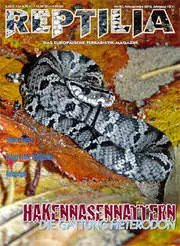
Product information "Reptilia 115 - Adders for the terrarium"
Reptilia 115 - Adders for the Terrarium
Flamingo flowers Blue rock iguana New Zealand mantis
Contents:
Cover story: Adders for the Terrarium
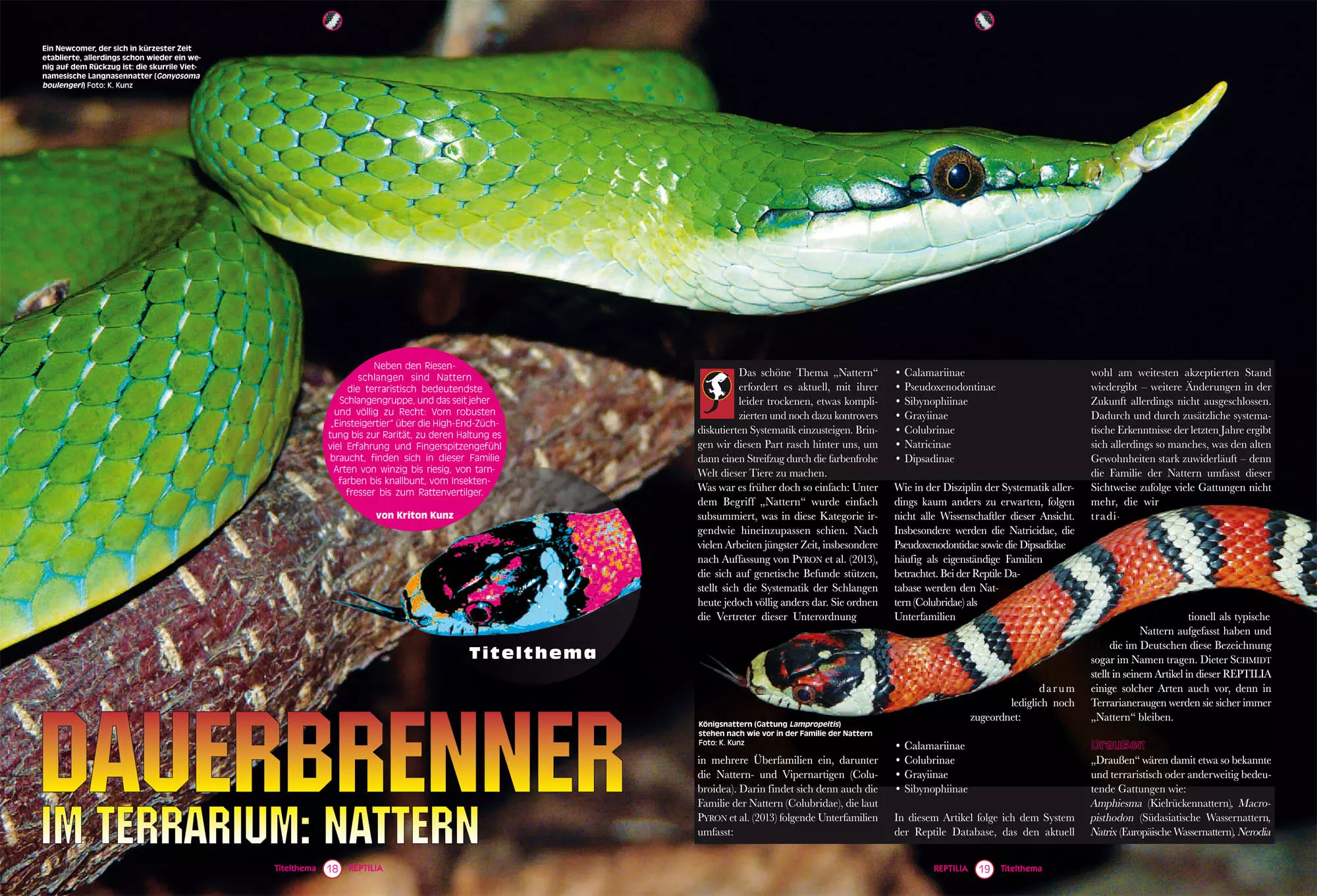
Adders are among the classic and most popular terrarium animals. This extremely species-rich group of snakes has produced some of the most popular reptile pets. We provide an overview of the terrarium-relevant species and focus in particular on those adders suitable for beginners, among which there are many truly perfect pets. But we also have a real beauty for advanced keepers and report on the keeping and breeding of red bamboo adders.
Editorial MAGAZINE DATES
WESTERN HERP PERSPECTIVES The dark side B. Love
Fotostory Evergreens in the terrarium: Adders K. Kunz
Practice Adders. Species and tips for beginners D. Schmidt
Husbandry and breeding Thai bamboo adders (Oreocryptophis porphyraceus coxi) in the terrarium M. Hornig
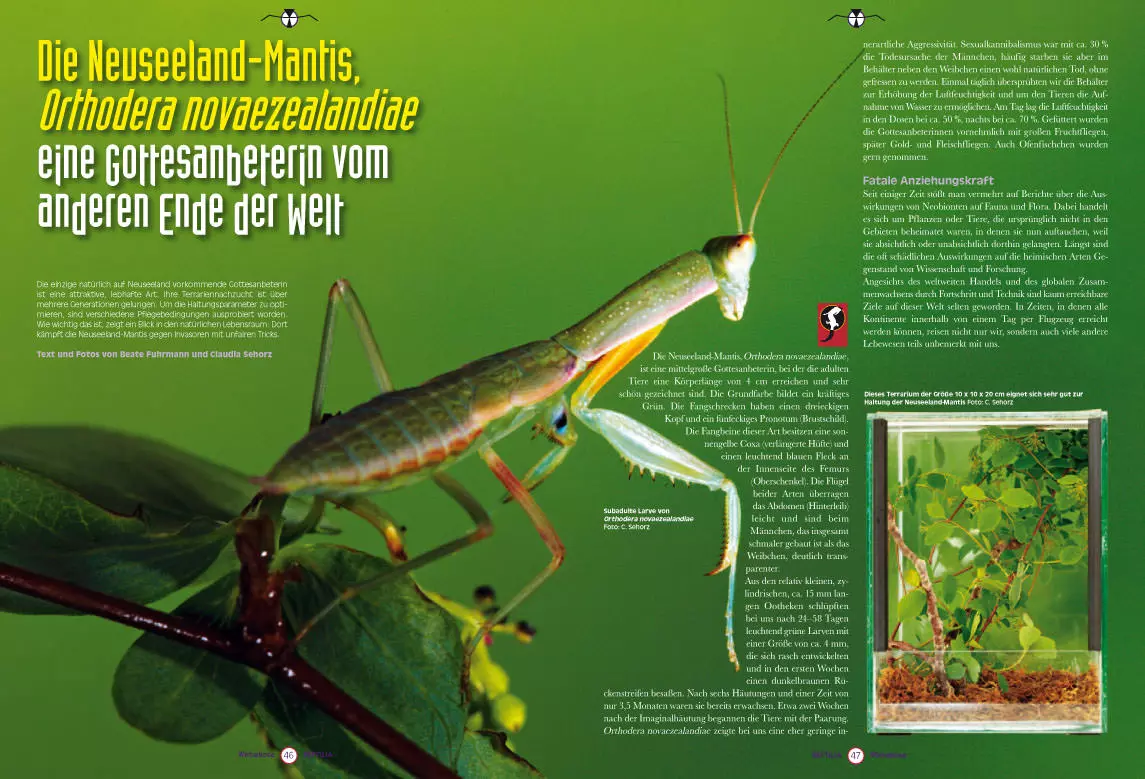
Husbandry and breeding The New Zealand mantis, Orthodera novaezealandiae. A praying mantis from the other side of the world B. Fuhrmann & C. Sehorz
Husbandry and breeding The keeping and breeding of the Blue rock iguana (Petrosaurus thalassinus) in the terrarium J. Schulz
Plants Arum family in the terrarium. Part 3: The genus Anthurium B. Akeret
Husbandry and breeding First ever natural rearing of the critically endangered Philippine crocodiles (Crocodylus mindorensis) in Europe successful T. Ziegler, A. Rauhaus & C. Niggemann, AG Zoological Garden Cologne
Animals of our homeland The fire salamander R. Leptien
ALSO IN YOUR AREA
Service
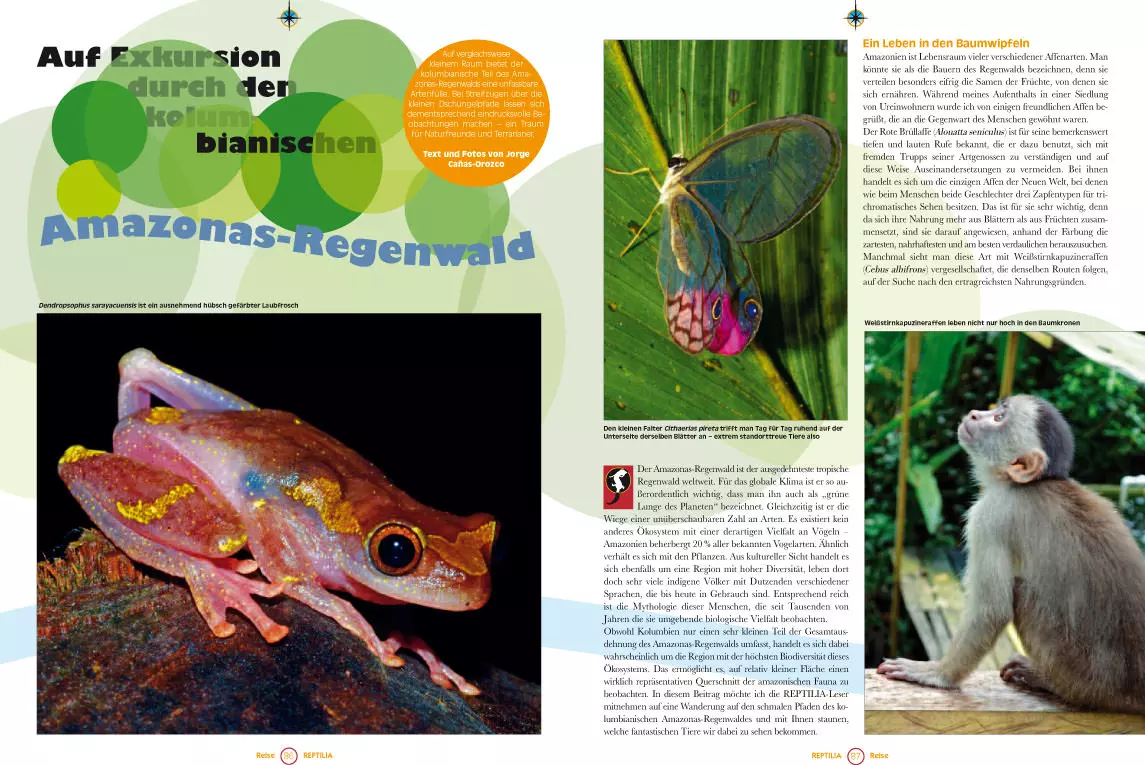
Travel On an excursion through the Colombian Amazon rainforest J. Cañas-Orozco
PREVIEW
INCUBATOR Attention – more cat content H. Werning
Composition
Feeding recommendation
Technical details
Size information
0 of 0 reviews
Give us a rating!
Share your experience with the product with other customers.
Login
No reviews found. Go ahead and share your findings with others.
Reptilia 107 Toad lizards
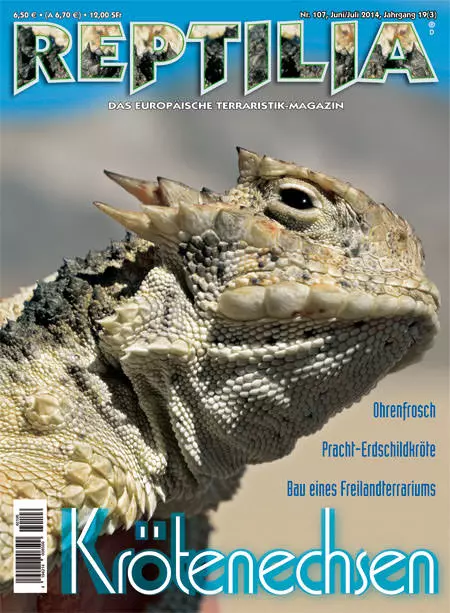
Eared frogMagnificent tortoiseConstruction of an outdoor terrarium Contents:Cover story: Toad lizardsThe bizarre toad lizards of the genus Phrynosoma are among the almost legendary terrarium animals. Every reptile lover is probably enchanted by the appearance of these small North American iguanas, but they have a reputation for being impossible to keep. However, more and more dedicated terrarium keepers are succeeding not only in keeping these food specialists for many years, but also in breeding them successfully. We provide an overview of the genus, discuss the problem of feeding these animals and provide two examples of successful keeping and breeding.
EditorialMAGAZINEDATES
WESTERN HERP PERSPECTIVESThe invisible ark B. Love
PHOTOSTORYToad lizards – a (very good) freak of natureH. Werning
REPORTAGEConsiderations on the diet of toad lizardsB. Fabian
KEEPING AND BREEDINGKeeping and breeding the giant toad lizard (Phrynosoma asio) in the terrariumK. Haase
KEEPINGPhrynosoma orbiculare – a toad lizard from the highlands in captive careK. Haase
KEEPINGThe eared frog, a little-known guest in the terrariumP. Janzen
KEEPING AND BREEDINGSilent observers – on the lifestyle and keeping of the Central American magnificent tortoiseL. Spinner
PracticeConstruction of an outdoor enclosure for emerald lizardsM. Herz
TEST RUNSuccessful combination of terrarium and rackK. Kunz
ANIMALS OF OUR HOMEThe spadefoot toadR. Leptien
LIBRARYSERVICEALSO NEAR YOU
TRAVELTerra incognita in the middle of Madagascar's rice fields – the herpetofauna of BetaolanaS. Wolf
PREVIEW
BRUTKASTEN Tangimangi – or: Take what you need!M. Zawadzki
Reptilia 06 - Mimicry - The perfect illusion
MaltaBuilding polystyrene terrariumsNutrition of tortoises
Contents:
Page 2 - EditorialPage 3 - Letters to the editorPage 5 - MagazinePage 11 - DatesPage 14 - Western Herp Perspectives: The Queen of Snakes, by B. LovePage 16 - Photo reportage: Mimicry, by L. AissefairePage 24 - Report: Mimicry - Saving energy through camouflage, by Dr M. GaulkePage 32 - Keeping and breeding: Like a leaf in the wind. The walking leaf Phyllum celebicum in the terrarium, by H. FischerPage 38 - Travelogue: Temples, disc-tongued frogs and reptiles – impressions of a trip to Malta, by U. SchlüterPage 43 - Photographic profile: Reptiles and amphibians in the Du Tsingy de Bamaraha nature reserve (West Madagascar), by G. Hallmann, E. Hoffmann, J. Krüger, P. Schlagböhmer and G. TrautmannPage 47 - Portrait and poster: Gastrotheca riobambae, by H. WerningPage 51 - Report: Nutrition of European tortoises, Part 2, by Dr C. DennertPage 59 - Keeping and breeding: A mini-crocodile for the paludarium – The keeled skink Tropidophorus grayi, by U. DostPage 64 - Terrarium practice: Styrofoam terrariums, by D. HasselbergPage 69 - Herpetofauna: The Bismarck Dwarf Python Liasis boa – keeping and breeding a colourful giant snake, by V. FranzPage 72 - Herpetology and culture: Snakes go to school – Part 2, by M. HallmenPage 81 - Reptilia on the road: Zoo Berlin-Friedrichsfelde, by H. WerningPage 84 - Advice and HelpPage 90 - LibraryPage 96 - Satire: Something different, by A. Scheffler
Reptilia 49 - Food animal breedingScorpion crust lizardSpotted pythonChinese mountain dragonContents:
2 EDITORIAL
4 READER LETTERS
5 MAGAZINE
14 DATES
18 WESTERN HERP PERSPECTIVESHurricane Sale in Floridaby B. Love
20 PHOTO REPORTAGE Breeding food animals yourself - a problem?by F. Bruse & H. Werning
27 REPORTAGEEfficient and productive cricket breeding
by F. Bruse
33 REPORTAGEBreeding the chocolate cockroach (Shellfordella tartara)
by F. Bruse
36 REPORTAGEA simple Drosophila breeding project
by F. Bruse
40 HERPETOFAUNANotes on the Motagua lizard (Cnemidophorus motaguae)
by U. Schlüter
43 TRAVELHerpetological observations and more from Gambia
by U. Thieme
51 PORTRAIT AND POSTERGeoclemys hamiltoniby H. - D. Philippen
56 KEEPING AND BREEDINGKeeping and Breeding the Chinese Mountain Agame (Japalura splendida) by H. Schradin
68 HERPETOFAUNADendrobates pumilioThe strawberry frog on the Bocas Islands by B. Schwarz
72 KEEPING AND BREEDING The black Mexican chain snake (Lampropeltis getula nigrita in the terrariumby M. Thums
79 REPORTAGEAntaresia maculosa (PETERS, 1873)Spotted pythonby D. Hasselberg
85 CLASSIFIED ADS
90 RAT & TAT
93 LIBRARY
104 GLOSSESIn search of Uracentron azureumPart 1by H. Werning
Reptilia 81 - Hook-nosed snakes
Samar cobraPantanal flatback turtleGalápagos
Contents:
The hook-nosed snakes of the genus Heterodon are currently experiencing an unimagined terraristic boom. Previously rather underappreciated, various very attractive colour forms have recently been bred, and this has led to a real boom. But even the normally coloured animals – and the natural spectrum of the eastern hook-nosed snake in particular covers an extremely wide range of colours – are extremely lovable terrarium pets.We present all species in detail, offer detailed breeding reports even on rarer forms, and a splendidly illustrated overview of current developments in colour variety breeding is of course also included. EDITORIAL
MAGAZINE
DATES
PHOTOSTORY
Hooked on Hogs! Hooked on hook-nosed snakes
by K. Kunz
KEEPING AND REPRODUCTION
The Western hook-nosed snake of North America "trend snake"
by B. Bumgardner
HERPETOFAUNA
Unleashed East! – The Eastern hook-nosed snake, Heterodon platirhinos
by L. Spinner
KEEPING AND REPRODUCTION
Small but mighty! The Southern hook-nosed snake
by K. Kunz & N. Nickel
HERPETOFAUNA
The Pantanal flatback turtle, Acanthochelys macrocephala – A turtle that still raises many questions
by T. & S. Vinke
PORTRAIT AND POSTER
Gekko gecko (Linnaeus, 1758). Tokay gecko
von M. Gaulke
TRAVEL
In the footsteps of Darwin through South America
Part 4: Galápagos – The Darwin Archipelago
by H. Werning
KEEPING AND REPRODUCTION
Keeping and breeding Samar cobra (Naja samarensis)
by C. Frömberg
KEEPING AND REPRODUCTION
Sicarius terrosus in the terrarium
by R. Hübers
ANIMALS OF OUR HOME
The forest lizard
by R. Leptien
WESTERN HERP PERSPECTIVES
The big frost
by B. Love
LIBRARYBook review: Fläschendräger & Wijffel (2009): Anolisby U. Bartelt
SUBSCRIPTION & SERVICE
ALSO NEAR YOU
PREVIEW
BRUTKASTEN
Alone among sheep. Part 1
by H. Werning
Reptilia 72 - Grasshoppers, Crickets, House Crickets
Jamaican AnoleIndochinese Hinged TurtleSunglow Boas
Contents:
2 EDITORIAL
4 REPORTAGE Potential Dangers of Giant Snakes by B. Akeret
13 MAGAZINE
21 DATES
24 PHOTOSTORY Crickets and Grasshoppers by F. Tomasinelli
32 REPORTAGE Grasshoppers: Defence and Survival by F. Tomasinelli
36 KEEPING AND BREEDING The Egyptian Migratory Locust Anacridium aegyptium by A. Mangoni
40 REPORTAGE Lord of the Bugs Visiting Europe’s Largest Breeding Facility for Feeder Insects by H. Werning
54 HERPETOFAUNA The European Tree Frog (Hyla arborea) “Frog of the Year” in the “Year of the Frog 2008” by A. Kwet, A. Nöllert & A. Geiger
64 KEEPING AND BREEDING Successful Keeping and Offspring of Cistoclemmys (galbinifrons) bouretti, the Indochinese Hinged Turtle by W. & K. Heuberger
73 TRAVEL/KEEPING AND BREEDING Jamaica, its Iguanas and the Giant Anole Anolis garmani by T. Baum
81 KEEPING AND BREEDING And the Sun Rises … the Sunglow Boa by R. Ihle & J. Bergman
86 WESTERN HERP PERSPECTIVES A Turtle Story by B. Love
91 LIBRARY
104 BRUTKASTEN Thoughts on the Day of Milk Suffering by H. Werning
Reptilia 98 - Sick due to reptiles? About the [alleged] danger of salmonella
Drosophila food animal breedingUnderwoodisaurus miliiToad-headed tortoises
Contents:
EDITORIALMAGAZINEDATES
AROUND THE WORLD IN 5 YEARSTree creepers instead of flowersA. Pachmann
WESTERN HERP PERSPECTIVES American herp problemsB. Love
REPORTAGEAttack with bioweapons: Salmonella tactics against the terrarium hobbyH. Werning
ReportageSalmonella in amphibians and reptiles. The importance of terrarium animals as sources of infection for humansF. Mutschmann
HerpetofaunaPhrynops. The genus of toad-headed tortoisesH. - D. Philippen
ReportageIn the land of the golden ants. Splendour to the end of the worldM. Freuding
Keeping and breedingThe Australian fat-tailed gecko, Underwoodisaurus miliiS. Arth & S. Baus
Terrarium practiceCursed in the kitchen, loved in the terrarium: fruit fliesU. Dost
Terrarium displaysLa Ferme aux Crocodiles in Pierrelatte/Southern FranceM. Dieckmann
LibraryTest runTips & tricksSUBSCRIPTION & SERVICEALSO NEAR YOU
TRAVELDzanga-Sangha. In search of frogs between elephants and gorillasJ. M. Dehling & D. M. Dehling
PREVIEWBRUTKASTENSpecies protection reportH. Werning
Handbook of forage plants 2nd revised editionMarion Minch is not only a successful breeder of diverse tortoises for many years, but also an excellent connoisseur of native wild herbs. She founded and runs samenkiste.de, which is well known to many tortoise keepers and nature lovers. Her name is inextricably linked with reptile care and species-appropriate nutrition for tortoises. Her handbook of food plants summarises the most important native food plants for herbivorous and omnivorous reptiles. She not only considers tortoises, but also iguanas, spiny-tailed dragons and even chameleons. From the basics of plant biology to native wild herbs to suitable food plants for hardy tropical reptile species, this comprehensive work provides the basis for species-appropriate keeping. In the expanded and supplemented 2nd edition, the plant section is divided according to flower colour. This makes it even easier to identify wild herbs. The work has also been supplemented with a wealth of additional information and many pictures.
Geckos in the terrarium by Astrid FalkThe book offers a comprehensive introduction to geckos and their species-appropriate keeping in terrariums. It explains what you need to think about before buying a gecko and what preparations should be made. The book describes in detail how the terrarium is technically equipped and set up. The care of the animals, their special features and behaviour, their diet, reproduction and rearing of young animals are described, as well as diseases and husbandry problems with tried and tested suggestions for prevention and treatment. Individual gecko species that are particularly suitable for keeping and breeding in terrariums are portrayed in detail in the second part of the book.
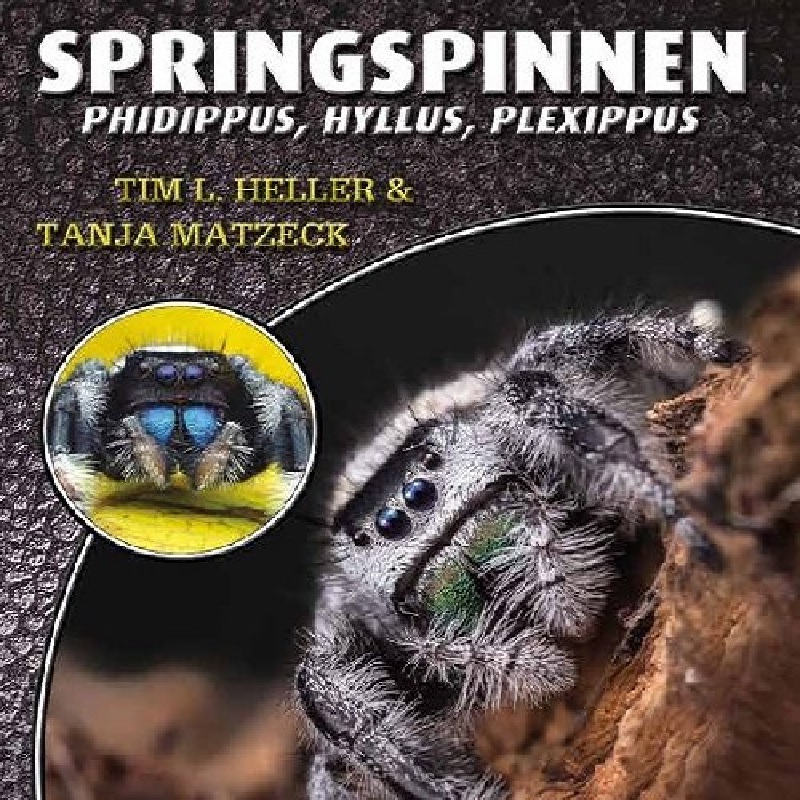
Book Jumping Spiders -
Phidippus, Hyllus & Plexippus
A guide to keeping jumping spiders of the genera Phidippus, Hyllus & Plexippus. Who can resist the charm of jumping spiders? The childlike appearance of their expressive face simply leaves no one cold! In addition, their behavior is extremely exciting to observe, their colors are bright and their requirements for species-appropriate keeping are very easy to meet. No wonder these likeable jumpers are all the rage!
This volume in the "Species by Species" series describes in detail what to look out for when buying and keeping them, introduces the most commonly kept species and color forms and provides plenty of tips on how to keep them successfully - so you can be sure they will breed well!
Species by Species introduces you to the books in this series, which present the most popular terrarium animals. Each volume offers you detailed, practical care instructions and all the information you need to successfully breed your animals.
All important questions from the required tank size to terrarium set-up, technical equipment, species-appropriate nutrition and disease prevention are answered with numerous tricks and tips.
Experienced, long-standing breeders reveal how you can encourage the animals to reproduce and raise healthy young.
All this in full color, generously illustrated and attractively designed - just about your terrarium animal - species by species
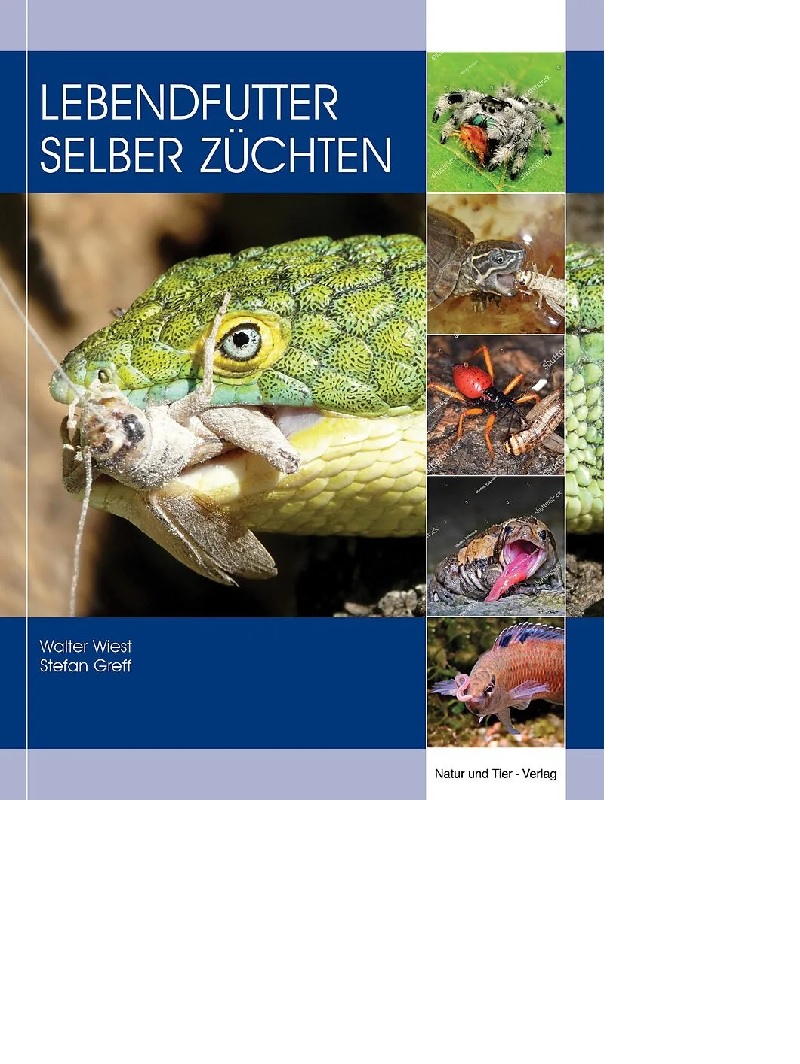
Book "Grow your own live food" - The perfect guide for pet owners
Discover practical and detailed instructions on how you can easily breed food for your reptiles, birds, fish or other animals yourself in the book "Breeding live food yourself". With valuable tips on various food insects, their care and breeding, you can save money and ensure a species-appropriate diet for your pets.
Contents of the book:
Step-by-step instructions for breeding feeder insects
Information on the best types of food for reptiles, birds and fish
Care instructions and breeding conditions for various live food species
Tips for sustainable and cost-effective food production
Why breed your own live food?
Get healthy, fresh food for your animals
Save money and reduce dependence on pet shops
Promote the health and well-being of your animals with species-appropriate food
Whether you are a beginner or an experienced pet owner, this book provides you with everything you need to successfully breed live food yourself.
Marginata 69 - New Guinea tortoises – the genus ElseyaCover storyThe unrecognised beauties: New Guinea tortoises (Andreas S. Hennig)My experiences with Branderhorst's New Guinea tortoise, Elseya (Elseya) branderhorsti (Ouwens, 1914) (Andreas S. Hennig)Keeping and breeding of Rhodin's New Guinea tortoise, Elseya (Hanwarachelys) rhodini Thomson, Amepou, Anamiato & Georges, 2015 (Andreas S. Hennig)PortraitGeoemyda spengleri, Chinese serrated tortoise (Andreas S. Hennig)ReportageMacrochelys temminckii – Experiences and impressions with vulture tortoises part 2 (Reiner Praschag)KeepingAn alternative to year-round keeping of the Egyptian tortoise in the terrarium – my experiences with seasonal outdoor keeping of Testudo kleinmanni (Ricarda Schramm)EtymologySawbacks and living maps part 4: Graptemys gibbonsi, Pascagoula humpback tortoise (Holger Vetter)Classifieds & animal placement
Reptilia 16 - Thorntails
Food animal breeding: CockroachesChameleon keepingPeloponnese
Contents:
Page 2 - EditorialPage 3 - MagazinePage 9 - Herpetofauna: Crocodile newts, by Dr J. FleckPage 12 - DatesPage 16 - Western Herp Perspecives: Souvenirs from Florida, by B. LovePage 18 - Photo reportage: Spiny-tailed agamas, by T. WilmsPage 25 - Keeping and breeding: The care and breeding of spiny-tailed agamas in the terrarium, by T. WilmsPage 30 - Report: Arabia Felix - in search of Uromastyx thomasi, by F. Hulbert and T. WilmsPage 34 - Keeping and breeding: The reproductive behaviour of the Uromastyx species, by T. WilmsPage 38 - Travelogue: Herpetological observations on the Peloponnese, by L. Siegmund and B. TrappPage 44 - Report: The brown-edged tortoise Testudo marginata in the surroundings of Tolo (Peloponnese), by H. RautertPage 47 - Portrait and poster: Atelopus flavescens, M. SchmidtPage 51 - Keeping and breeding: Introduction to keeping chameleons, by R. LeptienPage 56 - Report: Breeding the Argentine cockroach (Blaptica dubia), by B. HauschildPage 63 - Keeping and breeding: Experiences with the Typhloneces compressicauda, by H. WallaysPage 68 - Keeping and breeding: Keeping and breeding the silver-grey slender boa Epicrates striatus striatus, by J.-M. HerrmannPage 73 - Herpetology and culture: ...but more and more often. Reptiles in advertising, by L. HogebackPage 82 - Reptilia on the road: Parque Seminario in Guayaquil, Ecuador, by H. WerningPage 85 - Advice and actionPage 91 - LibraryPage 96 - Glossary: Iguana à la carte, by H. Werning
Draco 09 - Invertebrates in the terrarium
Content:
2 - Editorial
3 - Invertebrates, by Dieter Masberg
20 - The Landing Crab, by Harry Wölfel
27 - Phasmids (ghost insects, stick insects and walking leaves), by Sven Bradler and Christoph Seiler
33 - Phasmids as pets, by Christoph Seiler and Sven Bradler
38 - The Australian Pfeffermins stick insect Megacrania batesii - no simple fosterling, by Christoph Seiler and Sven Bradler
41 - essence of darkness - essence of light: The Mysterious Life of the Giant and Rose Beetles, by Arndt Löwenberg
55 - Exotic cord feet in the terrarium, by Timm Adam
67 - Safety in scorpion keeping: 10 golden rules, by Herbert Schiejok
70 - Own experiences with the keeping of Euscorpius carpaticus mauretanicus (THORELL, 1876), by Mario Schedel
74 - Pseudoscorpions in nature and in small terrariums, by Kriton Kunz
82 - Book case
94 - Magazine
The content at a glance:Invertebrates - the large army of the animal world, fascinatingly multi-layered, mostly hardly researched and weathered by the otherness to the vertebrates and to us humans since ancient mystery. Dieter Mahsberg's introduction to this unusual DRACO fans out the entire prism of the invertebrates: What characterizes all invertebrates, what groups are there, how do they live? After this overview you will also find a list of all taxa with species numbers that are relevant for keeping - a huge potential of highly interesting animals that will certainly not leave your thirst for research cold!Phasmids (ghost insects, stick insects and wandering leaves)Phasmids are certainly among the stars of the invertebrate boom: Sven Bradler and Christoph Seiler present the basics of the systematics and biology of these interesting animals, which include the longest insect still living today. Learn everything you need to know about the way of life of the well camouflaged invertebrates, marvel at sophisticated protection and defence mechanisms or unusual reproductive strategies. By the way, an extra section of the richly illustrated article is dedicated to the European species: so why not keep your eyes open during your next holiday!Phasmids as petsAnd on we go with the phasmids, because Christoph Seiler and Sven Bradler naturally also explain to you the keeping and breeding of the insects, which are often quite easy to care for, and which as pure herbivores make the time-consuming breeding of feed animals superfluous. The authors name the most important food plants, describe the types of terrariums with which you can meet the different requirements of the animals, and give insider tips on how to reproduce the beautiful insects - and of course they also point out possible sources of error that should be avoided! For beginners in phasmid breeding as well as for old hands an absolute must!The Australian peppermint stick insect Megacrania batesii - no simple fosterlingAnd to make sure that the absolute phasmid experts also get their money's worth, Seiler and Bradler go into detail about the keeping and breeding of this little kept and quite difficult to reproduce species in this article, in which especially the young animals captivate with their rich colors. The secret of the success in the reproduction of the Australian peppermint stick insect begins already with the suitable food, because the animals are very choosy. Seiler and Bradler will give you tips on how to get the plants you need to breed this very special stick insect without spending a lot of money. And, of course, the authors also give you insight into their successful breeding methods, so that after reading this article you have acquired all the prerequisites to try your hand at cultivating this Australian jewel yourself!The hermit crabThey often appear in pet shops and on dealer lists, these cute crustaceans, but hardly anyone knows how to keep them successful. Harry Wölfel presents amazing facts from the biology of these crustaceans, which are not very species-rich but all the more interesting - or did you know that the largest species in this group can reach a range of up to 1 m? Our DRACO author will not only tell you where the land hermit crabs occur and how they "function", but will also explain what to look out for when keeping them, how to set up the terrarium adequately, and he will even give you hints on how to breed them, which is not easy. One of the very few articles in the relevant literature, and in addition so expert and detailed - it's your own fault who as a crab fan escapes this treat!Beings of darkness - Beings of light. The mysterious life of the giant and rose beetlesThese magnificent beetles are certainly among the most beautiful insects of all, and even people who otherwise have nothing to do with "crawling animals" cannot escape the aesthetics of the animals. Did you know why nature has endowed many species of rose beetles with such lavish splendour? Arndt Löwenberg will not only tell you this, but will also give you a comprehensive introduction to the biology of these increasingly cultivated animals. And he gives a practical description of where these pearls and giants of the beetle world come from, how they are kept and bred and what the key to success is!Exotic cord feet in the terrariumUnfortunately, there is almost nothing to be found in the literature about keeping and breeding the quaint string feet. Timm Adam is a competent remedy. What is a string foot, how do these bizarre animals live? The author does not only go into detail about the stars of his contribution, but also about their relatives, for example the Skolopender. But the focus is clearly on the string feet and the role they play in science and terraristics. Are string feet poisonous? How can I set up a suitable terrarium, what do I have to consider with the climatic conditions, how can I feed the animals? And how do you breed these interesting invertebrates? Timm Adam has all the answers ready and does not leave out any hints of problems with their breeding. In short: The ultimate string foot hit!Own experiences with the keeping of Euscorpius carpaticus mauretanicus (Thorell, 1876)If you are fascinated by scorpions, but don't want to bring the most poisonous ones into your house, you are well advised to use specimens of this small species. Their keeping and breeding are not particularly difficult and can therefore be recommended to beginners in scorpion keeping. To make sure that you do everything right from the start, Mario Schedel will show you what to look out for. From the suitable terrarium over aspects like socialization up to the successful offspring all important aspects are covered!Safety in keeping scorpionsTopic number 1 in the keeping of these fascinating arachnids is, of course, always safety, which must be absolutely guaranteed. Scorpion expert Herbert Schiejok points out all the important parameters that have to be observed for a safe keeping, gives tips on which terrarium types are best suited, what has to be taken into account when setting up the tank and what has to be observed when handling the animals in the terrarium. How, for example, do you catch a scorpion safely, how do you move it, and what do I do if the animal has been stabbed in spite of all caution? A responsible terrarium keeper who cares about his own protection and that of his fellow human beings will certainly not miss this contribution!Pseudoscorpions in nature and in the smallest terrariumDo you find scorpions fascinating, but shy away from the risk of a poison sting? You would like to take care of really special animals? How about pseudoscorpions? These tiny creatures, which you can easily find in your garden, in the forest or perhaps even in your house, are very similar to their big relatives, but unlike them they do not have a "tail" with a poison sting. Kriton Kunz overhears with you the secret activities of the funny little guys, presents them fascinating details from the widely unknown biology of the unusual arachnids and gives you tips on where and how you can capture the dwarves. And anyone who has ever maintained or even recreated the bizarre "mini scorpions" in a neatly furnished mini-terrarium will certainly not be able to get rid of them in a hurry!
NTV The Australian Giant Stick Insect
Everything about keeping and caring for Australian giant stick insects.
64 pages
Format: 14.8 x 21 cm
57 colour photos
Author Stefan Schorn
Publisher NTV
Contents:
Foreword
Classification
Physique
Size, mass and age
Sexual differences and colouration
Distribution and habitat
Defence
Legal basis and acquisition
Moulting
Preparation
Diseases and parasites
Nutrition
The terrarium
Furnishings
Terrarium climate
Socialisation
Handling the animals
Breeding
Acknowledgements
Further information
References and further reading
Reptilia 101 - Outdoor terrariums
Planting of poison dart frog terrariumsSouth American tarantulasTravelling through the USA in a motorhome
Contents:
Many terrarium animals flourish in natural sunlight and fresh air. Keeping them outdoors, even if only for a few weeks in summer, is good for almost all of our reptiles. However, many species can also live outside all year round.REPTILIA presents the most beautiful outdoor enclosures, documents the construction of two different terrariums as examples and deals with keeping lizards in the garden.
EDITORIALMAGAZINEDATES
PHOTOREPORTAGELet's get out! The fascination of outdoor terrariumsMartin Hallmen
HOLDINGOutdoor keeping of pearl lizardsIngo Kober
TERRARIUM PRACTICEUp close to the little adders - building a raised terrarium in the garden and first experiencesH. Kreyerhoff
TERRARIUM PRACTICEFear of loss - the protection of outdoor enclosures for tortoisesMichael Wirth
KEEPING AND BREEDINGUnusual South American tarantulas of the genus EphebopusKarin Manns
TERRARIUM PRACTICEJewels in stainless steel Building a terrarium for poison dart frogs Part 2: PlantingMichael Schulte
Animals of our homelandThe yellow-bellied toadRolf Leptien
LIBRARYTIPS AND TRICKS
WESTERN HERP PERSPECTIVESBoa fantasiesBill Love
ServiceALSO NEAR YOU
JourneyBest of Southwest. Travelling with the family in search of reptiles. A small travel guide through the south-west of the USAHeiko Werning
PREVIEW
BRUTKASTENProblem discussionJörg Hofmann
Marginata 47 - Turtles of Mexico
Rarities from VietnamSearching for turtles in the PeloponneseLeatherback turtle
EditorialMagazineTOPICThe turtles of MexicoMaik ShieldsTOPICThe pointed-snouted turtle. A small aquatic turtle for the terrarium Maik ShieldsTOPICSalvin's cross-breasted tortoise. An interesting species from MexicoMaik ShieldsTOPICThe Nayarit tortoise in nature and culture Fabio CupulPORTRAITDermochelys coricea Vandelli, 1761. Leatherback turtleKriton KunzTRAVELMorea – in search of turtles and other reptiles in the west of the Peloponnese (1) Axel KwetTRAVELIn search of the "shy beauty" and the "cave turtles" Torsten Blanck, Sebastian Braun, Timothy McCormack, Hoang Van Ha, Nguyen Tai Thang, Nguyen Van Luc & Minh LeSubscription & ServiceRegional guide
Draco 21 - Lizards
Contents:
2 Editorial
4 The true lizards of the family Lacertidae – an overviewWolfgang Bischoff
28 Lizards in the terrariumMichael Kroninger & Mike Zawadski
38 The lizards of GreeceBenny Trapp
43 On the ecology and terrarium husbandry of the Eastern Giant Green Lizard, Lacerta media israelica PETERS, 1964Hans Esterbauer
48 The Canary Island lizard Gallotia galloti (OUDART, 1839)Ingo Kober
60 Es Vedrá – a mystical island and its lizardsMike Zawadski & Michael Kroninger
68The greens from the KaiserstuhlWalther Rohdich
72 Omanosaura – the Arabian collared lizardsRolf Leptien
76Observations on an Aschaffenburg wall lizard populationMartin Felke
82 The Mongolian Desert Runner, Eremias argus PETERS, 1869Uwe Schlüter
87 Book box
94 Magazine
Marginata 13 - False map turtles
Food plants for aquatic turtles 1The power of scentsKyrgyz four-toed tortoise
Contents:
2 EDITORIAL
3 READER LETTERS
4 MAGAZINE
8 DATES
10 REPORTAGE False map turtles – colourful and easy-to-keep humpback turtles Hans - Dieter Philippen
16 BREEDING IN HUMAN CARE Keeping and breeding the false map turtle Siegbert Schulz
24 BREEDING IN HUMAN CARE The Mississippi humpback turtle in human care Elmar Meier
31 PORTRAIT South African beaked tortoise Erica Staelenberg & Hans - Dieter Philippen
35 REPORTAGE Food plants for aquatic turtles (Part I) Susanne Vogel
40 REPORTAGE The language of scents: European pond turtles use water-soluble messengers Jens R. Poschadel & Martin Plath
48 REPORTAGE Hope for the four-toed steppe tortoise Valentina Ismailovna Toropova, Thorsten Harder & Heike Finke
51 SHORT REPORT Discovery of an unusually marked brown tortoise on the island of Sumatra Elva Gemita
52 REPORTAGE Distribution of Cuora pani aurocapitata Part 1 Torsten Blanck & Tanja Kremser
57 SHORT REPORT The slider turtle issue Thomas Türbl, Markus Baur, Rudolf Hoffmann, Tobias Friz, Sabine Öfner & Friederike Weinzierl
60 BOOK TIP
61 CLASSIFIED ADS
62 REGIONAL GUIDE
CHF 14.70
❅
❆
❅
❆
❅
❆
❅
❆
❅
❆
❅
❆
This website uses cookies to ensure the best experience possible. More information...