Reptilia 72 - Grasshoppers, crickets, house crickets

Article no: reptilia72

CHF 12.00

Stock: 0

Ready for dispatch in 1-3 days, delivery time 7 working days

Delivery between Tuesday, 12 May and Wednesday, 13 May
Zahlungsarten
Product information "Reptilia 72 - Grasshoppers, crickets, house crickets"

Reptilia 72 - Grasshoppers, Crickets, House Crickets

Jamaican Anole
Indochinese Hinged Turtle
Sunglow Boas

Contents:

  • 2    EDITORIAL
  • 4    REPORTAGE
          Potential Dangers of Giant Snakes
          by B. Akeret
  • 13  MAGAZINE
  • 21  DATES
  • 24  PHOTOSTORY
          Crickets and Grasshoppers
          by F. Tomasinelli
  • 32  REPORTAGE
          Grasshoppers:
          Defence and Survival
          by F. Tomasinelli
  • 36  KEEPING AND BREEDING
          The Egyptian Migratory Locust
         Anacridium aegyptium
         by A. Mangoni
  • 40  REPORTAGE
          Lord of the Bugs
          Visiting Europe’s Largest
          Breeding Facility for Feeder Insects
          by H. Werning
  • 54  HERPETOFAUNA
          The European Tree Frog (Hyla arborea)
          “Frog of the Year” in the “Year of the
          Frog 2008”
          by A. Kwet, A. Nöllert & A. Geiger
  • 64  KEEPING AND BREEDING
          Successful Keeping and Offspring of
          Cistoclemmys (galbinifrons) bouretti,
          the Indochinese Hinged Turtle
          by W. & K. Heuberger
  • 73  TRAVEL/KEEPING AND BREEDING
          Jamaica, its Iguanas and the
          Giant Anole Anolis garmani
          by T. Baum
  • 81  KEEPING AND BREEDING
          And the Sun Rises … the Sunglow Boa
          by R. Ihle & J. Bergman
  • 86  WESTERN HERP PERSPECTIVES
          A Turtle Story
          by B. Love
  • 91  LIBRARY
  • 104 BRUTKASTEN
          Thoughts on the Day of Milk Suffering
          by H. Werning
Composition
Feeding recommendation
Technical details
Size information

0 of 0 reviews

Give us a rating!

Share your experience with the product with other customers.


Customers also bought

Reptilia 98 - Sick due to reptiles? About the [alleged] danger of salmonella
Reptilia 98 - Sick due to reptiles? About the [alleged] danger of salmonella Drosophila food animal breedingUnderwoodisaurus miliiToad-headed tortoises Contents: EDITORIALMAGAZINEDATES AROUND THE WORLD IN 5 YEARSTree creepers instead of flowersA. Pachmann WESTERN HERP PERSPECTIVES   American herp problemsB. Love REPORTAGEAttack with bioweapons: Salmonella tactics against the terrarium hobbyH. Werning ReportageSalmonella in amphibians and reptiles. The importance of terrarium animals as sources of infection for humansF. Mutschmann HerpetofaunaPhrynops. The genus of toad-headed tortoisesH. - D. Philippen ReportageIn the land of the golden ants. Splendour to the end of the worldM. Freuding Keeping and breedingThe Australian fat-tailed gecko, Underwoodisaurus miliiS. Arth & S. Baus Terrarium practiceCursed in the kitchen, loved in the terrarium: fruit fliesU. Dost Terrarium displaysLa Ferme aux Crocodiles in Pierrelatte/Southern FranceM. Dieckmann LibraryTest runTips & tricksSUBSCRIPTION & SERVICEALSO NEAR YOU TRAVELDzanga-Sangha. In search of frogs between elephants and gorillasJ. M. Dehling & D. M. Dehling PREVIEWBRUTKASTENSpecies protection reportH. Werning

CHF 12.00

Reptilia 115 - Adders for the terrarium
Reptilia 115 - Adders for the Terrarium Flamingo flowersBlue rock iguanaNew Zealand mantis Contents:Cover story: Adders for the TerrariumAdders are among the classic and most popular terrarium animals. This extremely species-rich group of snakes has produced some of the most popular reptile pets. We provide an overview of the terrarium-relevant species and focus in particular on those adders suitable for beginners, among which there are many truly perfect pets. But we also have a real beauty for advanced keepers and report on the keeping and breeding of red bamboo adders. EditorialMAGAZINEDATES WESTERN HERP PERSPECTIVESThe dark sideB. Love FotostoryEvergreens in the terrarium: AddersK. Kunz PracticeAdders. Species and tips for beginnersD. Schmidt Husbandry and breedingThai bamboo adders (Oreocryptophis porphyraceus coxi) in the terrariumM. Hornig Husbandry and breedingThe New Zealand mantis, Orthodera novaezealandiae. A praying mantis from the other side of the worldB. Fuhrmann & C. Sehorz Husbandry and breedingThe keeping and breeding of the Blue rock iguana (Petrosaurus thalassinus) in the terrariumJ. Schulz PlantsArum family in the terrarium. Part 3: The genus AnthuriumB. Akeret Husbandry and breedingFirst ever natural rearing of the critically endangered Philippine crocodiles (Crocodylus mindorensis) in Europe successfulT. Ziegler, A. Rauhaus & C. Niggemann, AG Zoological Garden Cologne Animals of our homelandThe fire salamanderR. Leptien ALSO IN YOUR AREA Service TravelOn an excursion through the Colombian Amazon rainforestJ. Cañas-Orozco PREVIEW INCUBATOR Attention – more cat contentH. Werning

CHF 12.00

Reptilia 65 - Girdled lizards
Reptilia 65 - Girdled TailStar tortoiseIndigo snakeMonitor IslandContents: 2 EDITORIAL 3 READER LETTERS 4 MAGAZINE 12 DATES 14 WESTERN HERP PERSPECTIVESA country tripFrom B. Love 16 PHOTO REPORTAGEBelt-tailed lizards – the genus CordylusBy H. Schwier 24 KEEPING AND REPRODUCTIONDwarf Belted Tails: keeping and Breeding of Cordylus tropidosternum(Cope, 1869)From P. Fritz 32 KEEPING AND REPRODUCTIONCordylus mossambicus FitzSimons, 1958A persistent and interesting keeperFrom H.-P. Berghof 40 HERPETOFAUNAThe giant belted skink Cordylus giganteus – unique and mysterious at the same timeFrom H. Schwier 45 REPORTAGEThe radiated tortoise of Madagascar -an armoured beautyFrom J. Hammer 51 PORTRAIT AND POSTERPhilothamnus punctatusFrom M. Dobiey 56 KEEPING AND REPRODUCTIONNewts of the genus Paramesotriton- The Vietnamese and Laotian warty newtsFrom P. Bachhausen 64 KEEPING AND REPRODUCTIONDrymarchon couperi – the Eastern Indigo SnakeFrom N. Miele 72 TRAVELThe island of the monitor lizardsFrom A. Gumprecht 88 FAQ - FREQUENTLY ASKED QUESTIONSCorn snakesBy K. Kunz 92 REPORTAGESerpentário SanmaruFrom M. Junge 95 LIBRARY 104 BRUTKASTEN Chicken heart, be braveBy H. Werning

CHF 11.20

Reptilia 39 - Pythons
Reptilia 39 - Pythons Southern MexicoQuarantineChameleon protection Contents: 2 EDITORIAL 3 READER LETTERS 7 MAGAZINE 17 DATES 20 WESTERN HERP PERSPECTIVESNew citizenby B. Love 22 PHOTO REPORTAGE Pythonsby V. Franz 30 KEEPING AND BREEDINGMorelia spilota – Keeping and breeding the Diamond Python by U. Amundsen 34 KEEPING AND BREEDINGPython anchietae – Keeping and breeding the Angolan Python by V. Franz 37 REPORTAGEFascination record snake. Part 1: From childhood dream to research by H. Bellosa 40 TRAVELSouthern Mexicoby S. Vogler 51 PORTRAIT AND POSTERGeochelone nigraby H. Werning 56 REPORTAGEChamaeleo africanus in Europe: On a conservation project to preserve a reptile species threatened with extinction in Europeby B. Trapp 62 HerpetofaunaContribution to the knowledge and first report on breeding the Vietnamese swamp turtle, Mauremys annamensis (SIEBENROCK, 1903)by M. Schilde 66 REPORTAGEHow should a professional quarantine be carried out?by T. Eisenberg 72 REPORTAGEFire-bellied newts of the genus Cynops. Part 2: Breeding and newt registerby P. Bachhausen 78 REPORTAGEWith pencil and ink: treasures conjured on paperby R. Fenske 88 CLASSIFIED ADS 90 RAT & TAT 93 LIBRARY 104 GLOSSState guest in Chileby H. Werning

CHF 11.20

Reptilia 107 - Toad lizards
Reptilia 107 Toad lizards Eared frogMagnificent tortoiseConstruction of an outdoor terrarium Contents:Cover story: Toad lizardsThe bizarre toad lizards of the genus Phrynosoma are among the almost legendary terrarium animals. Every reptile lover is probably enchanted by the appearance of these small North American iguanas, but they have a reputation for being impossible to keep. However, more and more dedicated terrarium keepers are succeeding not only in keeping these food specialists for many years, but also in breeding them successfully. We provide an overview of the genus, discuss the problem of feeding these animals and provide two examples of successful keeping and breeding. EditorialMAGAZINEDATES WESTERN HERP PERSPECTIVESThe invisible ark B. Love PHOTOSTORYToad lizards – a (very good) freak of natureH. Werning REPORTAGEConsiderations on the diet of toad lizardsB. Fabian KEEPING AND BREEDINGKeeping and breeding the giant toad lizard (Phrynosoma asio) in the terrariumK. Haase KEEPINGPhrynosoma orbiculare – a toad lizard  from the highlands in captive careK. Haase KEEPINGThe eared frog, a little-known guest in the terrariumP. Janzen KEEPING AND BREEDINGSilent observers – on the lifestyle and keeping of the Central American magnificent tortoiseL. Spinner PracticeConstruction of an outdoor enclosure for emerald lizardsM. Herz TEST RUNSuccessful combination of terrarium and rackK. Kunz ANIMALS OF OUR HOMEThe spadefoot toadR. Leptien LIBRARYSERVICEALSO NEAR YOU TRAVELTerra incognita in the middle of Madagascar's rice fields – the herpetofauna of BetaolanaS. Wolf PREVIEW BRUTKASTEN Tangimangi – or: Take what you need!M. Zawadzki 

CHF 12.00

Reptilia 06 - Mimicry - The perfect deception
Reptilia 06 - Mimicry - The perfect illusion MaltaBuilding polystyrene terrariumsNutrition of tortoises Contents: Page 2 - EditorialPage 3 - Letters to the editorPage 5 - MagazinePage 11 - DatesPage 14 - Western Herp Perspectives: The Queen of Snakes, by B. LovePage 16 - Photo reportage: Mimicry, by L. AissefairePage 24 - Report: Mimicry - Saving energy through camouflage, by Dr M. GaulkePage 32 - Keeping and breeding: Like a leaf in the wind. The walking leaf Phyllum celebicum in the terrarium, by H. FischerPage 38 - Travelogue: Temples, disc-tongued frogs and reptiles – impressions of a trip to Malta, by U. SchlüterPage 43 - Photographic profile: Reptiles and amphibians in the Du Tsingy de Bamaraha nature reserve (West Madagascar), by G. Hallmann, E. Hoffmann, J. Krüger, P. Schlagböhmer and G. TrautmannPage 47 - Portrait and poster: Gastrotheca riobambae, by H. WerningPage 51 - Report: Nutrition of European tortoises, Part 2, by Dr C. DennertPage 59 - Keeping and breeding: A mini-crocodile for the paludarium – The keeled skink Tropidophorus grayi, by U. DostPage 64 - Terrarium practice: Styrofoam terrariums, by D. HasselbergPage 69 - Herpetofauna: The Bismarck Dwarf Python Liasis boa – keeping and breeding a colourful giant snake, by V. FranzPage 72 - Herpetology and culture: Snakes go to school – Part 2, by M. HallmenPage 81 - Reptilia on the road: Zoo Berlin-Friedrichsfelde, by H. WerningPage 84 - Advice and HelpPage 90 - LibraryPage 96 - Satire: Something different, by A. Scheffler

CHF 9.80

Reptilia 49 - Food animal breeding
Reptilia 49 - Food animal breedingScorpion crust lizardSpotted pythonChinese mountain dragonContents: 2 EDITORIAL 4 READER LETTERS 5 MAGAZINE 14 DATES 18 WESTERN HERP PERSPECTIVESHurricane Sale in Floridaby B. Love 20 PHOTO REPORTAGE Breeding food animals yourself - a problem?by F. Bruse & H. Werning 27 REPORTAGEEfficient and productive cricket breeding by F. Bruse 33 REPORTAGEBreeding the chocolate cockroach (Shellfordella tartara) by F. Bruse 36 REPORTAGEA simple Drosophila breeding project by F. Bruse 40 HERPETOFAUNANotes on the Motagua lizard (Cnemidophorus motaguae) by U. Schlüter 43 TRAVELHerpetological observations and more from Gambia by U. Thieme 51 PORTRAIT AND POSTERGeoclemys hamiltoniby H. - D. Philippen 56 KEEPING AND BREEDINGKeeping and Breeding the Chinese Mountain Agame (Japalura splendida) by H. Schradin 68 HERPETOFAUNADendrobates pumilioThe strawberry frog on the Bocas Islands by B. Schwarz 72 KEEPING AND BREEDING The black Mexican chain snake (Lampropeltis getula nigrita in the terrariumby M. Thums 79 REPORTAGEAntaresia maculosa (PETERS, 1873)Spotted pythonby D. Hasselberg 85 CLASSIFIED ADS 90 RAT & TAT 93 LIBRARY 104 GLOSSESIn search of Uracentron azureumPart 1by H. Werning

CHF 11.20

Suggested products

Handbook of food plants for tortoises and other reptiles
Handbook of forage plants 2nd revised editionMarion Minch is not only a successful breeder of diverse tortoises for many years, but also an excellent connoisseur of native wild herbs. She founded and runs samenkiste.de, which is well known to many tortoise keepers and nature lovers. Her name is inextricably linked with reptile care and species-appropriate nutrition for tortoises. Her handbook of food plants summarises the most important native food plants for herbivorous and omnivorous reptiles. She not only considers tortoises, but also iguanas, spiny-tailed dragons and even chameleons. From the basics of plant biology to native wild herbs to suitable food plants for hardy tropical reptile species, this comprehensive work provides the basis for species-appropriate keeping. In the expanded and supplemented 2nd edition, the plant section is divided according to flower colour. This makes it even easier to identify wild herbs. The work has also been supplemented with a wealth of additional information and many pictures.

CHF 46.50

Geckos
Geckos in the terrarium by Astrid FalkThe book offers a comprehensive introduction to geckos and their species-appropriate keeping in terrariums. It explains what you need to think about before buying a gecko and what preparations should be made. The book describes in detail how the terrarium is technically equipped and set up. The care of the animals, their special features and behaviour, their diet, reproduction and rearing of young animals are described, as well as diseases and husbandry problems with tried and tested suggestions for prevention and treatment. Individual gecko species that are particularly suitable for keeping and breeding in terrariums are portrayed in detail in the second part of the book.

CHF 28.50

Jumping spiders Phidippus, Hyllus, Plexippus
Book Jumping Spiders - Phidippus, Hyllus & Plexippus A guide to keeping jumping spiders of the genera Phidippus, Hyllus & Plexippus. Who can resist the charm of jumping spiders? The childlike appearance of their expressive face simply leaves no one cold! In addition, their behavior is extremely exciting to observe, their colors are bright and their requirements for species-appropriate keeping are very easy to meet. No wonder these likeable jumpers are all the rage! This volume in the "Species by Species" series describes in detail what to look out for when buying and keeping them, introduces the most commonly kept species and color forms and provides plenty of tips on how to keep them successfully - so you can be sure they will breed well! Species by Species introduces you to the books in this series, which present the most popular terrarium animals. Each volume offers you detailed, practical care instructions and all the information you need to successfully breed your animals. All important questions from the required tank size to terrarium set-up, technical equipment, species-appropriate nutrition and disease prevention are answered with numerous tricks and tips. Experienced, long-standing breeders reveal how you can encourage the animals to reproduce and raise healthy young. All this in full color, generously illustrated and attractively designed - just about your terrarium animal - species by species

CHF 23.90

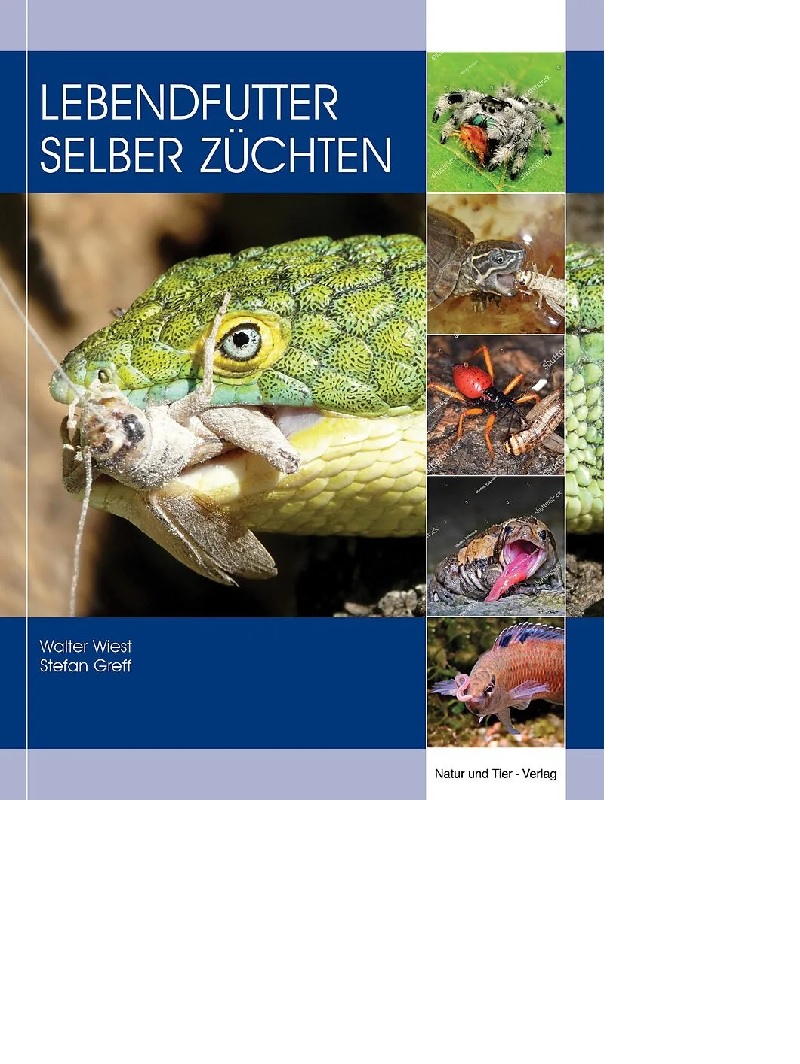
Book Breeding live food yourself
Book "Grow your own live food" - The perfect guide for pet owners Discover practical and detailed instructions on how you can easily breed food for your reptiles, birds, fish or other animals yourself in the book "Breeding live food yourself". With valuable tips on various food insects, their care and breeding, you can save money and ensure a species-appropriate diet for your pets. Contents of the book: Step-by-step instructions for breeding feeder insects Information on the best types of food for reptiles, birds and fish Care instructions and breeding conditions for various live food species Tips for sustainable and cost-effective food production Why breed your own live food? Get healthy, fresh food for your animals Save money and reduce dependence on pet shops Promote the health and well-being of your animals with species-appropriate food Whether you are a beginner or an experienced pet owner, this book provides you with everything you need to successfully breed live food yourself.

CHF 46.50

Marginata 69 - New Guinea tortoises
Marginata 69 - New Guinea tortoises – the genus ElseyaCover storyThe unrecognised beauties: New Guinea tortoises (Andreas S. Hennig)My experiences with Branderhorst's New Guinea tortoise, Elseya (Elseya) branderhorsti (Ouwens, 1914) (Andreas S. Hennig)Keeping and breeding of Rhodin's New Guinea tortoise, Elseya (Hanwarachelys) rhodini Thomson, Amepou, Anamiato & Georges, 2015 (Andreas S. Hennig)PortraitGeoemyda spengleri, Chinese serrated tortoise (Andreas S. Hennig)ReportageMacrochelys temminckii – Experiences and impressions with vulture tortoises part 2 (Reiner Praschag)KeepingAn alternative to year-round keeping of the Egyptian tortoise in the terrarium – my experiences with seasonal outdoor keeping of Testudo kleinmanni (Ricarda Schramm)EtymologySawbacks and living maps part 4: Graptemys gibbonsi, Pascagoula humpback tortoise (Holger Vetter)Classifieds & animal placement

CHF 16.50

Marginata No. 34 - Hinge-back Tortoises, the turtles with the crease in the tank
  Im Biotop der Großkopf-Schienenschildkröte?Zucht von Kinosternon bauriiHaltung und Zucht von Astrochelys radiata Teil 6 Inhalt: Editorial Magazin Termine FOTOSTORY Die Gattung Kinixys. Schildkröten mit „Knick“ im Panzer Hans-Dieter Philippen NACHZUCHT Gemischte Erfahrungen bei Haltung und Nachzucht der Madagassischen oder Dormergues Glattrand Gelenkschildkröte Viktor Mislin & Hans-Dieter Philippen NACHZUCHT Haltung und Nachzucht der Stutz-Gelenkschildkröte (Kinixys homeana) bis zur F2-Generation John Zoran PORTRÄT Weissingers Breitrandschildkröte, Testudo marginata weissingeri Hans-Dieter Philippen HALTUNG UND NACHZUCHT Haltung und Nachzucht der Madagassischen Strahlenschildkröte. Teil 6 Michael Wirth & Peter Fritz REPTORTAGE Im Biotop der Großkopf-Schienenschildkröte (Peltocephalus dumerilianus) Mario Herz ZUCHT Haltung, Pflege und Nachzucht der Dreistreifen-Klappschildkröte, Kinosternon baurii Nicolas Pellegrin Buchtipp Kleinanzeigen Abo & Service Regionalführer    

CHF 16.50

Draco 03 - Poison Arrow Frogs
Draco 03 - Poison dart frogs Contents: 2 Editorial 4 Poison dart frogs - An introduction to biology, systematics and distribution, by S. Lötters 16 Brood care in poison dart frogs, by A. Quiguango-Ubillus 24 Reproductive behaviour in poison dart frogs, by K.-H. Jungfer 29 The poison dart frogs of Bolivia and their distribution, by S. Lötters and S. Reichle 32 Poison dart frogs in the terrarium, by M. Schmidt 50 Building an artificial waterfall from polystyrene, by D. Löhmann 58 The Web-climbing Tree Frog - A small jewel from the rainforest, by H. Divossen 62 Keeping and breeding Dendrobates histrionicus, by E. Schoop 70 Colourful encounters in the Choco, by J. Stelder 73 Infectious diseases - a constant threat to dendrobatid keeping? by M. Mutschmann 83 Book box 89 Magazine

CHF 14.90

Reptilia 58 - Crustacean lizards
Reptilia 58 - Crustacean lizards Bush crocodileAgate snailsPlains snake Contents: 2 EDITORIAL 4 MAGAZINE 8 DATES 12 REPORTAGEExperience with keeping and breedingof dinos in the terrariumBy D. Schmidtwith a review by H. Werning 16 WESTERN HERP PERSPECTIVESThe Madagascan turtle crisisBy B. Love 18 PHOTO REPORTAGECrustacean lizards – the genus HelodermaBy T. Wilms 26 KEEPING AND BREEDINGThe successful and continuouskeeping and breeding of the scorpion-crustacean lizard Heloderma horridumexasperatumBy M. Reisinger 36 HERPETOFAUNAThe Guatemalan scorpion crustacean lizard, Heloderma horridum charlesbogertiCampbell & Vannini, 1998By L. S. Meléndez Garcia 39 SPECIES CONSERVATIONPoisonous giants facing extinction?REPTILIA project for the protection of theGuatemalan scorpion crustacean lizardBy K. Kunz 44 REPORTAGEHunting anacondas with sonar and guillotineBy L. Dirksen 51 PORTRAIT AND POSTERBufo brongersmaiBy U. Schlüter 55 KEEPING AND BREEDINGThe bush crocodile – secret beauty in theterrariumBy M. Evers 63 KEEPING AND BREEDINGKeeping and breeding of the ChineseDione snake (Elaphe dione)By M. Diekmann & A. Weyers 72 KEEPING AND BREEDING Agate snails in the terrariumBy K. Wandtke 81 REPTILIA ON THE ROAD30 years Reptile Zoo HappBy D. Schmidt 88 CLASSIFIED ADS 93 RAT & TAT 94 LIBRARY 104 INCUBATORProtocol of a failed attempt at acautious approach, at first sight based on mutualsympathy and intersexualattraction, during a jubilantcelebrationBy H. Werning

CHF 11.20

Reptilia 66 - Rattlesnakes
Reptilia 66 - Rattlesnakes Peninsula tortoiseMadagascar terrariumFringed Fingers Contents: 2 EDITORIAL 3 MAGAZINE 14 DATES 16 WESTERN HERP PERSPECTIVESTurtles in the seaFrom B. Love 18 PHOTO REPORTAGERattlesnakes! The genus CrotalusBy S. Winchell 26 KEEPING AND REPRODUCTIONKeeping and breeding of the Western diamondback rattlesnakeBy F. J. Caballero Gasca & J. M. Rodriguez Gòmez 32 REPORTAGEPhoto hunt for mountain rattlesnakesin MexicoBy R. W. Bryson Jr. 38 KEEPING AND REPRODUCTIONTerrarium keeping of Mountain RattlesnakesBy D. Lazcano, R. D. J. Galvàn C. Garcia de la Pena G. Castaneda 42 TRAVELA stay in a remote part of the Brazilian Amazon region: Herpetological diaryBy P. Ulmer 51 PORTRAIT AND POSTERAgama lionotus lionotusBy M. Dobiey & P. Wagner 56 HERPETOFAUNAFrogsnake of the year 2007 The spadefoot toad (Pelobates fuscus)By A. Kwet & A. Nöllert 64 PRACTICEMadagascar in the living roomBy A. Hartig 68 HERPETOFAUNAFringed-fingered lizards (Acanthodactylus) in nature and in the terrariumPart 1: General information on ecology and behaviourBy U. Schlüter 77 HERPETOFAUNAKeeping and breeding of the Peninsula Ornate Tortoise Pseudemys peninsularis Carr, 1938By A. S. Hennig 87 FAQ - FREQUENTLY ASKED QUESTIONSThe Indian Praying MantisBy K. Kunz 92 LIBRARY 104 BRUTKASTEN The Silence of the Nose Frogs, Part 1 From H. Werning

CHF 11.20

Draco 17 - Snakes
Draco 17 - Snakes Contents: 2 Editorial 4 In a nutshell: All about snakesDieter Preißler 22 On the reproduction of snakes in the terrarium.Tasks, facts, problemsDieter Schmidt 37 Basics of keeping venomous snakesBeat Akeret 54 Snake symbolism in the Egyptian Book of the DeadKriton Kunz 64 To drive you out of your skin – observations on adder shirtsMartin Hallmen 68 Infrared detection in snakesLars Wartenberg 74 Snake skins – does the length of the tanned skin really not allow any conclusions to be drawn about that of the living animal?Karlheinz & Manuel Fuchs 82 Book box 94 Magazine

CHF 16.80

Terraria 27 - The panther chameleon
Terraria 27 - The Panther Chameleon The African Horned ViperSea turtles in Bali Contents: With its spectacular colours, the panther chameleon, Furcifer pardalis. enchants every reptile enthusiast. Fortunately, however, it is not only one of the most beautiful lizards of all, but is also easy to keep and breed for a chameleon. Carsten Schneider presents the basics of caring for and breeding these beautiful animals step by step. And it goes without saying that this cover story will be particularly colourful. EDITORIALMAGAZINEGondwanaland – a pioneering project at Leipzig Zoo, Part 3Andreas S. Henning Change of staff at Museum Koenig in Bonn: Wolfgang Böhme leaves, Dennis Rödder arrivesAxel Kwet & Heiko Werning A brief encounter with Alpine newts (Salamandra atra)Chritiane Kohlruss SupersilkKriton Kunz Lookup News on the pointed-head agamas of the genus PseudocalotesJakob Hallermann TERRAglobalHard days in TabaconasMaik Dobiey TOPICThe colourful panther. About the chameleon Furcifer pardalis Carsten Schneider The keeping of panther chameleonsCarsten Schneider The breeding of the panther chameleon Carsten Schneider Diseases and treatment options for the panther chameleonCarsten Schneider The Tierra Caliente red-kneed tarantula, Brachypelma auratum – a highland tarantula from the Mexican highlands?Boris F. Striffler The African horned viper, Cerastes cerastes cerastes Georg Jachan Small but nice: Proyek Penyu – the sea turtle breeding station in Pemuteran on Bali Martin Hallmen Ranas de Cristal. In search of glass frogs in north-east HondurasAlexander Gutsche New speciesFat prey from MadagascarJörn Köhler … and new “fat frogs” from BrazilAxel Kwet AMONG RESEARCHERSWho belongs to whom? In search of tadpoles and frogs in the eastern lowlands of BoliviaArne Schulze CATCH THE EYELarge and small large ones – the terrarium system of Stefanie and Jochen GeigerMichael Wirth NEAR YOUSUBSCRIPTION & SERVICEPREVIEW INCUBATORIn reality, I was always completely indifferent to clothing (for Wolfgang Böhme) Heiko Werning

CHF 12.00

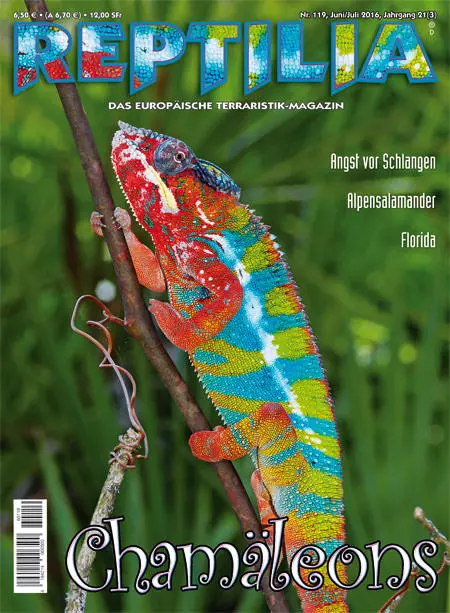
Reptilia 119 - Chameleons
Reptilia 119 - Chameleons Fear of snakesAlpine salamanderFloridaContents:Cover story: ChameleonsThey used to be considered untenable, but today they are among the most popular terrarium animals. Chameleons, the "dragons of our time". We indulge in pictures of these extremely photogenic animals, present in detail the keeping and breeding of one of the most prominent representatives of this group, the lobed chameleon, and devote ourselves to the legendary colour-changing ability of these lizards. EditorialMagazineDates Photo storyChameleons. Always something newN. Lutzmann Keeping and breedingKeeping and breeding the elephant-eared chameleon (Trioceros melleri)C. Malberg & A. Schäberle ResearchInfluence of various factors on colour change in the Yemen chameleon (Chamaeleo calyptratus) and the Madagascar giant chameleon (Furcifer oustaleti)A. Schmidt MAN AND ANIMALFear of snakes: innate, learnt or groundless?D. Schmidt ReportageViper snakes for breakfast. Observations of Natrix maura in southern PortugalW. & Y. Lantermann SERVICEALSO NEAR YOU Animals of our homelandThe Alpine SalamanderR. Leptien LIBRARY WESTERN HERP PERSPECTIVESEuropeans are known for …B. Love TRAVELThe great trek.  Part 2: Spring rivers and eternal swampsH. Werning PREVIEW BRUTKASTEN The spider's web (or: Stuttgart 21 will not be the last victim of these green lizard spiders)Ancestor

CHF 12.00