Handbook of forage plants 2nd revised editionMarion Minch is not only a successful breeder of diverse tortoises for many years, but also an excellent connoisseur of native wild herbs. She founded and runs samenkiste.de, which is well known to many tortoise keepers and nature lovers. Her name is inextricably linked with reptile care and species-appropriate nutrition for tortoises. Her handbook of food plants summarises the most important native food plants for herbivorous and omnivorous reptiles. She not only considers tortoises, but also iguanas, spiny-tailed dragons and even chameleons. From the basics of plant biology to native wild herbs to suitable food plants for hardy tropical reptile species, this comprehensive work provides the basis for species-appropriate keeping. In the expanded and supplemented 2nd edition, the plant section is divided according to flower colour. This makes it even easier to identify wild herbs. The work has also been supplemented with a wealth of additional information and many pictures.
Geckos in the terrarium by Astrid FalkThe book offers a comprehensive introduction to geckos and their species-appropriate keeping in terrariums. It explains what you need to think about before buying a gecko and what preparations should be made. The book describes in detail how the terrarium is technically equipped and set up. The care of the animals, their special features and behaviour, their diet, reproduction and rearing of young animals are described, as well as diseases and husbandry problems with tried and tested suggestions for prevention and treatment. Individual gecko species that are particularly suitable for keeping and breeding in terrariums are portrayed in detail in the second part of the book.
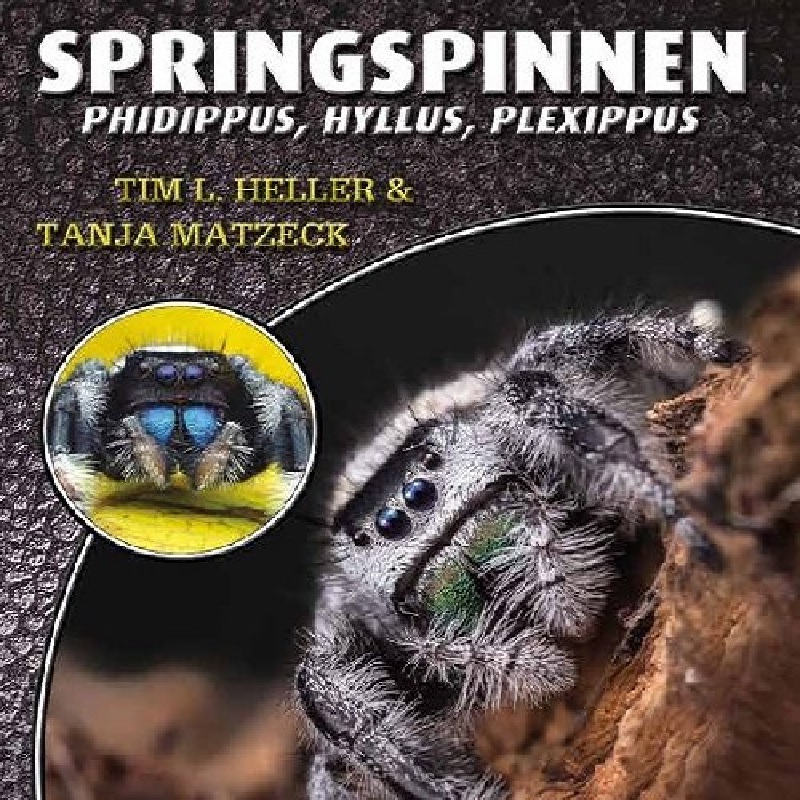
Book Jumping Spiders -
Phidippus, Hyllus & Plexippus
A guide to keeping jumping spiders of the genera Phidippus, Hyllus & Plexippus. Who can resist the charm of jumping spiders? The childlike appearance of their expressive face simply leaves no one cold! In addition, their behavior is extremely exciting to observe, their colors are bright and their requirements for species-appropriate keeping are very easy to meet. No wonder these likeable jumpers are all the rage!
This volume in the "Species by Species" series describes in detail what to look out for when buying and keeping them, introduces the most commonly kept species and color forms and provides plenty of tips on how to keep them successfully - so you can be sure they will breed well!
Species by Species introduces you to the books in this series, which present the most popular terrarium animals. Each volume offers you detailed, practical care instructions and all the information you need to successfully breed your animals.
All important questions from the required tank size to terrarium set-up, technical equipment, species-appropriate nutrition and disease prevention are answered with numerous tricks and tips.
Experienced, long-standing breeders reveal how you can encourage the animals to reproduce and raise healthy young.
All this in full color, generously illustrated and attractively designed - just about your terrarium animal - species by species
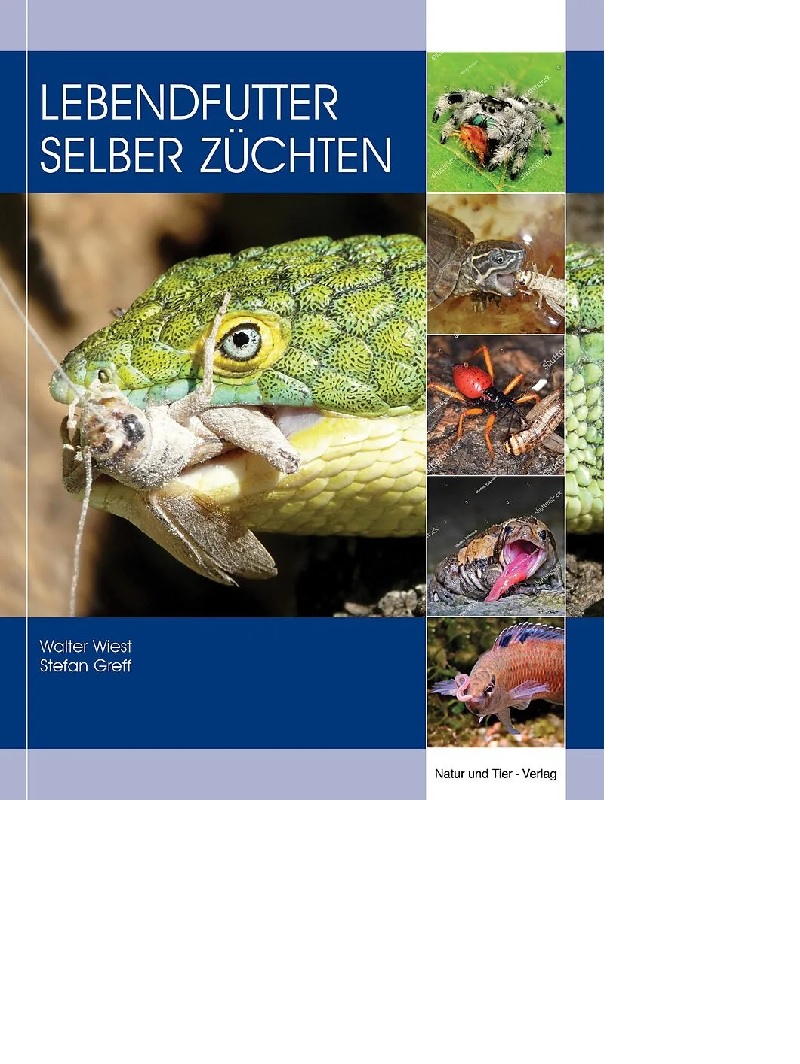
Book "Grow your own live food" - The perfect guide for pet owners
Discover practical and detailed instructions on how you can easily breed food for your reptiles, birds, fish or other animals yourself in the book "Breeding live food yourself". With valuable tips on various food insects, their care and breeding, you can save money and ensure a species-appropriate diet for your pets.
Contents of the book:
Step-by-step instructions for breeding feeder insects
Information on the best types of food for reptiles, birds and fish
Care instructions and breeding conditions for various live food species
Tips for sustainable and cost-effective food production
Why breed your own live food?
Get healthy, fresh food for your animals
Save money and reduce dependence on pet shops
Promote the health and well-being of your animals with species-appropriate food
Whether you are a beginner or an experienced pet owner, this book provides you with everything you need to successfully breed live food yourself.
Marginata 69 - New Guinea tortoises – the genus ElseyaCover storyThe unrecognised beauties: New Guinea tortoises (Andreas S. Hennig)My experiences with Branderhorst's New Guinea tortoise, Elseya (Elseya) branderhorsti (Ouwens, 1914) (Andreas S. Hennig)Keeping and breeding of Rhodin's New Guinea tortoise, Elseya (Hanwarachelys) rhodini Thomson, Amepou, Anamiato & Georges, 2015 (Andreas S. Hennig)PortraitGeoemyda spengleri, Chinese serrated tortoise (Andreas S. Hennig)ReportageMacrochelys temminckii – Experiences and impressions with vulture tortoises part 2 (Reiner Praschag)KeepingAn alternative to year-round keeping of the Egyptian tortoise in the terrarium – my experiences with seasonal outdoor keeping of Testudo kleinmanni (Ricarda Schramm)EtymologySawbacks and living maps part 4: Graptemys gibbonsi, Pascagoula humpback tortoise (Holger Vetter)Classifieds & animal placement
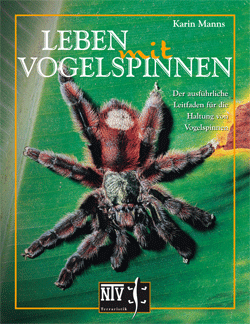
NTV, Life with tarantulas
ISBN: 978-3-86659-042-7
Karin Manns
176 pages
numerous colour photos
Format: 16.8 x 21.8 cm
Contents:
Karin Manns is an animal psychologist and loves tarantulas. She was not deterred by the fact that little is known about diseases of these animals and their treatment, but sought contact with an experienced vet to find out more about this topic. In this book, she not only describes some revealing case studies of successful treatments and the methods used, but also shares very personal experiences of keeping tarantulas together and considers whether distinguishing between "aggressive" and "less aggressive" species makes sense. Life with tarantulas – intense and very close to the animal!
Foreword and acknowledgements
The tarantula as a pet
Keeping and care
Breeding tarantulas
Species portraits
Morphology and anatomy
Morphology
Anatomy
Diseases and treatment options in tarantulas
Bacterial diseases: cause, diagnosis, treatment
Case studies
Neurotoxic diseases: cause, diagnosis, treatment
Metabolic diseases: cause, diagnosis, treatment
Fungal diseases: cause, diagnosis, treatment
Further risks for our tarantulas
Injuries
Moulting problems
Motor disorders
“Tarantula cancer”
Nematodes
Moulting delay
Apathy
Cessation of venom production
Deformation of the limbs and body structure
Anus closure
Administration of medication
Social behaviour in tarantulas
Coexistence of two males Avicularia avicularia
Coexistence of a female and a male Avicularia avicularia
Joint rearing and keeping of Avicularia metallica
Inter-species communal housing of tarantulas of the genus Avicularia
Joint rearing and care ofPoecilotheria regalis
Joint rearing and keeping ofPoecilotheria ornata
Summary
Aggressive vs. tame tarantulas: a meaningful distinction?
Case study: Pterinochilus murinus
Closing words
References
Press reviews
Karin Manns is an animal psychologist and loves tarantulas. She was not deterred by the fact that little is known about the diseases of these animals and their treatment, but sought contact with an experienced vet to find out more about this topic. Species portraits and a chapter on social behaviour round off this fascinating book.
Zoologischer Zentral Anzeiger 2/2009
Marginata 38 - Turtle Hybrids
Breeding of the radiated three-keeled turtleBreeding of the areolate flat tortoise Part IIITurtle Honour Grove in Kunduz
Contents:
EditorialMagazineDatesOVERVIEWChecklist of turtle hybrids known to date – natural hybrids as well as those created in human care Hans Volker Karl & Hans - Dieter PhilippenFIELD RESEARCHCentral Vietnam: On the trail of East Asian "stream turtles" and hybridsTorsten Blanck & Sebastian BraunPORTRAITMexican gopher tortoise (Gopherus berlandieri Agassiz, 1854)Hans - Dieter PhilippenREPRODUCTIONMulti-year keeping and breeding of the radiated three-keeled turtle (Geoclemys hamiltonii)Uli BollackREPRODUCTIONExperiences with keeping and breeding the areolate flat tortoise (Homopus areolatus) under different conditions in Namibia and Switzerland. Part 3: Indoor and outdoor terrariumsMarcel Reck & Lydia Reck-RinggenbergPRACTICEIncubation as natural as possibleChristine DworschakREPORTAGEFour-toed tortoises (Agrionemys h. horsfieldii) in northern AfghanistanFrank JoistenOBITUARYIn memoriam Jutta WiechertHans - Dieter PhilippenREPORTAGETurtle sanctuary Playa Ostional in Costa RicaRolf & Angela SommerClassifiedsBook tipSubscription & ServiceRegional guide
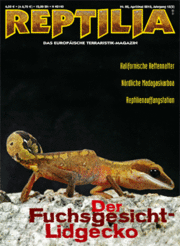
Reptilia 82 - The Fox-faced Lidgecko
Californian chain snakeNorthern Madagascar boaReptile rescue centre
Contents:
It is undoubtedly one of the strangest lizards in our terrariums, the Fox-faced Lidgecko (Aeluroscalabotes felinus), with its feline-like silent movements and almost ghostly appearance. And it has had one of the most remarkable terrarium careers in recent times. Just a few years ago, this species was practically unknown and a sensation for specialists, but today it has almost become a fashionable gecko.No wonder, because these easy-to-hold animals captivate with their appearance as well as their behaviour. Siriporn Maier and Thomas Bamann present the keeping and breeding of this exceptional gecko in detail and in a way that is easy to understand, even for beginners. EDITORIAL
MAGAZINE
DATES
WESTERN HERP PERSPECTIVES
The China-Connection
B. Love
PHOTOSTORY
Fox-faced geckos – fascinating goblins of the night
S. Maier & T. Bamann
KEEPING AND REPRODUCTION
A wild cat in the terrarium – keeping fox-faced geckos
S. Maier & T. Bamann
KEEPING AND REPRODUCTION
Breeding the fox-faced gecko
S. Maier & T. Bamann
TRAVEL
Mysterious Peru
C. Koch
PORTRAIT and poster
Rhacophorus nigropalmatus
J. M. Dehling
KEEPING AND REPRODUCTION
Keeping and breeding the Californian chain snake, Lampropeltis californiae
R. Meierkord
REPORTAGE
The Berlin Reptile Centre
L. Dirksen
KEEPING AND REPRODUCTION
Acrantophis madagascariensis – keeping and breeding of the Northern Madagascar boaM. Borer
HERPETOFAUNA
The genus Ambystoma in Mexico
G. Casas-Andreu & X. Aguilar-Miguel
HERPETOFAUNA
Observations on common toads
M. Felke
ANIMALS OF OUR HOME
The grass snake
R. Leptien
SUBSCRIPTION & SERVICE
ALSO NEAR YOU
PREVIEW
BRUTKASTEN
Alone among sheep. Part 2
H. Werning
All about the leopard gecko by Melanie Hartwig
64 pages
Format: 14.8 x 21 cm
70 colour photos
1 map
Paperback
Author Melanie Hartwig
Contents:
Foreword
Description
Distribution and natural habitat
Lifestyle
Legal regulations and acquisition
Transport and quarantine
Terrarium and technology
The terrarium setup
Care and diet
Hibernation
Propagation
Rearing the young
Colour and pattern forms
Basics of the theory of heredity
Diseases
Socialisation
Further information
Thanks
Literature used and further reading
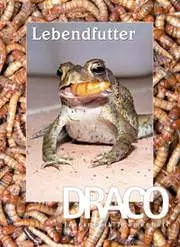
Draco 28 - Live food
Contents:
2 Editorial 4 Live food for amphibians and reptiles– History and basicsUrsula Friedrich 22 The professional handling of food animals – Basic requirement for a species- and animal-appropriate diet for reptiles and amphibiansThomas Wilms 32 Some aspects of breeding your own food animalsStefan Ziesmann 39 The pea aphid – an unusual food animalLars Österdahl 42 Breeding the common fruit fly (Drosophila melanogaster)– Many paths lead to successMarco Wagemann 50 Tropical cockroaches – lively insect lovers, valuable food animals or even both?Andreas Bauer 58 Oven fish breeding – a way to provide a little variety in the diet of our vivarium animals with little effort!Marco Wagemann 64 The breeding of aquatic snails Cornelia Gabler 67 Agate snails – not only an extraordinary food animalUwe Geissel 71 Tubifex breedingCornelia Gabler 74 Small mammals as food animals – using the house mouse (Mus musculus) as an exampleThomas Wilms & Beate Löhr 86 Book box
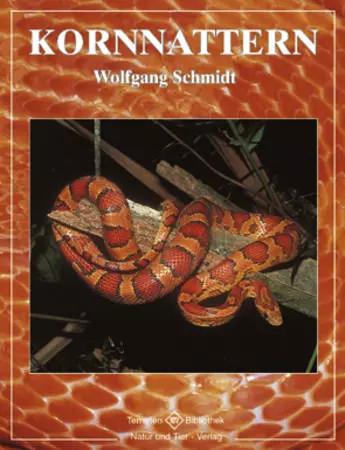
All about corn snakes
88 Seiten
62 Abbildungen
Format: 16,8 x 21,8 cm
Autor Wolfgang Schmidt
Inhalt:
Kornnattern gehören schon seit jeher zu den beliebtesten Terrarientieren. Nahezu jeder engagierte Terrarianer hat sie schon kennen gelernt. Doch woher kommt das starke Interesse gerade an dieser Kletternatter? Die Antwort liegt sicherlich in erster Linie im Wesen der Schlange begründet. Als besonders friedfertige Natur ist sie daher nicht nur dem fortgeschrittenen Terrarianer zu empfehlen, sondern sie eignet sich auch ausgezeichnet für den Einstieg in die Terraristik.Der Autor geht intensiv auf die Pflege und Zucht der Tiere ein, spart aber auch Themen wie Krankheiten und deren Behandlung nicht aus. Neben den drei Unterarten stellt er Farbformen vor, die sich mittlerweile auch hierzulande grosser Beliebtheit erfreuen.
Ulmer , Salamanders and newts – Everything about these fascinating creatures
96 pages
58 colour photos, 19 drawings
hardback
1st edition
Author Kurt Rimpp
Ulmer Eugen Verlag
A piece of the primeval world in the terrarium? Amphibians such as the axolotl, tiger salamander and alpine newt are the descendants of primeval amphibians that have survived to this day. In this book, you will find out how they can be kept optimally in the terrarium and what there is to observe and discover. Tips and advice provide information on the following important points:
Where and how do amphibians live in nature?
Considerations before purchase
Terrarium and furnishings
Care and hibernation
Health and nutrition
A portrait of suitable species
Exo Terra Medium terrarium
The Exo Terra terrariums offer a good opportunity for keeping various terrarium animals
The Exo Terra Terrarium is the ideal home for reptiles and amphibians, designed by European herpetologists. The front-opening doors allow easy access for feeding and care. A special locking mechanism prevents “escapes” and the doors can be opened independently of one another. The top, made of fine-mesh metal mesh, and the resulting good ventilation allow UVB and infrared light to penetrate the terrarium. It can be easily removed completely for decoration or cleaning purposes. On both sides of the rear of the top, there are 5 sealable cable channels for installing heat mats, waterfalls, sensors, etc. inside the terrarium. The base of the terrarium is raised so that a substrate heater can be fitted to heat part of the enlarged floor area. The extra-high front windows are ideal for thick layers of substrate (so that reptiles can burrow), for water features (paludarium) or for installing a Exo Terra reptile cave. The lifelike background is in the same colour as all other Exo Terra decorative items (water bowls, waterfalls, heat rocks, etc.) and offers extra space for climbing.Accessories (not included)
Ventilation through the front window (1)
Two doors for escape-proof access (2)
Waterproof bottom (3)
Raised bottom frame (4)
Top made of fine-meshed stainless steel (5)
Lock to prevent “escapes” (6)
Mesh screen cover can be easily attached (7)
Closable holes for hoses and/or cables (8)
Recesses at the back for hoses and/or cables (9)
60x45x30cm, 60x45x45cm, 60x45x60cm or 60x45x90cm
PLEASE NOTE: The animals shown are NOT suitable for this terrarium size!
Suitable for the Compact Top Medium PT2227 and the Light Dome PT2055/PT2057 (10)Hygro-, Thermo- and Combometer PT2477/PT2472/PT2470 (11)Lock PT2620 (12)
Background included!
The Exo Terra Stone Motif Background is an exceptionally lifelike backdrop that is easy to cut to size. It creates a multi-dimensional habitat that is ideal for climbing reptiles or can simply be used to enhance the natural look of the terrarium. Its colour and texture match those of all Exo Terra decorative items, creating a perfectly harmonised terrarium environment, whether humid or dry.