Terraria 53 - The European pond turtle

Article no: terraria53

CHF 12.00

Stock: 0

Ready for dispatch in 1-3 days, delivery time 7 working days

Delivery between Tuesday, 12 May and Wednesday, 13 May
Zahlungsarten
Product information "Terraria 53 - The European pond turtle"

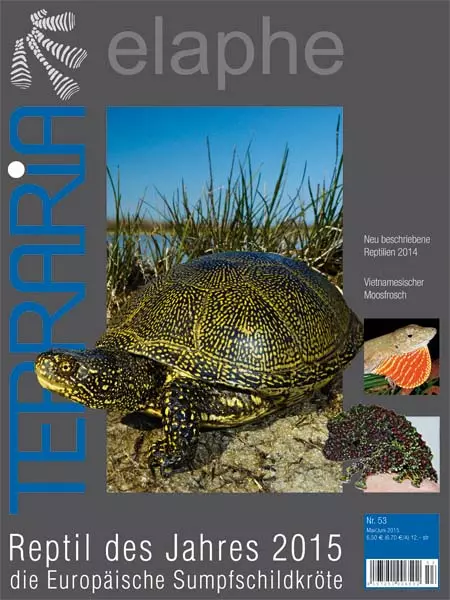
Terraria 53 - The European pond turtle

Newly described reptiles 2014
Vietnamese moss frog


Contents:

Cover story: Reptile of the year 2015 – the European pond turtle

The only turtle in Central Europe is the reptile of the year! As a characteristic animal of the native herpetofauna, the species also enjoys a lot of sympathy among the general public. The next issue of TERRARIA/elaphe is dedicated to various aspects of this highly endangered species. We present the European pond turtle in a detailed portrait, provide insights into a current reintroduction project and report on keeping and breeding in private hands.

Territorial

Herpetorama
Aspidoscelis neavesi – a running lizard is the first reptile species created in a laboratory / Spiny devil: The meowing night frog / Colour change in chameleons through photonic crystals / Synanthrope: The crocodiles of Nîmes / Leaf climber: Award-winning lizard

Cover story
From fasting food to reptile of the year 2015 – the European pond turtle
Axel Kwet, Uwe Fritz, Andreas Nöllert, Richard Podloucky & Norbert Schneeweiss

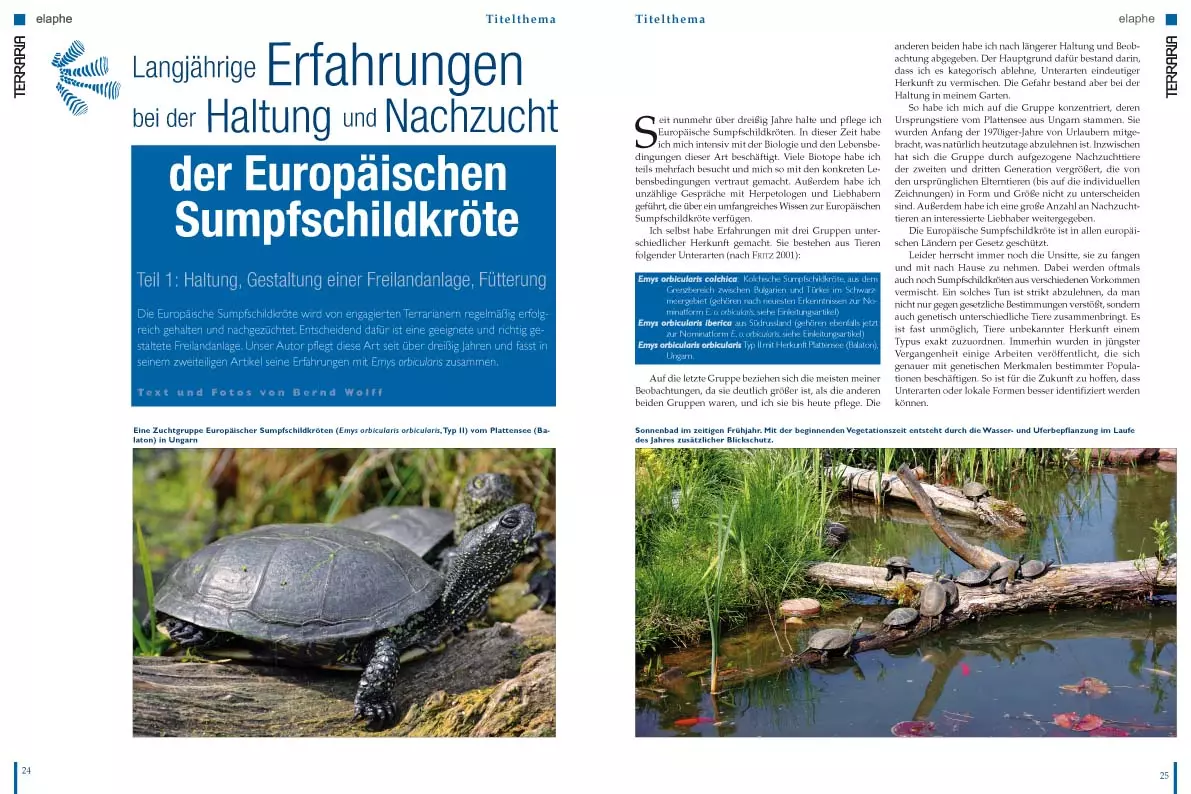
Many years of experience in keeping and breeding the European pond turtle. Part 1: Keeping, designing an outdoor enclosure, feeding
Bernd Wolff

A reintroduction project for the European pond turtle and the problem of abandoned pond turtles from private keeping
Florian Brandes & Martina Anne-Claire Meeske

Panorama
The island of lost salamanders: On the herpetofauna of the Honduran Isla del Tigre
Alexander Gutsche

Reptile and amphibian fauna of the Quinta do Barranco da Estrada in Portugal's Alentejo – a travelogue
Werner & Yvonne Lantermann

Research

New species
List of reptiles newly described in 2014
Axel Kwet

Salamandra

Terrarium husbandry
Why vivaristics is indispensable now and in the future 
Jens Crueger, Peter Sound & Christina-Johanne Schröder

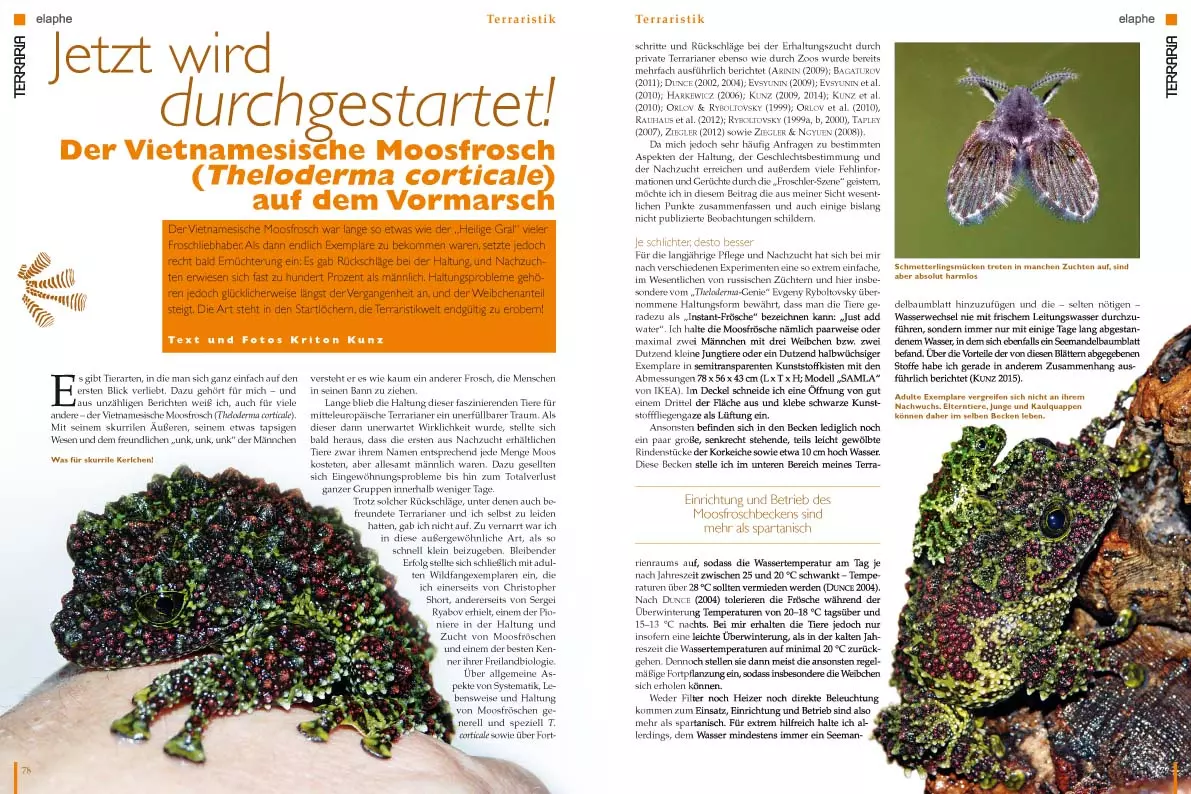
Let's get started!
The Vietnamese moss frog (Theloderma corticale) on the rise
Kriton Kunz

Nature and species conservation

Field notes
Rare amphibians in the canton of Lucerne I: Italian tree frog (Hyla intermedia) in blue
Urs & Heidi Jost

Rare amphibians in the canton of Lucerne II: Common frog (Rana temporaria) in white
Urs & Heidi Jost

Subscription & Service
Also in your neighbourhood
Preview

Incubator
Always eat chalk
Heiko Werning 

Composition
Feeding recommendation
Technical details
Size information

0 of 0 reviews

Give us a rating!

Share your experience with the product with other customers.


Suggested products

Handbook of food plants for tortoises and other reptiles
Handbook of forage plants 2nd revised editionMarion Minch is not only a successful breeder of diverse tortoises for many years, but also an excellent connoisseur of native wild herbs. She founded and runs samenkiste.de, which is well known to many tortoise keepers and nature lovers. Her name is inextricably linked with reptile care and species-appropriate nutrition for tortoises. Her handbook of food plants summarises the most important native food plants for herbivorous and omnivorous reptiles. She not only considers tortoises, but also iguanas, spiny-tailed dragons and even chameleons. From the basics of plant biology to native wild herbs to suitable food plants for hardy tropical reptile species, this comprehensive work provides the basis for species-appropriate keeping. In the expanded and supplemented 2nd edition, the plant section is divided according to flower colour. This makes it even easier to identify wild herbs. The work has also been supplemented with a wealth of additional information and many pictures.

CHF 46.50

Geckos
Geckos in the terrarium by Astrid FalkThe book offers a comprehensive introduction to geckos and their species-appropriate keeping in terrariums. It explains what you need to think about before buying a gecko and what preparations should be made. The book describes in detail how the terrarium is technically equipped and set up. The care of the animals, their special features and behaviour, their diet, reproduction and rearing of young animals are described, as well as diseases and husbandry problems with tried and tested suggestions for prevention and treatment. Individual gecko species that are particularly suitable for keeping and breeding in terrariums are portrayed in detail in the second part of the book.

CHF 28.50

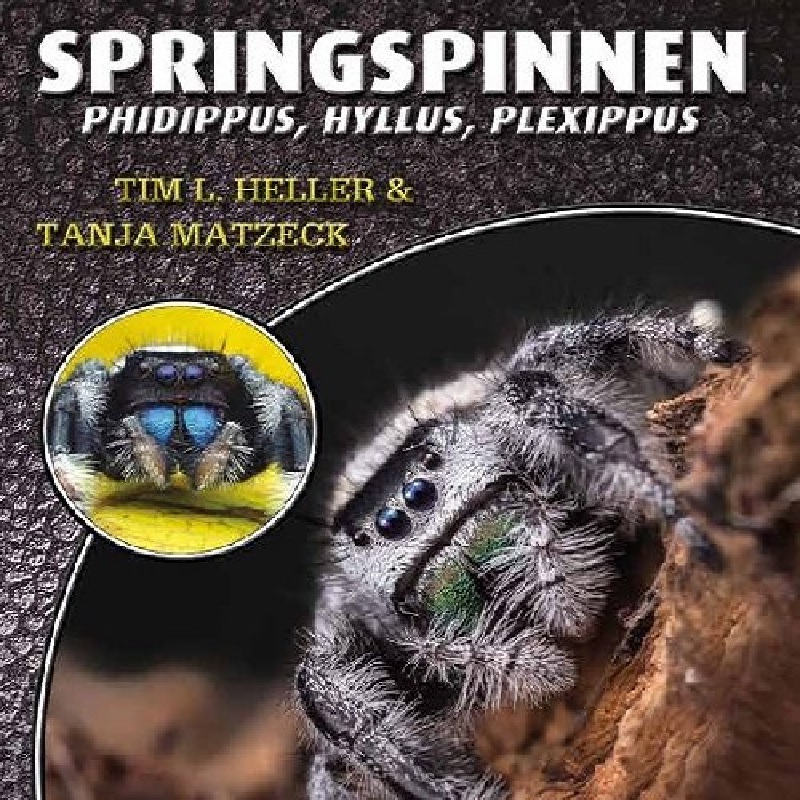
Jumping spiders Phidippus, Hyllus, Plexippus
Book Jumping Spiders - Phidippus, Hyllus & Plexippus A guide to keeping jumping spiders of the genera Phidippus, Hyllus & Plexippus. Who can resist the charm of jumping spiders? The childlike appearance of their expressive face simply leaves no one cold! In addition, their behavior is extremely exciting to observe, their colors are bright and their requirements for species-appropriate keeping are very easy to meet. No wonder these likeable jumpers are all the rage! This volume in the "Species by Species" series describes in detail what to look out for when buying and keeping them, introduces the most commonly kept species and color forms and provides plenty of tips on how to keep them successfully - so you can be sure they will breed well! Species by Species introduces you to the books in this series, which present the most popular terrarium animals. Each volume offers you detailed, practical care instructions and all the information you need to successfully breed your animals. All important questions from the required tank size to terrarium set-up, technical equipment, species-appropriate nutrition and disease prevention are answered with numerous tricks and tips. Experienced, long-standing breeders reveal how you can encourage the animals to reproduce and raise healthy young. All this in full color, generously illustrated and attractively designed - just about your terrarium animal - species by species

CHF 23.90

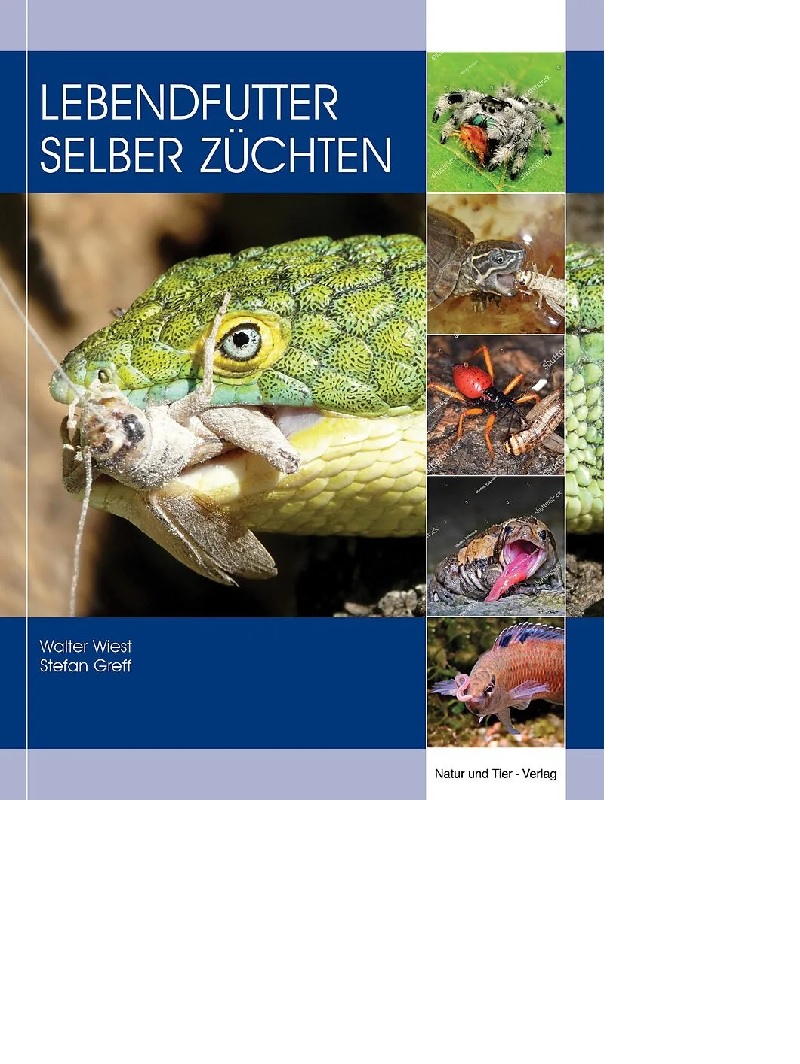
Book Breeding live food yourself
Book "Grow your own live food" - The perfect guide for pet owners Discover practical and detailed instructions on how you can easily breed food for your reptiles, birds, fish or other animals yourself in the book "Breeding live food yourself". With valuable tips on various food insects, their care and breeding, you can save money and ensure a species-appropriate diet for your pets. Contents of the book: Step-by-step instructions for breeding feeder insects Information on the best types of food for reptiles, birds and fish Care instructions and breeding conditions for various live food species Tips for sustainable and cost-effective food production Why breed your own live food? Get healthy, fresh food for your animals Save money and reduce dependence on pet shops Promote the health and well-being of your animals with species-appropriate food Whether you are a beginner or an experienced pet owner, this book provides you with everything you need to successfully breed live food yourself.

CHF 46.50

Marginata 69 - New Guinea tortoises
Marginata 69 - New Guinea tortoises – the genus ElseyaCover storyThe unrecognised beauties: New Guinea tortoises (Andreas S. Hennig)My experiences with Branderhorst's New Guinea tortoise, Elseya (Elseya) branderhorsti (Ouwens, 1914) (Andreas S. Hennig)Keeping and breeding of Rhodin's New Guinea tortoise, Elseya (Hanwarachelys) rhodini Thomson, Amepou, Anamiato & Georges, 2015 (Andreas S. Hennig)PortraitGeoemyda spengleri, Chinese serrated tortoise (Andreas S. Hennig)ReportageMacrochelys temminckii – Experiences and impressions with vulture tortoises part 2 (Reiner Praschag)KeepingAn alternative to year-round keeping of the Egyptian tortoise in the terrarium – my experiences with seasonal outdoor keeping of Testudo kleinmanni (Ricarda Schramm)EtymologySawbacks and living maps part 4: Graptemys gibbonsi, Pascagoula humpback tortoise (Holger Vetter)Classifieds & animal placement

CHF 16.50

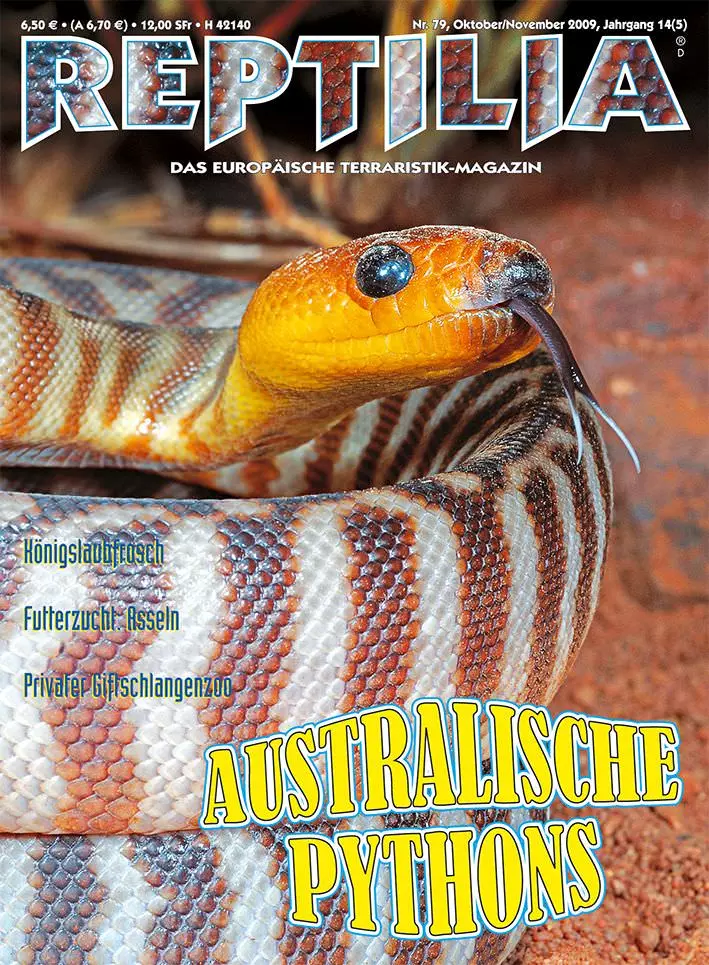
Reptilia 79 - Australian Pythons
Reptilia 79 - Australian PythonsRoyal tree frogFood breeding woodlicePrivate venomous snake zooContents:The unique herpetofauna of Australia is always at the centre of theInterest among terrarium keepers. This is particularly true of the giant snakes of the fifth continent. We report on them in detail, focussing on the rare forms Pilbara olive python (Liasis olivaceus barroni), Oenpelli's python (Morelia oenpelliensis) and the rough-scaled python (Morelia carinata).EDITORIALMAGAZINEDATES PHOTOSTORYPythons of Australiaby S. Winchell HERPETOFAUNARare and little-known pythons from Australia – Part 1: The rough-scaled python, Morelia carinataby S. Alcini HERPETOFAUNARare and little-known pythons from Australia – Part 2: The Pilbara olive python, Liasis olivacea barroniby S. Alcini HERPETOFAUNARare and little-known pythons from Australia – Part 3: The Oenpelli python, Morelia oenpelliensisby S. Alcini REPORTAGEThe most beautiful of them all – the leafhopper Ancylecha fenestrata von A. Schmidt PORTRAIT and posterChamaeleo hoehneliiby M. DobieyTRAVELIn the footsteps of Darwin through South America. Part 2: From Patagonia to Central Chileby H. Werning--> Literature on all three parts KEEPING AND REPRODUCTIONWoodlice as food animalsby J. Felka WESTERN HERP PERSPECTIVESHas the trade in reptiles and amphibians reached maturity?from B. Love KEEPING AND REPRODUCTIONThe King Tree Frog, Pseudacris regilla. Reintroduction of an old acquaintanceby R. Münzer TERRARIUM DISPLAYSThe serpentarium of the Snakeparadise in Eschlikon in Schweizerby H. Werning LIBRARYSUBSCRIPTION & SERVICEALSO NEAR YOUPREVIEW BRUTKASTEN Bear Country. Quasi live from Yellowstone National Parkby H. Werning

CHF 12.00

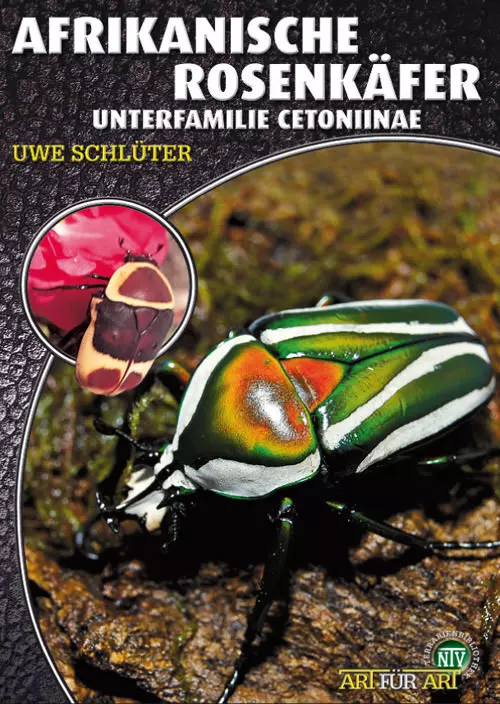
The african rose chafer
Not just food animals! Everything about keeping and caring for African rose chafer beetles at home. 64 pages Format: 14.8 x 21 cm numerous colour photos Author Uwe Schlüter Many terrarium keepers only know them as food animals: the larvae of rose chafer beetles. However, these beautiful insects are in turn fascinating, easy-to-keep terrarium animals. Uwe Schlüter presents tropical species of rose chafer beetles from Africa that are currently in vogue, including the impressive goliath beetles. Beetle care made easy! Contents: Foreword Classification Morphology of rose chafer beetles Imagines of the Cetoniinae Larvae of the Cetoniinae Rose chafer beetles in nature Lifestyle and behaviour Life cycle Care in the terrarium Acquisition and transport Terrarium equipment and climate Socialisation Feeding of imagines and larvae Reproduction in the terrarium Egg laying Rearing the larvae Pupation and hatching of imagines Descriptions of selected species Further information Further and used literature

CHF 19.90

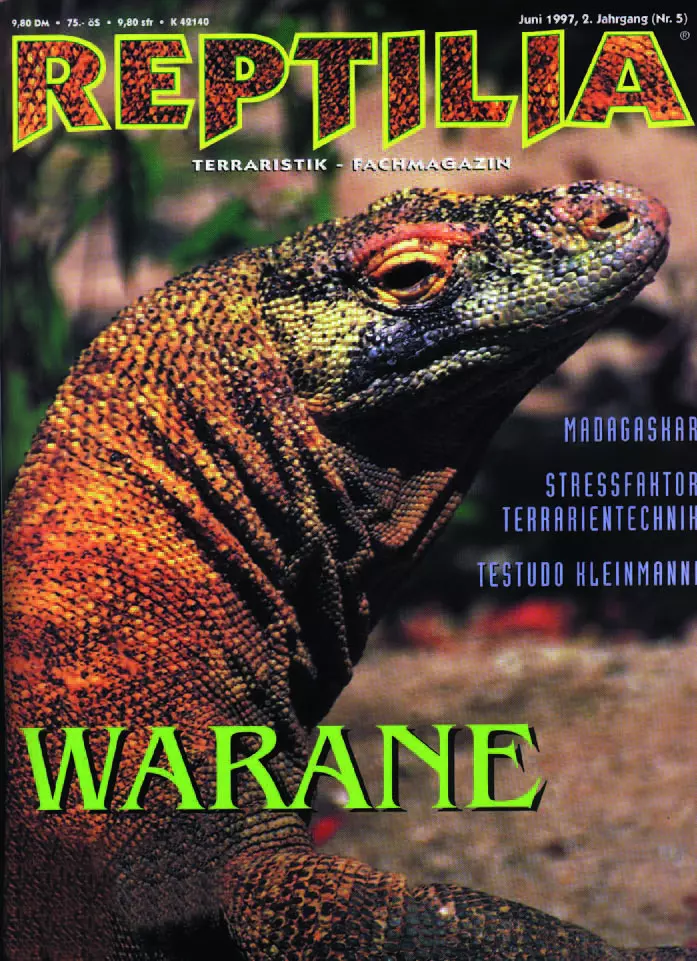
Reptilia 05 - Monitor Lizards
Reptilia 05 - Monitor lizards MadagascarStress factor terrarium technologyTestudo Kleinmanni Contents: Page 2 - EditorialPage 3 - Letters to the editorPage 4 - Discussion: What to do after snake bites?Page 6 - MagazinePage 16 - Photo reportage: Monitor lizards, by J. de Ávalos and P. Martínez CarriónPage 22 - Keeping and breeding: Keeping and breeding monitor lizards, by B. EidenmüllerPage 26 - Herpetofauna: The spoilt dragons of Komodo, by H. WerningPage 28 - Monitor lizards - Use by humans, by Dr M. GaulkePage 33 - Travelogue: Journey to the south-east of Madagascar, by W. Schmidt and K. LiebelPage 39 - Portrait and poster: Dendrobates tinctorius, by M. SchmidtPage 43 - Herpetofauna: Testudo kleinmanni, by B. DevauxPage 52 - Terraristics: Stress in the terrarium, by G. VossPage 56 - Herpetofauna: Frogs of the genus Eleutheradactylus in Costa Rica, by J. EhmckePage 60 - Herpetology and Culture: Magic and superstition, Part 2: Snakes and lizards, by L. B. Carissimi-PrioriPage 69 - Reptilia on the road: Terrazoo Moers, by W. SchmidtPage 74 - Advice and actionPage 75 - LibraryPage 80 - Incubator: Column by H. Werning

CHF 9.80

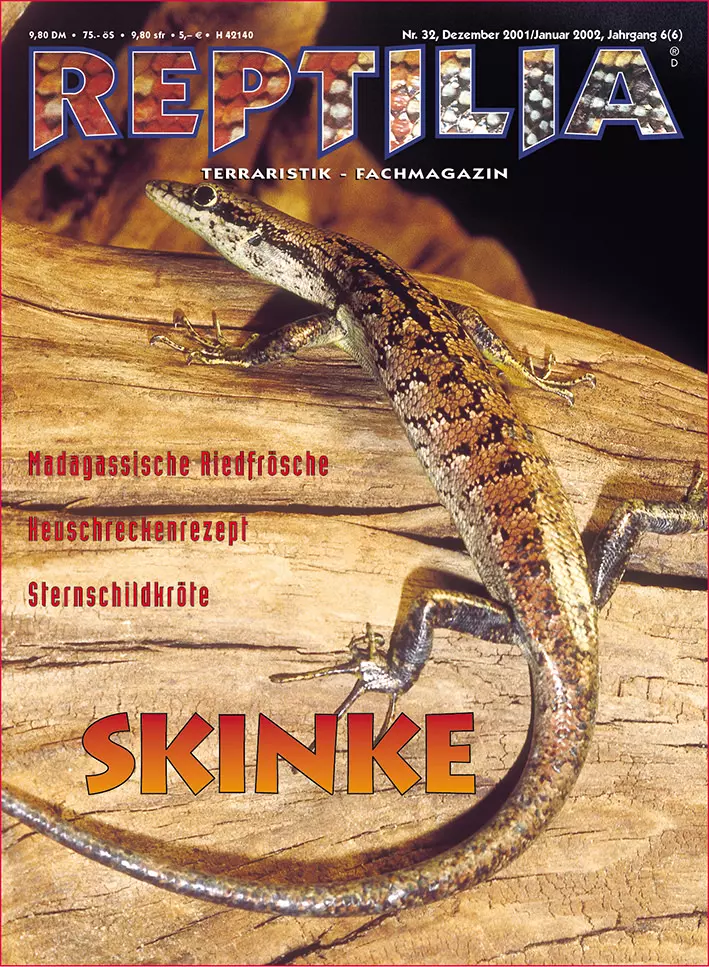
Reptilia 32 - Skinke
Reptilia 32 Skinks Madagascan reed frogsGrasshopper recipeStar tortoise Contents: 2 Editorial 3 Magazine 11 Dates 14 Western Herp PerspectivesThe value of the nature experiencefrom B. Love 16 Photo reportageSkinkby A. Hauschild 22 HerpetofaunaObservations on Eumeces (=Novoeumeces) schneideri aldrovandiifrom S. Wegner 28 Keeping and breedingOn the care and breeding of Algerian skinks (Eumeces [=Novoeumeces] algeriensis) Peters, 1864by R. Struijk 35 Keeping and breedingAustralian snail skink Cyclodomorphus gerradii Grav, 1845 – Care and breeding 41 ReportageDelicious, these grasshoppersby I. & B. Fritzsche 44 JourneyA journey to the United Arab Emirates - From the mangroves to the scree desertby R. Leptien 51 Portrait and posterElaphe quatorlineatafrom B. Trapp 56 Keeping and breedingThe Indian star tortoise Geochelone elegans (Schoepf, 1795) – a problematic tropical tortoise? Part 1: Appearance, distribution and local breeds, acclimatisation, introduction to the breeding groupby J. Bidmon 66 ReportageJapan in the year of the snakeby A. Kast & M. Mori 71 Herpetofauna The Madagascan marsh frogs of the genus Heterixalusby K. Schmidt, F. Glaw & M. Vences 80 Reptilia on the roadThe snake park "World of Snakes" in Grecia, Costa Ricaby R. Fenske 87 Classifieds 91 Advice and action 94 Library 104 GlossOur author Dr Spechtby H. Werning

CHF 9.80

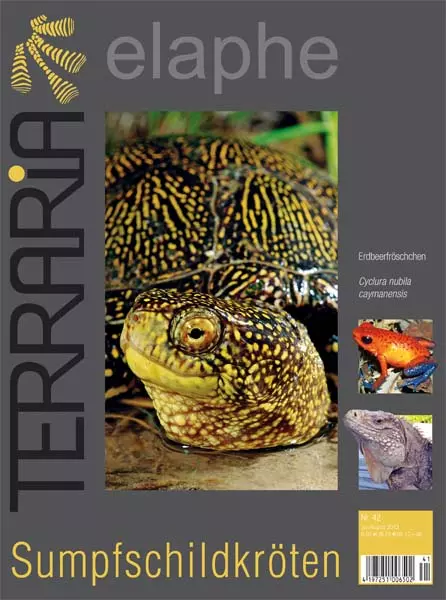
Terraria 42 - Pond turtles
Terraria 42 - TerrapinsStrawberry FrogsCyclura nubila caymanensisContents:The Emydidae family includes some of the best-known and most popular turtles. In addition to our native European pond turtle, these include the North American ornamental and decorative turtles of the genera Pseudemys and Trachemys as well as the Terrapene box turtles. In the cover story, we provide an up-to-date overview of this interesting group and present a detailed article about the magnificent tortoise, Graptemys oculifera. We also shed light on the role that European pond turtles can play in biology lessons.TerritorialHerpetoramaCover storyThe New World terrapins of the family EmydidaeAndreas S. HennigGraptemys oculifera: Biology, Care and Breeding of the Splendid Box Turtle Part 1: Biology, Endangerment and Initial Care Experiences Ewald RoddewigThe European pond turtle (Emys orbicularis) in biology lessonsMichael FreundPanoramaTerraglobalOn safari in Zambia, or: Why do the pelomeduses flee?Alfred SchleicherPearl lizards (Timon lepidus) in the Sierra de Grazalema, AndalusiaWerner & Yvonne LantermannResearchNew speciesA Comorian gecko and the problem of the new online taxonomy Oliver HawlitschekTrachylepis cristinae, a new skink from Sokrota Axel KwetIn search of strawberry frogs in NicaraguaDiana Galindo Uribe, Javier Sunyer, Adolfo Amézquita, Gunther Köhler, Heiko Pröhl & Miguel VencesSalamandraTerraristicsClassicsThe North African spiny-tailed dragonBothriopsis taeniata, a beauty from the South American rainforestJuan TimmsHomerangeIn the realm of the little lizards. A visit to the terrarium facility of Katrin and Dietmar MistlerPatrick SchöneckerNature and species conservationField notesSubmerging under water as an escape strategy for the common lizardRudolf MalkmusGrass snakes and slow worms - hunters and huntedAndreas OchsenbeinThe smooth snake (Coronella austriaca). Reptile of the Year 2013Dirk Alfermann, Axel Kwet & Richard PodlouckyThreatened in paradiseKathrin Sawannia, Matthias Goetz & Katharina FoersterMissingVogl’s Stump-footed Frog (Atelopus vogli)Also in your neighbourhoodSubscription & ServiceGalleryHave a nice holiday! The journey is the rewardBenny TrappPreviewIncubatorExpired part 2Heiko Werning

CHF 12.00

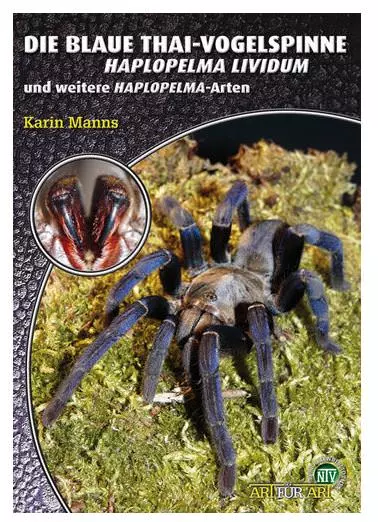
NTV - Haplopelma lividum
Haplopelma lividum - All about the blue Thai tarantula 64 pages numerous colour photos Series species by species A5 Paperback Author Karin Manns Publisher NTV The booklet explains everything about the systematics, anatomy, distribution, appearance, life expectancy and natural enemies. It also explains how poisonous the Haplopelma lividum is, which legal regulations apply to it and acquiring this tarantula. From the contents: Foreword Systematics and anatomy Distribution Appearance and behaviour Natural enemies Life expectancy How poisonous is Haplopelma lividum Legal regulations Acquisition and transport Keeping and care The terrarium Technology and climate Socialisation Nutrition How to handle the tarantula Moulting Diseases and injuries Reproduction - Mating - Cocoon construction and rearing Conclusion

CHF 19.90

Giant tarant spiders
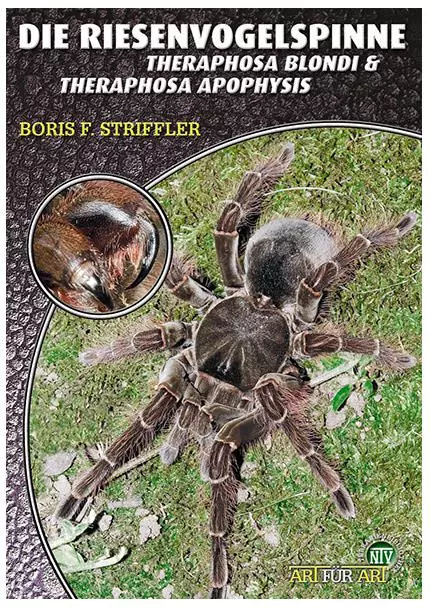
The book about the giant tarantulas Theraphosa blondi and Theraphosa apophysis 64 pages many colour photos Theraphosa blondi and Theraphosa apophysis Author Boris F. Striffler Publisher NTV In this book, the author explains everything about the two giant tarantulas. It describes how to keep and care for these large eight-legged creatures, as well as the terrarium and how to handle these animals. The following is described: Systematics and body structure The fascinating biology: From the life of giant tarantulas All information on species-appropriate keeping: from suitable terrariums to equipment and technology to feeding Successful breeding: Mating stimulation, various methods for egg laying and rearing the young Solutions to problems: How to avoid the most common mistakes in care and how to help sick animals

CHF 21.90