Reptilia 79 - Australian Pythons

Article no: reptilia79

CHF 12.00

Stock: 0

Ready for dispatch in 1-3 days, delivery time 7 working days

Delivery between Tuesday, 12 May and Wednesday, 13 May
Zahlungsarten
Product information "Reptilia 79 - Australian Pythons"

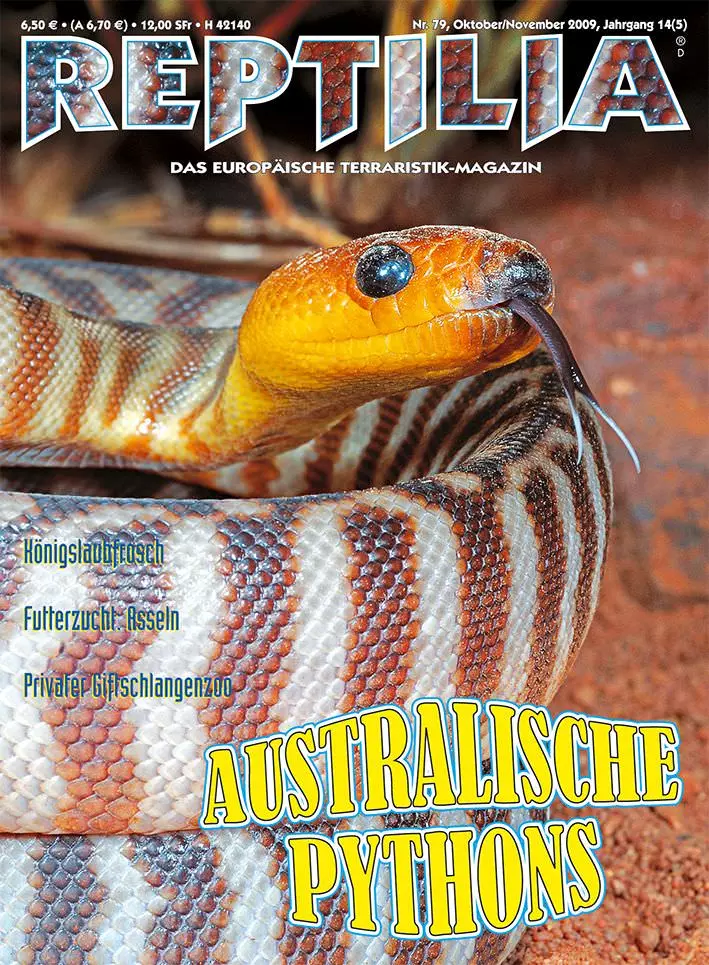
Reptilia 79 - Australian Pythons

Royal tree frog
Food breeding woodlice
Private venomous snake zoo

Contents:

The unique herpetofauna of Australia is always at the centre of the
Interest among terrarium keepers. This is particularly true of the giant snakes of the fifth continent. We report on them in detail, focussing on the rare forms Pilbara olive python (Liasis olivaceus barroni), Oenpelli's python (Morelia oenpelliensis) and the rough-scaled python (Morelia carinata).

EDITORIAL
MAGAZINE
DATES
 
PHOTOSTORY
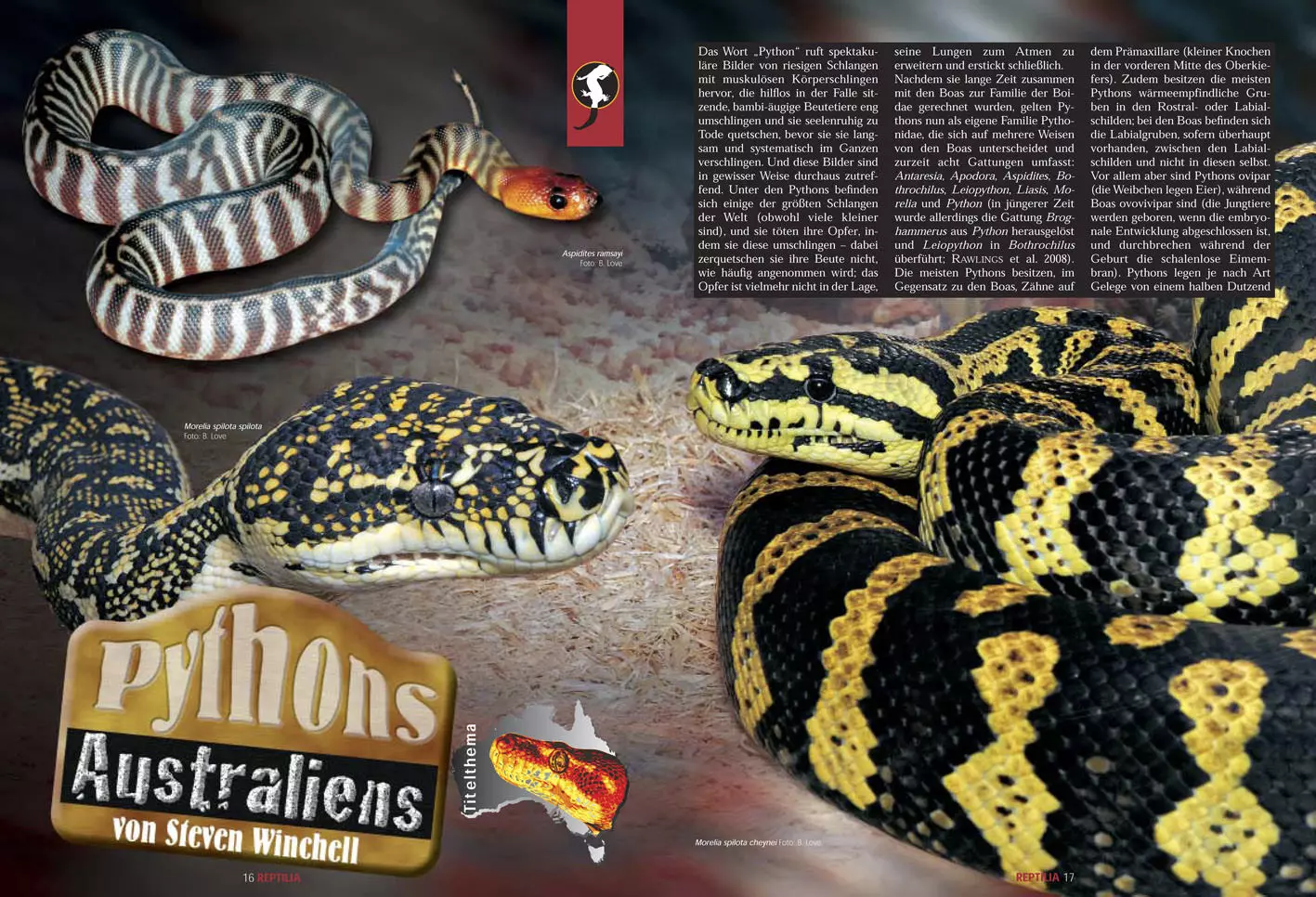
Pythons of Australia
by S. Winchell
 
HERPETOFAUNA
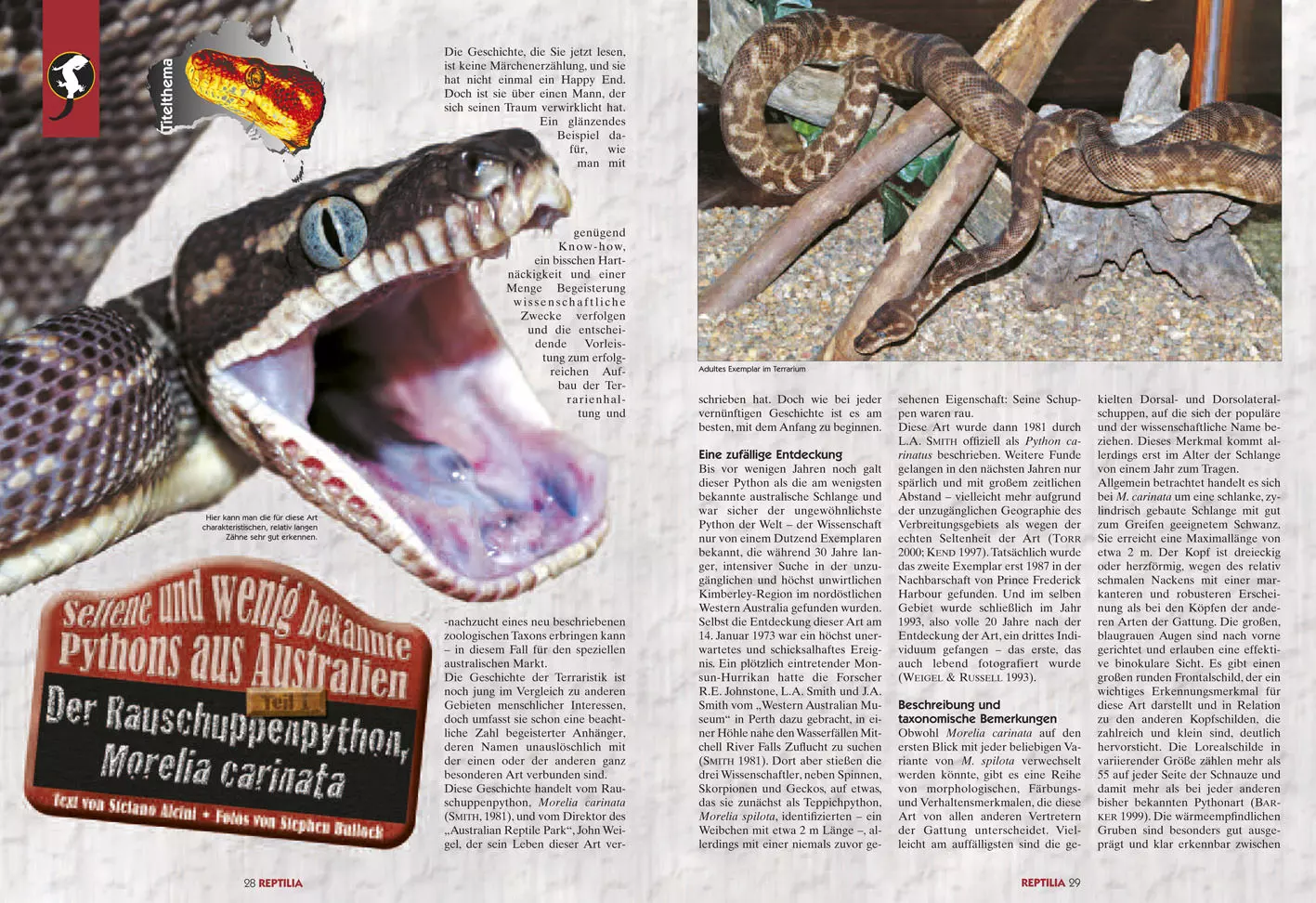
Rare and little-known pythons from Australia – Part 1: The rough-scaled python, Morelia carinata
by S. Alcini
 
HERPETOFAUNA
Rare and little-known pythons from Australia – Part 2: The Pilbara olive python, Liasis olivacea barroni
by S. Alcini
 
HERPETOFAUNA
Rare and little-known pythons from Australia – Part 3: The Oenpelli python, Morelia oenpelliensis
by S. Alcini
 
REPORTAGE
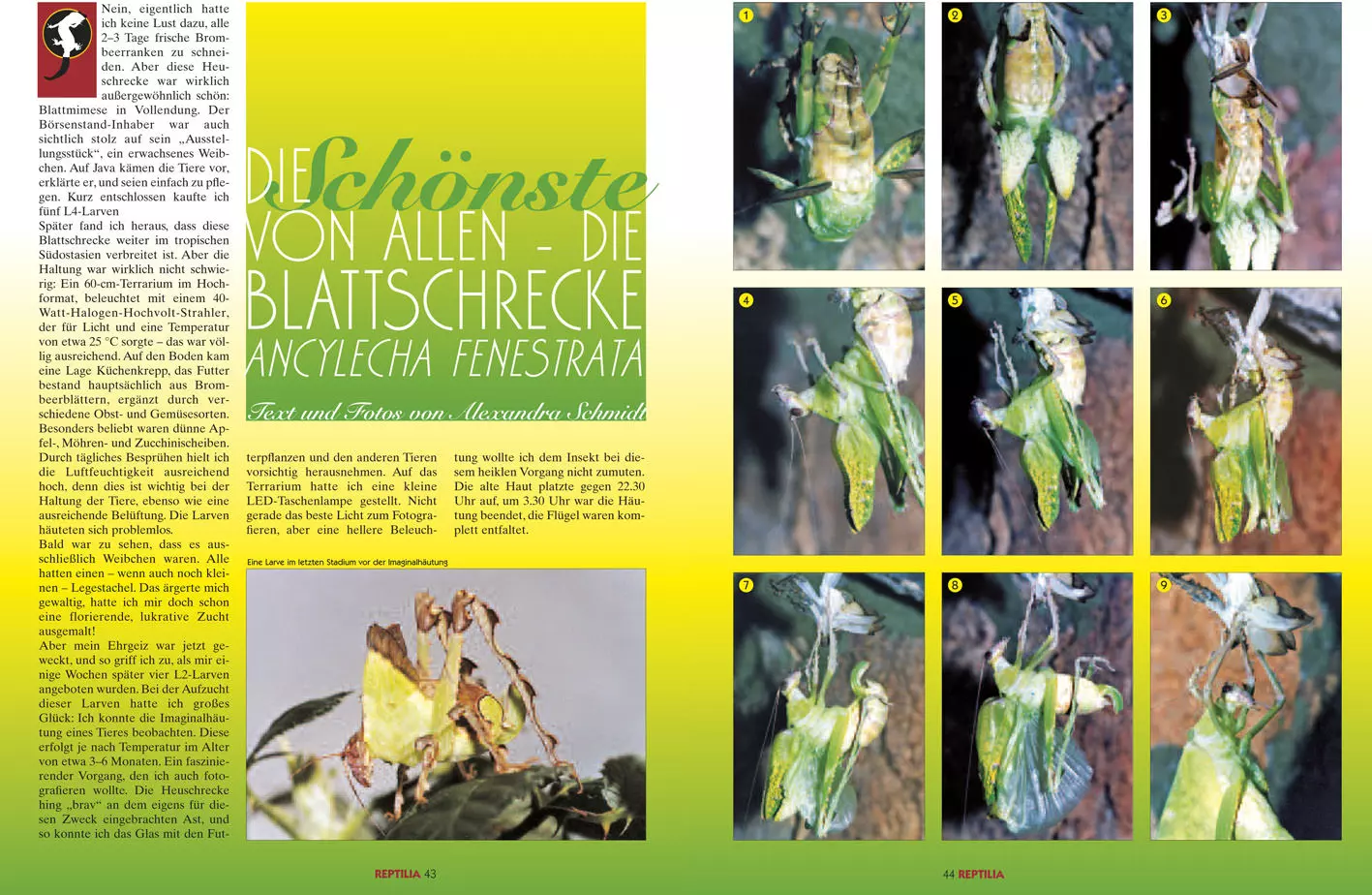
The most beautiful of them all – the leafhopper Ancylecha fenestrata 
von A. Schmidt
 
PORTRAIT and poster
Chamaeleo hoehnelii
by M. Dobiey

TRAVEL
In the footsteps of Darwin through South America. Part 2: From Patagonia to Central Chile
 
KEEPING AND REPRODUCTION
Woodlice as food animals
by J. Felka
 
WESTERN HERP PERSPECTIVES
Has the trade in reptiles and amphibians reached maturity?
from B. Love
 
KEEPING AND REPRODUCTION
The King Tree Frog, Pseudacris regilla. Reintroduction of an old acquaintance
by R. Münzer
 
TERRARIUM DISPLAYS
The serpentarium of the Snakeparadise in Eschlikon in Schweizer
by H. Werning
 
LIBRARY
SUBSCRIPTION & SERVICE
ALSO NEAR YOU
PREVIEW
 
BRUTKASTEN 
Bear Country. Quasi live from Yellowstone National Park
by H. Werning

Composition
Feeding recommendation
Technical details
Size information

0 of 0 reviews

Give us a rating!

Share your experience with the product with other customers.


Suggested products

Handbook of food plants for tortoises and other reptiles
Handbook of forage plants 2nd revised editionMarion Minch is not only a successful breeder of diverse tortoises for many years, but also an excellent connoisseur of native wild herbs. She founded and runs samenkiste.de, which is well known to many tortoise keepers and nature lovers. Her name is inextricably linked with reptile care and species-appropriate nutrition for tortoises. Her handbook of food plants summarises the most important native food plants for herbivorous and omnivorous reptiles. She not only considers tortoises, but also iguanas, spiny-tailed dragons and even chameleons. From the basics of plant biology to native wild herbs to suitable food plants for hardy tropical reptile species, this comprehensive work provides the basis for species-appropriate keeping. In the expanded and supplemented 2nd edition, the plant section is divided according to flower colour. This makes it even easier to identify wild herbs. The work has also been supplemented with a wealth of additional information and many pictures.

CHF 46.50

Geckos
Geckos in the terrarium by Astrid FalkThe book offers a comprehensive introduction to geckos and their species-appropriate keeping in terrariums. It explains what you need to think about before buying a gecko and what preparations should be made. The book describes in detail how the terrarium is technically equipped and set up. The care of the animals, their special features and behaviour, their diet, reproduction and rearing of young animals are described, as well as diseases and husbandry problems with tried and tested suggestions for prevention and treatment. Individual gecko species that are particularly suitable for keeping and breeding in terrariums are portrayed in detail in the second part of the book.

CHF 28.50

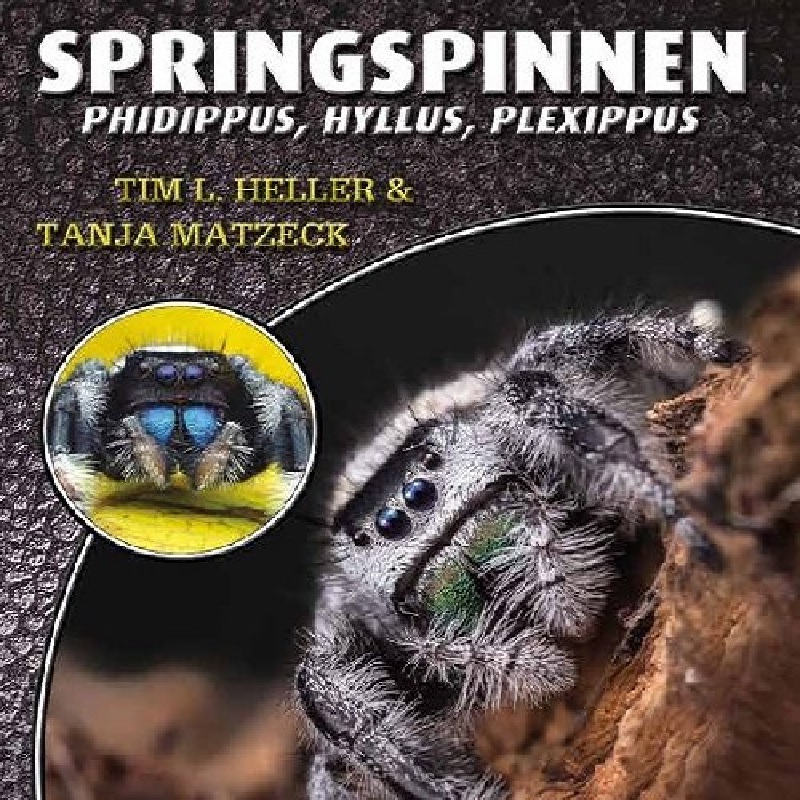
Jumping spiders Phidippus, Hyllus, Plexippus
Book Jumping Spiders - Phidippus, Hyllus & Plexippus A guide to keeping jumping spiders of the genera Phidippus, Hyllus & Plexippus. Who can resist the charm of jumping spiders? The childlike appearance of their expressive face simply leaves no one cold! In addition, their behavior is extremely exciting to observe, their colors are bright and their requirements for species-appropriate keeping are very easy to meet. No wonder these likeable jumpers are all the rage! This volume in the "Species by Species" series describes in detail what to look out for when buying and keeping them, introduces the most commonly kept species and color forms and provides plenty of tips on how to keep them successfully - so you can be sure they will breed well! Species by Species introduces you to the books in this series, which present the most popular terrarium animals. Each volume offers you detailed, practical care instructions and all the information you need to successfully breed your animals. All important questions from the required tank size to terrarium set-up, technical equipment, species-appropriate nutrition and disease prevention are answered with numerous tricks and tips. Experienced, long-standing breeders reveal how you can encourage the animals to reproduce and raise healthy young. All this in full color, generously illustrated and attractively designed - just about your terrarium animal - species by species

CHF 23.90

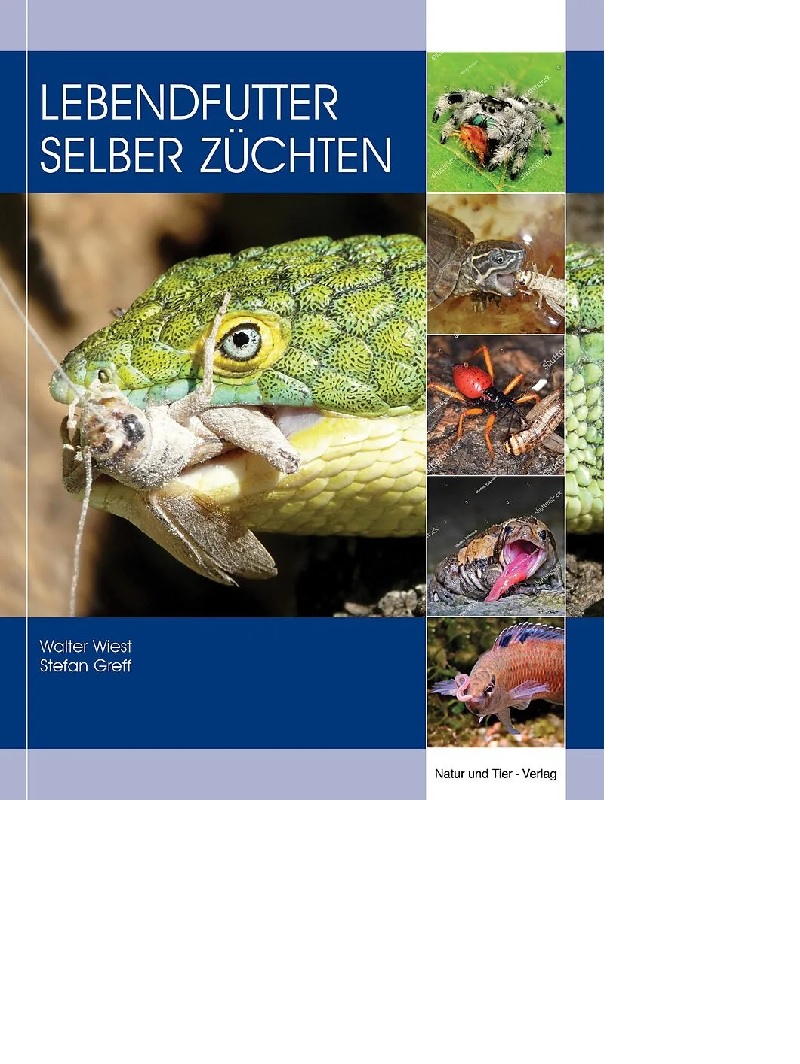
Book Breeding live food yourself
Book "Grow your own live food" - The perfect guide for pet owners Discover practical and detailed instructions on how you can easily breed food for your reptiles, birds, fish or other animals yourself in the book "Breeding live food yourself". With valuable tips on various food insects, their care and breeding, you can save money and ensure a species-appropriate diet for your pets. Contents of the book: Step-by-step instructions for breeding feeder insects Information on the best types of food for reptiles, birds and fish Care instructions and breeding conditions for various live food species Tips for sustainable and cost-effective food production Why breed your own live food? Get healthy, fresh food for your animals Save money and reduce dependence on pet shops Promote the health and well-being of your animals with species-appropriate food Whether you are a beginner or an experienced pet owner, this book provides you with everything you need to successfully breed live food yourself.

CHF 46.50

Marginata 69 - New Guinea tortoises
Marginata 69 - New Guinea tortoises – the genus ElseyaCover storyThe unrecognised beauties: New Guinea tortoises (Andreas S. Hennig)My experiences with Branderhorst's New Guinea tortoise, Elseya (Elseya) branderhorsti (Ouwens, 1914) (Andreas S. Hennig)Keeping and breeding of Rhodin's New Guinea tortoise, Elseya (Hanwarachelys) rhodini Thomson, Amepou, Anamiato & Georges, 2015 (Andreas S. Hennig)PortraitGeoemyda spengleri, Chinese serrated tortoise (Andreas S. Hennig)ReportageMacrochelys temminckii – Experiences and impressions with vulture tortoises part 2 (Reiner Praschag)KeepingAn alternative to year-round keeping of the Egyptian tortoise in the terrarium – my experiences with seasonal outdoor keeping of Testudo kleinmanni (Ricarda Schramm)EtymologySawbacks and living maps part 4: Graptemys gibbonsi, Pascagoula humpback tortoise (Holger Vetter)Classifieds & animal placement

CHF 16.50

Land turtles book
Landschildkröten-Fibel - Der Schildkrötenfachmann Marco Wagemann beantwortet mit diesem Buch alle wichtigen Fragen über die Haltung und Pflege der Landschildkröten. 96 Seiten 150 Fotos gebunden 1. Auflage 2014 Autor Marco Wagemann Verlag Dähne Verlag Das Fibel ist ein ideales Einsteiger Buch und beantwortet alle wichtigen Fragen über die Haltung und die Pflege der Landschildkröten wie zum Beispiel: Worauf beim Kauf geachtet werden muss, wie sich ein Freigehege anlegen lässt und wie es zu beschaffen ist, über die Ernährung und über eine artgerechte Überwinterung. Es werden auch die wichtigsten europäischen Arten aus den Ländern rund um das Mittelmeer vorgestellt.

CHF 21.90

Marginata 03 - Endangered tortoises
Marginata 03 - Endangered tortoises Three-striped roofed turtleCoahuila box turtle Contents: 2 EDITORIAL 3 READER LETTERS 4 MAGAZINE 7 DATES 9 PHOTO REPORTAGEEndangered tortoisesHans - Dieter Philippen 13 REPORTAGEIn search of mates for "Lonesome George" – Results of the Pinta Expedition 2003Peter C. H. Pritchard 21 REPORTAGESouth Africa – attempt to conserve one third of the world's known tortoisesMargaretha D. Hofmeyr and Brian T. Henen 31 PORTRAITMadagascan beaked tortoiseAstrochelys yniphora (VAILLANT, 1885)Hans - Dieter Philippen 36 REPORTAGEThe Seychelles giant tortoisesA contribution to nature conservation and species preservationJustin Gerlach 44 REPORTAGEThe species conservation project for the three-striped roofed turtle (Kachuga trivittata) at Mandalay ZooGerald Kuchling and U Twint Lwin 52 REPORTAGEKeeping and breeding the Coahuila box turtle Terrapene coahuila SCHMIDT & OWENS, 1944)Part 1 Markus Baur & Irmtraud Jasser-Häger 60 BOOK TIP 61 CLASSIFIEDS 62 REGIONAL GUIDE 64 AGATHA MARGINATA

CHF 14.70

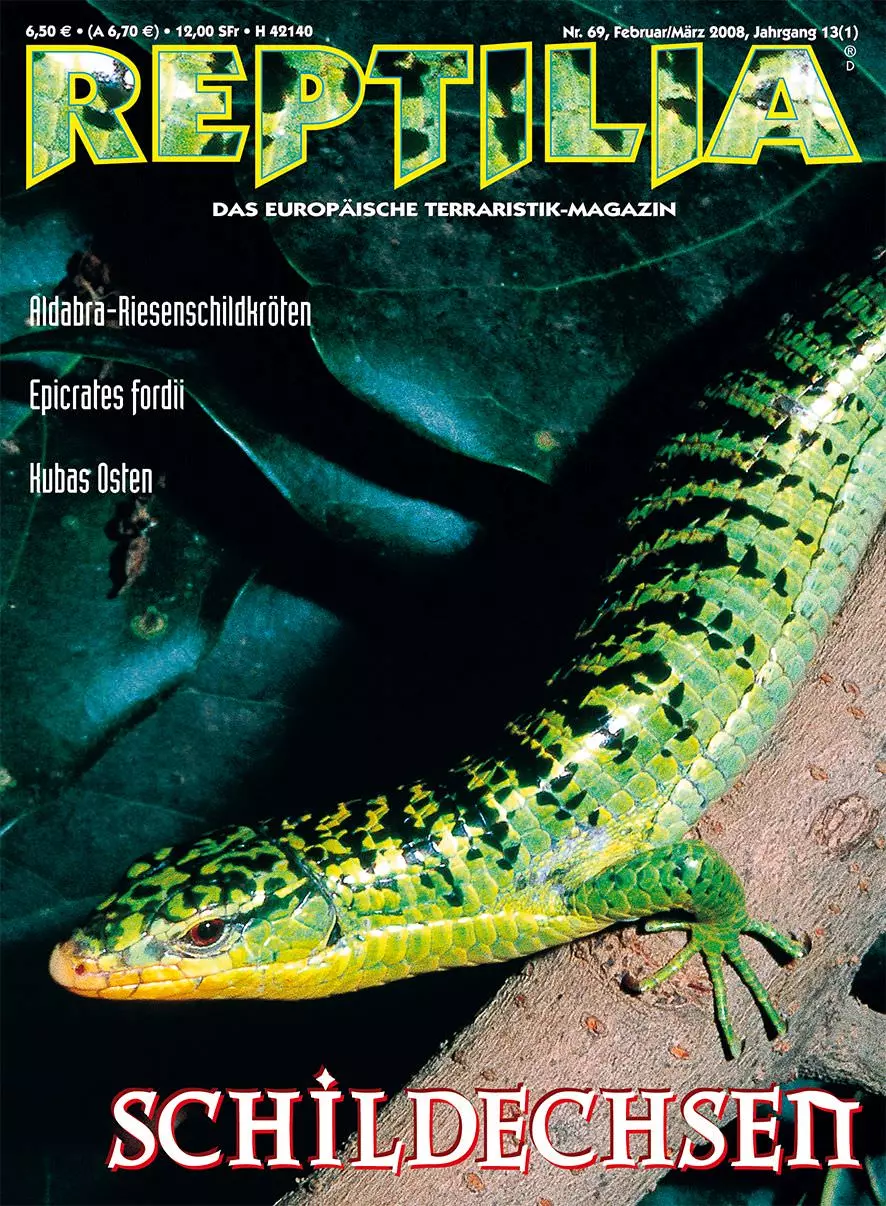
Reptilia 69 - Gerrhosauridae
Reptilia 69 - Shield lizards Aldabra giant tortoisesEpicrates fordiiEastern Cuba Contents: 2 EDITORIAL 3 MAGAZINE 13 DATES 16 WESTERN HERP PERSPECTIVESTurtles in troubleBy B. Love 18 PHOTO REPORTAGEShield lizardsGenera and species at a glance By M. Barts 26 HERPETOFAUNARing-tailed shield lizardsThe genus ZonosaurusBy M. Rogner 32 KEEPING AND BREEDINGA short report on the Sudan-shield lizard (Gerrhosaurus major)By S. Dassow 37 KEEPING AND BREEDINGThe rock shield lizard(Gerrhosaurus vallidus)By F. Schmidt 44 TRAVEL Herpetological between Columbus' landing point and the CaribbeanCuba's middle eastBy B. Krüger 51 PORTRAIT AND POSTERRhinella ictericaBy A. Kwet 56 KEEPING AND BREEDINGThe Aldabra giant tortoiseDipsochelys dussumieriBy B. Devaux - SOPTOM 64 KEEPING AND BREEDINGEpicrates fordii – a giant snake in miniatureBy S. Einolf 67 REPORTAGEThe "asthma beetle" and its use in folk medicineBy K. Kunz 76 TERRARIUM EXHIBITSThe Avilon Montalban Zoological Park, PhilippinesBy M. Gaulke 85 REPORTAGEThe Good, the Bad and the UglyVisiting Thomas Wilms in Saudi Arabia -a guest article about living and researchingin a beautiful countryBy P. Wagner 89 FAQ - FREQUENTLY ASKED QUESTIONSRed-eyed tree frogsBy T. Eisenberg 94 LIBRARY 104 INCUBATORFlorida Diaries (Part 2)By H. Werning

CHF 12.00

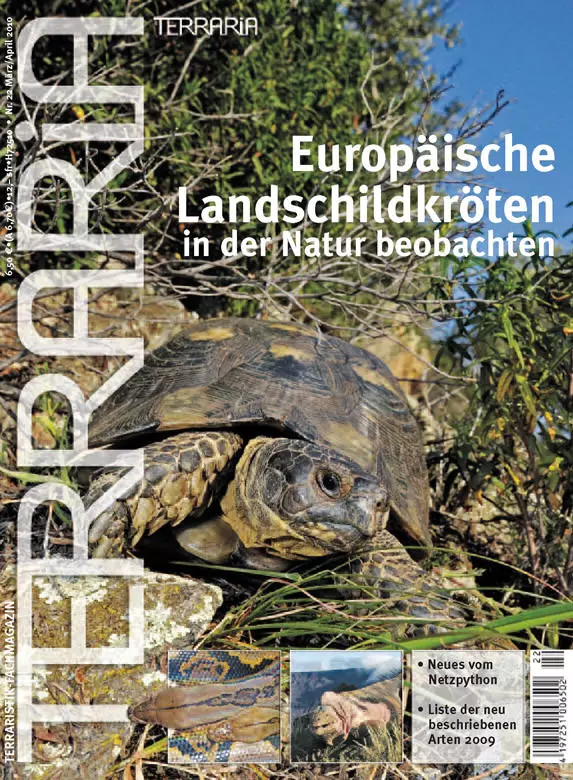
Terraria 22 - European tortoises in the nature observe
Terraria 22 - Observe European tortoises in the wildNews from the reticulated pythonList of newly described species 2009Contents:EditorialMagazineTraditional use of the Great Honeycomb Toad (Pipa pipa) by the indigenous population of French Guiana / A success for species conservation: reintroduction of young hawksbill turtles from Frankfurt Zoo to the Seychelles / Snake booklet for the further training of biology teachers / MarketplaceTERRAglobalThe "water snake"Fabio CupulVisiting the Red-throated Leaf-tailed Gecko, Saltuarius salebrosusGunther SchmidaCover storyObserving European tortoises in the wildMichael WirthThe tortoise project of MurciaBenny TrappThe Marginated Tortoise, Testudo marginata – black giants from the Greek PhryganaMichael WirthBetween rubbish and mines: the Dalmatian tortoise Testudo hermanni hercegovinensis Part 1Michael WirthSome remarks on systematics, care and reproduction of the reticulated pythonHenry Bellosa & Ralf MößleA grateful fosterling: The Oman lizard, Omanosaura jayakari, its keeping and breeding Sascha EsserNew speciesList of amphibian and reptile species newly described in 2009Axel KwetTest runRearing racksKriton KunzNear youSubscription & ServicePreviewIncubatorAxolotl RoadwayHeiko Werning

CHF 12.00

Reptilia 114 - Jurassic World in the living room, dinosaur for the terrarium
Reptilia 114 - Jurassic World in the living room, dinosaurs for the terrarium Florida climbing plantsTropical land snailsContents:Cover story: Jurassic World in the living room – dinosaurs for the terrarium“Jurassic World” is this summer’s blockbuster. Hardly anyone can escape the fascination of dinosaurs. And our modern-day prehistoric creatures quickly catch the eye. Many lizards actually look like real dinosaurs in miniature. They enchant with their prehistoric charm and make many people want to keep such a miniature dinosaur at home. And the best thing is: with many species, this is very possible! We present the best “dinosaurs” for the terrarium. And, of course, we take a closer look at “Jurassic World” and talk to a palaeontologist about the chances of us actually being able to see real dinosaurs one day – and whether they would even look like they do in the cinema. EditorialMagazineDates Western Herp PerspectivesThe end of the golden age for terrariumsB. LovePhoto story The return of the prehistoric lizardsH. Werning Keeping and breedingJurassic World in the living room. Mini dinosaurs for the terrariumH. Werning Film reviewJurassic World – The park is openH. Werning InterviewJurassic World – Questions about the filmA. Kwet in conversation with R. Schoch Keeping and breedingThe Green Water Dragon (Physignathus cocincinus) in the terrariumM. Rogner PlantsArum plants in the terrarium Part 2: Climbing araceaeB. Akeret Keeping and breedingThe local variants of Rhacodactylus leachianus in terrarium keeping Part 2: The island formsS. Cemelli & F. Fast ReportageSlowing down through the rainforestM. Gaulke Animals of our homelandThe pond frogR. Leptien LibraryAlso in your neighbourhoodService JourneyA round trip through Sri LankaV. Harport Preview Incubator The holiday jobA. “Spider” Krenzke

CHF 12.00

Terraria 51 - Amphibian crisis
Terraria 51 - Amphibian crisis ChacoMoroccan day gecko Contents: Cover story: Amphibian crisis The global amphibian crisis is threatening frogs all over the world, and we may be facing a dramatic extinction of species. One glimmer of hope is the so-called amphibian ark, the targeted breeding of particularly endangered species in human care. In the cover story of the next issue of TERRARIA/elaphe, we look at various methods used by zoos, scientific institutions and private keepers to successfully breed frogs in the long term. Territorial Herpetorama Cover story Tailed amphibians in danger a “salamander-eating fungus” spreads in EuropeAxel Kwet Questions about the Salamander EaterInterview with Prof. Frank Pasmans, with questions from Axel Kwet Species conservation and captive breeding of amphibians a new approach to keeping cave-dwelling paddle-footed frogs using Rhacophorus orloviMikhail F. Bagaturov, Anna A. Bagaturova & Rustam K. Berdiev PanoramaImpressions of the herpetofauna in the Chaco of ParaguayStephan Böhm The ruin lizards (Podarcis siculus tyrrhenicus) of the island of GiannutriJürgen Gebhart Research New speciesNew keel-tailed iguanas of the genus TropidurusAxel Kwet Newly described: three Japanese angle-toothed newts from KyushuAxel Kwet Among researchersField study on the Cypriot Levantine viper (Macrovipera lebetina lebetina)Daniel Jestrzemski An observation on ophiophagy in the puff adder (Bitis arietans)Tobias Machts Salamandra TerraristicsThe day gecko of south-western Morocco Quedenfeldtia moerens (Chabanaud, 1916)Uwe Schlüter Also in your neighbourhood Nature and species conservation Field notesFrost effect on the spawn of the grass frogRudolf Malkmus Hail damage to amphibians?Axel Kwet Strange toad observations on the island of SyltWolf-Rüdiger Grosse Subscription & Service GalleryThe Thesaurus of Albertus Seba. Old treasures in the Berlin Museum of Natural HistoryAxel Kwet, Rainer Günther & Aaron Bauer Preview Incubator Smoke detectorRolf Leptien

CHF 12.00

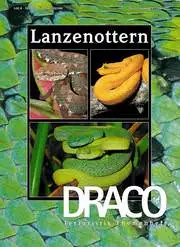
Draco 33 - Lance adders
Draco 33 - Lance adders Contents: 2 Editorial 4 Neotropical pit vipers – evolution, biogeography and ecologyMarkus Monzel & Wolfgang Wüster 28 The scaly lance adder – Bothrops asper (Garman, 1884)D. Matthias Dehling & J. Maximilian Dehling 35 Keeping, care and breeding of neotropical lance adders of the genus Bothrops using the example of Bothrops asper and Bothrops venezuelensisRichard Sethao 39 Moments from the life of the Chaco lance adder Bothrops diporus Garman, 1862Ludwig Trutnau 44 The Bothriechis species of Guatemala – data on biology and breeding Lester Meléndez 50 The lance adders of the genus Bothrops in BoliviaMartin Jansen 57 Bite accidents caused by lance adders – venoms, epidemiology and snakebite managementMarkus Monzel 66 Bothriechis schlegelii (Berthold, 1846) – In search of the prehensile-tailed lance adder in Costa Rica Michael Wirth 76 Breeding and rearing of the half-moon lance adder (Bothrops alternatus)C. Meyer 80 Remarks on the natural history, care and breeding of Bothrops atrox (Linnaeus, 1758)Ludwig Trutnau 88 Magazine

CHF 18.40