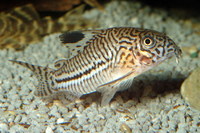

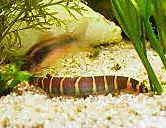
Coolie loach

Pangio kuhlii (spotted dogfish)

available for sale


Profile

Family: Loaches
Home: Asia
Synonyms: Cobitis kuhlii, Acanthophthalmus fasciatus, A. kuhlii
First introduction: 1909 by the Vereinigte Zierfischzüchtereien in Conradshöhe near Berlin.
Size: 12cm
Sexual differences: Unknown
Nutrition: Flake food, live food of all kinds, freeze-dried food tablets (FD). Feed in the evening, as nocturnal fish.
Temperature: 24-30C
Tank size: min. 60cm 
Water values: PH: 5.5-6.5
GH: 2-8
  Atlas 1 / page 364
Product information "Coolie loach"

Herkunftsgebiet:

Südostasien: Thailand, Westmalaysia, Singapur, Sumatra, Java, Borneo.


Soziales Verhalten:

Einzelgängerisch lebende, dämmerungs- bzw. nachtaktive Fische, die tagsüber ein verstecktes Leben führen.


Hälterungsbedingungen:

Weicher Bodengrund, dieser kann auch mit dünner Mulm- oder Torfschicht bedeckt sein. Dichte Bepflanzung mit feinfliedrigen Pflanzen. feinfiedrige Pflanzen aber nur , wenn keine Mulmschicht vorhanden ist . Verstecke aus Wurzeln und Steinen. Schwimmpflanzen zur Dämpfung des Lichtes. Wasser kalkarm (weich) und torfsauer . Pangio-Arten sind wärmebedürftig.


Zucht:

Im Aquarium nur in Ausnahmefällen gelungen. Diese Erfolge sind aber meist dem Zufall zu verdanken. Die Eier werden unter der Wasseroberfläche abgegeben. Sie kleben an den Wurzeln der Schwimmpflanzen oder bleiben dort hängen. Die Eier haben eine hellgrüne Färbung und sind sehr klein.


Besonderheiten:

Diese Art spaltet sich in zwei Unterarten, Pangio kuhlii kuhlii (VAL., 1846) und P. kuhlii sumatranus, FRASER-BRUNNER ,1940 ( Sumatra Dornauge) . Diese Unterart wurde zuerst eingeführt.(1909), aber erst 1940 als Unterart beschrieben. Beide Unterarten unterscheiden sich nur durch Färbung und Zeichenmuster. Nach KLAUSEWITZ gehört P. myersi ebenfalls in diese Gruppe und hieße dann P. kuhlii myersi.
 

Quellennachweis: Mergus Atlas Band 1

Für Fragen und Probleme steht Ihnen unser ausgebildetes Team im Zoo Roco zur Verfügung. Es kann Sie in allen Fragen fachgerecht beraten.

Composition
Feeding recommendation
Technical details
Size information

0 of 0 reviews

Give us a rating!

Share your experience with the product with other customers.


Suggested products

Eubranchipus grubii
Fairy shrimps (spring gillfoot) Fairy shrimps (spring gillfoot) are very common. Fairy shrimps are gilled crustaceans that have been found on our planet since prehistoric times in salt lakes, drying waters or polar waters.Only animals from Asia or America that live in a water temperature of 20-30°C are suitable for keeping in an aquarium. These species (Branchinella thailandensis and Dendrocephalus brasiliensis) live in waters that regularly dry out and are only filled with rainwater. The water is therefore very soft. Appearance The animals have 11 pairs of leaf feet. These leaf-shaped limbs serve not only for locomotion but also for breathing – which has led to the term "gilled-foot crustacean". There are sometimes minor differences in colour. They are found in colours ranging from orange to reddish-brown and may have greenish to bluish hues at the joints and at the boundaries of the segments.Both sexes have two short thread-like antennae. However, another pair of antennae differ in both shape and according to sex. Males have lobe-shaped appendages that can be curled up. Adult females are mainly distinguished by the ventrally located brood sacs, which are filled with eggs, and the ends of the female's tail are translucently light. Systematics Phylum: Arthropoda / ArthropodsSubphylum: Crustacea / CrustaceansClass: Anostraca – Gill-feetFamily: BranchipodidaeGenus: Branchipus / Eubranchipus /Tanymastix etc. Care Depending on the species, fairy shrimps live for 6-12 weeks and the size of adult animals varies from 1-3cm.Can Triops and fairy shrimps be kept together?yes, they can Aquarium size: Initially, a Faunarium box size 230 x 155 x 170 mm is quite sufficient From a body length of 1.5cm, they can be gradually accustomed to larger tanks Basic lighting: Sunlight or aquarium lighting is sufficientAeration: An air pump with a stone and very little air flow is sufficient for keepingSetup:Only water and breeding substrate in the breeding/starting container. A little fine aquarium sand can be used as substrate (but this is not absolutely necessary)Decorations can be used, but are only for our eyes and not of importance to the fairy shrimps.Fairy shrimps are free-swimmers – so they need enough free swimming space in the breeding container.If the animals swim around freely, you can also add a little aquarium moss to the water. To ensure the water is soft, it is best to use 2/3 distilled water and 1/3 mineral water (non-carbonated).Water temperature: Fluctuations in temperature of +/- 5° C are not dramatic.The ideal breeding temperature is 26°.Start:The larvae only hatch when they are completely surrounded by water. Therefore, place the eggs on adhesive tape and then put this in the water – so the eggs are not washed to the edge and always remain in contact with water.After 1-3 days the larvae hatch. The larvae grow quickly and can reach sexual maturity after up to 40 moults in one to two weeks. The males hold the females with their jaw pincers shortly before and also during mating. After mating, the eggs develop in the egg sacs on the females’ abdomens. They fall to the bottom of the water and can survive for several years of prolonged drought in the substrate.When the fairy shrimps have died, the water can be drained off and the substrate with the eggs left completely dry. The larvae can only hatch again if the eggs were completely dry.Once this is dried out, a new batch can be started.If no substrate is used, you can also siphon off the eggs with a thin hose. Let the water containing the eggs run through a fine net or a coffee filter – this way you can collect the eggs.Important: The animals do not tolerate large water changes. If fairy shrimps are to be moved to a larger home, it is best to place the animals together with the breeding water into the new home or tank and slowly fill up the container with conditioned tap water. Feeding The larvae are fed from the 3rd day after hatching.The larvae can be fed with algae powder or JBL Artemio fluid. For all animal husbandry: Children must be guided, supervised and monitored by their parents. Children must learn that an animal has its own needs and habits and they must respect this. Parents should be aware that they are responsible for the animal. For questions and problems our trained team at Zoo Roco is at your disposal. They can advise you professionally on all matters.
 
Indian mudskippers (Periophthalmus novemradiatus)
Periophthalmus novemradiatus - The Indian mudskipperOrigin & habitatThe Indian mudskipper (Periophthalmus novemradiatus) originates from the coastal regions of South Asia, particularly India, Sri Lanka and Bangladesh. Its favourite habitat is mangrove forests, brackish water zones, muddy estuaries and intertidal zones. Here it finds ideal conditions to live between water and land.AppearanceThis unusual fish has an elongated, scale-covered body, which is usually grey-brownish in colour and can be covered with small, shimmering spots. Particularly striking are its protruding eyes, which sit high up on the head and can be moved independently of each other - a perfect adaptation to life outside the water. Males also have a more conspicuous dorsal fin, which they raise for courtship.SizePeriophthalmus novemradiatus is one of the smaller mudskipper species. Adults reach a length of around 6 to 10 centimetres.Life expectancyIn suitable husbandry or under natural conditions, an Indian mudskipper can live for around 3 to 5 years. Factors such as water quality, diet and habitat play an important role here.LifestyleThe Indian mudskipper is diurnal and semi-aquatic, which means that it spends most of its time out of the water. Thanks to its powerful pectoral fins, it can "jump" and move on wet mud. It uses both its gills and a special skin respiration system to breathe as long as the skin remains moist. Mudskippers are territorial and can be quite aggressive towards conspecifics.Unique characteristicsAmphibious lifestyle: One of the few fish that can actively move around on land.Eyes like a chameleon: Their eyes can rotate independently of one another – a great advantage for navigation and hunting prey.Jumping & Climbing: Despite their small size, they can jump surprisingly far and even climb roots or stones.Skin and mucous membrane respiration: Like amphibians, the mudskipper can also absorb oxygen through its moist skin and the mucous membranes in its mouth and throat. However, this epidermal respiration only works as long as the skin is well moistened – which is why the mudskipper relies on a humid environment or frequent periods in the water.Keeping in a paludariumA paludarium - a combination of aquarium and terrarium - is ideal for keeping the Indian mudskipper in a species-appropriate way. This should offer both a water area and sufficient land area with a moist, muddy or sandy substrate.SetupLand area: At least half of the paludarium should consist of dry, slightly damp sand on which the animals can walk and jump. Fine aquarium sand or a clay-sand mixture works well.Aquarium section: Shallow and warm (24–28°C), with slightly brackish water (salinity approx. 5–15 g/L), as the animals originate from brackish water zones.Hiding places & climbing opportunities: Roots, stones or mangrove roots provide shelter and climbing opportunities.Plants: Saltwater-tolerant plants or artificial alternatives can be used – a robust setup is important, as the fish dig.TidesA particularly natural paludarium offers a simulated ebb and flow of the tide. This can be controlled using pumps or a timer: At high tide, the water area fills slowly and provides access for swimming. At low tide, the water level drops and more land becomes accessible. This corresponds to the natural behaviour of the animals and significantly stimulates their activity.General conditionsLighting: Daylight simulation with UV components is recommended.Humidity: High, ideally between 70–90%.Cover: The paludarium should be well covered, as mudskippers are excellent climbers and can escape quickly.Created with ChatGPT – revised by Zoo Roco

CHF 1,000.00

Congo catfish
Herkunftsgebiet: Zaire-Becken von Kinshasa bis Basonga Soziales Verhalten: Friedlich, auch gegenüber Artgenossen. Guter Gesellschafter Hälterungsbedingungen: Ein mit breitblättrigen Pflanzen (Echinodorus) bewachsenes Becken, das mir Wurzeln und Steinen als Unterschlupf ausgestattet sein sollte. Ist das geeignetste Aquarium für diesen Wels. Gern weidet er die Blattunterseite ab, wobei viel eher nach fleischlicher Nahrung (Insektenlaven) als nach Algen gesucht wird. Zucht: Als eine der wenigen Synodontis-Arten wurde S. nigriventris einige Male im Aquarium nachgezüchtet. Die Eier werden in einer Höhle abgelegt. Die Weibchen sind besonders zur Laichzeit sehr rundlich. Die Eltern betreiben eine Art Brutpflege. Die Jungen tragen bis zum 4 Tag einen Dottersack und nehmen bald darauf frischgeschlüpfte Artemia. Ab der 7. Bis 8. Woche drehen sich die Jungen von normaler Schwimmlage auf den Rücken. Bis zu einer Länge von 5 cm (von 2 cm Länge an) bilden die Jungfische gern einen Schwarm. Später verliert sich dieses Verhalten wieder Besonderheiten: Die Rückenschwimmlage ermöglicht es dieser Welsart, besonders die Larven der Stechmücke von der Wasseroberfläche aufzunehmen. Diese Nahrung leitet häufig bei sonst günstigen Bedingungen das Brutgeschäft ein.Quellennachweis: Mergus Atlas Band 1Für Fragen und Probleme steht Ihnen unser ausgebildetes Team im Zoo Roco zur Verfügung. Es kann Sie in allen Fragen fachgerecht beraten.
 
Zebrafish
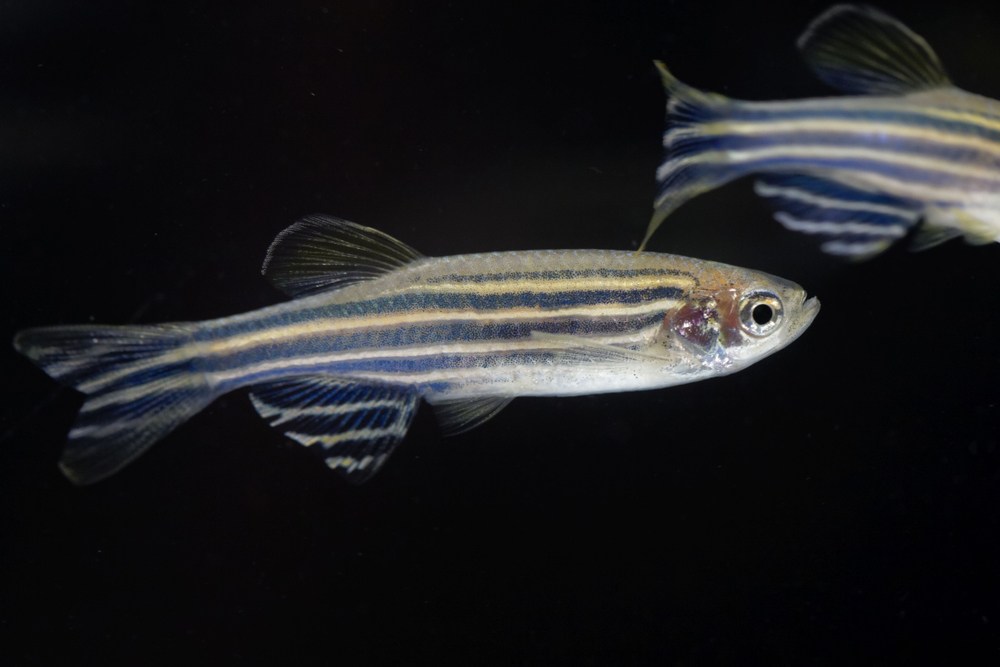
ZebrafishArea of origin:The zebrafish originates from clear to slightly murky, shallow streams, rice fields and ponds in South Asia. High oxygen levels and moderate currents are among its natural conditions.Species:The zebrafish is a species within the genus Danio. Other related species:Danio kyathit (leopard danio)Danio choprae (Glowlight Danio)Devario aequipinnatus (giant barbel)The species frequently offered in pet shops includeZebrafish (Danio rerio - wild form)Veiled zebrafishGolden zebrafishLong-finned varietiesLeopard danio (Danio kyathit - often sold as a variant)Social behaviour:Very lively, peaceful schooling fish. Show pronounced group swimming. Play and chase each other playfully. Can become shy if kept too small. Ideal for community tanks with other mobile species.Keeping conditions:They like long, well-filtered aquariums bestLight current desiredOpen swimming zones + planted edge zonesNo strong temperature fluctuationsRobust and adaptable speciesBreeding:Relatively simple. Free spawners. Eggs are released via plants or spawning grids. Parents eat the spawn → separate breeding tanks necessary. The larvae hatch after 2-3 days. Fry need infusoria, later Artemia nauplii.Special features:Very robust and beginner-friendly. Lively and always on the move. Also tolerates cooler temperatures → ideal for unheated aquariums. Important model organism in research (but normal breeding lines in the pet trade)Conclusion:The zebrafish is a lively, uncomplicated schooling fish that enriches any community aquarium with its attractive stripes and socially active behaviour. With sufficient swimming space, good water quality and a larger group, it is particularly lively and harmonious.If you have any questions or problems, our trained team at Zoo Roco is at your disposal. They can provide you with expert advice on all matters.
 
Longitudinally striped lattice-barred loricariid catfish
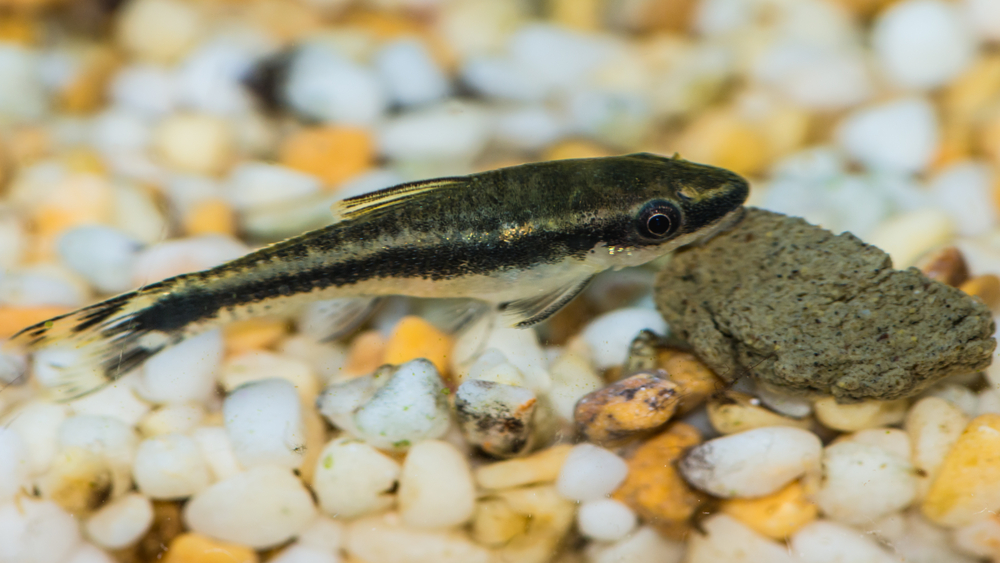
Longitudinally striped lattice-barred loricariid catfishArea of originOtocinclus vittatus lives in clear, oxygen-rich waters of the Amazon and Orinoco regions. Mostly in shallow river zones with dense vegetation, plenty of plants and roots.SpeciesThe genus Otocinclus includes around 19 species. Many look very similar. The species frequently offered in the pet trade includeOtocinclus vittatusOtocinclus macrospilusOtocinclus affinis (usually misnamed - true species rare)Otocinclus cocama (Zebra Otocinclus - rare)Social behaviourExtremely peaceful. Very social - active and relaxed in groups. Shy when kept alone. Ideal for community tanks with small, calm fish. Perfect algae eaters (especially green algae & growth)Keeping conditionsWell-planted aquarium with plenty of surfaces to graze on. Not a newer, "sterile" aquarium - need biofilm! Soft to medium-hard water. High oxygen levels. No aggressive co-inhabitants. Caution with medication → sensitive to chemicalsBreedingRare in the aquarium, but possible. Group spawners. Males engage in courtship → Females attach eggs to discs and plants. Parents occasionally eat eggs. Juveniles require the finest growth food / spirulina-based powdered food. Very sensitive rearing.BpeculiaritiesOne of the best algae eaters for small aquaria. Very peaceful and ideal for shrimp tanks (does not eat juveniles). Very sensitive during transport and acclimatisation. Needs stable water values and regular feeding with green food. Must be kept in groups. ConclusionOtocinclus vittatus is an extremely peaceful, useful and social dwarf catfish that is particularly well suited to planted, quiet aquaria. It is an excellent algae eater, but needs stable water values, good acclimatisation and always a group. Properly cared for, it is a valuable and friendly helper in the aquarium.If you have any questions or problems, our trained team at Zoo Roco is here to help. They can provide expert advice on all matters.
 
Red-tailed black shark
Herkunftsgebiet: Thailand: Zentralthailand, Menam, Chao Phya-Bassin und die Paknampo--Region. Soziales Verhalten: Einzelgängerisch und revierbildend. Die Tiere sind gegen Artgenossen sehr unverträglich und bissig. Gegenüber anderen Beckeninsassen dagegen meist friedlich. Große Tiere können aber zu wahren Tyrannen werden, die selbst große Mitbewohner terrorisieren. Hälterungsbedingungen: Grosse Recken mit feinem Sand als Bodengrund; Verstecke aus Wurzeln und Steinen. Die Bepflanzung so vornehmen, dass die Tiere Reviere bilden können, ohne direkten Sichtkontakt mit ihren Nachbarn zu haben. Viel freier Schwimmraum. Weiches bis mittelhartes (bis 15 dGH) und neutrales Wasser (pH um 7). Die Art ist nur bedingt für das Gesellschaftsbecken geeignet. Zucht: Die Zucht ist wegen der Unverträglichkeit der Tiere sehr schwierig und deshalb nur selten gelungen.Über die gelungene Zucht von E. bicolor berichten DEAKIN & MORRILL. Zuchttemperatur 27 - 28 Grad C; Wasser weich und mit Torf angesäuert. Es wurde in einer Steinhöhle abgelaicht. Die Jungfische schlüpften nach zwei Tagen und nach weiteren zwei Tagen schwammen sie frei. Die Jungfische haben weiße Flossenspitzen. Ihre Färbung geht von einem silbrigen Braun über Dunkelbraun zu Schwarz über. Die Schwanzflosse und wird erst ab der 7. Woche rötlich.Quellennachweis: Mergus Atlas Band 1Für Fragen und Probleme steht Ihnen unser ausgebildetes Team im Zoo Roco zur Verfügung. Es kann Sie in allen Fragen fachgerecht beraten.
 
Sumatran barb
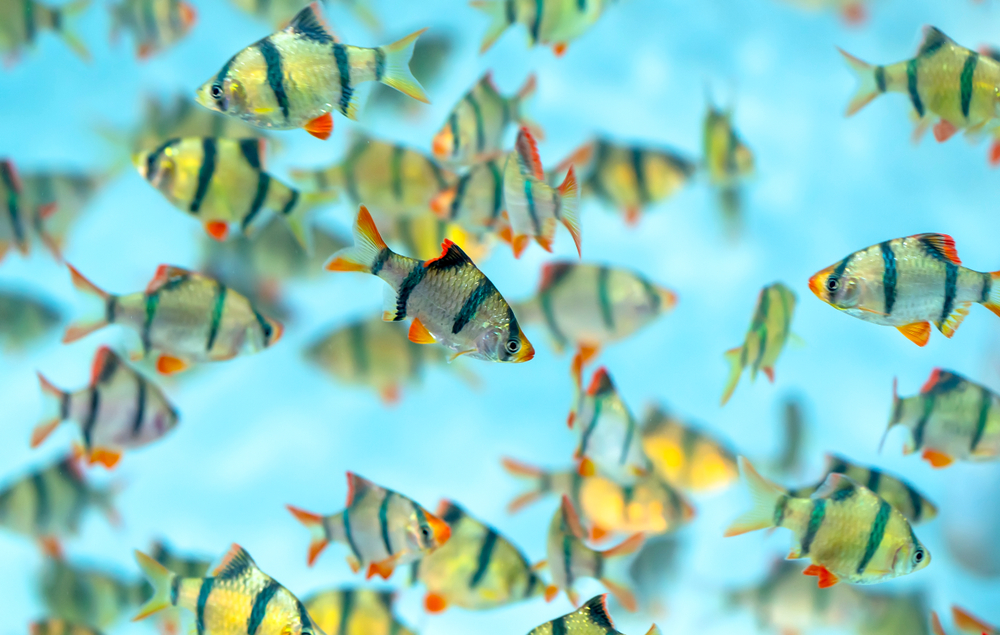
Profile: Sumatran barbArea of origin:The Sumatran barb lives in clear to slightly murky, shallow waters with dense shore vegetation in South-East Asia.Species:The Sumatran barb is a single species, but there are numerous colour variants. The species frequently offered in the pet trade include (colour forms)Classic Sumatran barb (wild-coloured)Moss barb (green)Albino Sumatran barbGold Sumatran barbBlack Ruby Barb (similar, but different species)Social behaviour:Sumatran barbs are lively, playful and sometimes rough towards slower or long-finned fish. In a larger group, the intra-species temperament is evenly distributed, which makes them appear much more peaceful. They are constantly on the move and very active.Keeping conditions:A long aquarium with plenty of swimming space and dense marginal planting is ideal. They love gently flowing water and clear structures. Regular water changes and good filtration contribute to their health.Breeding:Breeding is successful in a separate breeding tank. They are free spawners that scatter eggs over plants or spawning substrates. The parents must be removed after spawning as they eat the spawn and fry.Special features:Very active, lively fish Can nibble fins if kept in groups that are too small Easy to care for and robust Colours develop particularly strongly with a varied dietConclusion:The Sumatran barb is a colourful, lively and sociable schooling fish that exhibits fascinating behaviour with sufficient swimming space and a larger group. It brings dynamism and movement to any community aquarium, but requires suitable tankmates and sufficient space.If you have any questions or encounter any problems, our trained team at Zoo Roco is here to help. They can provide expert advice on all matters.
 
Guppy
The guppy fish (guppies / guppies) Area of origin: Central America to Brazil, today mostly captive bred from Asia (Singapore). Social behaviour: Livebearers. Some parents chase their young immediately after birth. No brood care, otherwise very peaceful Keeping conditions: The persistent guppy can be kept in almost any aquarium. High-breeding guppies are sensitive. pH 5.5 - 8.5 (7.0); hardness 5 - 25 (15) dGH. Well-planted tank of any size if possible. Breeding: Surface plants such as floating ferns for random breeding. Targeted breeding only possible with spawning box. 20 - 40 young, males sexually mature at three months, females earlier. Stock insemination possible. Raise fry with Artemia, powdered food and powdered flake food. Standard forms: European guppy breeders currently recognise 12 different standards, which can be divided into three classes. The classes are the large-finned breeding forms (fantail, triangle-tail, veiltail and flag-tail), the swordtype class (double-sword, top-sword, bottom-sword and lyre-tail) and the short-tail class (spade-tail, spear-tail, round-tail and needle-tail). In addition, there is an almost infinite number of colours in the animals in each class and in each standard, which are usually judged separately at shows. Here are the individual standards: Fantail The tail fin has an elongated triangular shape with an angle of 45 degrees close to the body. Its ideal length is equal to the body length. The edges are straight, the transitions can be slightly rounded. The dorsal fin is pointed, rises steeply at the base and extends to the end of the first third of the caudal fin Triangle tail The tail fin has the shape of a triangle with an angle of 70 degrees close to the body. Its length is 80% of the body length. The edges are straight, the transitions can be slightly rounded. The dorsal fin rises steeply, is broad and extends bluntly to the end of the first third of the caudal fin. Veiltail The upper and lower edges of the caudal fin form curves which run in such a way that the greatest width of the fin is reached at 75% of its length. The rear edge is concave, the length is 80% of the body length and should not be less than 50%. The fin width is 3/4 of the length. The dorsal fin has a rounded end and extends to the end of the first third of the caudal fin. Bannertail The tail fin has the shape of a rectangle, the length of which is 8/10 of the body length. The fin width is 4/10 of the body length. The base of the fins is rounded. Minimum tail length 6/10 of the body length. Minimum width the largest body width. The dorsal fin extends to the end of the first third of the caudal fin and is pointed. Double sword The caudal fin has an oval basic shape with sword-shaped extension of the upper and lower fin rays. The length of the fins corresponds to the length of the body. The outer edges form an angle of 30 degrees. The part of the fins between the blades must not exceed 4/10 of the body length and can be colourless. Here too, the dorsal fin extends to the end of the first third of the caudal fin. The dorsal fin is slender, rises steeply at the base and is pointed at the end. Topsword The caudal fin has an oval basic shape with a sword-shaped extension of the upper fin rays. The length of the sword corresponds to the length of the body and runs at the upper edge at a 15 degree angle or parallel to the body axis. The basic oval shape must not exceed 4/10 of the body length and can be colourless. The dorsal fin is slender and extends, as usual, tapering to the end of the first third of the caudal fin. Bottom sword The caudal fin has an oval basic shape with a sword-shaped extension of the lower fin rays. The length of the sword corresponds to the body length and forms an angle of 15 degrees to the body axis at its lower edge. The basic oval shape must not exceed 4/10 of the body length and can be colourless. The dorsal fin is slender, rises steeply at the base and reaches out to where? To the end of the first third of the caudal fin, of course. Lyretail The caudal fin has approximately the shape of a lyre. The basic shape is round and must not exceed 4/10 of the body length. The outer fin rays reach 8/10 of the body length with the tips clearly bent outwards. The dorsal fin rises steeply and reaches the end of the first third of the caudal fin with an upwardly curved tip. Spade tail The shape of the tail fin resembles a miner's spade. The upper and lower fin borders, which stand out from the body with a clear projection, are parallel. Their length corresponds to half the body length, the height reaches 8/10 of the fin length. The dorsal fin extends pointedly from the base of the caudal fin to the end of the first third of the caudal fin. Speartail The shape of the tail fin resembles the tip of a spear. Its length is 8/10 of the body length, the height 6/10 of the fin length. The dorsal fin rises steeply and reaches the end of the first third of the caudal fin with an upward curved tip. Roundtail The caudal fin has a circular shape, the diameter is 5/10 of the body length The dorsal fin extends roundly to the base of the caudal fin. Needletail The tail fin has a circular shape, the length of which is 4/10 of the body length. The centre fin rays are elongated like needles. The total length of the fin corresponds to the body length. The dorsal fin is slender, rises steeply at the base and tapers to the end of the first third of the caudal fin. Special features: The guppy's ability to breed quickly, its variability in shape and colour and its endurance make it one of the most popular fish for beginners. Recently, the guppy has been reclassified as a member of the genus Lebistes. It is therefore correctly called Lebistes reticulatus again. Do not socialise guppies with fighting fish. The fins of the males are eaten by the fighting fish of both sexes.Source reference: Mergus Atlas Volume 1If you have any questions or problems, our trained team is at your disposal at Zoo Roco. They can provide you with expert advice on all questions.
 
Axolotl (Ambystoma mexicanum)
A journey of discovery into the world of the axolotlIn the mysterious and fascinating world of aquatic creatures, there is one creature that delights scientists and enthusiasts alike: the axolotl. With its fascinating appearance and amazing abilities, this amphibious salamander has captured the hearts of many people and is increasingly becoming the object of research and admiration. Let's immerse ourselves in the world of the axolotl and discover what makes these fascinating creatures so special.Origin: Originally native to the waters around Lake Xochimilco in Mexico.Life expectancy: In the wild, axolotls can live for around 10-15 years, while in human care they can often live up to 15-20 years or even longer.Appearance: The axolotl is an amphibious tailed amphibian and often retains juvenile characteristics even when fully grown. It has a flat body, external gills that look like a curly crest, and characteristic small eyes. Colours vary depending on the breeding line and range from white to grey, brown and black.Size: Axolotls typically reach a length of around 15-45 centimetres, with females usually being larger than males.Lifestyle: Axolotls are aquatic creatures and spend their entire lives in water. They are nocturnal and feed mainly on small fish, insects, worms and other invertebrates.Origin and habitatThe axolotl (Ambystoma mexicanum) is a tailed salamander that is originally native to the waters around Lake Xochimilco in Mexico. This species of salamander is found exclusively in a small area in central Mexico, making it an endemic species. Historically, the axolotl was an important part of Aztec culture and mythology, which further emphasises its importance in the region.Unique characteristicsWhat makes the axolotl particularly fascinating are its amazing regenerative abilities. Unlike most other amphibians, the axolotl retains its ability to regenerate limbs, organs and even parts of its brain well into adulthood. This remarkable property has piqued the interest of medical researchers as it could potentially provide insights to regenerate human tissues as well.The axolotl is also known for its neotenic appearance, which means that it retains certain juvenile characteristics even when fully grown. These include its extremely cute facial expression, external gills and, of course, its characteristic swan neck. These characteristics make the axolotl a popular pet and a sought-after species in aquariums worldwide.Threatened existenceDespite its fascinating characteristics and popularity as a pet, the axolotl unfortunately faces serious threats in the wild. The destruction of its natural habitat through pollution, drainage of wetlands and the introduction of non-native species have led to a sharp decline in populations. In the wild, the axolotl is even considered endangered and its future is uncertain.The importance of protectionWith the axolotl under increasing threat, it is vital that measures are taken to protect its habitats and conserve its populations. This requires not only protecting the waters in which the axolotl lives, but also raising public awareness of the importance of conserving this fascinating species. Furthermore, it is important to continue research on the axolotl in order to better understand its regenerative potential and possibly transfer it to medical applications.Overall, the axolotl is undoubtedly a remarkable creature, admired not only for its cute appearance, but also for its unique abilities and its importance to science. It is up to us to safeguard its future and ensure that this fascinating creature continues to enrich the waters of our planet for a long time to come.Created with ChatGPT – revised by Zoo Roco
 
Amano Shrimp
Diese bis 4 cm groß werdende Garnele besticht nicht durch ihr Aussehen, sondern durch ihre Leidenschaft für (Grün-)Algen. Der Name "Amanogarnele" wird benutzt, da der bekannte Aquarienfotograf Takashi Amano diese Garnelen zur Algenbekämpfung in seine Becken einsetzt und sie somit auf vielen seiner Bilder erscheinen. Diese Art gehört zu den besten bekannten Algenfressern und muss mit Algen und Futter mit Schwerpunkt auf Pflanzenbasis ernährt werden. Sie ist sehr friedlich. Gehalten werden kann sie bei Temperaturen bis 27°C und einem pH-Wert zwischen 6 und 8. Die Wasserhärte ist zweitrangig und sollte unter 20 dgH liegen.Caridina japonica wurde bereits mehrfach erfolgreich nachgezogen. Da sie zum primitiven Fortpflanzungstyp gehört, die Larven sehr klein sind und zur erfolgreichen Aufzucht Brackwasser benötigen, ist die Zucht allerdings mit etwas Aufwand verbunden.   Herkunftsgebiet: Japan Beschreibung: Farbe milchig, glasig, 0,3 mm braune Punkte. Zucht: Nach erfolgreicher Befruchtung wandern die Eier in die Bauchtaschen der Weibchen. Nach ca. 6 Wochen stößt das Weibchen die Eier ab und es schlüpfen ca. 1mm kleine, milchig-durchsichtige Larven. Diese müssen in Brackwasser (1,6% Salzgehalt) überführt werden. Nach 4 Wochen und zahlreichen Häutungen sind die Larven zu Junggarnelen herangewachsen und können in Süßwasser überführt werden.Gelegegrössen / Nachwuchsanzahl: bis ca. 2000 EierHäufigkeit der Vermehrung: ständig, mit einer Laichpause im Januar/Februar Besonderheiten: Die Amano-Garnele ist sehr beliebt aufgrund der guten AlgenbekämpfungFür Fragen und Probleme steht Ihnen unser ausgebildetes Team im Zoo Roco zur Verfügung. Es kann Sie in allen Fragen fachgerecht beraten.
 
Red neon
Profile red neon / cardinalfishArea of originThe cardinal tetra inhabits the dark, blackwater rivers of theAmazonas region. There, the water is very soft, acidic, rich in humic substances and heavily overgrown with plants and roots.SpeciesParacheirodon axelrodi is one of three Paracheirodon species: Species commonly offered in the pet trade include:Paracheirodon axelrodi - Cardinalfish (solid red lower body)Paracheirodon innesi - neon fish (red stripe only at the back)Paracheirodon simulans - Blue neon / Green neon (smaller, more delicate)Social behaviourVery peaceful. Shows harmonious, synchronised swimming behaviour in a shoal. Ideal for community tanks with calm species. Intense colours in larger groups. Shy in groups that are too small or with hectic tankmates.Keeping conditionsSoft, slightly acidic water. Dark substrate and subdued light. Lots of plants, roots, leaf litter. Good filtration, but no strong current. Regular water changes important. Very sensitive to nitrite BreedingSophisticated Requires soft, very acidic water. Twilight promotes readiness to spawn. Free spawners, eggs are scattered. Parents must be removed immediately after laying eggs. Eggs are sensitive to light → darken! Breeding the tiny fry requires infusoria Special featuresOne of the most colourful freshwater fish species Blackwater requirements → ideal for biotope aquariums. Requires stable water conditions. Stress-free in large groupsConclusionParacheirodon axelrodi is a particularly colourful, peaceful schooling fish that unfolds its full beauty in a soft, acidic and densely planted aquarium. It is ideal for quiet community tanks and blackwater aquariums. It displays fascinating, harmonious shoaling behaviour in groups.If you have any questions or problems, our trained team at Zoo Roco is here to help. They can provide expert advice on all matters.
 
Julii armoured catfish
Profile of the Julii armoured catfishArea of originThe Julii armoured catfish lives in slow-flowing, shallow waters in South America with sandy bottoms and dense vegetation. Often found in flooded forest areas.SpeciesCorydoras comprises over 170 species. The Julii armoured catfish is one of the smaller, finely marked Corydoras species. The species frequently offered in the pet trade includeCorydoras julii (true Julii armoured catfish - rare)Corydoras trilineatus (three-line armoured catfish - often sold as "Julii")Corydoras pandaCorydoras sterbaiCorydoras aeneus (incl. albino)Social behaviourVery peaceful and sociable. Prefers bottom region. Likes to dig in the sand for food. Ideal for community tanks. No aggressive behaviour.Keeping conditionsFine sandy soil is a must! → Gravel can injure the barbels. Well-planted aquarium with lots of hiding places (roots, stones). Calm current. Very clean water required. Oxygen-rich environment. Regular water changesBreedingPossible, but somewhat more demanding Typical "T-position" spawning behaviour: Females stick eggs to glass or plants. Eggs often have to be protected from the parents. Fry require very fine food (infusoria, Artemia nauplii)Special featuresVery active and peaceful bottom dwellers. True Corydoras julii is rare - Corydoras trilineatus is often sold as Julii. Tolerates higher temperatures than some other Corydoras species. A larger group ensures well-being and beautiful observationsConclusionThe Julii armoured catfish is a pretty, sociable and extremely peaceful bottom fish that fits perfectly into a community aquarium. With fine sand, good water quality and a larger group, it displays its lively, charming behaviour and remains healthy for a long time. If you have any questions or problems, our trained team at Zoo Roco is here to help. They can provide expert advice on all matters.
 

Customers also saw

%
Fluval Plant 3.0 LED - Lighting
Size (1): 61-85cm | Size (4): 61-85cm
 3rd generation of Fluval LED lighting All inclusive - control via the free app, so no additional controller is required. No additional controller required Programmable 24-hour lighting cycle Customisable colour spectrum Can also be controlled manually (on, off, dimming) Three preset light configurations Uniform lighting over 120° Extendable brackets included T5/T8 brackets are optionally available Waterproof according to IP67 Suitable for freshwater Developed in Germany Approx. 50,000 hours life expectancy This luminaire contains built-in LED lamps. The lamps cannot be replaced in the luminaire. Fluval Plant Spectrum 3.0 LED available in 3 sizes: 61-85 cm, 168 LEDs, 32 W, 2350 lm, 6500 K91-122 cm, 252 LEDs, 46 W, 3300 lm, 6500 K122-147 cm, 336 LEDs, 59 W, 4250 lm, 6500 K

CHF 149.00 CHF 229.00 (34.93% saved)

Indian mudskippers (Periophthalmus novemradiatus)
Periophthalmus novemradiatus - The Indian mudskipperOrigin & habitatThe Indian mudskipper (Periophthalmus novemradiatus) originates from the coastal regions of South Asia, particularly India, Sri Lanka and Bangladesh. Its favourite habitat is mangrove forests, brackish water zones, muddy estuaries and intertidal zones. Here it finds ideal conditions to live between water and land.AppearanceThis unusual fish has an elongated, scale-covered body, which is usually grey-brownish in colour and can be covered with small, shimmering spots. Particularly striking are its protruding eyes, which sit high up on the head and can be moved independently of each other - a perfect adaptation to life outside the water. Males also have a more conspicuous dorsal fin, which they raise for courtship.SizePeriophthalmus novemradiatus is one of the smaller mudskipper species. Adults reach a length of around 6 to 10 centimetres.Life expectancyIn suitable husbandry or under natural conditions, an Indian mudskipper can live for around 3 to 5 years. Factors such as water quality, diet and habitat play an important role here.LifestyleThe Indian mudskipper is diurnal and semi-aquatic, which means that it spends most of its time out of the water. Thanks to its powerful pectoral fins, it can "jump" and move on wet mud. It uses both its gills and a special skin respiration system to breathe as long as the skin remains moist. Mudskippers are territorial and can be quite aggressive towards conspecifics.Unique characteristicsAmphibious lifestyle: One of the few fish that can actively move around on land.Eyes like a chameleon: Their eyes can rotate independently of one another – a great advantage for navigation and hunting prey.Jumping & Climbing: Despite their small size, they can jump surprisingly far and even climb roots or stones.Skin and mucous membrane respiration: Like amphibians, the mudskipper can also absorb oxygen through its moist skin and the mucous membranes in its mouth and throat. However, this epidermal respiration only works as long as the skin is well moistened – which is why the mudskipper relies on a humid environment or frequent periods in the water.Keeping in a paludariumA paludarium - a combination of aquarium and terrarium - is ideal for keeping the Indian mudskipper in a species-appropriate way. This should offer both a water area and sufficient land area with a moist, muddy or sandy substrate.SetupLand area: At least half of the paludarium should consist of dry, slightly damp sand on which the animals can walk and jump. Fine aquarium sand or a clay-sand mixture works well.Aquarium section: Shallow and warm (24–28°C), with slightly brackish water (salinity approx. 5–15 g/L), as the animals originate from brackish water zones.Hiding places & climbing opportunities: Roots, stones or mangrove roots provide shelter and climbing opportunities.Plants: Saltwater-tolerant plants or artificial alternatives can be used – a robust setup is important, as the fish dig.TidesA particularly natural paludarium offers a simulated ebb and flow of the tide. This can be controlled using pumps or a timer: At high tide, the water area fills slowly and provides access for swimming. At low tide, the water level drops and more land becomes accessible. This corresponds to the natural behaviour of the animals and significantly stimulates their activity.General conditionsLighting: Daylight simulation with UV components is recommended.Humidity: High, ideally between 70–90%.Cover: The paludarium should be well covered, as mudskippers are excellent climbers and can escape quickly.Created with ChatGPT – revised by Zoo Roco

CHF 1,000.00

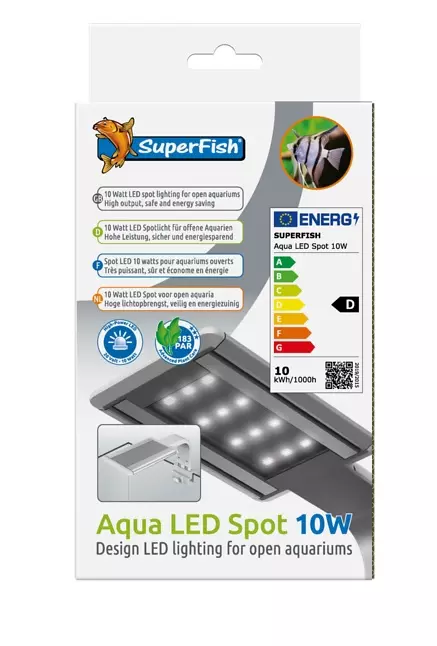
LED Aqua Spot
Watt: 10 watts
SuperFish Aqua LED Spot 10W or 14W This slim-line design light is perfect for open aquariums and is equipped with a high-performance LED. The LED is characterised by its high brightness and long service life. Par 183, Lux 11300, Kelvin 6400 Ensures excellent plant growth Safe (DC 20 Volt) Waterproof (IP68) for safe use Suitable for tropical and cold water aquariums Maximum glass thickness of 10 mm Very simple installation With 2-year guarantee and full instructions for use

CHF 44.90

Riccia fluitans - Floating liverwort
Riccia fluitans - pond liverwort portion max. growth height - 5 cm Country of origin Tropical cosmopolitan Suitability NanoCube, community aquarium, aquascaping Type free floating underwater plant / floating plant family Ricciaceae Genus Riccia Propagation Division Growth rate fast pH 5 - 8 Water hardness 0 - 20 °dh Notes   The pond liverwort Riccia is found worldwide and colonises floating water surfaces or damp soils. It was Takashi Amano who first introduced this floating moss to the aquarium hobby. In many of his designs, Riccia can be admired as a foreground plant. Cultivation and care are very simple: the moss clumps are tied onto stones or roots, where they can grow beautifully. The compact growth habit is maintained if the light green clumps are trimmed with scissors from time to time. CO₂ 2 -supplementation significantly promotes growth.Aquatic plants in vitroIn vitro plants are cultivated in the laboratory under sterile conditions. They are supplied in a 7cm closed container. The small plants are completely free of algae and snails and can be planted directly. This product group is ideal for smaller aquariums and nano cubes as well as for modern aquascaping. You can easily see how demanding each plant is by looking at the top right-hand corner of the packaging. Before planting, simply rinse off the culture medium and portion out the plant

CHF 11.90