Amano Shrimp

Caridina japonica

available for sale


Profile

Home: Japan
Size: M: 38mm
W: 40mm
Sexual differences: Female with larger abdominal pouches
Nutrition: Flake food, Artemia, FD food, fine live food
Temperature: 23-27 degrees C
Age expectation: 2 years
Tank size: 20 litres for 5 animals
Tank set-up: Lots of plants and hiding places, loves some current
Water values: PH: 5.8 to 8.0
2 to 20 degrees total hardness
Product information "Amano Shrimp"

Diese bis 4 cm groß werdende Garnele besticht nicht durch ihr Aussehen, sondern durch ihre Leidenschaft für (Grün-)Algen. Der Name "Amanogarnele" wird benutzt, da der bekannte Aquarienfotograf Takashi Amano diese Garnelen zur Algenbekämpfung in seine Becken einsetzt und sie somit auf vielen seiner Bilder erscheinen. Diese Art gehört zu den besten bekannten Algenfressern und muss mit Algen und Futter mit Schwerpunkt auf Pflanzenbasis ernährt werden. Sie ist sehr friedlich. Gehalten werden kann sie bei Temperaturen bis 27°C und einem pH-Wert zwischen 6 und 8. Die Wasserhärte ist zweitrangig und sollte unter 20 dgH liegen.
Caridina japonica wurde bereits mehrfach erfolgreich nachgezogen. Da sie zum primitiven Fortpflanzungstyp gehört, die Larven sehr klein sind und zur erfolgreichen Aufzucht Brackwasser benötigen, ist die Zucht allerdings mit etwas Aufwand verbunden.


Herkunftsgebiet:

Japan


Beschreibung:

Farbe milchig, glasig, 0,3 mm braune Punkte.


Zucht:

Nach erfolgreicher Befruchtung wandern die Eier in die Bauchtaschen der Weibchen. Nach ca. 6 Wochen stößt das Weibchen die Eier ab und es schlüpfen ca. 1mm kleine, milchig-durchsichtige Larven. Diese müssen in Brackwasser (1,6% Salzgehalt) überführt werden. Nach 4 Wochen und zahlreichen Häutungen sind die Larven zu Junggarnelen herangewachsen und können in Süßwasser überführt werden.

Gelegegrössen / Nachwuchsanzahl: bis ca. 2000 Eier
Häufigkeit der Vermehrung: ständig, mit einer Laichpause im Januar/Februar


Besonderheiten:

Die Amano-Garnele ist sehr beliebt aufgrund der guten Algenbekämpfung

Für Fragen und Probleme steht Ihnen unser ausgebildetes Team im Zoo Roco zur Verfügung. Es kann Sie in allen Fragen fachgerecht beraten.

Composition
Feeding recommendation
Technical details
Size information

0 of 0 reviews

Give us a rating!

Share your experience with the product with other customers.


Suggested products

Eubranchipus grubii
Fairy shrimps (spring gillfoot) Fairy shrimps (spring gillfoot) are very common. Fairy shrimps are gilled crustaceans that have been found on our planet since prehistoric times in salt lakes, drying waters or polar waters.Only animals from Asia or America that live in a water temperature of 20-30°C are suitable for keeping in an aquarium. These species (Branchinella thailandensis and Dendrocephalus brasiliensis) live in waters that regularly dry out and are only filled with rainwater. The water is therefore very soft. Appearance The animals have 11 pairs of leaf feet. These leaf-shaped limbs serve not only for locomotion but also for breathing – which has led to the term "gilled-foot crustacean". There are sometimes minor differences in colour. They are found in colours ranging from orange to reddish-brown and may have greenish to bluish hues at the joints and at the boundaries of the segments.Both sexes have two short thread-like antennae. However, another pair of antennae differ in both shape and according to sex. Males have lobe-shaped appendages that can be curled up. Adult females are mainly distinguished by the ventrally located brood sacs, which are filled with eggs, and the ends of the female's tail are translucently light. Systematics Phylum: Arthropoda / ArthropodsSubphylum: Crustacea / CrustaceansClass: Anostraca – Gill-feetFamily: BranchipodidaeGenus: Branchipus / Eubranchipus /Tanymastix etc. Care Depending on the species, fairy shrimps live for 6-12 weeks and the size of adult animals varies from 1-3cm.Can Triops and fairy shrimps be kept together?yes, they can Aquarium size: Initially, a Faunarium box size 230 x 155 x 170 mm is quite sufficient From a body length of 1.5cm, they can be gradually accustomed to larger tanks Basic lighting: Sunlight or aquarium lighting is sufficientAeration: An air pump with a stone and very little air flow is sufficient for keepingSetup:Only water and breeding substrate in the breeding/starting container. A little fine aquarium sand can be used as substrate (but this is not absolutely necessary)Decorations can be used, but are only for our eyes and not of importance to the fairy shrimps.Fairy shrimps are free-swimmers – so they need enough free swimming space in the breeding container.If the animals swim around freely, you can also add a little aquarium moss to the water. To ensure the water is soft, it is best to use 2/3 distilled water and 1/3 mineral water (non-carbonated).Water temperature: Fluctuations in temperature of +/- 5° C are not dramatic.The ideal breeding temperature is 26°.Start:The larvae only hatch when they are completely surrounded by water. Therefore, place the eggs on adhesive tape and then put this in the water – so the eggs are not washed to the edge and always remain in contact with water.After 1-3 days the larvae hatch. The larvae grow quickly and can reach sexual maturity after up to 40 moults in one to two weeks. The males hold the females with their jaw pincers shortly before and also during mating. After mating, the eggs develop in the egg sacs on the females’ abdomens. They fall to the bottom of the water and can survive for several years of prolonged drought in the substrate.When the fairy shrimps have died, the water can be drained off and the substrate with the eggs left completely dry. The larvae can only hatch again if the eggs were completely dry.Once this is dried out, a new batch can be started.If no substrate is used, you can also siphon off the eggs with a thin hose. Let the water containing the eggs run through a fine net or a coffee filter – this way you can collect the eggs.Important: The animals do not tolerate large water changes. If fairy shrimps are to be moved to a larger home, it is best to place the animals together with the breeding water into the new home or tank and slowly fill up the container with conditioned tap water. Feeding The larvae are fed from the 3rd day after hatching.The larvae can be fed with algae powder or JBL Artemio fluid. For all animal husbandry: Children must be guided, supervised and monitored by their parents. Children must learn that an animal has its own needs and habits and they must respect this. Parents should be aware that they are responsible for the animal. For questions and problems our trained team at Zoo Roco is at your disposal. They can advise you professionally on all matters.
 
Black phantom tetra
Profile Black Phantom TetraArea of origin:The black phantom tetra lives in slow-flowing, densely vegetated waters in South America. The water is often soft, slightly acidic and shady due to plant growth.Species:The black phantom tetra offered in the trade is predominantly Hyphessobrycon megalopterus.Other "phantom" species are e.g:Red phantom tetra (Hyphessobrycon sweglesi)White phantom tetra (Megalamphodus megalopterus var.)The species frequently offered in pet shops includeBlack phantom tetra (standard form)Rarer:Longfin variantSocial behaviour:The black phantom tetra is peaceful and displays beautiful courtship and display behaviour within the school - the males in particular show off their large dorsal fins. It is ideal for community aquariums with other calm species.Keeping conditions:Well-planted aquarium with free swimming zones. Darkened areas (roots, floating plants) preferred. Gentle current. Stable water values and regular water changes. Dark substrate makes the colours appear stronger.Breeding:Free spawners - the eggs are scattered over plants or spawning substrates. Parents eat the spawn → breeding tank necessary. Soft, slightly acidic water promotes spawning success. Fry are very small and require infusoria/small food.Special features:Very peaceful and ideal for community tanks Males like to show off with fanned-out fins Colours look particularly intense in shady, darker aquariums Robust and well suited for beginners Conclusion:The black phantom tetra is an elegant, peaceful schooling fish that particularly comes into its own in well-planted aquariums with soft light. Its harmonious nature and beautiful contrasting colours make it an ideal inhabitant for many community aquariums.If you have any questions or problems, our trained team at Zoo Roco is here to help. They can provide expert advice on all matters.
 
Swordtail
Swordtail profileArea of origin:Swordtails live in rivers, streams and slow-flowing waters in Central America. They often live in densely overgrown bank areas.Species:Mainly breeding forms of Xiphophorus helleri are offered in the pet trade. The species frequently offered in pet shops include (colour and fin variants)Red swordtailKoi swordtailTuxedo WagtailGreen swordtail (wild form)Highfin swordtailPineappleBlack MoscowMarigoldSocial behaviour:Swordtails are active and peaceful fish, but males can occasionally rival each other. In a well-structured aquarium, their behaviour is usually calm. They go well with many other peaceful species. Keeping conditions:A spacious, well-planted aquarium with free swimming space is important. Swordtails prefer harder water, a gentle current and regular water changes. A cover is also recommended - they can jump.Breeding:Swordtails are viviparous. Females give birth to 30-80 fry every 4-6 weeks. Fine plants are recommended as protection for the young, as the parents can eat their offspring. Breeding is very easy.Special features:Very robust and recommended species for beginners Males can "metamorphose" late - sometimes females develop a sword later Wide range of colours and varieties. Very reproductiveConclusion:The swordtail is an attractive, lively and uncomplicated aquarium fish that exhibits interesting social behaviour, especially in groups. Thanks to its robustness and easy breeding, it is ideal for community aquariums and also for beginners.If you have any questions or problems, our trained team at Zoo Roco is here to help. They can provide expert advice on all matters.
 
Black Molly
Herkunftsgebiet: In zahlreichen Lokalformen vom nördlichsten Südamerika über das gesamte Mittelamerika der atlantischen Abdachung bis zum Süden Nordamerikas  Soziales Verhalten: Sehr friedlich, guter Algenfresser. Im Gesellschaftsaquarium nicht sehr ausdauernd, da Zuchtformen leicht kränkeln Hälterungsbedingungen: Die Zuchtform Black Molly ist wärmebedürftig (26 - 30°C); die Wildform verträgt Temperaturen ab 18° C. Becken mit schnellwüchsigen Pflanzen und viel Oberflächenbewuchs ausstatten. Verstecke bieten. Etwas Salzzugabe (0,1 %). pH-Wert 7,5 - 8,2; Härte 11 -3O°dGH. Zucht: Sehr vermehrungsfreudige Art. Von schwarzen Eltern kann man leicht gescheckte Junge bekommen. Zuchtformen: Leierschwanz, Mondmolly, Fahnenmolly.Tragzeit: 30-40 Tage Besonderheiten: Black Mollies werden nicht sehr alt, die Zuchtformen meist nicht mehr als drei Jahre. Die starke Variationsbreite dieser Art hat zu der grossen Zahl der Synonyma geführt.Quellennachweis: Mergus Atlas Band 1Für Fragen und Probleme steht Ihnen unser ausgebildetes Team im Zoo Roco zur Verfügung. Es kann Sie in allen Fragen fachgerecht beraten.
 
Boesemans rainbowfish
Boesemans rainbowfishArea of origin:Boeseman's Rainbowfish inhabits clear, slightly alkaline lakes and tributaries of West Papua. The water is hard, rich in oxygen and often very clear.Species:The Boesemans Rainbowfish belongs to the genus Melanotaenia. Other known species (not identical, but closely related): The species frequently offered in the pet trade include:Melanotaenia boesemani (Boeseman)Melanotaenia praecox (neon rainbowfish)Melanotaenia lacustrisMelanotaenia herbertaxelrodiGlossolepis incisus (red rainbowfish)Social behaviour:Very peaceful Ideal for larger community tanks. Strong mating behaviour, especially in the morning. Show very dynamic swimming behaviour in the shoal. Pair-forming during courtship, but shoaling speciesKeeping conditions:Lots of free swimming space. Dense marginal planting Clear, stable water parameters. Strong filtration and good oxygen supply. A cover is recommended – rainbowfish like to jump. Good light intensity promotes colourfulnessBreedingRelatively simple Free spawners with daily egg-laying over fine-leaved plants or spawning mops. Eggs stick to plants. Parents should be separated after spawning. Fry require the finest powdered food/infusoria, later Artemia nauplii. Hard, slightly alkaline water promotes breeding success.Special featuresOne of the most colourful freshwater fish of all. Colours become more intense with age. Particularly active and keen swimmers. Very social species – keeping them alone leads to stress. Good water quality is crucial for health.Conclusion:Boeseman's rainbowfish are colourful, lively and robust schooling fish that really come into their own in larger aquariums. If you provide sufficient space, clear water and varied feeding, you will have an impressive, active and peaceful aquarium inhabitant.If you have any questions or problems, our trained team at Zoo Roco is here to help. They can provide expert advice on all matters.
 
Cayo Largo Screw
Herkunftsgebiet: Florida bis Brasilien, Bermuda (Fundort Cayo Largo/Kuba) und auf Jamaica (Blue River bis Frenchman's Cove) Die Schnecken sind auch ausserhalb des Wassers bis zu 0,5m im feuchten Uferbereich zu finden. Beschreibung: Die Schnecke ist in der Farbe und im Muster extrem variabel Besonderheiten: Fressen keine Pflanzen.Für Fragen und Probleme steht Ihnen unser ausgebildetes Team im Zoo Roco zur Verfügung. Es kann Sie in allen Fragen fachgerecht beraten.
 
Pearl gourami
Area of origin: Malaysia, Borneo and Sumatra; in rivers densely overgrown with plants Social behaviour: Very peaceful, but two males can often fight each other. Keeping conditions: Water level from approx. 30 cm, provide hiding places on the water surface (floating ferns). Do not keep with rowdy fish (e.g. cichlids), T. leeri then loses its magnificent colours and stands shyly in a corner, indeed, does not dare to eat. The room temperature should be above 20-22° C, otherwise the fish will catch a cold easily and become ill Breeding: Lower the water level to approx. 12 cm. A large foam nest is built between aquatic plants and is well guarded by the male after spawning. The male does not drive the female away as brusquely as other labyrinth fish species.Foam nest Special features: Very persistent, the hardiest of the labyrinthine fish next to the blue gourami. Lives for about 8 years. Source: Mergus Atlas Volume 1Our trained team is available to assist you with any questions or issues at Zoo Roco. They can provide you with expert advice on all matters.
 
Honey gourami
Herkunftsgebiet: Nordöstliches Indien und Assam, Bangladesh. Soziales Verhalten: Friedlich und scheu; zur Laichzeit stark revierverteidigend. Hälterungsbedingungen: Dicht bepflanzte Becken mit teilweiser Abdeckung der Oberfläche durch Schwimmpflanzen. Nur mit ruhigen und friedlichen, kleineren Arten vergesellschaften. pH-Wert 6 - 7,5; Härte bis 15° dGH. Zucht: Während der Laichzeit grenzen die Paare ihr Revier (ca. 500 cm2) gegen Artgenossen ab. Die Männchen bauen lockeres Schaumnest, es wurde auch schon Laichabgabe ohne ein solches beobachtet. Die Larven schlüpfen nach 24 - 36 Stunden, je nach Temperatur, und schwimmen bereits nach einem Tag frei. Aufzucht der Jungen mit Infusorien, später Artemia und feinst gemahlenes Flockenfutter; auch pulverisierte FD-Tabletten eignen sich. Besonderheiten: Nicht ganz unproblematischer Labyrinthfisch, der nur sehr bedingt für das Gesellschaftsbecken geeignet ist. Die Art ist anfällig für Oodinium pululans. Quellennachweis: Mergus Atlas Band 1Für Fragen und Probleme steht Ihnen unser ausgebildetes Team im Zoo Roco zur Verfügung. Es kann Sie in allen Fragen fachgerecht beraten.
 
Catfish
Herkunftsgebiet: Zuflüsse des Amazonas, schnellfliessende klare Bäche Soziales Verhalten: Friedliche Art, die für große Gesellschaftsaquarien geeignet ist Hälterungsbedingungen: Bevorzugt grosse, klare Becken, sauerstoffreich und mit grossen Wurzeln als dunkle Rastplätze ausgestattet. Hier, gegen das Licht geschützt, verbringen die Welse den größten Teil des Tages bewegungslos. Ein starker Filter oder Ausströmer sollen für Strömung und Sauerstoffanreicherung sorgen.   Zucht: Die Paarungsbereitschaft ist durch Färbung erkennbar. Männchen färbt sich dunkel mit weißen Punkten, Weibchen färbt Kopf graurot. Der Laichakt beginnt dann bald. Laicht in Höhlen von Wurzeln. Das Männchen betreibt Brutpflege und befächelt das Gelege. Zucht bei Wasserwerten von pH 6,7 - 7. Härte 4 - 10 Grad dGH. Eier sind senfkornähnlich in Gelegeballen. Junge schlüpfen nach ca. 5 Tagen und saugen sich sogleich an den Beckenscheiben fest. Nach etwa 14 Tagen verschwindet der große Dottersack und man muss mit grünem, feinstem Flockenfutter (MicroMin) füttern. Quellennachweis: Mergus Atlas Band 1   Für Fragen und Probleme steht Ihnen unser ausgebildetes Team im Zoo Roco zur Verfügung. Es kann Sie in allen Fragen fachgerecht beraten.
 
Congo catfish
Herkunftsgebiet: Zaire-Becken von Kinshasa bis Basonga Soziales Verhalten: Friedlich, auch gegenüber Artgenossen. Guter Gesellschafter Hälterungsbedingungen: Ein mit breitblättrigen Pflanzen (Echinodorus) bewachsenes Becken, das mir Wurzeln und Steinen als Unterschlupf ausgestattet sein sollte. Ist das geeignetste Aquarium für diesen Wels. Gern weidet er die Blattunterseite ab, wobei viel eher nach fleischlicher Nahrung (Insektenlaven) als nach Algen gesucht wird. Zucht: Als eine der wenigen Synodontis-Arten wurde S. nigriventris einige Male im Aquarium nachgezüchtet. Die Eier werden in einer Höhle abgelegt. Die Weibchen sind besonders zur Laichzeit sehr rundlich. Die Eltern betreiben eine Art Brutpflege. Die Jungen tragen bis zum 4 Tag einen Dottersack und nehmen bald darauf frischgeschlüpfte Artemia. Ab der 7. Bis 8. Woche drehen sich die Jungen von normaler Schwimmlage auf den Rücken. Bis zu einer Länge von 5 cm (von 2 cm Länge an) bilden die Jungfische gern einen Schwarm. Später verliert sich dieses Verhalten wieder Besonderheiten: Die Rückenschwimmlage ermöglicht es dieser Welsart, besonders die Larven der Stechmücke von der Wasseroberfläche aufzunehmen. Diese Nahrung leitet häufig bei sonst günstigen Bedingungen das Brutgeschäft ein.Quellennachweis: Mergus Atlas Band 1Für Fragen und Probleme steht Ihnen unser ausgebildetes Team im Zoo Roco zur Verfügung. Es kann Sie in allen Fragen fachgerecht beraten.
 
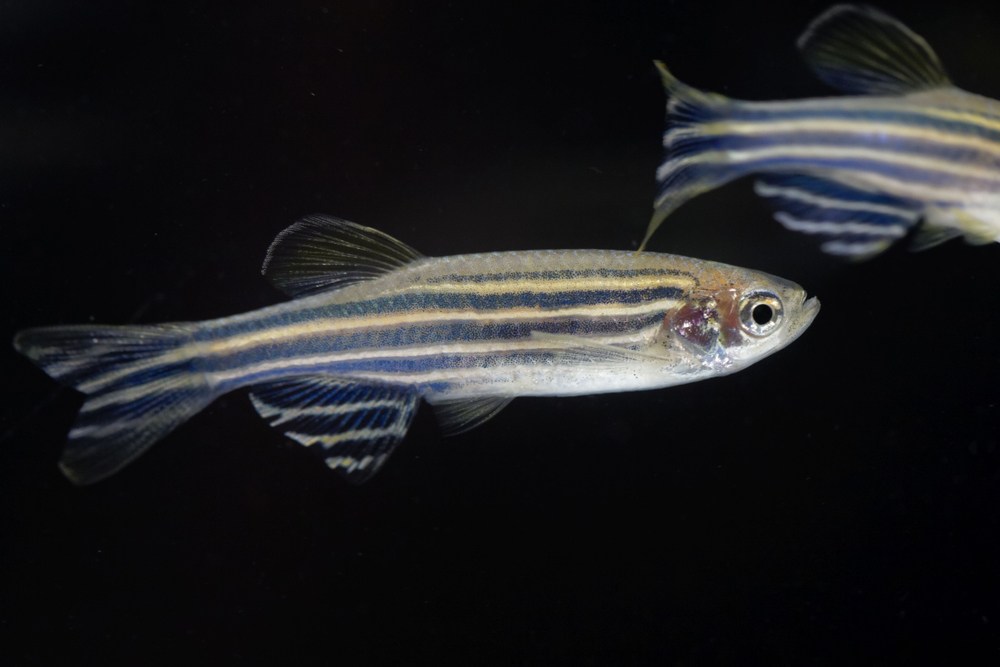
Zebrafish
ZebrafishArea of origin:The zebrafish originates from clear to slightly murky, shallow streams, rice fields and ponds in South Asia. High oxygen levels and moderate currents are among its natural conditions.Species:The zebrafish is a species within the genus Danio. Other related species:Danio kyathit (leopard danio)Danio choprae (Glowlight Danio)Devario aequipinnatus (giant barbel)The species frequently offered in pet shops includeZebrafish (Danio rerio - wild form)Veiled zebrafishGolden zebrafishLong-finned varietiesLeopard danio (Danio kyathit - often sold as a variant)Social behaviour:Very lively, peaceful schooling fish. Show pronounced group swimming. Play and chase each other playfully. Can become shy if kept too small. Ideal for community tanks with other mobile species.Keeping conditions:They like long, well-filtered aquariums bestLight current desiredOpen swimming zones + planted edge zonesNo strong temperature fluctuationsRobust and adaptable speciesBreeding:Relatively simple. Free spawners. Eggs are released via plants or spawning grids. Parents eat the spawn → separate breeding tanks necessary. The larvae hatch after 2-3 days. Fry need infusoria, later Artemia nauplii.Special features:Very robust and beginner-friendly. Lively and always on the move. Also tolerates cooler temperatures → ideal for unheated aquariums. Important model organism in research (but normal breeding lines in the pet trade)Conclusion:The zebrafish is a lively, uncomplicated schooling fish that enriches any community aquarium with its attractive stripes and socially active behaviour. With sufficient swimming space, good water quality and a larger group, it is particularly lively and harmonious.If you have any questions or problems, our trained team at Zoo Roco is at your disposal. They can provide you with expert advice on all matters.
 
Indian mudskippers (Periophthalmus novemradiatus)
Periophthalmus novemradiatus - The Indian mudskipperOrigin & habitatThe Indian mudskipper (Periophthalmus novemradiatus) originates from the coastal regions of South Asia, particularly India, Sri Lanka and Bangladesh. Its favourite habitat is mangrove forests, brackish water zones, muddy estuaries and intertidal zones. Here it finds ideal conditions to live between water and land.AppearanceThis unusual fish has an elongated, scale-covered body, which is usually grey-brownish in colour and can be covered with small, shimmering spots. Particularly striking are its protruding eyes, which sit high up on the head and can be moved independently of each other - a perfect adaptation to life outside the water. Males also have a more conspicuous dorsal fin, which they raise for courtship.SizePeriophthalmus novemradiatus is one of the smaller mudskipper species. Adults reach a length of around 6 to 10 centimetres.Life expectancyIn suitable husbandry or under natural conditions, an Indian mudskipper can live for around 3 to 5 years. Factors such as water quality, diet and habitat play an important role here.LifestyleThe Indian mudskipper is diurnal and semi-aquatic, which means that it spends most of its time out of the water. Thanks to its powerful pectoral fins, it can "jump" and move on wet mud. It uses both its gills and a special skin respiration system to breathe as long as the skin remains moist. Mudskippers are territorial and can be quite aggressive towards conspecifics.Unique characteristicsAmphibious lifestyle: One of the few fish that can actively move around on land.Eyes like a chameleon: Their eyes can rotate independently of one another – a great advantage for navigation and hunting prey.Jumping & Climbing: Despite their small size, they can jump surprisingly far and even climb roots or stones.Skin and mucous membrane respiration: Like amphibians, the mudskipper can also absorb oxygen through its moist skin and the mucous membranes in its mouth and throat. However, this epidermal respiration only works as long as the skin is well moistened – which is why the mudskipper relies on a humid environment or frequent periods in the water.Keeping in a paludariumA paludarium - a combination of aquarium and terrarium - is ideal for keeping the Indian mudskipper in a species-appropriate way. This should offer both a water area and sufficient land area with a moist, muddy or sandy substrate.SetupLand area: At least half of the paludarium should consist of dry, slightly damp sand on which the animals can walk and jump. Fine aquarium sand or a clay-sand mixture works well.Aquarium section: Shallow and warm (24–28°C), with slightly brackish water (salinity approx. 5–15 g/L), as the animals originate from brackish water zones.Hiding places & climbing opportunities: Roots, stones or mangrove roots provide shelter and climbing opportunities.Plants: Saltwater-tolerant plants or artificial alternatives can be used – a robust setup is important, as the fish dig.TidesA particularly natural paludarium offers a simulated ebb and flow of the tide. This can be controlled using pumps or a timer: At high tide, the water area fills slowly and provides access for swimming. At low tide, the water level drops and more land becomes accessible. This corresponds to the natural behaviour of the animals and significantly stimulates their activity.General conditionsLighting: Daylight simulation with UV components is recommended.Humidity: High, ideally between 70–90%.Cover: The paludarium should be well covered, as mudskippers are excellent climbers and can escape quickly.Created with ChatGPT – revised by Zoo Roco

CHF 1,000.00

Customers also saw

Swordtail
Swordtail profileArea of origin:Swordtails live in rivers, streams and slow-flowing waters in Central America. They often live in densely overgrown bank areas.Species:Mainly breeding forms of Xiphophorus helleri are offered in the pet trade. The species frequently offered in pet shops include (colour and fin variants)Red swordtailKoi swordtailTuxedo WagtailGreen swordtail (wild form)Highfin swordtailPineappleBlack MoscowMarigoldSocial behaviour:Swordtails are active and peaceful fish, but males can occasionally rival each other. In a well-structured aquarium, their behaviour is usually calm. They go well with many other peaceful species. Keeping conditions:A spacious, well-planted aquarium with free swimming space is important. Swordtails prefer harder water, a gentle current and regular water changes. A cover is also recommended - they can jump.Breeding:Swordtails are viviparous. Females give birth to 30-80 fry every 4-6 weeks. Fine plants are recommended as protection for the young, as the parents can eat their offspring. Breeding is very easy.Special features:Very robust and recommended species for beginners Males can "metamorphose" late - sometimes females develop a sword later Wide range of colours and varieties. Very reproductiveConclusion:The swordtail is an attractive, lively and uncomplicated aquarium fish that exhibits interesting social behaviour, especially in groups. Thanks to its robustness and easy breeding, it is ideal for community aquariums and also for beginners.If you have any questions or problems, our trained team at Zoo Roco is here to help. They can provide expert advice on all matters.
 
Lucky Reptile The Night Sky LED set - the light of the moon
The Night Sky LED set imitates the light of the moon and makes nocturnal observations of reptiles and amphibians possible, without disturbing the animals perfect for nighttime viewing crates confortable night ambience no distrubance for the animals low power consumption no heat developement extendable installation in terrarium ceiling widespread illumination of the vivarium PnP connetors for easy installation Advantages of the LED technology are low energy consumption, low heat emission and a long life of the light emitting diodes. Therefore, illuminating terrariums all night long is possible, without hindering the natural nocturnal drop of temperature as with other light sources. Especially nightlight incandescent lamps consume a lot of energy and consequently produce a lot of unwanted heat as well. In addition their ability to illuminate the terrarium properly and allow nighttime viewing is limited.The energy consumption of the LEDs in the Night Sky LED set is merely 0,2W per LED. This is the most energy efficient way to illuminate a terrarium at night. The Night Sky LED set contains 3 moonlight LEDs and an electric transformer, with which up to 6 LEDs can be powered. Additional LEDs are available separately. The LEDs are connected to the transformer by a connector, which makes them easy to install. Mounted on the ceiling of a terrarium, they enable a well-balanced nocturnal illumination of the whole terrarium.

CHF 39.90

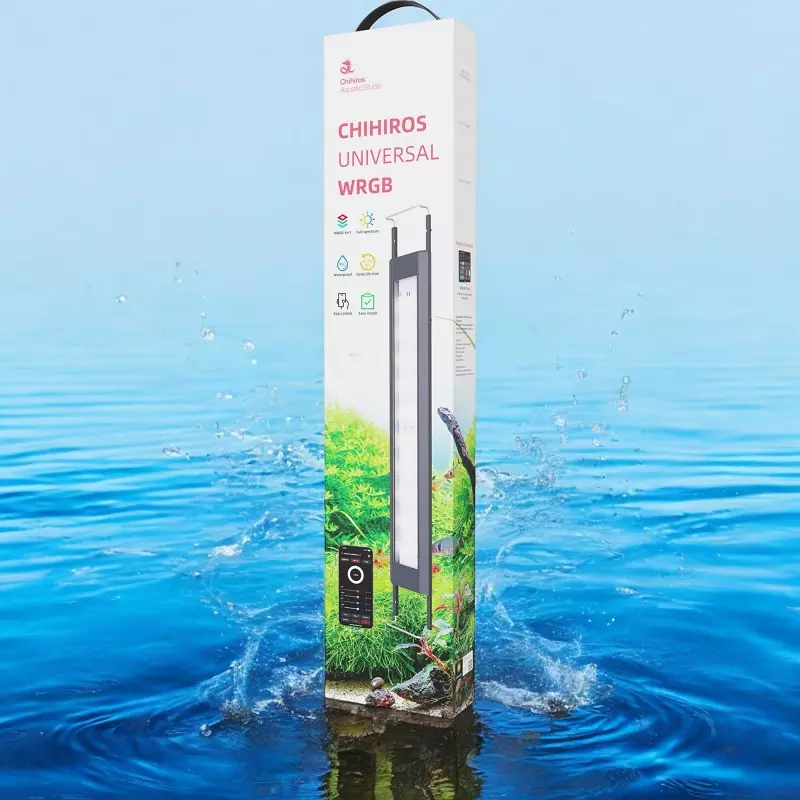
Chihiro's universal WRGB LED aquarium light
Chihiros Universal WRGB LED aquarium lightThe Chihiros Universal WRGB including controller is a state-of-the-art aquarium light that sets new standards in terms of versatility and performance: Key features: WRGB technology: Combines white LEDs with RGB color spectrum for optimal plant care and brilliant color display IP67 watertightness: Enables safe use in aquarium covers Flexible mounting system: Four different adapters and cable suspension included Slim Design: Elegant black lamp body blends in visually with any aquarium Expandable: Several lights can be connected to form a longer unit Adaptability: Eight sizes available: From 55 cm to 150 cm in length Compatible with popular aquarium brands such as Juwel, Eheim and Oase Adjustable holding pins allow individual length adjustment - 550, suitable for 50-60cm aquariums (28 watts / 2123 lumens)- 600, suitable for 55-65cm aquariums (29 watts / 2245 lumens)- 700, suitable for 65-75cm aquariums (33 watts / 2613 lumens)- 800, suitable for 75-85cm aquariums (36 watts / 2789 lumens)- 920, suitable for 87-97cm aquariums (55 watts / 3848 lumens)- 1000, suitable for 95-105cm aquariums (59 watts / 4246 lumens)- 1200, suitable for 115-125cm aquariums (91 watts / 6251 lumens)- 1500, suitable for 145-160cm aquariums (100 watts / 7358 lumens) Control system: Controller included for easy operation App control possible for advanced functions (color settings, schedules, etc.)Performance: High light output for optimum plant growth Adjustable color temperature and intensity The Chihiros Universal WRGB offers a professional lighting solution for aquarists who value quality, flexibility and excellent lighting conditions. Its versatile application options and expandable design make it suitable for a wide range of aquarium sizes and types.

From CHF 189.00

Eubranchipus grubii
Fairy shrimps (spring gillfoot) Fairy shrimps (spring gillfoot) are very common. Fairy shrimps are gilled crustaceans that have been found on our planet since prehistoric times in salt lakes, drying waters or polar waters.Only animals from Asia or America that live in a water temperature of 20-30°C are suitable for keeping in an aquarium. These species (Branchinella thailandensis and Dendrocephalus brasiliensis) live in waters that regularly dry out and are only filled with rainwater. The water is therefore very soft. Appearance The animals have 11 pairs of leaf feet. These leaf-shaped limbs serve not only for locomotion but also for breathing – which has led to the term "gilled-foot crustacean". There are sometimes minor differences in colour. They are found in colours ranging from orange to reddish-brown and may have greenish to bluish hues at the joints and at the boundaries of the segments.Both sexes have two short thread-like antennae. However, another pair of antennae differ in both shape and according to sex. Males have lobe-shaped appendages that can be curled up. Adult females are mainly distinguished by the ventrally located brood sacs, which are filled with eggs, and the ends of the female's tail are translucently light. Systematics Phylum: Arthropoda / ArthropodsSubphylum: Crustacea / CrustaceansClass: Anostraca – Gill-feetFamily: BranchipodidaeGenus: Branchipus / Eubranchipus /Tanymastix etc. Care Depending on the species, fairy shrimps live for 6-12 weeks and the size of adult animals varies from 1-3cm.Can Triops and fairy shrimps be kept together?yes, they can Aquarium size: Initially, a Faunarium box size 230 x 155 x 170 mm is quite sufficient From a body length of 1.5cm, they can be gradually accustomed to larger tanks Basic lighting: Sunlight or aquarium lighting is sufficientAeration: An air pump with a stone and very little air flow is sufficient for keepingSetup:Only water and breeding substrate in the breeding/starting container. A little fine aquarium sand can be used as substrate (but this is not absolutely necessary)Decorations can be used, but are only for our eyes and not of importance to the fairy shrimps.Fairy shrimps are free-swimmers – so they need enough free swimming space in the breeding container.If the animals swim around freely, you can also add a little aquarium moss to the water. To ensure the water is soft, it is best to use 2/3 distilled water and 1/3 mineral water (non-carbonated).Water temperature: Fluctuations in temperature of +/- 5° C are not dramatic.The ideal breeding temperature is 26°.Start:The larvae only hatch when they are completely surrounded by water. Therefore, place the eggs on adhesive tape and then put this in the water – so the eggs are not washed to the edge and always remain in contact with water.After 1-3 days the larvae hatch. The larvae grow quickly and can reach sexual maturity after up to 40 moults in one to two weeks. The males hold the females with their jaw pincers shortly before and also during mating. After mating, the eggs develop in the egg sacs on the females’ abdomens. They fall to the bottom of the water and can survive for several years of prolonged drought in the substrate.When the fairy shrimps have died, the water can be drained off and the substrate with the eggs left completely dry. The larvae can only hatch again if the eggs were completely dry.Once this is dried out, a new batch can be started.If no substrate is used, you can also siphon off the eggs with a thin hose. Let the water containing the eggs run through a fine net or a coffee filter – this way you can collect the eggs.Important: The animals do not tolerate large water changes. If fairy shrimps are to be moved to a larger home, it is best to place the animals together with the breeding water into the new home or tank and slowly fill up the container with conditioned tap water. Feeding The larvae are fed from the 3rd day after hatching.The larvae can be fed with algae powder or JBL Artemio fluid. For all animal husbandry: Children must be guided, supervised and monitored by their parents. Children must learn that an animal has its own needs and habits and they must respect this. Parents should be aware that they are responsible for the animal. For questions and problems our trained team at Zoo Roco is at your disposal. They can advise you professionally on all matters.