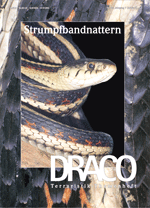
Draco 25 - Garter snakes

Article no: draco25

CHF 18.40

Stock: 0

Ready for dispatch in 1-3 days, delivery time 7 working days

Delivery between Tuesday, 12 May and Wednesday, 13 May
Zahlungsarten
Product information "Draco 25 - Garter snakes"

Draco 25 - Garter snakes

Contents:

  • 2 Editorial
  • 6 Overview of the genus Thamnophis
    Martin Hallmen & Daniel Grübner
  • 25 Old and new developments regarding the San Francisco garter snake (Thamnophis sirtalis tetrataenia)
    Martin Hallmen
  • 32 The most common garter snakes in the terrarium
    Daniel Grübner
  • 40 The garter snakes
    Jan Sonnenberg
  • 50 Aids for distinguishing some subspecies and colour forms of garter snakes
    Part 1: Thamnophis sirtalis sirtalis “flame” and
    Thamnophis sirtalis sirtalis “speckled flame”
    Martin Hallmen
    Part 2: The red subspecies of Thamnophis sirtalis
    Jan Sonnenberg
    Part 3: Thamnophis sirtalis similis and
    Thamnophis sirtalis sirtalis “Florida blue”
    Martin Hallmen
    Part 4: Distinguishing between Thamnophis proximus and
    Thamnophis sauritus and differentiation from
    Thamnophis radix and Thamnophis sirtalis sirtalis
    Jan Sonnenberg
  • 60 Garter snakes in science
    Jan Gebauer
  • 66 The less frequently recognised garter snakes
    Daniel Grübner
  • 77 Colour forms of garter snakes
    Daniel Grübner & Jan Sonnenberg
  • 86 Field observations of garter snakes in North America
    Herbert Bruchmann
  • 94 Common diseases in garter snakes
    Birgit Rüschoff, Bettina Christian & Daniel Grübner
  • 102 Garter snakes in outdoor terrariums
    Martin Hallmen
  • 114 10 years European Garter Snake Association
    Martin Hallmen
  • 116 Book box
  • 124 Magazine
Composition
Feeding recommendation
Technical details
Size information

0 of 0 reviews

Give us a rating!

Share your experience with the product with other customers.


Suggested products

Handbook of food plants for tortoises and other reptiles
Handbook of forage plants 2nd revised editionMarion Minch is not only a successful breeder of diverse tortoises for many years, but also an excellent connoisseur of native wild herbs. She founded and runs samenkiste.de, which is well known to many tortoise keepers and nature lovers. Her name is inextricably linked with reptile care and species-appropriate nutrition for tortoises. Her handbook of food plants summarises the most important native food plants for herbivorous and omnivorous reptiles. She not only considers tortoises, but also iguanas, spiny-tailed dragons and even chameleons. From the basics of plant biology to native wild herbs to suitable food plants for hardy tropical reptile species, this comprehensive work provides the basis for species-appropriate keeping. In the expanded and supplemented 2nd edition, the plant section is divided according to flower colour. This makes it even easier to identify wild herbs. The work has also been supplemented with a wealth of additional information and many pictures.

CHF 46.50

Geckos
Geckos in the terrarium by Astrid FalkThe book offers a comprehensive introduction to geckos and their species-appropriate keeping in terrariums. It explains what you need to think about before buying a gecko and what preparations should be made. The book describes in detail how the terrarium is technically equipped and set up. The care of the animals, their special features and behaviour, their diet, reproduction and rearing of young animals are described, as well as diseases and husbandry problems with tried and tested suggestions for prevention and treatment. Individual gecko species that are particularly suitable for keeping and breeding in terrariums are portrayed in detail in the second part of the book.

CHF 28.50

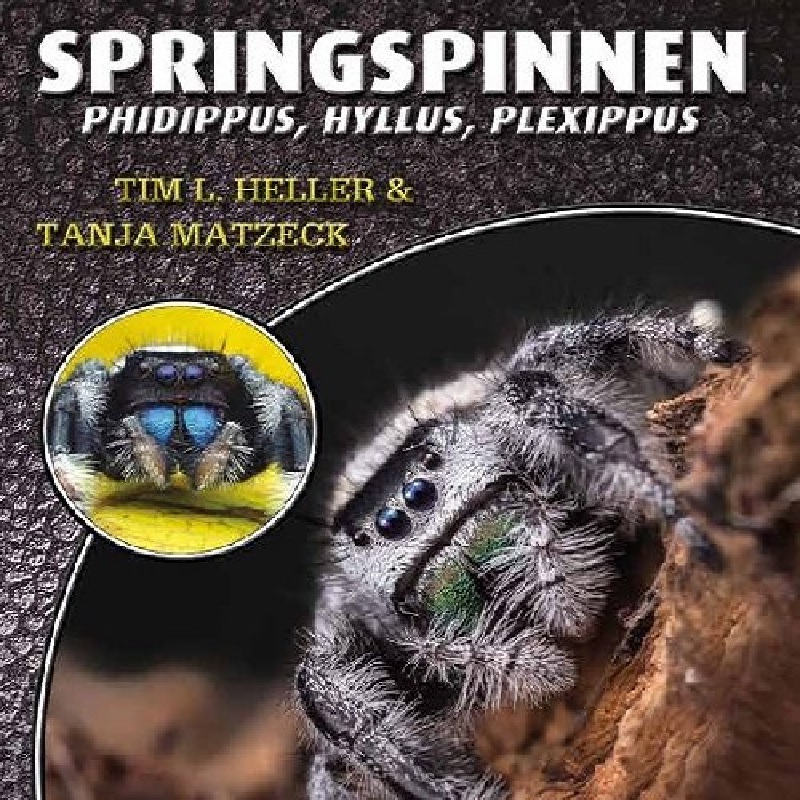
Jumping spiders Phidippus, Hyllus, Plexippus
Book Jumping Spiders - Phidippus, Hyllus & Plexippus A guide to keeping jumping spiders of the genera Phidippus, Hyllus & Plexippus. Who can resist the charm of jumping spiders? The childlike appearance of their expressive face simply leaves no one cold! In addition, their behavior is extremely exciting to observe, their colors are bright and their requirements for species-appropriate keeping are very easy to meet. No wonder these likeable jumpers are all the rage! This volume in the "Species by Species" series describes in detail what to look out for when buying and keeping them, introduces the most commonly kept species and color forms and provides plenty of tips on how to keep them successfully - so you can be sure they will breed well! Species by Species introduces you to the books in this series, which present the most popular terrarium animals. Each volume offers you detailed, practical care instructions and all the information you need to successfully breed your animals. All important questions from the required tank size to terrarium set-up, technical equipment, species-appropriate nutrition and disease prevention are answered with numerous tricks and tips. Experienced, long-standing breeders reveal how you can encourage the animals to reproduce and raise healthy young. All this in full color, generously illustrated and attractively designed - just about your terrarium animal - species by species

CHF 23.90

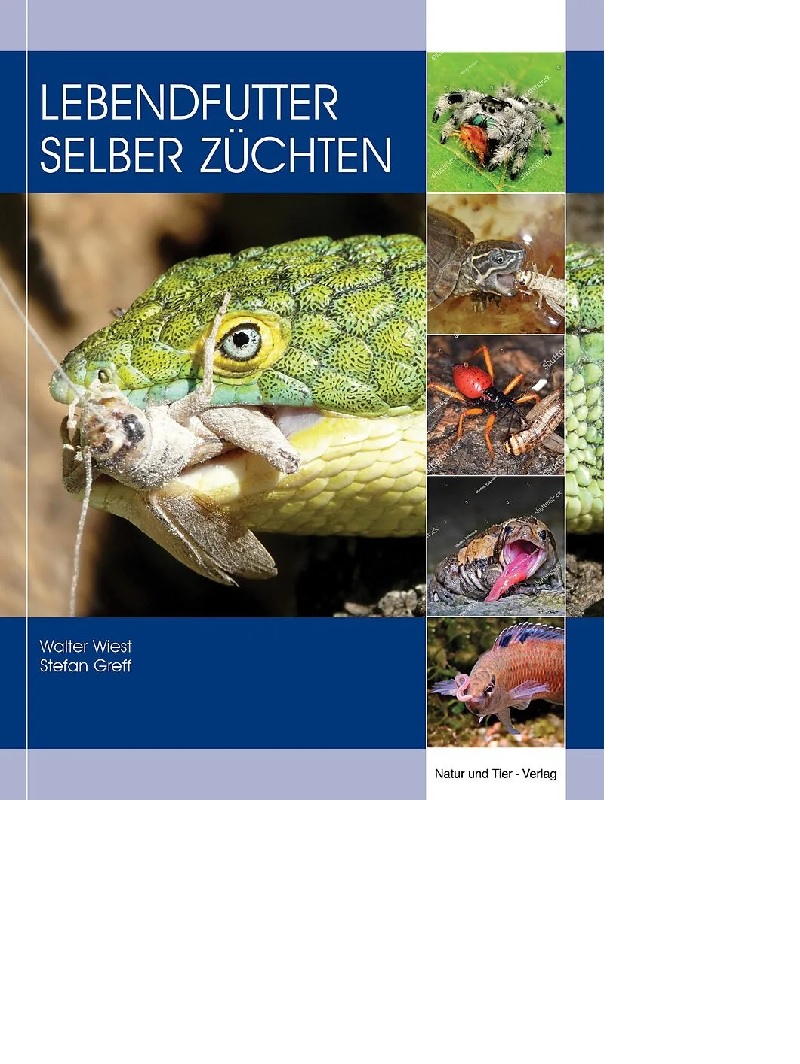
Book Breeding live food yourself
Book "Grow your own live food" - The perfect guide for pet owners Discover practical and detailed instructions on how you can easily breed food for your reptiles, birds, fish or other animals yourself in the book "Breeding live food yourself". With valuable tips on various food insects, their care and breeding, you can save money and ensure a species-appropriate diet for your pets. Contents of the book: Step-by-step instructions for breeding feeder insects Information on the best types of food for reptiles, birds and fish Care instructions and breeding conditions for various live food species Tips for sustainable and cost-effective food production Why breed your own live food? Get healthy, fresh food for your animals Save money and reduce dependence on pet shops Promote the health and well-being of your animals with species-appropriate food Whether you are a beginner or an experienced pet owner, this book provides you with everything you need to successfully breed live food yourself.

CHF 46.50

Marginata 69 - New Guinea tortoises
Marginata 69 - New Guinea tortoises – the genus ElseyaCover storyThe unrecognised beauties: New Guinea tortoises (Andreas S. Hennig)My experiences with Branderhorst's New Guinea tortoise, Elseya (Elseya) branderhorsti (Ouwens, 1914) (Andreas S. Hennig)Keeping and breeding of Rhodin's New Guinea tortoise, Elseya (Hanwarachelys) rhodini Thomson, Amepou, Anamiato & Georges, 2015 (Andreas S. Hennig)PortraitGeoemyda spengleri, Chinese serrated tortoise (Andreas S. Hennig)ReportageMacrochelys temminckii – Experiences and impressions with vulture tortoises part 2 (Reiner Praschag)KeepingAn alternative to year-round keeping of the Egyptian tortoise in the terrarium – my experiences with seasonal outdoor keeping of Testudo kleinmanni (Ricarda Schramm)EtymologySawbacks and living maps part 4: Graptemys gibbonsi, Pascagoula humpback tortoise (Holger Vetter)Classifieds & animal placement

CHF 16.50

Reptilia 13 - Scorpions
Reptilia 13 - ScorpionsZurich's giant tortoisesGreen tree pythonNamibiaContents:Page 2 - EditorialPage 3 - Letters to the editorPage 7 - MagazinePage 13 - DatesPage 16 - Western Herp Perspectives: Stock market stress for snakes, by B. LovePage 18 - Photo reportage: Scorpions, by I. CastellvíPage 24 - Report: Scorpions - Social predators? by D. MahsbergPage 29 - Keeping and breeding: Scorpions in the terrarium, by R. LippePage 34 - Comment: Scorpions - still waste products of the terrarium hobby, by H. SchiejokPage 35 - Report: Spanish scorpions, by I. CastellvíPage 39 - Travelogue: The herpetofauna of the Namib Desert, by M. GabrielPage 47 - Portrait and poster: Ophisaurus apodus, by B. TrappPage 52 - Keeping and breeding: Keeping and breeding Argentine large tejus Tupinambis merianae, by B. LangerwerfPage 57 - Care and Breeding: The Green Tree Python – a 'Juwel' in the terrarium, by P. SchuPage 62 - Report: Zurich's giant tortoises, by R. E. HoneggerPage 71 - Keeping and breeding: An ideal pet for the terrarium - Phyllobates Iugubris, the small leaf frog, by H. DivossenPage 74 - Report: Crocodiles and international species conservation policy - CITES and sustainable use, Part 2, by H. WerningPage 88 - Advice and actionPage 91 - LibraryPage 96 - Incubator: Bon Maman tells Godzilla, by H. Evers

CHF 9.80

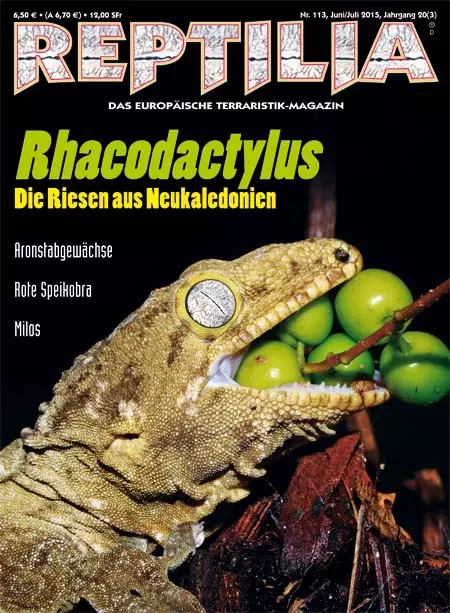
Reptilia 113 - Rhacodactylus, the giants from New Caledonia
Reptilia 113 - RhacodactylusThe giants of New Caledonia Arum familyRed spitting cobraMilos Cover story: Rhacodactylus, the giants of New Caledonia. EditorialMAGAZINEDATES Photo storyRhacodactylus – Diverse giants from New CaledoniaP. Schoenecker Keeping and breedingDark giants in the terrarium: keeping and breeding Rhacodactylus leachianus , the local form from Mont KoghisP. Schoenecker ReportageIn search of New Caledonian giant geckosC. Langner Keeping and breedingThe local variants of Rhacodactylus leachianus in terrarium keeping Part 1: Grande TerreS. Cemelli PlantsArum plants in the terrarium Part 1: Species diversity, biology and special featuresB. Akeret Keeping and breedingThe jewel of venomous snake keeping. The red spitting cobra, Naja pallida, as a pet in the terrariumO. S. Rudolphi ReportageQueensland's spiders and their venoms Part 2: The araneomorph spiders T. J. Hauke ALSO NEAR YOUService Animals of our homelandThe fire-bellied toadR. Leptien WESTERN HERP PERSPECTIVESWalk the boardsB. Love JourneyFeta cheese, sun and snakes. Welcome to Milos!A. Schmid PREVIEW BRUTKASTENChuckwalla anecdotes. Part 2H. Werning

CHF 12.00

Draco 49 - Outdoor facilities for turtles
Draco 49 - outdoor enclosures for tortoises Contents: Editorial A new home for tortoisesPeter Buchert Cold frame or greenhouse – the perfect shelter in a tortoise enclosureMichael Wirth Preparing to lay eggs: It's the mound that counts!Michael Wirth Always appropriate to size – the successful keeping and rearing of hatchlings and young animals in an outdoor terrariumMichael Wirth All for the sake of warmth – optimising tortoise enclosuresMichael Wirth The zoo moat – the invisible enclosure fencingMichael Wirth

CHF 18.40

Marginata 35 - Chinese three-legged turtle
Marginata 35 - Chinese three-legged turtleReintroduction of Testudo graeca in SpainBreeding the areolate flat tortoiseTurtle breeding at the Tennessee AquariumContents:EDITORIALMAGAZINEDATESPHOTOSTORYChinese three-keeled turtles (Mauremys [Chinemys] reevesii Gray, 1835)Hans - Dieter PhilippenREPORTAGEGlobal distribution of the Chinese three-keeled turtle (Mauremys [Chinemys] reevesii)Hans - Dieter PhilippenBREEDINGKeeping and breeding Chinese three-keeled turtles (Mauremys [Chinemys] reevesii Gray, 1831) on a slightly different scale – China’s turtle farmsTorsten Blanck, Ting Zhou, & Pi-Peng LiPORTRAITPinta Galápagos tortoise (Chelonoidis nigra abingdoni) – “Lonesome George”Hans - Dieter PhilippenBREEDINGRemarkable breeding successes in the Tennessee aquariumBill HughesREPORTAGEEvidence of viable populations of the Greek tortoise (Testudo graeca) establishing themselves outside their original range in the southof the iberian peninsulaJosé c. Báez, Jesús Duarte, M.A. Farfan & Raimundo RealBREEDINGExperiences with the husbandry and reproduction of the Areolate Flat-shelled Turtle (Homopus areolatus) under different conditions in Namibia and Switzerland. Part I: Husbandry and reproduction of the species in Namibia (Southern Africa)Alfred SchleicherREPORTAGEUnusual hatching of a Hermann’s tortoise (Testudo hermanni hermanni)Robert FröschBOOK TIPSMALL DISPLAYSSUBSCRIPTION & sERVIcEREGIONAL GUIDE

CHF 16.50

Terraria 48 - Herpeto Holiday Balearic Islands
Terraria 48 - Herpeto holiday Balearic IslandsBlack MambaForest skinkContents:TerritorialHerpetoramaCover storyHerpeto holiday Balearic Islands. Sun, beach and lizards on Mallorca, Ibiza & Co.Mike ZawadzkiIbiza - Sun, beach and lizardsMike ZawadzkiFormentera - Beyond timeMike ZawadzkiMenorca - Blown by the windMike ZawadzkiCabrera - Spain's little GalápagosMike ZawadzkiMallorca - The unrecognised islandMike ZawadzkiPanoramaIn search of mountain vipers (Monitvipera xanthina) in north-eastern Greece – Part 2Michael Wirth"Just Remember that Death is not the End". Taxidermy of reptilesJörg PetzoldWilly Wolterstorff. The "father of the newt" was born 150 years agoWolfgang BischoffResearchAmong researchers"Harmless" snake on the road or the discovery of a new pit viper in the HimalayasGernot VogelNew speciesThe relict-like leaf toad or the discovery of a new frog speciesMirko SoléSalamandraTerraristicsKeeping and breeding the Madagascar forest skink Amphiglossus macorcercusJochen MeyerSubscription & ServiceObservations of the black mamba, Dendroaspis polylepis, in the terrariumLudwig Trutnau & Alfred WallnerNature and species conservationField notesGreek vipersHans PichlerGrass frogs in VilsalpseeAxel KwetEasy help for the amphibian of the year, the yellow-bellied toadAndreas OchsenbeinAlso in your neighbourhoodPreviewIncubator The boys in the swampRolf Leptien

CHF 12.00

NTV - Discover the spiders
NTV, Discover the spiders 64 pages colour photos throughout Large format: 20.7 x 28 cm Hardcover Author Kriton Kunz Publisher NTV Contents: No other group of animals exhibits such diverse and fascinating behaviour as spiders. Their different hunting strategies and their exciting abilities arouse children's curiosity. "Discover the spiders" explains all the secrets of these extraordinary animals in a child-friendly, detailed and entertaining way and has lots of amazing things in store: Can spiders fly? Do spiders also walk on water, perhaps they even dive? What's the story behind the triangle spider's strange web, and why does the spitting spider spit on its prey? Children will find answers to all their questions in this book.A highly valuable educational book with a great fun factor! Welcome to the world of spiders! What kind of animals are spiders? The relatives of spiders Where you can find spiders everywhere Lots of spiders Which spiders are there? It's enough to make your skin crawl! The senses of spiders Bon appétit! How spiders hunt and eat Enemies of spiders Camouflage, warning and other tricks Venomous spiders Loners and communal creatures Can spiders communicate with each other? Reproduction What do spiders do in winter? Age and diseases Can spiders fly?EXTRA: Observe spiders Little spider quiz Thanks

CHF 19.90

Hard armour - soft heart
The turtle expert Thorsten Geier would like to inspire you as a turtle enthusiast to keep these special animals as close to nature as possible. Based on his almost 20 years of in-depth experience with European tortoises, he provides a wealth of practical advice and tips for practical use: using nature as a model, he explains that the animals should be spared a life in a terrarium. His guide contains over 180 pages of detailed suggestions for keeping animals close to nature. Thorsten Geier explains the design of outdoor enclosures and presents suitable and less suitable food plants. Other topics include: optimal nutrition, caring for hatchlings and young animals, winter torpor, animal health, successful reproduction, species protection, but also mistakes in keeping tortoises and much more. Over 200 photos of the animals' habitat, enclosure photos, plant pictures etc. make this book a particularly valuable read. In a separate chapter, the author addresses our youngest turtle friends. Thorsten Geier would like to encourage them (and their parents) in particular to treat turtles in a species-appropriate manner.

CHF 21.90