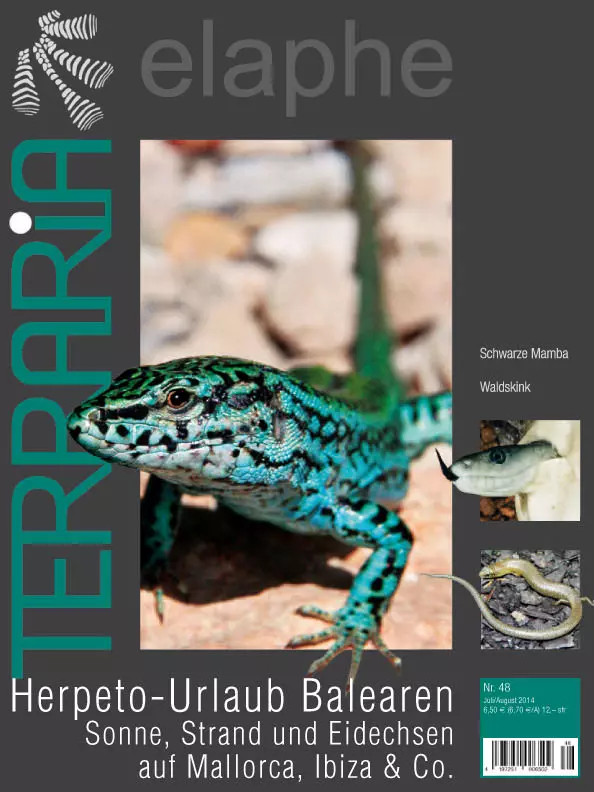
Terraria 48 - Herpeto Holiday Balearic Islands

Article no: terraria48

CHF 12.00

Stock: 0

Ready for dispatch in 1-3 days, delivery time 7 working days

Delivery between Tuesday, 12 May and Wednesday, 13 May
Zahlungsarten
Product information "Terraria 48 - Herpeto Holiday Balearic Islands"

Terraria 48 - Herpeto holiday Balearic Islands

Black Mamba
Forest skink

Contents:

Territorial
Herpetorama

Cover story
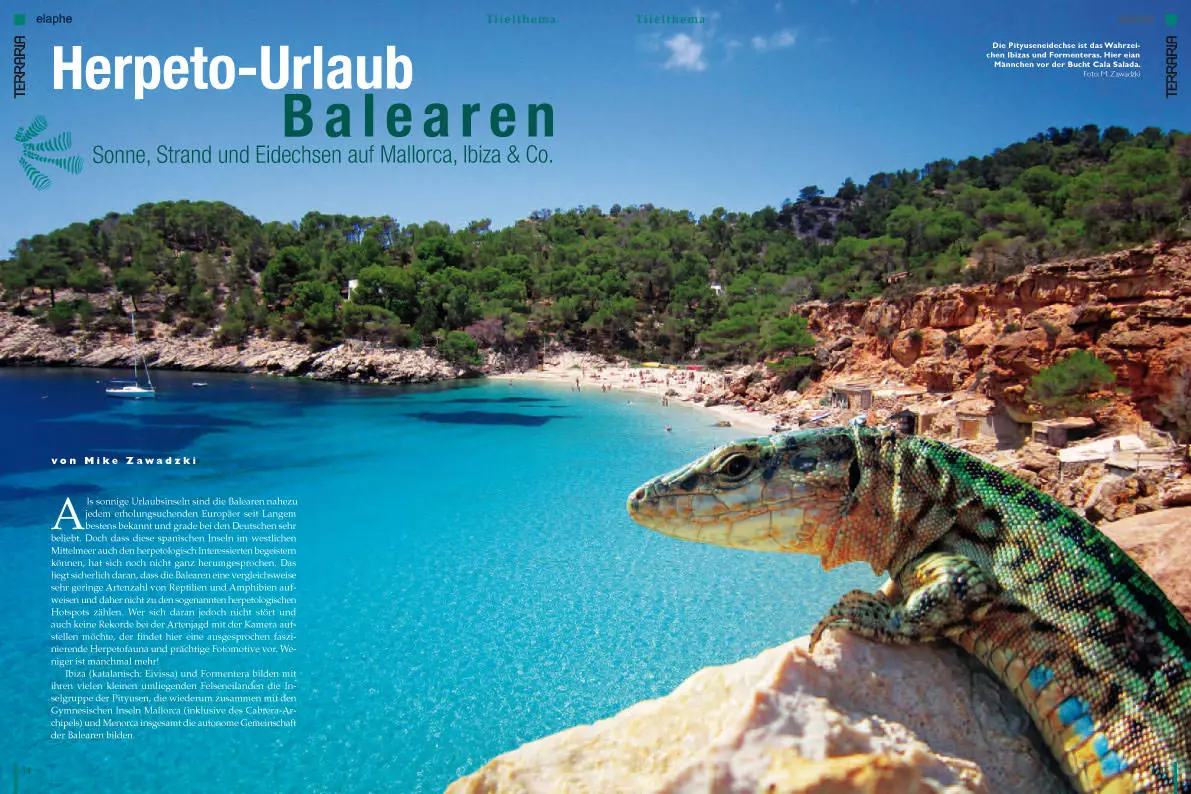
Herpeto holiday Balearic Islands. Sun, beach and lizards on Mallorca, Ibiza & Co.
Mike Zawadzki

Ibiza - Sun, beach and lizards
Mike Zawadzki

Formentera - Beyond time
Mike Zawadzki

Menorca - Blown by the wind
Mike Zawadzki

Cabrera - Spain's little Galápagos
Mike Zawadzki

Mallorca - The unrecognised island
Mike Zawadzki

Panorama
In search of mountain vipers (Monitvipera xanthina) in north-eastern Greece – Part 2
Michael Wirth

"Just Remember that Death is not the End". Taxidermy of reptiles
Jörg Petzold

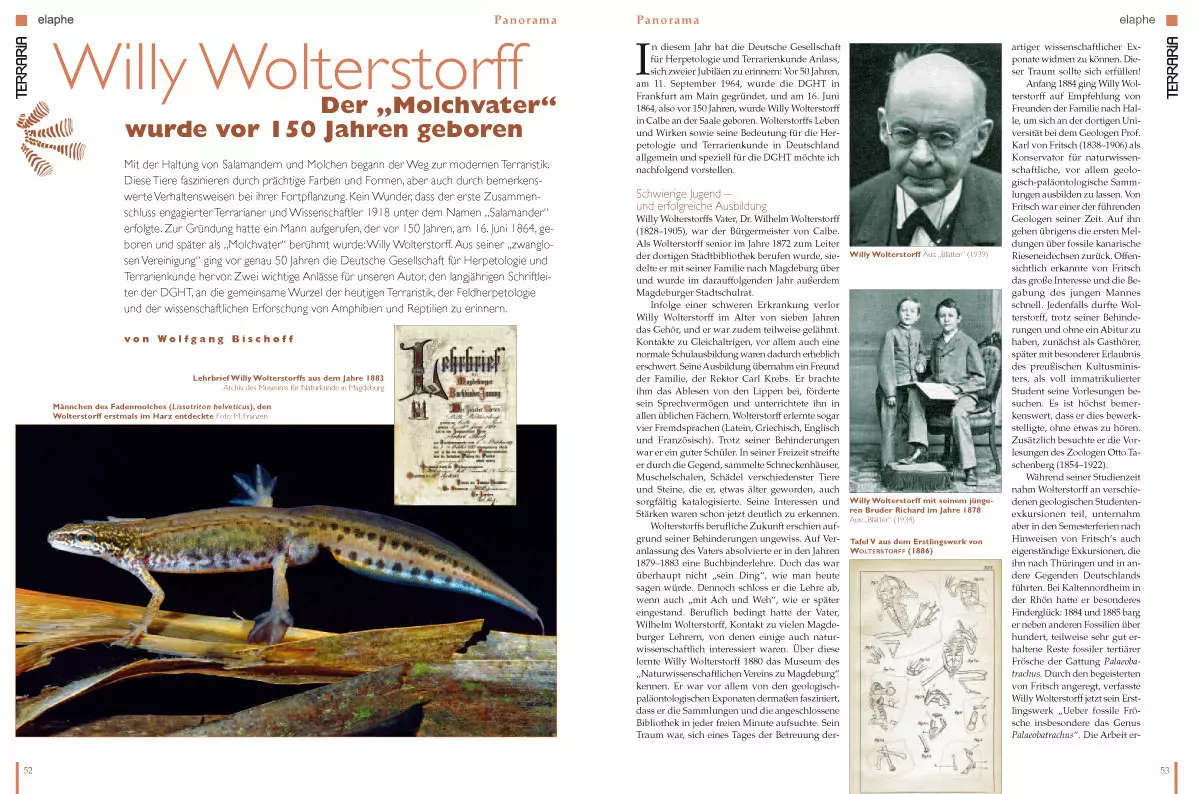
Willy Wolterstorff. The "father of the newt" was born 150 years ago
Wolfgang Bischoff

Research

Among researchers
"Harmless" snake on the road or the discovery of a new pit viper in the Himalayas
Gernot Vogel

New species
The relict-like leaf toad or the discovery of a new frog species
Mirko Solé

Salamandra

Terraristics
Keeping and breeding the Madagascar forest skink Amphiglossus macorcercus
Jochen Meyer

Subscription & Service

Observations of the black mamba, Dendroaspis polylepis, in the terrarium
Ludwig Trutnau & Alfred Wallner

Nature and species conservation

Field notes
Greek vipers
Hans Pichler

Grass frogs in Vilsalpsee
Axel Kwet

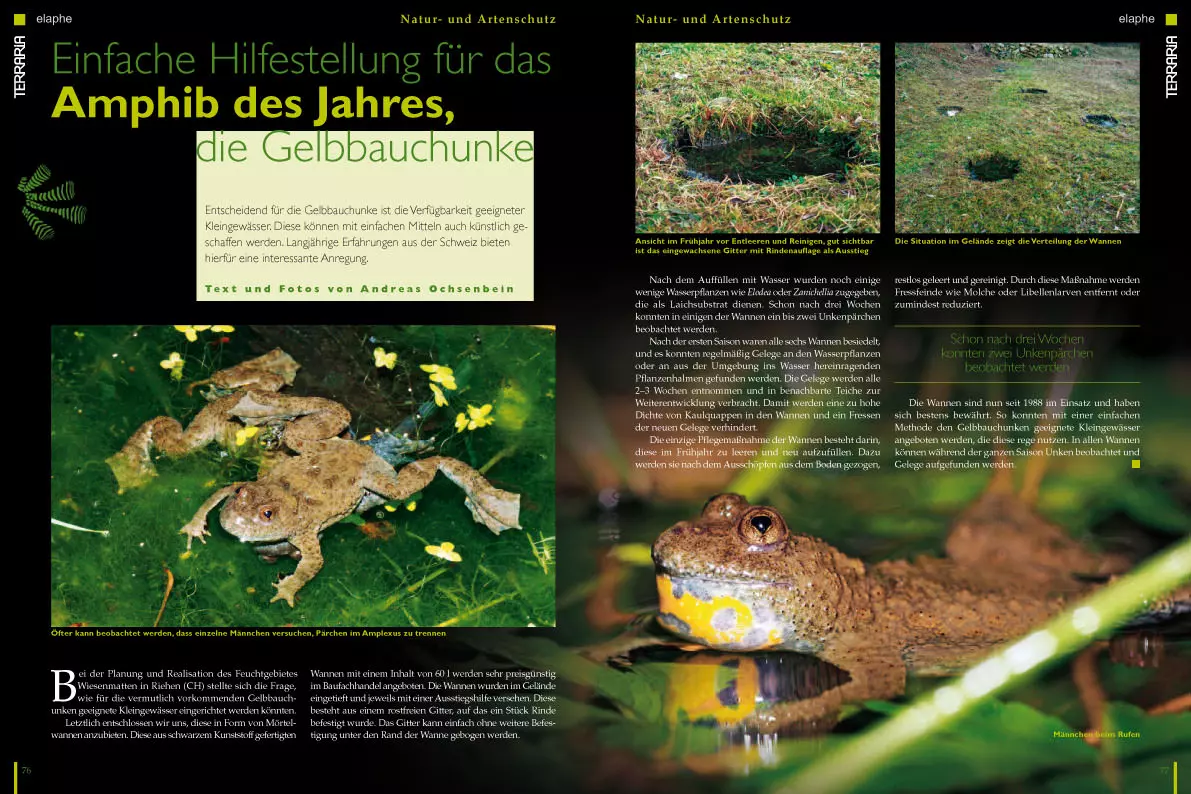
Easy help for the amphibian of the year, the yellow-bellied toad
Andreas Ochsenbein

Also in your neighbourhood
Preview

Incubator
The boys in the swamp
Rolf Leptien

Composition
Feeding recommendation
Technical details
Size information

0 of 0 reviews

Give us a rating!

Share your experience with the product with other customers.


Suggested products

Handbook of food plants for tortoises and other reptiles
Handbook of forage plants 2nd revised editionMarion Minch is not only a successful breeder of diverse tortoises for many years, but also an excellent connoisseur of native wild herbs. She founded and runs samenkiste.de, which is well known to many tortoise keepers and nature lovers. Her name is inextricably linked with reptile care and species-appropriate nutrition for tortoises. Her handbook of food plants summarises the most important native food plants for herbivorous and omnivorous reptiles. She not only considers tortoises, but also iguanas, spiny-tailed dragons and even chameleons. From the basics of plant biology to native wild herbs to suitable food plants for hardy tropical reptile species, this comprehensive work provides the basis for species-appropriate keeping. In the expanded and supplemented 2nd edition, the plant section is divided according to flower colour. This makes it even easier to identify wild herbs. The work has also been supplemented with a wealth of additional information and many pictures.

CHF 46.50

Geckos
Geckos in the terrarium by Astrid FalkThe book offers a comprehensive introduction to geckos and their species-appropriate keeping in terrariums. It explains what you need to think about before buying a gecko and what preparations should be made. The book describes in detail how the terrarium is technically equipped and set up. The care of the animals, their special features and behaviour, their diet, reproduction and rearing of young animals are described, as well as diseases and husbandry problems with tried and tested suggestions for prevention and treatment. Individual gecko species that are particularly suitable for keeping and breeding in terrariums are portrayed in detail in the second part of the book.

CHF 28.50

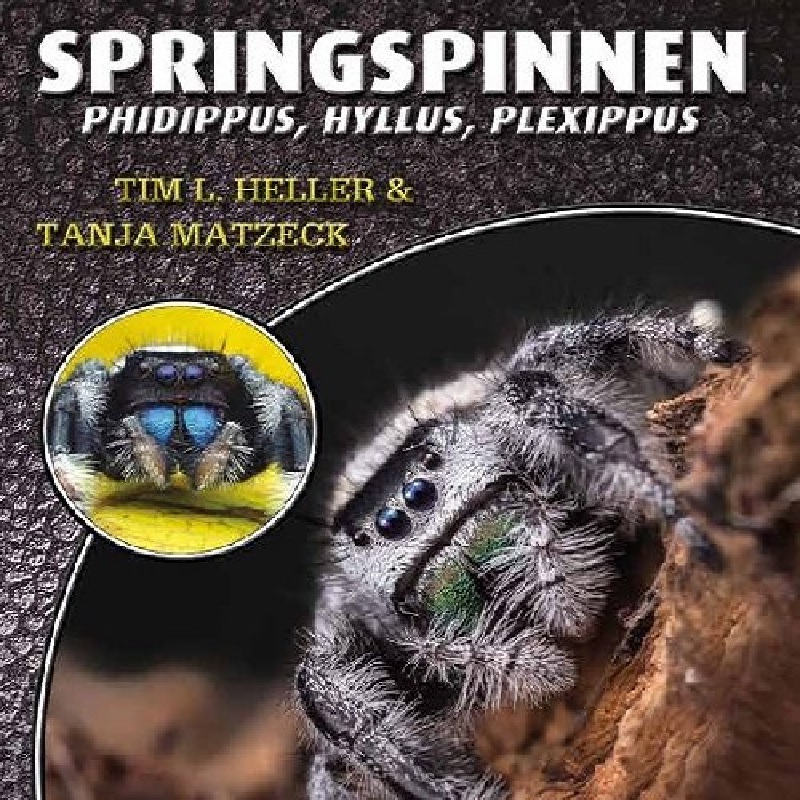
Jumping spiders Phidippus, Hyllus, Plexippus
Book Jumping Spiders - Phidippus, Hyllus & Plexippus A guide to keeping jumping spiders of the genera Phidippus, Hyllus & Plexippus. Who can resist the charm of jumping spiders? The childlike appearance of their expressive face simply leaves no one cold! In addition, their behavior is extremely exciting to observe, their colors are bright and their requirements for species-appropriate keeping are very easy to meet. No wonder these likeable jumpers are all the rage! This volume in the "Species by Species" series describes in detail what to look out for when buying and keeping them, introduces the most commonly kept species and color forms and provides plenty of tips on how to keep them successfully - so you can be sure they will breed well! Species by Species introduces you to the books in this series, which present the most popular terrarium animals. Each volume offers you detailed, practical care instructions and all the information you need to successfully breed your animals. All important questions from the required tank size to terrarium set-up, technical equipment, species-appropriate nutrition and disease prevention are answered with numerous tricks and tips. Experienced, long-standing breeders reveal how you can encourage the animals to reproduce and raise healthy young. All this in full color, generously illustrated and attractively designed - just about your terrarium animal - species by species

CHF 23.90

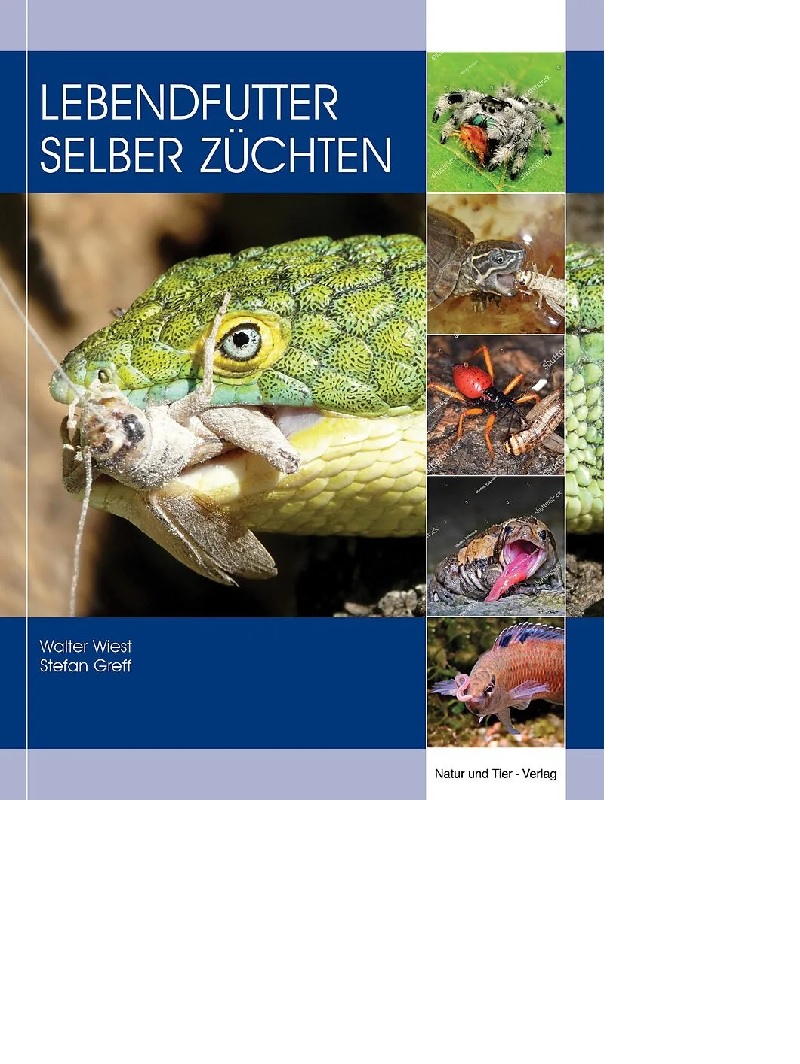
Book Breeding live food yourself
Book "Grow your own live food" - The perfect guide for pet owners Discover practical and detailed instructions on how you can easily breed food for your reptiles, birds, fish or other animals yourself in the book "Breeding live food yourself". With valuable tips on various food insects, their care and breeding, you can save money and ensure a species-appropriate diet for your pets. Contents of the book: Step-by-step instructions for breeding feeder insects Information on the best types of food for reptiles, birds and fish Care instructions and breeding conditions for various live food species Tips for sustainable and cost-effective food production Why breed your own live food? Get healthy, fresh food for your animals Save money and reduce dependence on pet shops Promote the health and well-being of your animals with species-appropriate food Whether you are a beginner or an experienced pet owner, this book provides you with everything you need to successfully breed live food yourself.

CHF 46.50

Marginata 69 - New Guinea tortoises
Marginata 69 - New Guinea tortoises – the genus ElseyaCover storyThe unrecognised beauties: New Guinea tortoises (Andreas S. Hennig)My experiences with Branderhorst's New Guinea tortoise, Elseya (Elseya) branderhorsti (Ouwens, 1914) (Andreas S. Hennig)Keeping and breeding of Rhodin's New Guinea tortoise, Elseya (Hanwarachelys) rhodini Thomson, Amepou, Anamiato & Georges, 2015 (Andreas S. Hennig)PortraitGeoemyda spengleri, Chinese serrated tortoise (Andreas S. Hennig)ReportageMacrochelys temminckii – Experiences and impressions with vulture tortoises part 2 (Reiner Praschag)KeepingAn alternative to year-round keeping of the Egyptian tortoise in the terrarium – my experiences with seasonal outdoor keeping of Testudo kleinmanni (Ricarda Schramm)EtymologySawbacks and living maps part 4: Graptemys gibbonsi, Pascagoula humpback tortoise (Holger Vetter)Classifieds & animal placement

CHF 16.50

Reptilia 124 - North American poisonous snakes
Reptilia 124 - North American venomous snakes Contents:Cover story: North American venomous snakesRattlesnakes fascinate every reptile lover! But North America is also home to other interesting venomous snakes, from the coral viper to the water moccasin snake. We offer an overview of the North American venomous snake fauna and then take an in-depth look at the rattlesnakes of the USA and the “cottonmouth” in the wild and in the terrarium. Spectacular new pictures by our photographer Bill Love included. Editorial   Farewell words Something of mine remains here L. Hogeback   MAGAZINE DATES   WESTERN HERP PERSPECTIVES The return to Australia B. Love   PHOTOSTORY The rattlesnakes of the USA in nature and terrarium L. Spinner   KEEPING AND BREEDING On the lookout: Water moccasin snakes in the wild and in the terrarium L. Spinner   TERRARIUM PLANTS The beach almond. Versatile use for small reptiles B. Röll   ALSO NEAR YOU   KEEPING AND BREEDING Jewels in the garden. The Western Green Lizard (Lacerta bilineata) in an outdoor terrarium C. Malberg & A. Schäberle   SERVICE   Journey Terribilis trip to Colombia. Excursion to a country in upheaval B. Encke, Frogs & Friends   PREVIEW   INCUBATOR  Three bright colours H. Werning

CHF 13.50

Marginata 03 - Endangered tortoises
Marginata 03 - Endangered tortoises Three-striped roofed turtleCoahuila box turtle Contents: 2 EDITORIAL 3 READER LETTERS 4 MAGAZINE 7 DATES 9 PHOTO REPORTAGEEndangered tortoisesHans - Dieter Philippen 13 REPORTAGEIn search of mates for "Lonesome George" – Results of the Pinta Expedition 2003Peter C. H. Pritchard 21 REPORTAGESouth Africa – attempt to conserve one third of the world's known tortoisesMargaretha D. Hofmeyr and Brian T. Henen 31 PORTRAITMadagascan beaked tortoiseAstrochelys yniphora (VAILLANT, 1885)Hans - Dieter Philippen 36 REPORTAGEThe Seychelles giant tortoisesA contribution to nature conservation and species preservationJustin Gerlach 44 REPORTAGEThe species conservation project for the three-striped roofed turtle (Kachuga trivittata) at Mandalay ZooGerald Kuchling and U Twint Lwin 52 REPORTAGEKeeping and breeding the Coahuila box turtle Terrapene coahuila SCHMIDT & OWENS, 1944)Part 1 Markus Baur & Irmtraud Jasser-Häger 60 BOOK TIP 61 CLASSIFIEDS 62 REGIONAL GUIDE 64 AGATHA MARGINATA

CHF 14.70

Terraria 19 - Diseases of tarantulas
Terraria 19 - Diseases of Tarantulas Northern Pine SnakeExpedition Tanzania Contents: While reptiles and amphibians have long been professionally treated by specialised veterinarians,unfortunately, there is still much to be done for invertebrate terrarium guests. However, our knowledge of these animals is gradually increasing. In this TERRARIA, expert Frank Schneider impressively summarises the current state of knowledge about diseases and parasites of tarantulas and offers approaches for treatment options.2Editorial   4Magazine Snake mites in reptiles: predatory mites as a biological control method/ Remarks on Pipa snethlegeae in French Guiana/Another wall lizard population threatened by a construction project/ "Benefiz-Terraristika" a great success/Vivarium Karlsruhe – "Climate and Habitats"/Phoresy in pseudo- scorpions in Baltic amber/ Legal 16TERRAglobal I, the Crocodile Hunter Joachim Bulian The snake with the mighty "Embrace" Fabio Cupul 20Diseases and parasites of tarantulas Frank Schneider 41On the keeping and breeding of the turnip-tailed viper gecko (Hemidactylus imbricatus or Teratolepis fasciata) in the terrarium Martin Dieckmann 50The Canary Island Mediterranean tree frog (Hyla meridionalis): Distribution, keeping and reproduction Manfred Rogner 54The Northern Pine Snake (Pituophis melanoleucus melanoleucus) In nature and terrarium. Part 1 Bernd Skubowius 61Travel "Exo Terra" Expedition Tanzania 2008 Part 1: In the realm of the turquoise blue dwarf day gecko (Lygodactylus williamsi) Roland Zobel 72New species New from Table Mountain: two dwarf tegus and a "miniature dragon" toadlet Axel Kwet 75Among researchers Amphibians and reptiles above the clouds – the decoding of species diversity in a forgotten world Philippe Kok 81Test run Heating mats Kriton Kunz 84 Near you 86Showcase In the Swiss cellar – A visit to Beat Akeret Heiko Werning 91 Subscription & Service 94Preview 96Incubator The "Rock Helga" – A Morocco adventure in two parts. Part 1 Mike Zawadzki

CHF 12.00

Reptilia 71 - Terrariums for poison dart frogs
Reptilia 71 - Terrariums for poison dart frogsAngola pythonPhilippine monitor lizard MabitangAquatic turtles for beginnersContents: 2 EDITORIAL 3 READER LETTERS 6 MAGAZINE 14 DATES 16 WESTERN HERP PERSPECTIVESNew equipment for "herping"From B. Love 18 PHOTO REPORTAGEPoison dart frog terrariums - Treasure chests for the Juwel of the rainforestBy H. Werning 26 PRACTICEA terrarium for poison dart frogs in 25 stepsBy H. Werning 36 REPORTAGEFrogs, frogs, frogsAt home with the poison dart frog breeders Renate and Bernd PieperBy M. Schmidt & H. Werning 42 TRAVELRanario Cahuita Costa RicaBy M. Haberkern 51 PORTRAIT AND POSTERTestudo hermanni hermanniBy M. Wirth 56 HERPETOFAUNANorth Carolina's Blue Ridge Mountains - The Salamander Capital of the WorldBy H.-J. Luef 63 KEEPING AND REPRODUCTIONPython anchietaeKeeping and breeding the Angolan pythonBy M. Borer 67 HERPETOFAUNAThe Mabitang (Varanus mabitang), a fruit-eating large monitor lizard from the PhilippinesBy M. Gaulke & A. D. Demegillo 75 HERPETOFAUNASkinks in the Usambara Mountains in north-east TanzaniaBy W. & Y. Lantermann 78 REPORTAGEMake two out of one - converting an outdoor terrarium for snakesPart 2: A unique experience among snakesBy M. Hallmen 87 FAQ - FREQUENTLY ASKED QUESTIONSAquatic turtlesBy A. S. Hennig 92 LIBRARY 104 BRUTKASTENZoo Director - Part 2By H. Werning

CHF 12.00

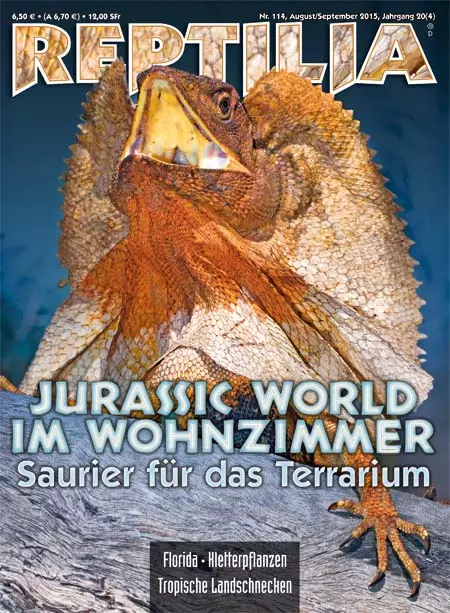
Reptilia 114 - Jurassic World in the living room, dinosaur for the terrarium
Reptilia 114 - Jurassic World in the living room, dinosaurs for the terrarium Florida climbing plantsTropical land snailsContents:Cover story: Jurassic World in the living room – dinosaurs for the terrarium“Jurassic World” is this summer’s blockbuster. Hardly anyone can escape the fascination of dinosaurs. And our modern-day prehistoric creatures quickly catch the eye. Many lizards actually look like real dinosaurs in miniature. They enchant with their prehistoric charm and make many people want to keep such a miniature dinosaur at home. And the best thing is: with many species, this is very possible! We present the best “dinosaurs” for the terrarium. And, of course, we take a closer look at “Jurassic World” and talk to a palaeontologist about the chances of us actually being able to see real dinosaurs one day – and whether they would even look like they do in the cinema. EditorialMagazineDates Western Herp PerspectivesThe end of the golden age for terrariumsB. LovePhoto story The return of the prehistoric lizardsH. Werning Keeping and breedingJurassic World in the living room. Mini dinosaurs for the terrariumH. Werning Film reviewJurassic World – The park is openH. Werning InterviewJurassic World – Questions about the filmA. Kwet in conversation with R. Schoch Keeping and breedingThe Green Water Dragon (Physignathus cocincinus) in the terrariumM. Rogner PlantsArum plants in the terrarium Part 2: Climbing araceaeB. Akeret Keeping and breedingThe local variants of Rhacodactylus leachianus in terrarium keeping Part 2: The island formsS. Cemelli & F. Fast ReportageSlowing down through the rainforestM. Gaulke Animals of our homelandThe pond frogR. Leptien LibraryAlso in your neighbourhoodService JourneyA round trip through Sri LankaV. Harport Preview Incubator The holiday jobA. “Spider” Krenzke

CHF 12.00

Reptilia 144 - American Earth Turtles
Reptilia 144- American tortoises Photo storyAmerican tortoises of the genus Rhinoclemmys – from disposables to unicornsBy S. Ettmar REPORTAGEThe American tortoises of ColombiaBy J. Cañas-Orozco Keeping and breedingKeeping and breeding the Guerrero tortoise, Rhinoclemmys pulcherrima pulcherrimaBy C. Godart Keeping and breedingKeeping and breeding the tiger snake (Rhabdophis tigrinus)By A. Walter Keeping and breedingJewellery, supermodel, delicacy: the milkweed bugBy K. Kunz Keeping and breedingThe fascination of sail lizards – keeping and comparing different species of the genus Hydrosaurus Part 2By O. Fischer SERVICEALSO NEAR YOU         JourneyWe're staying at home! Herping in the Corona summer 2020By B. Trapp PREVIEW BRUTKASTEN And it made zoomBy H. Werning  

CHF 13.50

Terraria 51 - Amphibian crisis
Terraria 51 - Amphibian crisis ChacoMoroccan day gecko Contents: Cover story: Amphibian crisis The global amphibian crisis is threatening frogs all over the world, and we may be facing a dramatic extinction of species. One glimmer of hope is the so-called amphibian ark, the targeted breeding of particularly endangered species in human care. In the cover story of the next issue of TERRARIA/elaphe, we look at various methods used by zoos, scientific institutions and private keepers to successfully breed frogs in the long term. Territorial Herpetorama Cover story Tailed amphibians in danger a “salamander-eating fungus” spreads in EuropeAxel Kwet Questions about the Salamander EaterInterview with Prof. Frank Pasmans, with questions from Axel Kwet Species conservation and captive breeding of amphibians a new approach to keeping cave-dwelling paddle-footed frogs using Rhacophorus orloviMikhail F. Bagaturov, Anna A. Bagaturova & Rustam K. Berdiev PanoramaImpressions of the herpetofauna in the Chaco of ParaguayStephan Böhm The ruin lizards (Podarcis siculus tyrrhenicus) of the island of GiannutriJürgen Gebhart Research New speciesNew keel-tailed iguanas of the genus TropidurusAxel Kwet Newly described: three Japanese angle-toothed newts from KyushuAxel Kwet Among researchersField study on the Cypriot Levantine viper (Macrovipera lebetina lebetina)Daniel Jestrzemski An observation on ophiophagy in the puff adder (Bitis arietans)Tobias Machts Salamandra TerraristicsThe day gecko of south-western Morocco Quedenfeldtia moerens (Chabanaud, 1916)Uwe Schlüter Also in your neighbourhood Nature and species conservation Field notesFrost effect on the spawn of the grass frogRudolf Malkmus Hail damage to amphibians?Axel Kwet Strange toad observations on the island of SyltWolf-Rüdiger Grosse Subscription & Service GalleryThe Thesaurus of Albertus Seba. Old treasures in the Berlin Museum of Natural HistoryAxel Kwet, Rainer Günther & Aaron Bauer Preview Incubator Smoke detectorRolf Leptien

CHF 12.00