NTV - Discover the spiders

Article no: CZ-AB11019

CHF 19.90

Stock: 0

Ready for dispatch in 1-3 days, delivery time 14 working days

Delivery between Tuesday, 19 May and Wednesday, 20 May
Zahlungsarten
Product information "NTV - Discover the spiders"

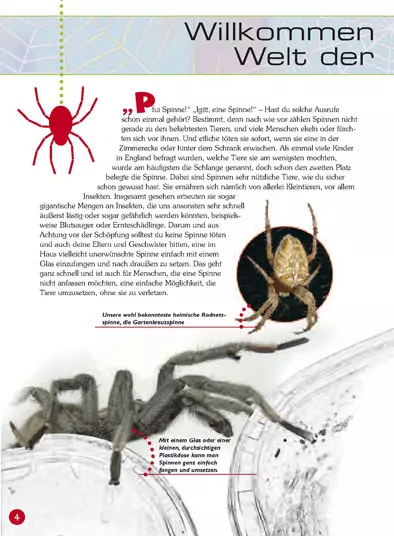
NTV, Discover the spiders

  • 64 pages
  • colour photos throughout
  • Large format: 20.7 x 28 cm
  • Hardcover
  • Author Kriton Kunz
  • Publisher NTV

Contents:

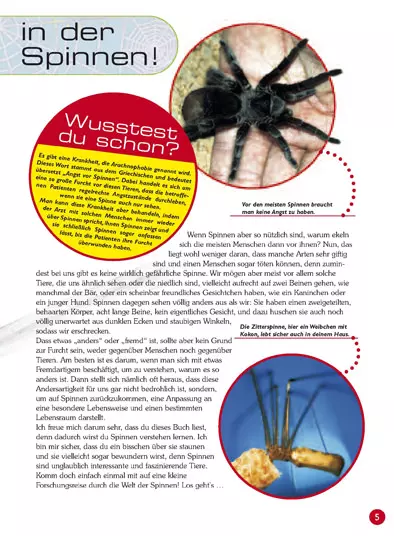
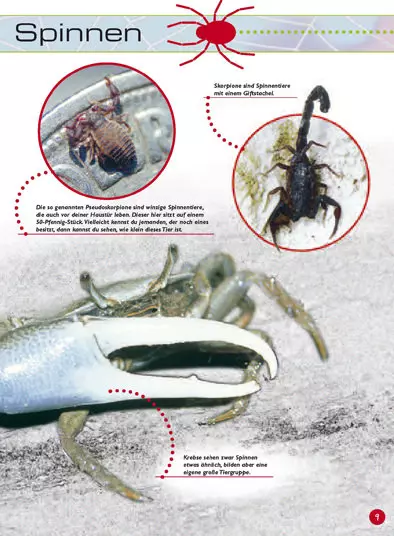
No other group of animals exhibits such diverse and fascinating behaviour as spiders. Their different hunting strategies and their exciting abilities arouse children's curiosity. "Discover the spiders" explains all the secrets of these extraordinary animals in a child-friendly, detailed and entertaining way and has lots of amazing things in store: Can spiders fly? Do spiders also walk on water, perhaps they even dive? What's the story behind the triangle spider's strange web, and why does the spitting spider spit on its prey? Children will find answers to all their questions in this book.
A highly valuable educational book with a great fun factor!

  • Welcome to the world of spiders!
  • What kind of animals are spiders?
  • The relatives of spiders
  • Where you can find spiders everywhere
  • Lots of spiders
  • Which spiders are there?
  • It's enough to make your skin crawl!
  • The senses of spiders
  • Bon appétit! How spiders hunt and eat
  • Enemies of spiders
  • Camouflage, warning and other tricks
  • Venomous spiders
  • Loners and communal creatures
  • Can spiders communicate with each other?
  • Reproduction
  • What do spiders do in winter?
  • Age and diseases
  • Can spiders fly?
    EXTRA:
  • Observe spiders
  • Little spider quiz
  • Thanks
Composition
Feeding recommendation
Technical details
Size information

0 of 0 reviews

Give us a rating!

Share your experience with the product with other customers.


Suggested products

Handbook of food plants for tortoises and other reptiles
Handbook of forage plants 2nd revised editionMarion Minch is not only a successful breeder of diverse tortoises for many years, but also an excellent connoisseur of native wild herbs. She founded and runs samenkiste.de, which is well known to many tortoise keepers and nature lovers. Her name is inextricably linked with reptile care and species-appropriate nutrition for tortoises. Her handbook of food plants summarises the most important native food plants for herbivorous and omnivorous reptiles. She not only considers tortoises, but also iguanas, spiny-tailed dragons and even chameleons. From the basics of plant biology to native wild herbs to suitable food plants for hardy tropical reptile species, this comprehensive work provides the basis for species-appropriate keeping. In the expanded and supplemented 2nd edition, the plant section is divided according to flower colour. This makes it even easier to identify wild herbs. The work has also been supplemented with a wealth of additional information and many pictures.

CHF 46.50

Geckos
Geckos in the terrarium by Astrid FalkThe book offers a comprehensive introduction to geckos and their species-appropriate keeping in terrariums. It explains what you need to think about before buying a gecko and what preparations should be made. The book describes in detail how the terrarium is technically equipped and set up. The care of the animals, their special features and behaviour, their diet, reproduction and rearing of young animals are described, as well as diseases and husbandry problems with tried and tested suggestions for prevention and treatment. Individual gecko species that are particularly suitable for keeping and breeding in terrariums are portrayed in detail in the second part of the book.

CHF 28.50

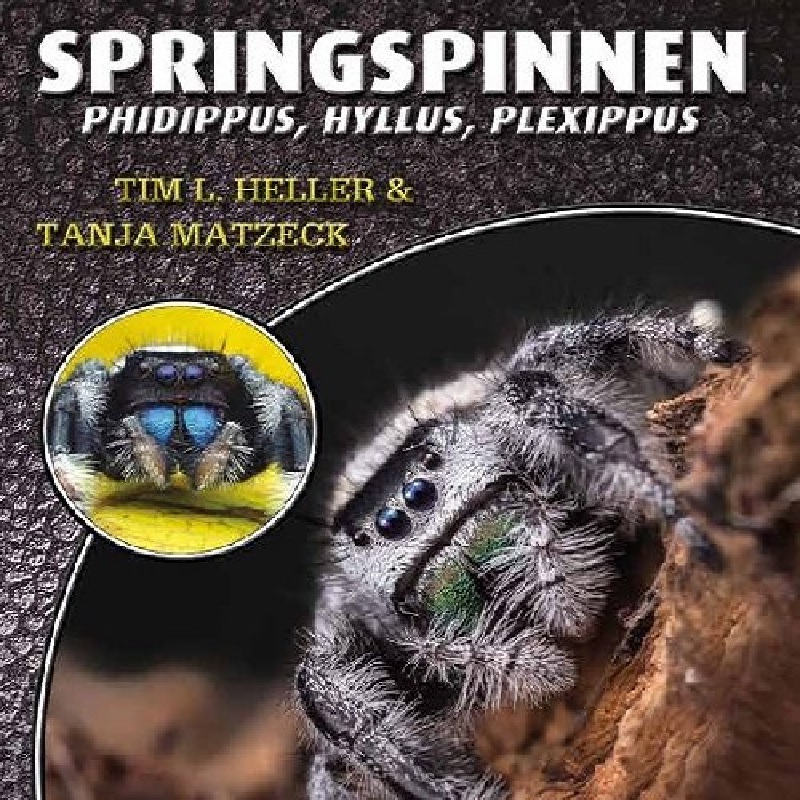
Jumping spiders Phidippus, Hyllus, Plexippus
Book Jumping Spiders - Phidippus, Hyllus & Plexippus A guide to keeping jumping spiders of the genera Phidippus, Hyllus & Plexippus. Who can resist the charm of jumping spiders? The childlike appearance of their expressive face simply leaves no one cold! In addition, their behavior is extremely exciting to observe, their colors are bright and their requirements for species-appropriate keeping are very easy to meet. No wonder these likeable jumpers are all the rage! This volume in the "Species by Species" series describes in detail what to look out for when buying and keeping them, introduces the most commonly kept species and color forms and provides plenty of tips on how to keep them successfully - so you can be sure they will breed well! Species by Species introduces you to the books in this series, which present the most popular terrarium animals. Each volume offers you detailed, practical care instructions and all the information you need to successfully breed your animals. All important questions from the required tank size to terrarium set-up, technical equipment, species-appropriate nutrition and disease prevention are answered with numerous tricks and tips. Experienced, long-standing breeders reveal how you can encourage the animals to reproduce and raise healthy young. All this in full color, generously illustrated and attractively designed - just about your terrarium animal - species by species

CHF 23.90

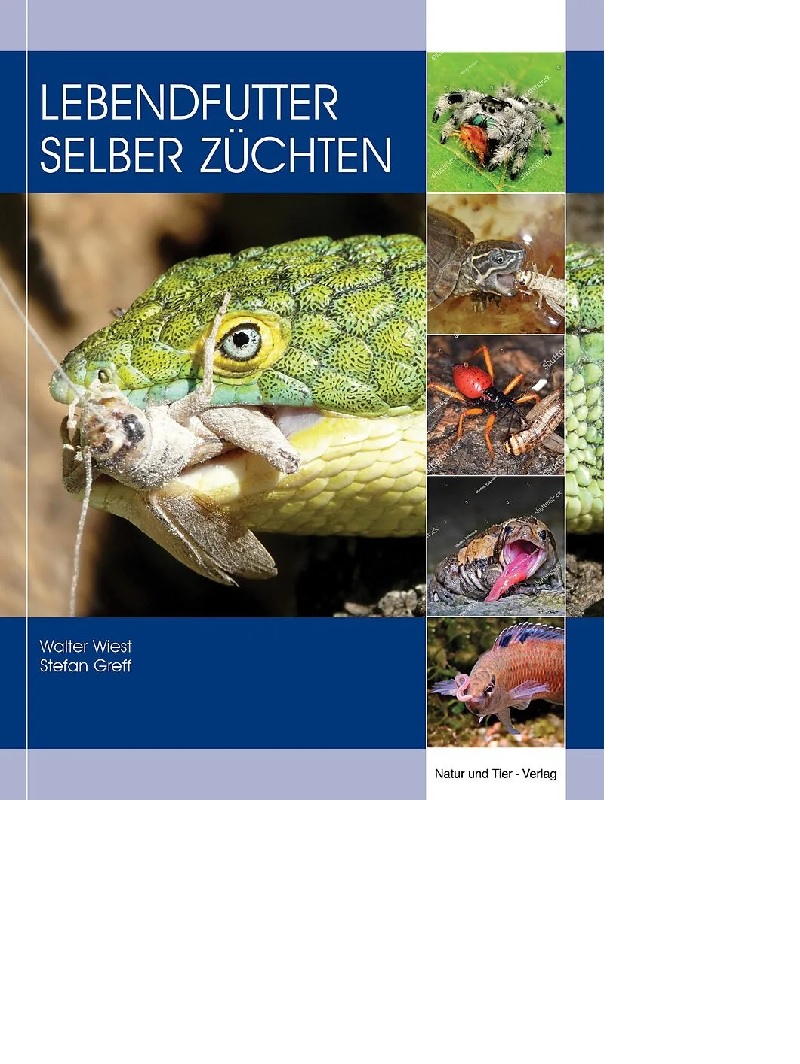
Book Breeding live food yourself
Book "Grow your own live food" - The perfect guide for pet owners Discover practical and detailed instructions on how you can easily breed food for your reptiles, birds, fish or other animals yourself in the book "Breeding live food yourself". With valuable tips on various food insects, their care and breeding, you can save money and ensure a species-appropriate diet for your pets. Contents of the book: Step-by-step instructions for breeding feeder insects Information on the best types of food for reptiles, birds and fish Care instructions and breeding conditions for various live food species Tips for sustainable and cost-effective food production Why breed your own live food? Get healthy, fresh food for your animals Save money and reduce dependence on pet shops Promote the health and well-being of your animals with species-appropriate food Whether you are a beginner or an experienced pet owner, this book provides you with everything you need to successfully breed live food yourself.

CHF 46.50

Marginata 69 - New Guinea tortoises
Marginata 69 - New Guinea tortoises – the genus ElseyaCover storyThe unrecognised beauties: New Guinea tortoises (Andreas S. Hennig)My experiences with Branderhorst's New Guinea tortoise, Elseya (Elseya) branderhorsti (Ouwens, 1914) (Andreas S. Hennig)Keeping and breeding of Rhodin's New Guinea tortoise, Elseya (Hanwarachelys) rhodini Thomson, Amepou, Anamiato & Georges, 2015 (Andreas S. Hennig)PortraitGeoemyda spengleri, Chinese serrated tortoise (Andreas S. Hennig)ReportageMacrochelys temminckii – Experiences and impressions with vulture tortoises part 2 (Reiner Praschag)KeepingAn alternative to year-round keeping of the Egyptian tortoise in the terrarium – my experiences with seasonal outdoor keeping of Testudo kleinmanni (Ricarda Schramm)EtymologySawbacks and living maps part 4: Graptemys gibbonsi, Pascagoula humpback tortoise (Holger Vetter)Classifieds & animal placement

CHF 16.50

The dwarf bearded dragon
All about dwarf bearded dragons by Martin Dieckmann 64 pages Format: 14.8 x 21 cm 55 colour photos Paperback Author Martin Dieckmann Contents: Systematics and body structure  The fascinating biology: From the life of the dwarf bearded dragon All information on species-appropriate keeping: from suitable terrariums to equipment and technology to feeding Successful breeding: Mating stimulation, incubation of eggs and rearing of hatchlings Solutions to problems: How to avoid the most common mistakes in care and how to help sick animals Brilliant photos

CHF 18.50

Reptilia 121 - More light - Terrarium lighting for sun-loving reptiles
Reptilia 121 - More lightTerrarium lighting for sun-loving reptiles CubaTerrarium for emerald monitor lizardsPeacock-eyed terrapinsContents:Cover story: More light! – Terrarium lighting for sun-loving reptilesThere are few topics that occupy terrarium keepers as much as the question of the right lighting, especially for sun-loving species. Which lamps give off the most light, how do I ensure that my animals get enough UV rays, what do I need to do to provide the ideal lighting? In our cover story, we take a closer look at this sometimes complex subject and analyse the suitability of HQI spotlights & co. as terrarium lamps. EditorialMAGAZINEDATES WESTERN HERP PERSPECTIVESA political view of today's terrarium challengesB. Love REPORTAGEThe right terrarium lighting for chameleons and other reptilesM. Grimm Terrarium technologyMetal halide lamps in terrariumsU. Geissel Keeping and breedingPeacock-eyed terrapins. The genus SacaliaM. Rogner ReportageA lifelong dream comes true. 40 years Reptile House UnteruhldingenA. Kwet TerraristicsA terrarium for the emerald monitor (Varanus prasinus)S. & S. Leber SERVICE Animals of our homelandThe little water frogR. Leptien ALSO NEAR YOU JourneyCuba all inclusive. Part 2: the centre and the westI. Kober PREVIEW BRUTKASTEN A day with ReinerJ. Bulian

CHF 12.00

Reptilia 123 - Planting of poison dart frog terrariums
Reptilia 123 - Planting of poison dart frog terrariums Contents: Cover story: Planting poison dart frog terrariumsPoison dart frog terrariums can be real gems. Not only because of the "jewels from the rainforest" themselves – but also because of the rainforest around them. Poison dart frogs come to us from biotopes that are also home to countless attractive tropical plants, many of which are available to us and can be cultivated excellently. The experienced terrarium plant specialist Beat Akeret explains in the cover story of this REPTILIA exactly which plants are suitable for poison dart frog terrariums, so that these not only look great and meet the needs of the frogs, but even conjure up an authentic Latin American rainforest section in the living room.Also in REPTILIA No. 123Keeping and breeding one of the most mystical reptiles of all: the Bornean earless monitor in the terrariumDanger in the magic of blossoms: crab spidersThe great trek 3: with REPTILIA editor-in-chief Heiko Werning from coast to coast through the south of the USAand much more 4          editorial             6          MAGAZINE             14        DATES             16        WESTERN HERP PERSPECTIVES                                    Only in America                                    By B. Love             18        PHOTOSTORY                                    Plants in the poison dart frog terrarium                                    By B. Akeret             26        Terrarium technology                                    Plant care in the poison dart frog terrarium                                    Basic considerations                                    By B. Akeret             32        plants                                    Suitable plants for poison dart frog terrariums                                    By B. Akeret             44        KEEPING AND BREEDING                                    Notes on keeping and breeding of the earless monitor, Lanthanotus borneensis                                    By M. Zollweg & R. Seipp             54        Terrarium technology                                    Even more light                                    Comments by S. Wunderlich and O. Fischer             61        SERVICE             64        travel                                    The great trek                                    Part 3: Georgia on my Mind                                    By H. Werning             76        ALSO NEAR YOU             80        PREVIEW             82        INCUBATOR                                     If this sets a precedent                                    Part 2                                    By H. Werning

CHF 13.50

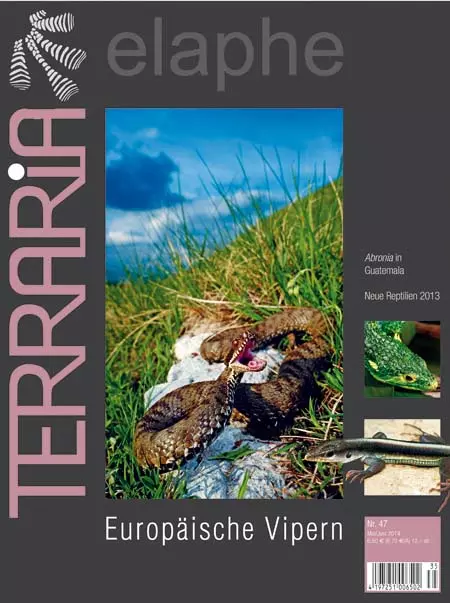
Terraria 47 - European vipers
Terraria 47 - European vipers Abronia in GuatemalaNew reptiles 2013 Contents:The venomous snakes on our doorstep are one of the most fascinating nature experiences for most reptile lovers. We present the species with the usual splendid pictures by photographer Benny Trapp, dedicate ourselves to the protection of the rare meadow viper and introduce the mountain viper and the milo viper in detailed articles. TerritorialHerpetorama Cover storyEuropean vipersBenny Trapp The Hungarian meadow viper – long protected, yet highly endangeredHans-Jürgen Luef The Milos viper, Macrovipera schweizeri, an endemic of the CycladesGuido Kreiner In search of mountain vipers (Montivipera xanthina) in north-eastern Greece Part 1Michael Wirth PanoramaTree snakes of the genus Abronia in GuatemalaChristian Ariano-Sánchez Bulgaria in May. Excursions through a natural outdoor terrariumPeter Kattke Research New speciesList of reptiles newly described in 2013Axel Kwet Salamandra TerraristicsThe chytrid fungus and terraristicsBenedikt R. Schmidt Also in your neighbourhoodNature and species conservation Field notesObservations of active midwife toads in FebruaryKlemens Fritz Fire salamander in the tyre trapRudolf Malkmus  GalleryHerpetology always in view. Historical wall charts for educational purposesMichael Markert, Uwe Hossfeld, Günter Stephan & Alexander Kupfer Subscription & ServicePreview Incubator Packing stationHeiko Werning

CHF 12.00

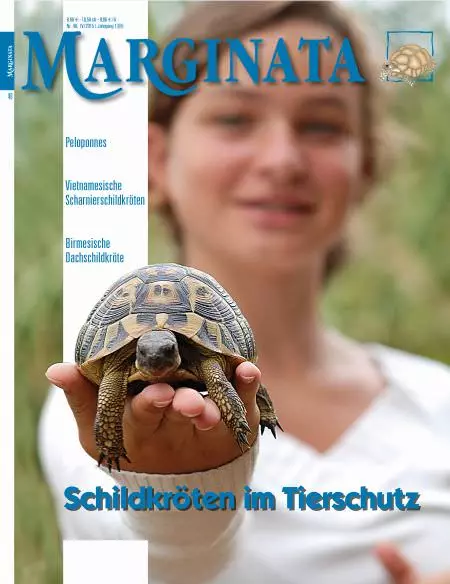
Marginata 48 - Turtles in animal protection
Marginata 48 - Turtles in animal welfarePeloponneseRarities from VietnamEuropean pond turtleTable of contents EditorialMagazineTOPIC"Chelonia" - Germany's largest turtle sanctuaryPatrick BoncourtTOPICSanctuary for tortoises in Stuttgart - a feel-good garden for tortoises Humans and animalsNicole Gehringer & Thomas SchällingTOPICTurtle animal welfare Supersize - the Phoenix Herpetological SocietyHeiko WerningPORTRAITEmys orbicularis (Linnaeus, 1758) European pond turtle, East Mediterranean pond turtleBenny Trapp TRAVELIn search of the "shy beauty" and the "Cave turtles" (2)Torsten Blanck, Sebastian Braun, Timothy McCormack, Hoang Van Ha, Nguyen Tai Thang, Nguyen Van Luc & Minh LeSCIENCETrachemys emolli or T. grayi in Honduras? Alexander GutscheTRAVELMorea - in search of turtles and other reptiles in the West the Peloponnese (2)Axel KwetSubscription & ServiceRegional guide

CHF 16.50

Tortoises Volume 3 - Outdoor enclosures
Outdoor enclosures for European tortoises A guide to natural husbandry in your own garden – 14–99 years Fortunately, the design of natural enclosures for European tortoises has increasingly become a focus for many tortoise owners in recent years. The tortoises’ natural habitat should serve as a model for keeping them in your own garden. The third volume in the series ‘Guide to Keeping European Tortoises’ deals with the topic of outdoor enclosures. In this book, authors Torsten Kiefer and Thorsten Geier share their many years of experience in designing tortoise enclosures. Taking nature as a model, this book provides a wealth of information on enclosure size, fencing and creating as diverse an environment as possible. The topic of cold frames and greenhouses is also presented in detail, including the necessary equipment. Furthermore, there is extensive information on food and enclosure plants (as well as unsuitable or poisonous plants) and a description of various enclosures for breeding, balcony enclosures, emergency enclosures, etc. Numerous photos showcase outdoor enclosures of all kinds and are intended to provide inspiration for your own garden. Other topics include accidents in enclosures, protection against predators and common mistakes in tortoise enclosures. This book aims to highlight the importance of natural husbandry in outdoor enclosures and to present the ‘European tortoises’ (Hobby) from a very special perspective. A book packed with ideas for designing outdoor enclosures.

CHF 28.90

Terraria 50 - Monitor lizards in the terrarium
Terraria 50 - Monitor lizards in a terrariumDrinking behaviour of snakesAndaman lizardsContents:Cover story: Monitor lizards and terrariumsMany monitor lizards are among the most sought-after species in the terrarium hobby. Hobby keepers have made a decisive contribution to our knowledge of these charismatic lizards, discovering species and describing their behaviour. Some island monitor lizards are considered endangered and their trade represents a risk factor. At the same time, breeding successes are now also regularly achieved with rare species. In the cover story of the upcoming TERRARIA/elaphe, we will be focussing on the many facets of the mutual relationship between monitor lizards and terraristics.TerritorialHerpetoramaCover storyHistory of keeping monitor lizards in Germany and SchweizerBeat AkeretThe blue monitor lizard. The incredible story of the discovery of Varanus macraeiManfred Reisinger7 years of keeping and breeding the Blue-spotted Tree Monitor (Varanus macraei) at Cologne Zoo: A look back and a look aheadAnna Rauhaus, Lorraine Gutjahr, Johannes Oberreuter & Thomas ZieglerFirst evidence of parthenogenesis in Varanus rainerguentheri, a Pacific monitor lizard from the indicus groupJulian GrabbePanoramaThe Andaman Islands - A little known animal paradiseGernot VogelResearchNew speciesConfusion about new vulture turtlesAxel KwetNew wolf tooth snake from CambodiaAxel KwetAmong researchersA road in the primary rainforest - a small cause with a big effectRudolf MalkmusHerat: We meet again. As a lecturer in a war zonePhilipp WagnersSalamandraTerraristicsLook smart, snake keeper Observations on the drinking behaviour of snakesRalf HöroldAlso in your neighbourhoodNature and species conservationField notesCrow catches grass snakeRalf GramlichGrass frog cannibals in the spawning watersAxel KwetSubscription & ServiceThe introduced wall lizards of KamenzDieter GramentzPreviewIncubator ElvisHeiko Werning

CHF 12.00