Product information "Terraria No. 30 - Social bird spiders and other social spiders"
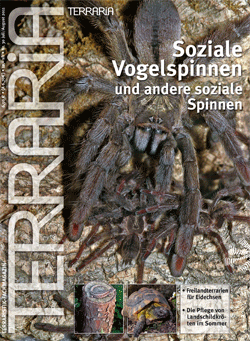
Terraria No. 30 - Social bird spiders and other social spiders

Freilandterrarien für Eidechsen Die Pflege von Landschildkröten im Sommer
Inhalt:
Etliche Vertreter der Vogelspinnen lassen sich im Terrarium in Gruppen halten, beispielsweise Poecilotheria-Arten oder Holothele incei. Die Pflege einer solchen Spinnengemeinschaft zählt zum Faszinierendsten, was man in der Wirbellosenterraristik erleben kann. Boris F. STRIFFLER stellt nicht nur sämtliche Vogelspinnen vor, die für eine solche Haltung infrage kommen, sondern geht außerdem auch auf weitere soziale Spinnen ein – selbst auf solche, die direkt vor unserer Haustür leben!
Editorial Kriton Kunz
Magazin Gondwanaland – ein zukunftsweisendes Projekt im Zoo Leipzig. Teil 4: Die Eröffnung der Tropenerlebniswelt / Revision der Familie Cordylidae / Marktplatz / Rechtliches / Wie kommt das Gift in die Beute?
TERRAglobal In der Bergwelt der Inka Maik Dobiey
Titelthema Soziale Vogelspinnen und andere soziale Spinnen Boris F. Striffler
Soziale Spinnen – ein Widerspruch in sich? Boris F. Striffler
Soziale Vogelspinnen? Beispiele aus Amerika Boris F. Striffler, Frank Schneider und Ingo Wendt Das Schildkrötenjahr. Freilandbiologie und Haltung europäischer Landschildkröten über den Jahreslauf Teil 3: Juli bis August – Sommerhitze Michael Wirth Die Gattung Nerodia. Wassernattern aus Nordamerika: Lebensweise sowie Haltung und Vermehrung im Terrarium Teil 1 Dieter Schmidt
Eidechsen im Freilandterrarium Martin Dieckmann
Reise Auf Amphibien- und Reptiliensuche in der Umgebung von Iquitos: Ranitomeya reticulata im Wald von Llanchama Mario Kassat
Neue Arten Ein psychedelischer Gecko Axel Kwet
Neuer Pfeilgiftfrosch aus Brasilien Axel Kwet
Abo & Service Unter Forschern Der Weg ist das Ziel – oder: Wie man sich eine Diplomarbeit selbst organisiert Stephan Böhm
Blickfang Terrarianernostalgie und tropischer Regenwald in Reutlingen – ein Besuch bei Florian Riedel Michael Wirth
In Ihrer Nähe Vorschau
Brutkasten Schlimme Nächte: Guayaquil Teil 2: Wir Kleinlaut-Touristen Heiko Werning
Composition
Feeding recommendation
Technical details
Size information
0 of 0 reviews
Give us a rating!
Share your experience with the product with other customers.
Login
No reviews found. Go ahead and share your findings with others.
Handbook of forage plants 2nd revised editionMarion Minch is not only a successful breeder of diverse tortoises for many years, but also an excellent connoisseur of native wild herbs. She founded and runs samenkiste.de, which is well known to many tortoise keepers and nature lovers. Her name is inextricably linked with reptile care and species-appropriate nutrition for tortoises. Her handbook of food plants summarises the most important native food plants for herbivorous and omnivorous reptiles. She not only considers tortoises, but also iguanas, spiny-tailed dragons and even chameleons. From the basics of plant biology to native wild herbs to suitable food plants for hardy tropical reptile species, this comprehensive work provides the basis for species-appropriate keeping. In the expanded and supplemented 2nd edition, the plant section is divided according to flower colour. This makes it even easier to identify wild herbs. The work has also been supplemented with a wealth of additional information and many pictures.
Geckos in the terrarium by Astrid FalkThe book offers a comprehensive introduction to geckos and their species-appropriate keeping in terrariums. It explains what you need to think about before buying a gecko and what preparations should be made. The book describes in detail how the terrarium is technically equipped and set up. The care of the animals, their special features and behaviour, their diet, reproduction and rearing of young animals are described, as well as diseases and husbandry problems with tried and tested suggestions for prevention and treatment. Individual gecko species that are particularly suitable for keeping and breeding in terrariums are portrayed in detail in the second part of the book.
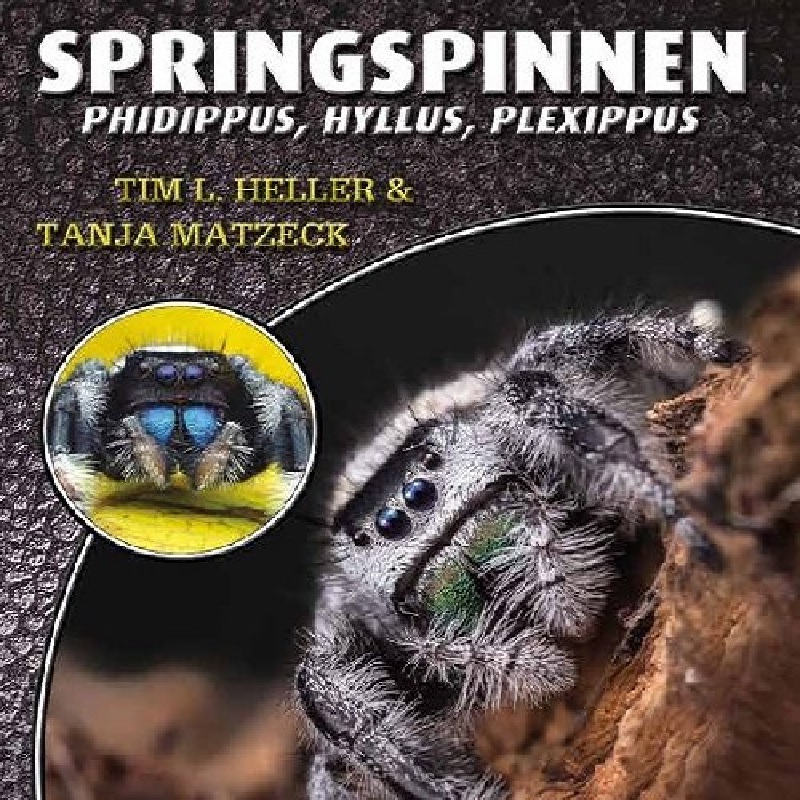
Book Jumping Spiders -
Phidippus, Hyllus & Plexippus
A guide to keeping jumping spiders of the genera Phidippus, Hyllus & Plexippus. Who can resist the charm of jumping spiders? The childlike appearance of their expressive face simply leaves no one cold! In addition, their behavior is extremely exciting to observe, their colors are bright and their requirements for species-appropriate keeping are very easy to meet. No wonder these likeable jumpers are all the rage!
This volume in the "Species by Species" series describes in detail what to look out for when buying and keeping them, introduces the most commonly kept species and color forms and provides plenty of tips on how to keep them successfully - so you can be sure they will breed well!
Species by Species introduces you to the books in this series, which present the most popular terrarium animals. Each volume offers you detailed, practical care instructions and all the information you need to successfully breed your animals.
All important questions from the required tank size to terrarium set-up, technical equipment, species-appropriate nutrition and disease prevention are answered with numerous tricks and tips.
Experienced, long-standing breeders reveal how you can encourage the animals to reproduce and raise healthy young.
All this in full color, generously illustrated and attractively designed - just about your terrarium animal - species by species
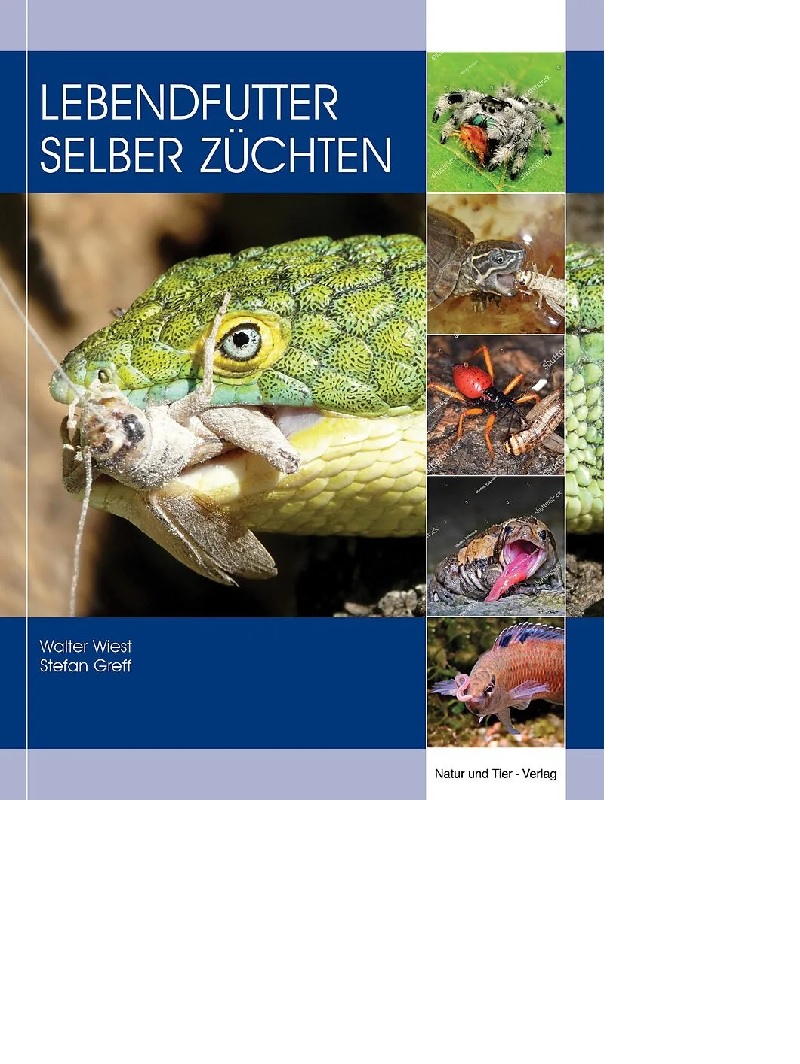
Book "Grow your own live food" - The perfect guide for pet owners
Discover practical and detailed instructions on how you can easily breed food for your reptiles, birds, fish or other animals yourself in the book "Breeding live food yourself". With valuable tips on various food insects, their care and breeding, you can save money and ensure a species-appropriate diet for your pets.
Contents of the book:
Step-by-step instructions for breeding feeder insects
Information on the best types of food for reptiles, birds and fish
Care instructions and breeding conditions for various live food species
Tips for sustainable and cost-effective food production
Why breed your own live food?
Get healthy, fresh food for your animals
Save money and reduce dependence on pet shops
Promote the health and well-being of your animals with species-appropriate food
Whether you are a beginner or an experienced pet owner, this book provides you with everything you need to successfully breed live food yourself.
Marginata 69 - New Guinea tortoises – the genus ElseyaCover storyThe unrecognised beauties: New Guinea tortoises (Andreas S. Hennig)My experiences with Branderhorst's New Guinea tortoise, Elseya (Elseya) branderhorsti (Ouwens, 1914) (Andreas S. Hennig)Keeping and breeding of Rhodin's New Guinea tortoise, Elseya (Hanwarachelys) rhodini Thomson, Amepou, Anamiato & Georges, 2015 (Andreas S. Hennig)PortraitGeoemyda spengleri, Chinese serrated tortoise (Andreas S. Hennig)ReportageMacrochelys temminckii – Experiences and impressions with vulture tortoises part 2 (Reiner Praschag)KeepingAn alternative to year-round keeping of the Egyptian tortoise in the terrarium – my experiences with seasonal outdoor keeping of Testudo kleinmanni (Ricarda Schramm)EtymologySawbacks and living maps part 4: Graptemys gibbonsi, Pascagoula humpback tortoise (Holger Vetter)Classifieds & animal placement
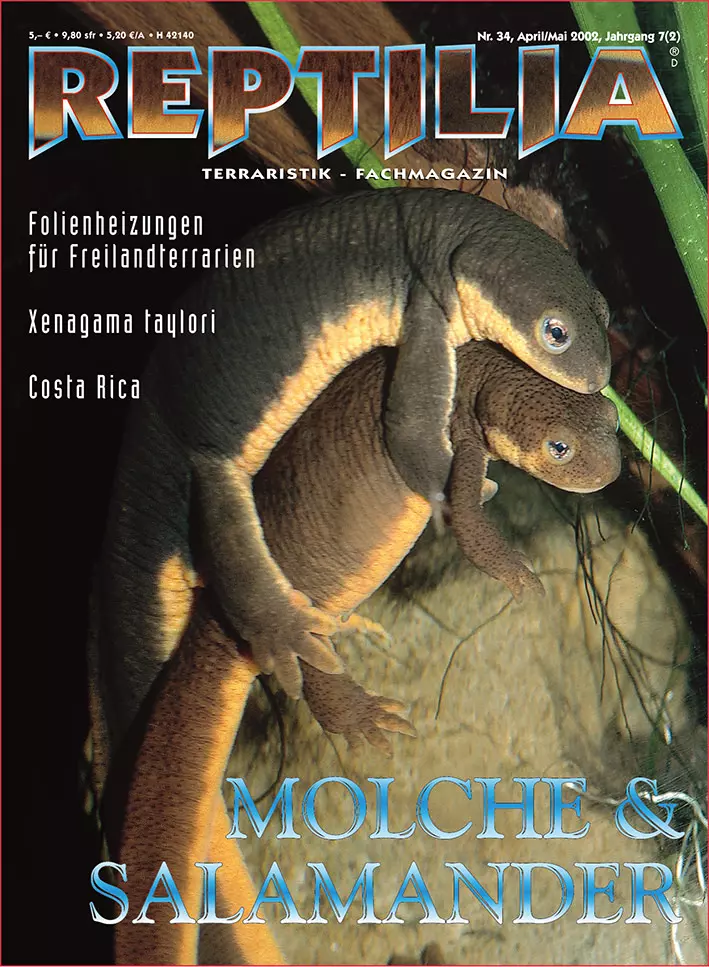
Reptilia 34 Efts & Salamanders
Foil heaters for outdoor terrariumsXenagama tayloriIn the roof of the rainforestContent:2 EDITORIAL4 READER'S LETTERS6 MAGAZINE16 DATES20 WESTERN HERP PERSPECTIVESSeptember - Ambush Attackfrom B. Love22 PHOTO REPORTAGEcaudatesby M. Staniszewski30 HUSBANDRY AND BREEDINGThe band newt Triturus vittatus ophryticusby Uwe Dost35 REPORTUnequal Brothers - The European Mountain Creek Newt (Genus Euproctus)by B. Thiesmeier & C. Hornberg43 TRAVELIn search of beavertail agams (Xenagama - A journey to Somalilandby A. Roos51 PORTRAIT AND POSTERAgalychnis callidryasby M. Schmidt56 HUSBANDRY AND BREEDINGThe Indian star turtle Geochelone elegans (Schoepff, 1795) - a problematic tropical land turtle? - Part 3: Offspringby H.-J. Bidmon63 REPORTLife above our heads: Amphibians and reptiles in the treetops of the Central American rainforestby T. Leenders70 HUSBANDRY AND BREEDINGBiology, Care and Breeding of Snakes of the Genus Pseustes (Fitzinger, 1834)by A. Hohmeister & F. Fiegenbaum75 REPORT"The foil heating - a simple and inexpensive possibility for the heat addition in free systemsby U. Strathemann78 REPORTThe oven fish (Thermobia domestica) - an ideal addition to the menu for numerous terrarium birdsby W. Schmidt81 REPTILIA ON THE ROADInnsbruck Alpine Zooby M. Hallmen88 CLASSIFIEDS92 ADVICE AND ACTION94 LIBRARY104 GLOSSERecently at the WG-Partyby Heiko WerningAnd here is an overview of the contents:This time your terraristics magazine is titled Molche & Salamander!It goes without saying that there should be a beautifully illustrated photo story in which an excerpt from the great variety of shapes of the tail amphibians is presented to you. And of course you will also get an overview of the essential facts about this amphibian order, its systematics, habitat, development and much more!The band newt Triturus vittatus ophryticusIn the wedding robe, the males of this subspecies of the band newt from Turkey and the Caucasus are certainly among the most spectacular amphibians of all: Apart from the magnificent coloration, the high and serrated ridge of the back makes the animals, which can reach a length of almost 20 cm in extreme cases, look like bizarre little dragons! Uwe Dost describes in detail and practically how to keep and breed these jewels among the newts, how to set up a suitable tank, how to care for the animals, and how to avoid possible problems from the beginning. In principle, however, the keeping and reproduction of the "water dragons" are not too difficult, so that after reading this article every amphibian friend will surely wish to take care of the beautiful newts himself!
Unequal Brothers - The European Mountain Creek Newt (Genus Euproctus)For a long time, little was known about the three species of the genus Euproctus in every respect, and they were regarded as not or only very difficult to keep and breed. Burkhard Thiesmeier and Claudia Hornberg describe here as examples, how a deepened knowledge of the habitat and the living conditions of a species has a positive effect on the care results. What do the biotopes of the respective species actually look like, and what consequences does this have for husbandry? Do the animals need an aquarium or a terrarium? These and all other relevant questions for a successful breeding of the rarely maintained mountain stream newts are answered by the authors in detail and competently. Try these highly interesting newts with their unique mating behaviour!Life above our heads: Amphibians and reptiles in the treetops of the Central American rainforestIt is well known that the deep sea is still a largely unexplored "continent". However, it is far less known that the canopy of the tropical rainforest contains an unbelievable wealth of species, only a fraction of which has so far been recorded. Twan Leenders himself has been researching the "treetop" habitat for a long time and now offers you an insight into this fascinating foreign world: the bizarre Bolitoglossa salamanders with their oversized feet, flying frogs, giant anole, bromeliad lizards, they all have amazing adaptations to their biotope high above the ground. How, for example, do the amphibians that are normally bound to water reproduce up there, how do they find partners in this extensive habitat? And what is a snake known as a digging species looking for at lofty altitudes? An extraordinary contribution with extraordinary insights!"The foil heating" - a simple and inexpensive possibility for the heat supplement for free plantsAnyone who cares for reptiles in the field knows the problem: In our latitudes it is difficult to ensure sufficient heat supply. If the weather is too cool and humid, the animals become ill quite quickly. One creates remedy with expensive and current eating radiators - or with the cleveren foil heating , whose production and effectiveness Udo Strathemann describes to you. This article will show you two different ways to help you offer your reptiles adequate conditions outside, which will of course also have a positive effect on their vitality and probably their reproductive success!The Indian star turtle Geochelone elegans (Schoepff, 1795), a problematic tropical tortoise? Several years of keeping and reproduction in GermanySo here is the third part of this incredibly detailed and highly descriptive report by Hans-J. Bidmon. This time the author dedicates himself to the successful breeding of his animals, describes mating behaviour, egg laying and incubation. Exact details and data - especially for the solution of problem cases - make this contribution interesting not only for all keepers of the beautifully drawn Indian star tortoise, but each tortoise friend can deduce from it conclusions, which surely benefit his own animals!The oven fish (Thermobia domestica): An ideal enrichment of the menu for numerous terrarium birds. If you feed your insect-eating terrarium birds day in, day out with crickets or crickets, you are certainly doing something wrong. Here Wolfgang Schmidt presents a possible alternative with the oven fish, a relative of the well-known silver fish. This urine insect offers many obvious advantages for breeding as a food animal: For example, it can be easily kept and reproduced, does not make any special demands on the food, and escaped specimens normally cannot reproduce in the home and therefore do not become a plague. Particularly important: not immediately eaten Ofenfischchen nibble neither the planting nor the terrarium animals themselves! Wolfgang Schmidt gives all important tips for the breeding, from the equipment of the containers over the attitude conditions up to the efficient feeding. The oven fish - a change in the menu that you should treat your amphibians or lizards to!
In search of beavertail agamas (Xenagama) - A journey to SomalilandDo you know anything about beaver tail agams? Have you ever been to Somaliland? If you answered both questions with "no", you certainly do not belong to the minority! There was hardly anything known about the genus Xenagama until now, and Somaliland is not exactly the main destination of sun-hungry African tourists. Alexander Roos, who carried out field biological studies on these very special animals there, describes the difficulties one has to struggle with when travelling to this region. The author's enthusiasm for the soon to be very trustful little agamas in the terrarium will certainly be passed on to the REPTILIA readers, especially as it is difficult to escape the impression of the beautiful photos of the cute guys anyway!Biology, care and breeding of snakes of the genus Pseustes (Fitzinger, 1843)And also with this article by Andreas Hohmeister and Franz Fiegenbaum we can offer you information about reptiles, of which so far practically no data from the terrarium keeping was available! The attractive, tree-dwelling species of the genus Pseustes are unfortunately still very rare guests in Central European terrariums, but the authors were able to cultivate two species successfully and even bring one of them several times to offspring. This probably fails with the other species only because of the lack of a female, because Hohmeister and Fliegenbaum describe the large, powerful vipers as very suitable fosterlings.A real treat for all snake fans!In addition to the above-mentioned articles, you will of course also find in this REPTILIA all the services you are accustomed to from your trade magazine, such as the sections Advice & Action, Dates, Posters, Classifieds, Library and of course the popular incubator not to forget!
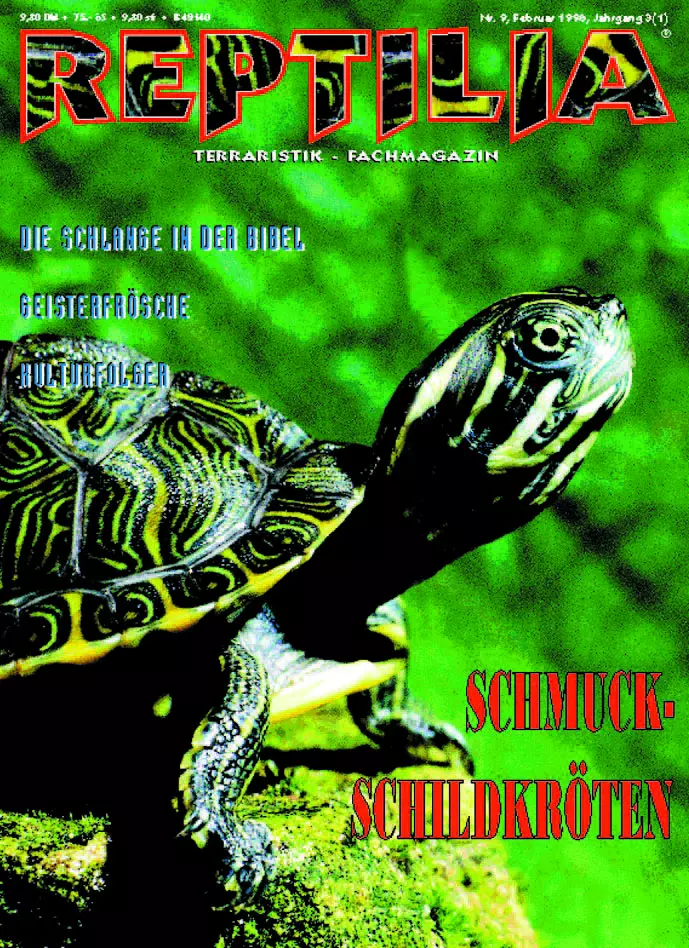
Reptilia 09 - Ornate tortoisesThe snake in the bibleGhost frogsCultural successorContents:Page 2 - EditorialPage 3 - Letters to the editorPage 5 - MagazinePage 16 - Western Herp Perspectives: The origin of our interest, by B. LovePage 18 - Photo reportage: Ornamental and decorative tortoises, by M. RognerPage 24 - Report: What to do with large tortoises, by E. MeierPage 28 - Keeping and breeding: Ornamental tortoises of the genus Chrysemys, by Dr U. ThiemePage 33 - Report: Reptiles and amphibians as cultural successors, by Dr M. GaulkePage 39 - Portrait and poster: Boa constrictor, by W. WenglerPage 43 - Keeping and breeding: Keeping and breeding ghost frogs, by C. ProyPage 48 - Keeping and breeding: Paleosuchus trigonatus, by K. HirschfeldPage 51 - Keeping and breeding: Peculiar care animals: Pug-headed iguanas, by U. SchlüterPage 55 - Herpetofauna: Salamanders of the family Plethodontidae in Costa Rica, by J. EhmckePage 59 - Herpetofauna and culture: The snake in the Bible, by Dr C. ThiedePage 68 – Reptilia on the road: La ferme aux crocodiles, by T. Wiegmann and V. SteffenPage 71 - LibraryPage 74 - Advice and actionPage 80 - Incubator: A chat from the sewing box, by Prof. Dr W. Böhme
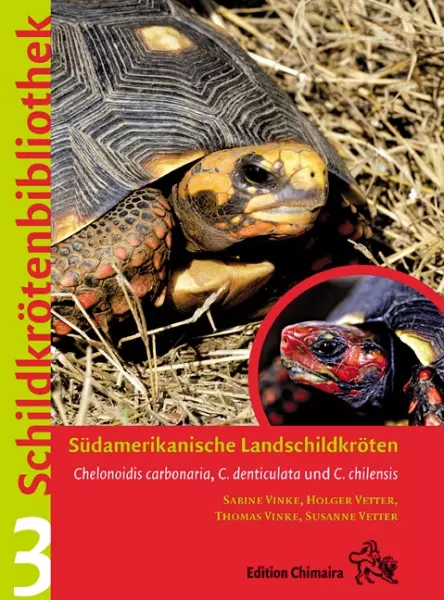
Turtle library 3 - The South American tortoises
Sabine & Thomas Finke, Susanne & Holger Vetter
355 pages
285 color photos
2 drawings 4 distribution maps
Format: 15 x 21.5 cm
Content:
This book is by far the most comprehensive collection of information from all parts of the Southern Turtle's tortoise range: Chelonoidis carbonaria, C. denticulata and C. chilensis.
Reptilia 123 - Planting of poison dart frog terrariums
Contents:
Cover story: Planting poison dart frog terrariumsPoison dart frog terrariums can be real gems. Not only because of the "jewels from the rainforest" themselves – but also because of the rainforest around them. Poison dart frogs come to us from biotopes that are also home to countless attractive tropical plants, many of which are available to us and can be cultivated excellently. The experienced terrarium plant specialist Beat Akeret explains in the cover story of this REPTILIA exactly which plants are suitable for poison dart frog terrariums, so that these not only look great and meet the needs of the frogs, but even conjure up an authentic Latin American rainforest section in the living room.Also in REPTILIA No. 123Keeping and breeding one of the most mystical reptiles of all: the Bornean earless monitor in the terrariumDanger in the magic of blossoms: crab spidersThe great trek 3: with REPTILIA editor-in-chief Heiko Werning from coast to coast through the south of the USAand much more
4 editorial
6 MAGAZINE
14 DATES
16 WESTERN HERP PERSPECTIVES
Only in America
By B. Love
18 PHOTOSTORY
Plants in the poison dart frog terrarium
By B. Akeret
26 Terrarium technology
Plant care in the poison dart frog terrarium
Basic considerations
By B. Akeret
32 plants
Suitable plants for poison dart frog terrariums
By B. Akeret
44 KEEPING AND BREEDING
Notes on keeping and breeding of the earless monitor, Lanthanotus borneensis
By M. Zollweg & R. Seipp
54 Terrarium technology
Even more light
Comments by S. Wunderlich and O. Fischer
61 SERVICE
64 travel
The great trek
Part 3: Georgia on my Mind
By H. Werning
76 ALSO NEAR YOU
80 PREVIEW
82 INCUBATOR
If this sets a precedent
Part 2
By H. Werning
Bugs No. 07 - Colourful tarantulas
Journey: Thailand and BorneoCockroaches: Deropeltis paulinoiRearing substrate: Flake SoilContents:Tarantulas are gloomy grey-brown? Not at all! Many species display fantastic, bright colours! We introduce you to the most beautiful representatives and show you how to keep and breed them using two species as examples.The colourful theme continues: Necroscia annulipes, one of the most colourful stick insects currently to be found in our terrariums, is presented. You can find out everything you need to know to keep them successfully in this issue of Bugs.Our travel report takes you to the forests of Thailand, where, for example, a lot of brightly coloured praying mantises live.For cockroach lovers we have an article about Deropeltis paulinoi – the authors report in detail about the breeding of this impressive species.In addition, of course, a number of other exciting topics are addressed, so that there will be something for fans of various invertebrate groups. Plus practical tips and news from the world of science and much more ...Table of contents
EditorialFacetsDatesFlown in
Cover storyColourful splendour on eight legs
Blue is beautiful!
FledgedA journey to the praying mantises and grasshoppers of Thailand and Borneo
Keeping & BreedingAbout the breeding of the privet hawk moth
PracticeFlake Soil – Quality offensive in beetle breeding
Keeping & BreedingTurquoise blue stick insect
CultureCockroaches in the mouth
Keeping & BreedingVelvet cockroaches – Noble terrarium inhabitants
Kids CornerA chirping and chirping
Book scorpionAlso in your neighbourhoodService & ImprintPreview
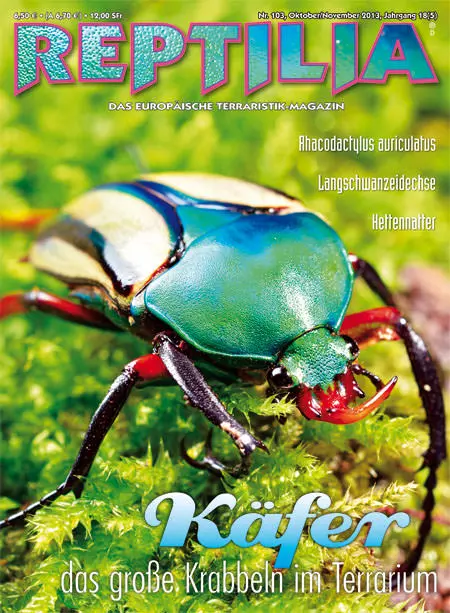
Reptilia 103 - Beetles - the big crawl in the terrarium
Hibernation of tortoisesRhacodactylus auriculatusChain snake
Contents:
Beetles are right on trend in terrariums! In addition to a large number of beautiful rose beetles, many stag beetles and giant beetles are now also being successfully bred – thanks in part to new substrates such as flake soil and Kinshi. In addition, splendid, agile ground beetles, social sugar beetles or whimsical black beetles also make it into terrariums time and again. REPTILIA introduces these beautiful animals and reveals how you can achieve breeding success with these colourful Juwel.
MAGAZINEDATESWESTERN HERP PERSPECTIVESAnnoying contemporariesB. Love
PHOTOREPORTAGEBeetles in the terrarium – A feast of colourF. Rossow
TERRARIUM PRACTICEIt all depends on the substrate!F. Rossow
KEEPING AND REPRODUCTIONBeetle breeding made easy!F. Rossow
KEEPING AND REPRODUCTIONRose chafer beetles – living JuwelH.-G. Kaiser
KEEPING AND REPRODUCTIONThe hump-headed gecko Rhacodactylus auriculatus – a colourful representative of the New Caledonian giant geckosK.-U. Volta
KEEPING AND REPRODUCTIONThe Speckled Chain Snake, Lampropeltis getula holbrooki – An underrated beautyD. Renner
TERRARIUM PRACTICEHibernation of Hermann’s tortoises (Testudo hermanni boettgeri)N. Schaible
ANIMALS OF OUR HOMEThe sea frogR. Leptien
LibraryTips & tricksServices
ALSO NEAR YOU
TRAVELAmphibians and reptiles in northern AfghanistanF. Joisten
PREVIEW
BRUTKASTEN Island of the iguanas part 2H. Werning
Outdoor enclosures for European tortoises
A guide to natural husbandry in your own garden – 14–99 years
Fortunately, the design of natural enclosures for European tortoises has increasingly become a focus for many tortoise owners in recent years. The tortoises’ natural habitat should serve as a model for keeping them in your own garden. The third volume in the series ‘Guide to Keeping European Tortoises’ deals with the topic of outdoor enclosures. In this book, authors Torsten Kiefer and Thorsten Geier share their many years of experience in designing tortoise enclosures. Taking nature as a model, this book provides a wealth of information on enclosure size, fencing and creating as diverse an environment as possible. The topic of cold frames and greenhouses is also presented in detail, including the necessary equipment. Furthermore, there is extensive information on food and enclosure plants (as well as unsuitable or poisonous plants) and a description of various enclosures for breeding, balcony enclosures, emergency enclosures, etc. Numerous photos showcase outdoor enclosures of all kinds and are intended to provide inspiration for your own garden. Other topics include accidents in enclosures, protection against predators and common mistakes in tortoise enclosures. This book aims to highlight the importance of natural husbandry in outdoor enclosures and to present the ‘European tortoises’ (Hobby) from a very special perspective. A book packed with ideas for designing outdoor enclosures.
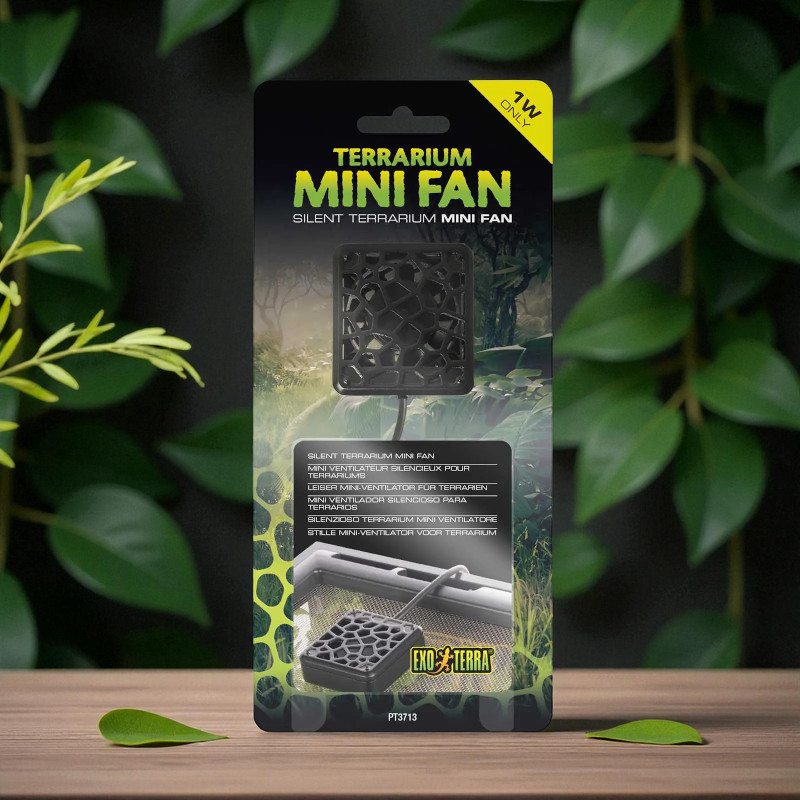
Exo Terra Terrarium Mini Fan Quiet, efficient fan for optimal air circulation in the terrarium
The Exo Terra Terr arium Mini Fan is a compact, energy-efficient, low-voltage fan specially designed for terrariums. With its virtually silent operation, it ensures optimal ventilation and fresh air circulation, reduces stagnant air and creates a healthy climate for animals and plants.
Good air circulation is crucial for the well-being of reptiles, amphibians and tropical plants. The mini fan improves air exchange, prevents condensation and reliably prevents mold and fungal growth.Product features
Improved air circulation: Increases the air exchange and ensures continuously fresh, oxygen-rich air in the terrarium.
Virtually silent operation: The high-quality 9-blade fan with ball bearing system runs quietly and reliably - ideal for living spaces.
Effective humidity regulation: Prevents condensation, reduces stagnant mist and supports a stable humidity level.
Natural climate simulation: Can be combined with a timer to realistically simulate day/night cycles and natural humidity fluctuations.
Healthy environment: Prevents respiratory infections in animals, prevents anaerobic bacteria from thriving and eliminates unpleasant odors.
Plant-friendly: Reduces heat stress, improves nutrient uptake and promotes vigorous plant growth in tropical terrariums.
Energy efficient and safe: Only 1 watt power consumption with safe low-voltage operation.
Easy to install: Easy to attach to the mesh grille cover with four fixing pins - no tools required.
Flexible orientation: Can both direct air into the terrarium and draw it out - depending on the desired climate effect.
Durable and versatile: Robust construction and soft silicone cable for flexible positioning.
Advantages of the Exo Terra Terrarium Mini FanThe Exo Terra Mini Fan offers numerous advantages for pet owners and plant lovers. It significantly improves the air quality in the terrarium by removing stagnant air and supplying fresh air. The gentle air flow prevents excessive humidity, reduces the risk of mold and ensures a clear view of the terrarium inhabitants. At the same time, it protects animals from respiratory diseases and supports natural behavior through realistic humidity and temperature cycles. Plants also benefit: The even air flow reduces heat stress, promotes growth and boosts vitality.
Thanks to its quiet, energy-efficient operation and simple installation, the mini fan is ideal for everyday use - reliable, safe and low-maintenance.Technical data
Power: 1 watt
Voltage: Low voltage (safe operation)
Fan: 9-blade system with ball bearings
Noise level: Very quiet
Installation: Plug & play with 4 retaining pins
Material: High-quality, durable components
Connection: Flexible silicone cable, compatible with standard mains adapters
CHF 24.90
❅
❆
❅
❆
❅
❆
❅
❆
❅
❆
❅
❆
This website uses cookies to ensure the best experience possible. More information...