Bugs No. 07 - Colorful bird spiders

Article no: bugs07

CHF 12.00

Stock: 0

This article is currently not available

Product information "Bugs No. 07 - Colorful bird spiders"

Bugs No. 07 - Colourful tarantulas

Journey: Thailand and Borneo
Cockroaches: Deropeltis paulinoi
Rearing substrate: Flake Soil

Contents:

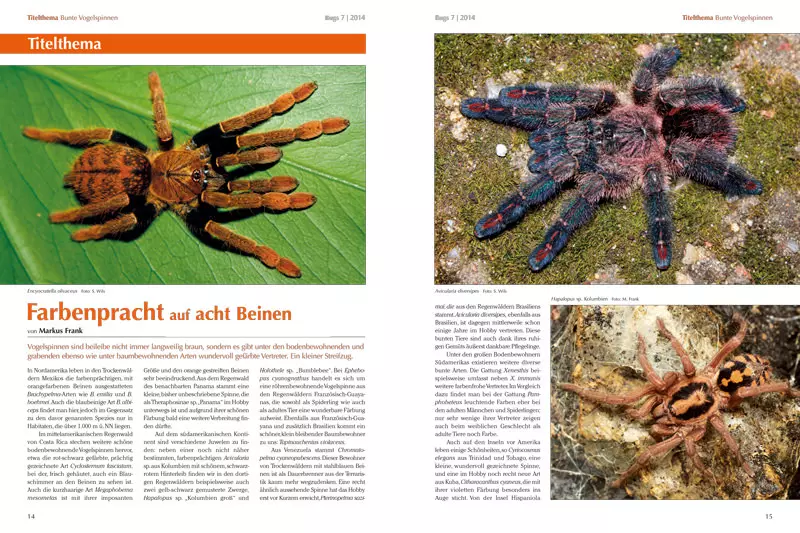
Tarantulas are gloomy grey-brown? Not at all! Many species display fantastic, bright colours! We introduce you to the most beautiful representatives and show you how to keep and breed them using two species as examples.

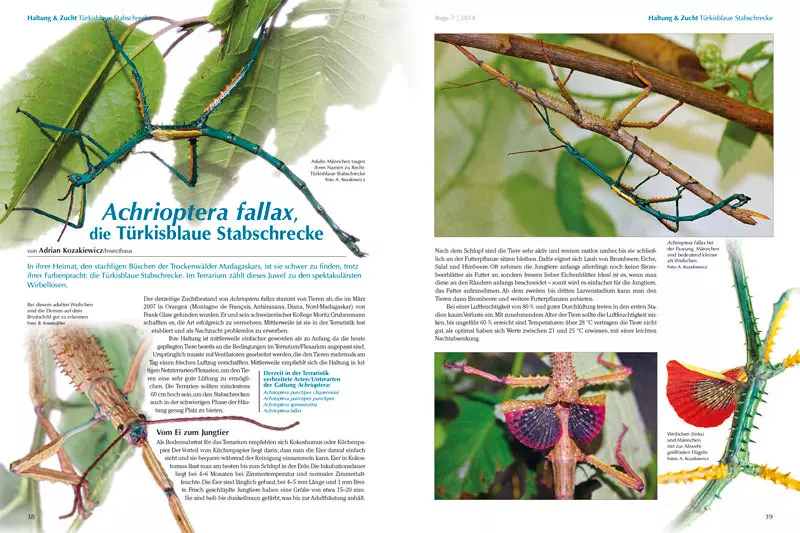
The colourful theme continues: Necroscia annulipes, one of the most colourful stick insects currently to be found in our terrariums, is presented. You can find out everything you need to know to keep them successfully in this issue of Bugs.

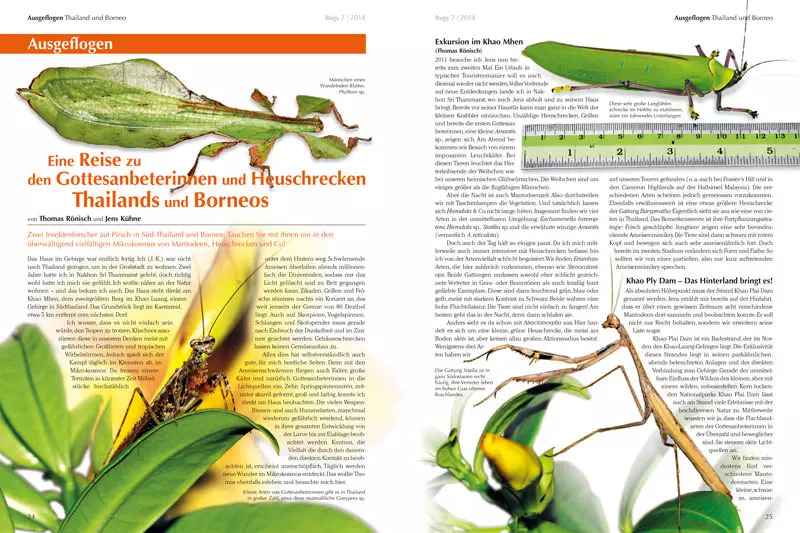
Our travel report takes you to the forests of Thailand, where, for example, a lot of brightly coloured praying mantises live.

For cockroach lovers we have an article about Deropeltis paulinoi – the authors report in detail about the breeding of this impressive species.

In addition, of course, a number of other exciting topics are addressed, so that there will be something for fans of various invertebrate groups. Plus practical tips and news from the world of science and much more ...

Table of contents

Editorial
Facets
Dates
Flown in

Cover story
Colourful splendour on eight legs

Blue is beautiful!

Fledged
A journey to the praying mantises and grasshoppers of Thailand and Borneo

Keeping & Breeding
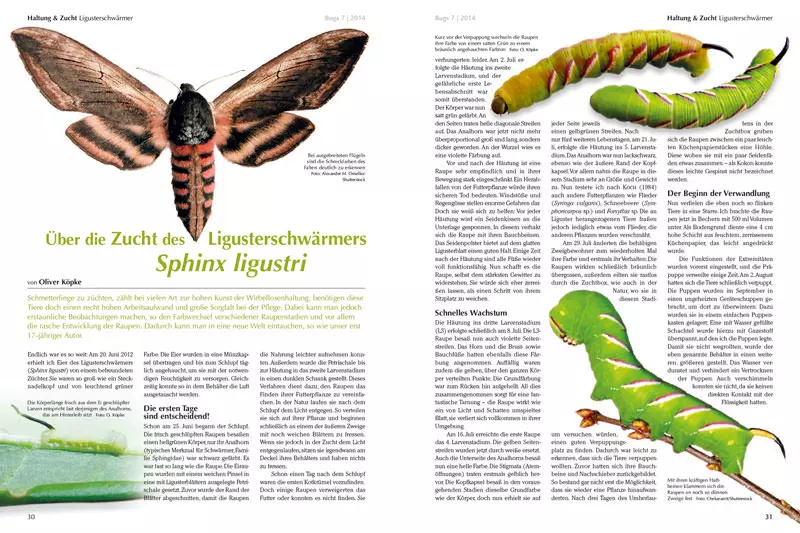
About the breeding of the privet hawk moth

Practice
Flake Soil – Quality offensive in beetle breeding

Keeping & Breeding
Turquoise blue stick insect

Culture
Cockroaches in the mouth

Keeping & Breeding
Velvet cockroaches – Noble terrarium inhabitants

Kids Corner
A chirping and chirping

Book scorpion
Also in your neighbourhood
Service & Imprint
Preview

Composition
Feeding recommendation
Technical details
Size information

0 of 0 reviews

Give us a rating!

Share your experience with the product with other customers.


Suggested products

Handbook of food plants for tortoises and other reptiles
Handbook of forage plants 2nd revised editionMarion Minch is not only a successful breeder of diverse tortoises for many years, but also an excellent connoisseur of native wild herbs. She founded and runs samenkiste.de, which is well known to many tortoise keepers and nature lovers. Her name is inextricably linked with reptile care and species-appropriate nutrition for tortoises. Her handbook of food plants summarises the most important native food plants for herbivorous and omnivorous reptiles. She not only considers tortoises, but also iguanas, spiny-tailed dragons and even chameleons. From the basics of plant biology to native wild herbs to suitable food plants for hardy tropical reptile species, this comprehensive work provides the basis for species-appropriate keeping. In the expanded and supplemented 2nd edition, the plant section is divided according to flower colour. This makes it even easier to identify wild herbs. The work has also been supplemented with a wealth of additional information and many pictures.

CHF 46.50

Geckos
Geckos in the terrarium by Astrid FalkThe book offers a comprehensive introduction to geckos and their species-appropriate keeping in terrariums. It explains what you need to think about before buying a gecko and what preparations should be made. The book describes in detail how the terrarium is technically equipped and set up. The care of the animals, their special features and behaviour, their diet, reproduction and rearing of young animals are described, as well as diseases and husbandry problems with tried and tested suggestions for prevention and treatment. Individual gecko species that are particularly suitable for keeping and breeding in terrariums are portrayed in detail in the second part of the book.

CHF 28.50

Jumping spiders Phidippus, Hyllus, Plexippus
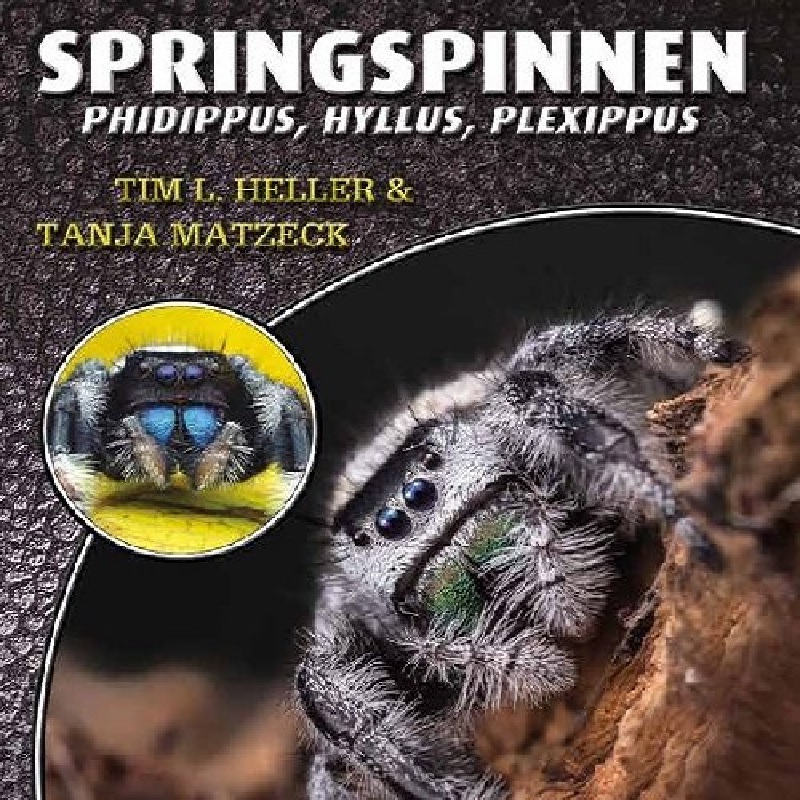
Book Jumping Spiders - Phidippus, Hyllus & Plexippus A guide to keeping jumping spiders of the genera Phidippus, Hyllus & Plexippus. Who can resist the charm of jumping spiders? The childlike appearance of their expressive face simply leaves no one cold! In addition, their behavior is extremely exciting to observe, their colors are bright and their requirements for species-appropriate keeping are very easy to meet. No wonder these likeable jumpers are all the rage! This volume in the "Species by Species" series describes in detail what to look out for when buying and keeping them, introduces the most commonly kept species and color forms and provides plenty of tips on how to keep them successfully - so you can be sure they will breed well! Species by Species introduces you to the books in this series, which present the most popular terrarium animals. Each volume offers you detailed, practical care instructions and all the information you need to successfully breed your animals. All important questions from the required tank size to terrarium set-up, technical equipment, species-appropriate nutrition and disease prevention are answered with numerous tricks and tips. Experienced, long-standing breeders reveal how you can encourage the animals to reproduce and raise healthy young. All this in full color, generously illustrated and attractively designed - just about your terrarium animal - species by species

CHF 23.90

Book Breeding live food yourself
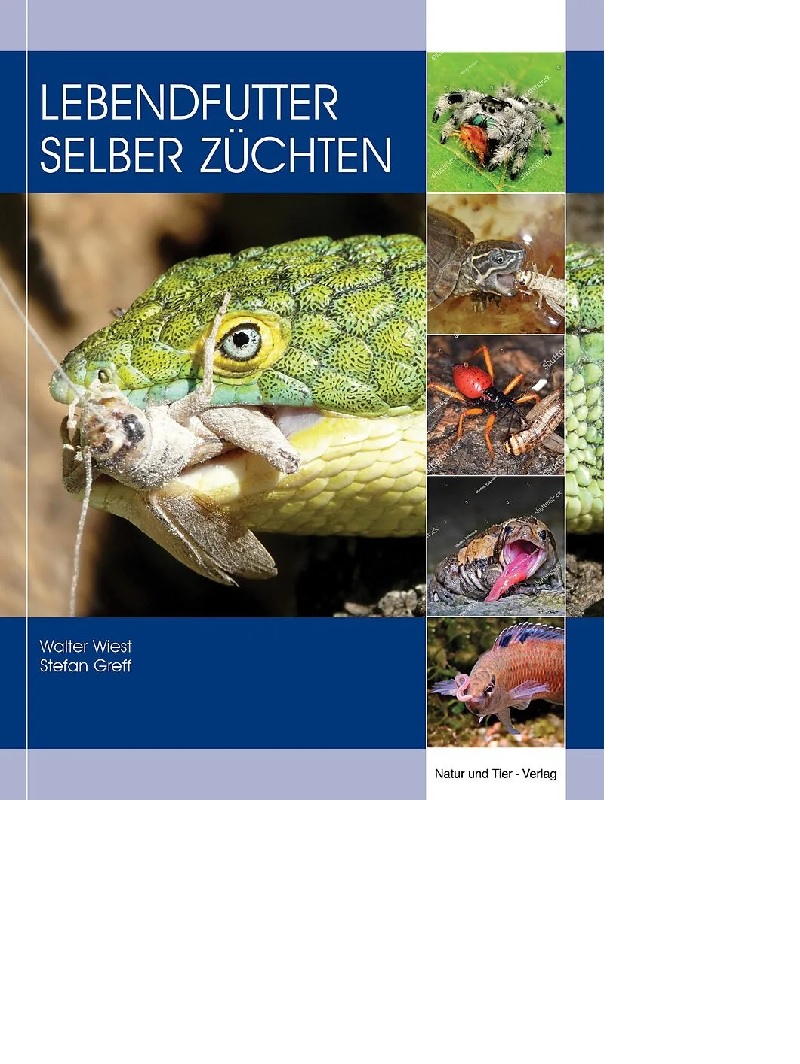
Book "Grow your own live food" - The perfect guide for pet owners Discover practical and detailed instructions on how you can easily breed food for your reptiles, birds, fish or other animals yourself in the book "Breeding live food yourself". With valuable tips on various food insects, their care and breeding, you can save money and ensure a species-appropriate diet for your pets. Contents of the book: Step-by-step instructions for breeding feeder insects Information on the best types of food for reptiles, birds and fish Care instructions and breeding conditions for various live food species Tips for sustainable and cost-effective food production Why breed your own live food? Get healthy, fresh food for your animals Save money and reduce dependence on pet shops Promote the health and well-being of your animals with species-appropriate food Whether you are a beginner or an experienced pet owner, this book provides you with everything you need to successfully breed live food yourself.

CHF 46.50

Marginata 69 - New Guinea tortoises
Marginata 69 - New Guinea tortoises – the genus ElseyaCover storyThe unrecognised beauties: New Guinea tortoises (Andreas S. Hennig)My experiences with Branderhorst's New Guinea tortoise, Elseya (Elseya) branderhorsti (Ouwens, 1914) (Andreas S. Hennig)Keeping and breeding of Rhodin's New Guinea tortoise, Elseya (Hanwarachelys) rhodini Thomson, Amepou, Anamiato & Georges, 2015 (Andreas S. Hennig)PortraitGeoemyda spengleri, Chinese serrated tortoise (Andreas S. Hennig)ReportageMacrochelys temminckii – Experiences and impressions with vulture tortoises part 2 (Reiner Praschag)KeepingAn alternative to year-round keeping of the Egyptian tortoise in the terrarium – my experiences with seasonal outdoor keeping of Testudo kleinmanni (Ricarda Schramm)EtymologySawbacks and living maps part 4: Graptemys gibbonsi, Pascagoula humpback tortoise (Holger Vetter)Classifieds & animal placement

CHF 16.50

Draco 17 - Snakes
Draco 17 - Snakes Contents: 2 Editorial 4 In a nutshell: All about snakesDieter Preißler 22 On the reproduction of snakes in the terrarium.Tasks, facts, problemsDieter Schmidt 37 Basics of keeping venomous snakesBeat Akeret 54 Snake symbolism in the Egyptian Book of the DeadKriton Kunz 64 To drive you out of your skin – observations on adder shirtsMartin Hallmen 68 Infrared detection in snakesLars Wartenberg 74 Snake skins – does the length of the tanned skin really not allow any conclusions to be drawn about that of the living animal?Karlheinz & Manuel Fuchs 82 Book box 94 Magazine

CHF 16.80

Draco 22 - Bearded dragons
Draco 22 - Bearded dragons Contents: 2 Editorial 4 Bearded dragons – the genus Pogona (STORR, 1982)Peter M. Müller 20 Basics of keeping Pogona vitticepsThomas Wilms & Karsten Grießhammer 28 Bearded Dragon FAQ (Frequently Asked Questions)Peter M. Müller & Renate Kohlmeyer 38 Presentation of a community facility for keeping Australian lizards at Reptilium LandauThomas Wilms 47 Observations on East Australian bearded dragonsGunther Schmida 55 Experiences in the care and breeding of Lawson’s dwarf bearded dragon (Pogona henrylawsoni (WELLS & WELLINGTON, 1985)Dieter Ruf 63 On the ecology and natural history of the dwarf bearded dragon (Pogona minor in the Great Victoria Desert (Australia)Eric. R. Pianka 67 Care and breeding of Mitchell’s bearded dragon Pogona mitchelli (BADHAM, 1976) Norbert Schuster 74 Bearded dragons in veterinary practiceJutta Wiechert 84 Book box 94 Magazine

CHF 16.80

Reptilia 27 - Anolis
Reptilia 27 - Anolis Curly-haired tarantulaCape CobraPhilippines Contents: 2 Editorial 3 letters to the editor 4 Lookup 5 Magazine 10 dates 14 Western Herp Perspectives: The aisle phenomenon, by B. Love 16 Photo reportage: Anolis, by L. Wijffels 22 Herpetofauna: The stretchable throat skin of the Anolis, by L. Wijffels 35 Herpetofauna: On the variation of "Le Roquet", the Anolis of Martinique, by L. Wijffels 44 Report: Anolis blanquillanus and Anolis onca. Two interesting skinks from the islands off Venezuela, by A. Flaschendräger 49 Obituary: In memory of Leo C. M. Wijffels, by A. Flaschendräger 51 Portrait and poster: Ctenosaura flavodorsalis, by T. Eisenberg 55 Journey: A visit to the Philippine rainforest, by Dr M. Gaulke 64 Keeping and breeding: Keeping and breeding the Indian star tortoise, by K. Gärtner 69 Terraristics: Building a snake enclosure, Part 3: Experiences, by M. Hallmen 74 Care and Breeding: The Cape Cobra Naja nivea, Care and Reproduction, by W. Strassmann 77 Herpetofauna: Curly Hair – Lovely Creatures, The tarantula Brachypelma albopilosa in the terrarium, by H. Fischer 82 Reptilia on the road: De Oliemeulen zoo and reptile house in Tilburg/Netherlands, by A. Hauschild 94 Advice and action 96 Library 104 Glossary: Anaconda! (Part 2), by H. Werning

CHF 9.80

Reptilia 125 - Madagascan big head geckos - the genus Paroedura
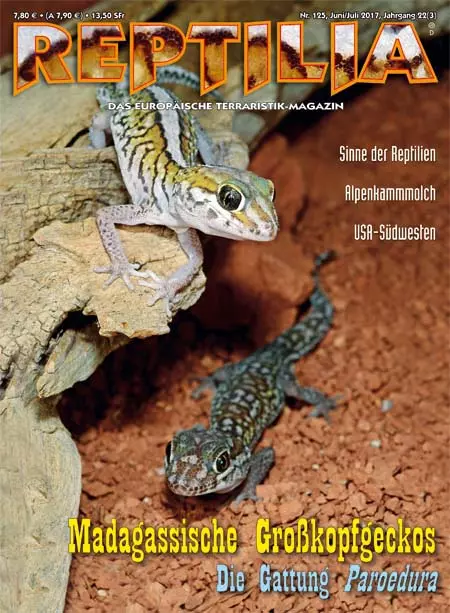
Reptilia 125 - Madagascan big-headed geckos - the genus Paroedura Contents: Cover story: Madagascan big-headed geckos – the genus Paroedura The charming Madagascan big-headed gecko Paroedura picta is one of the most popular lizards in the terrarium hobby, having been consistently captive-bred here for over thirty years. Another success story of the terrarium hobby. We provide a detailed guide to keeping and breeding this popular species and show that the genus Paroedura still has many surprises in store.   EditorialMAGAZINEDATES Photo story The Madagascan big-headed geckos of the genus Paroedura P. Schoenecker   KEEPING AND BREEDING The Madagascan big-headed gecko Paroedura picta in the terrarium. Part 1: General and behaviour By T. & A. Dark   Biology An amusing observation in the habitat of Paroedura picta H.-P. Berghof   KEEPING AND BREEDING Paroedura stellata. A rare star in the terrarium firmament K.-U. Volta & H.-P. Berghof   Biology The incredible and fascinating sensory abilities of reptiles M. Allerstorfer   Also in your neighbourhood   WESTERN HERP PERSPECTIVES Alien invaders – 100% evil? B. Love   Animals of our homeland The alpine crested newt R. Leptien   SERVICE   Journey The great trek.Part 4: Smoke on the Mountains H. Werning   PREVIEW   INCUBATOR  The sensation H. Werning

CHF 13.50

Draco 27 - Highland
Draco 27 - HighlandContents: 2 Editorial 4 Mountains and highlands - reptiles and amphibians in an extreme habitat Heiko Werning & Claudia Wolf 28 New Zealand - the discovery of new geckos at the end of the worldRonald Coleman 32 Giant toads and co. in the highlands of south-west ChinaKlaus Detlef Kühnel 36 Rwenzori - in search of amphibians in the mountains of the moonKatharina C. Wollenberg & Stefan Lötters 40 The keeping of highland chameleonsAndreas Böhle 45 chameleons in the Oster Usambara Mountains in northern TanzaniaWerner & Yvonne Lantermann 49 Spanish adders are also poisonous ...Axel Kwet 54 In search of mountain lizards in three continents Wolfgang Bischoff 74 Life, care and breeding of the alligator skink Mesaspis moreletii (Bocourt, 1871)Uwe Schlüter 81 Magazine

CHF 18.40

Draco 24 - Spiders
Draco 24 - Spiders Contents: 2 Editorial 4 Spiders - a look into strange worlds Kriton Kunz 24 "Relics of prehistoric times" - arthropod spiders, wallpaper spiders and their relativesThomas Ziegler & Boris F. Striffler 32 wheel web spiders in the terrariumTimm Adam 48 The genus Latrodectus - not just black widowsBoris F. Striffler 58 Colourful little predators - care and breeding of the lynx spider Peucetia madagascariensisKriton Kunz 62 water-hunting spiders of the family Ctenidae, Pisauridae and TrechaleidaeTimm Adam 70 Secret roommates in the house: from isopod hunters, hypnotisers and glue spittersKriton Kunz 80 With Piaroa Indians hunting the giant tarantula Theraphosa apophysisBoris F. Striffler & Barbara Zoller 88 Book box 93 Magazine

CHF 16.80

Marginata 45 - The Turtles of the Indian Subcontinent
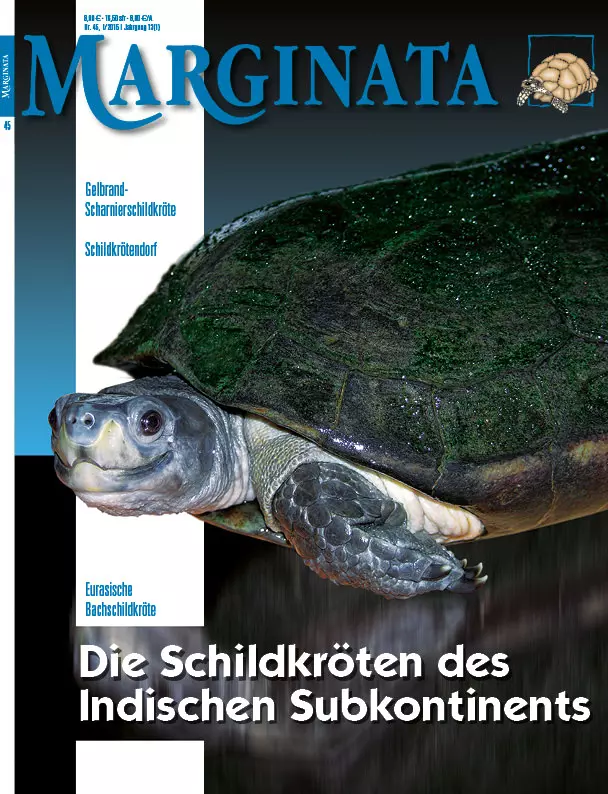
Marginata 45 - The Turtles of the Indian Subcontinent Yellow-margined Box TurtleTurtle villageEurasian pond turtle Contents: EditorialMagazineTOPICThe turtles of the Indian subcontinentSebastian NicklTOPICTurtles in IndiaBernd WolffTOPICA journey to the turtles of Sri LankaHerbert and Regina BeckerTOPICKeeping and breeding the black-bellied terrapin (Melanochelys trijuga thermalis) in the terrariumSebastian NicklPORTRAITMauremys rivulata Valenciennes, 1833. Eurasian pond turtleBenny TrappREPORTAGEThe turtle village in the Mauren massif Martin DieckmannKEEPING AND BREEDINGThe Yellow-margined Box Turtle (Cuora flavomarginata) Part 2: Breeding in the terrarium and endangerment in the wildUlrich HennenSubscription & ServiceRegional guide

CHF 16.50