Product information "Turtle library 3 - South American tortoises"
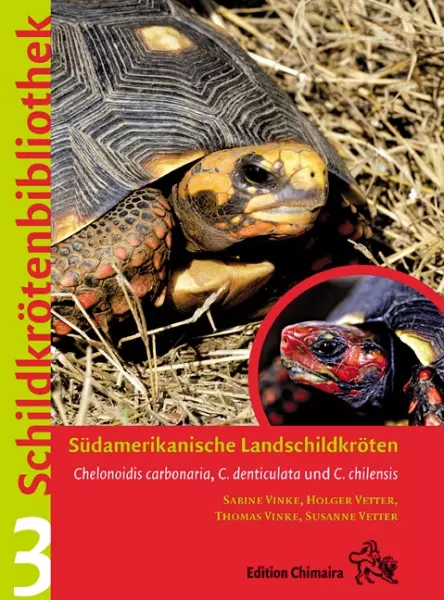
Turtle library 3 - The South American tortoises
Sabine & Thomas Finke, Susanne & Holger Vetter
355 pages
285 color photos
2 drawings 4 distribution maps
Format: 15 x 21.5 cm
Content:
This book is by far the most comprehensive collection of information from all parts of the Southern Turtle's tortoise range: Chelonoidis carbonaria, C. denticulata and C. chilensis.
Composition
Feeding recommendation
Technical details
Size information
0 of 0 reviews
Give us a rating!
Share your experience with the product with other customers.
Login
No reviews found. Go ahead and share your findings with others.
Handbook of forage plants 2nd revised editionMarion Minch is not only a successful breeder of diverse tortoises for many years, but also an excellent connoisseur of native wild herbs. She founded and runs samenkiste.de, which is well known to many tortoise keepers and nature lovers. Her name is inextricably linked with reptile care and species-appropriate nutrition for tortoises. Her handbook of food plants summarises the most important native food plants for herbivorous and omnivorous reptiles. She not only considers tortoises, but also iguanas, spiny-tailed dragons and even chameleons. From the basics of plant biology to native wild herbs to suitable food plants for hardy tropical reptile species, this comprehensive work provides the basis for species-appropriate keeping. In the expanded and supplemented 2nd edition, the plant section is divided according to flower colour. This makes it even easier to identify wild herbs. The work has also been supplemented with a wealth of additional information and many pictures.
Geckos in the terrarium by Astrid FalkThe book offers a comprehensive introduction to geckos and their species-appropriate keeping in terrariums. It explains what you need to think about before buying a gecko and what preparations should be made. The book describes in detail how the terrarium is technically equipped and set up. The care of the animals, their special features and behaviour, their diet, reproduction and rearing of young animals are described, as well as diseases and husbandry problems with tried and tested suggestions for prevention and treatment. Individual gecko species that are particularly suitable for keeping and breeding in terrariums are portrayed in detail in the second part of the book.
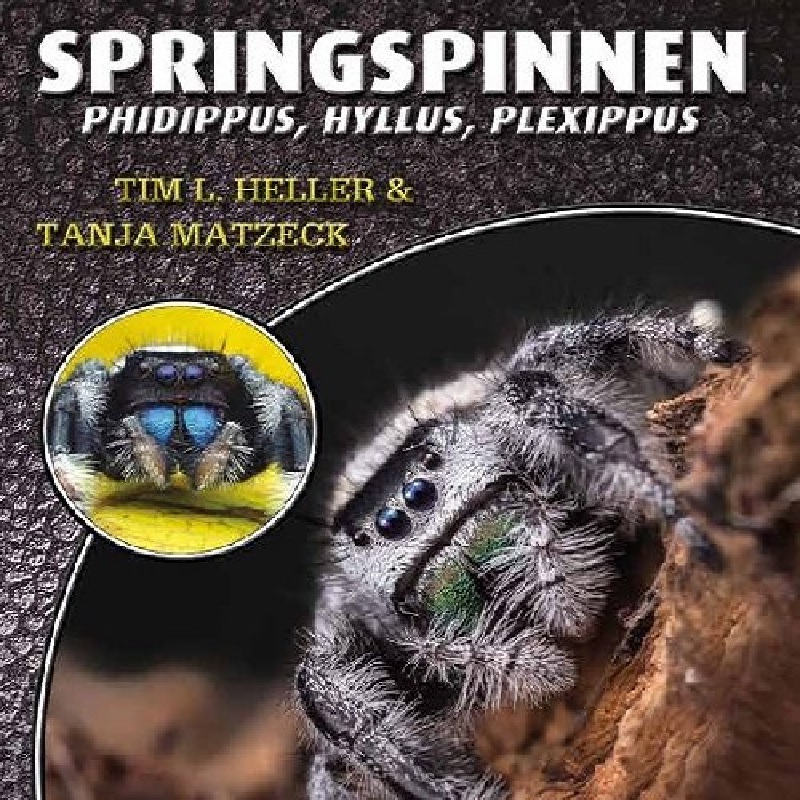
Book Jumping Spiders -
Phidippus, Hyllus & Plexippus
A guide to keeping jumping spiders of the genera Phidippus, Hyllus & Plexippus. Who can resist the charm of jumping spiders? The childlike appearance of their expressive face simply leaves no one cold! In addition, their behavior is extremely exciting to observe, their colors are bright and their requirements for species-appropriate keeping are very easy to meet. No wonder these likeable jumpers are all the rage!
This volume in the "Species by Species" series describes in detail what to look out for when buying and keeping them, introduces the most commonly kept species and color forms and provides plenty of tips on how to keep them successfully - so you can be sure they will breed well!
Species by Species introduces you to the books in this series, which present the most popular terrarium animals. Each volume offers you detailed, practical care instructions and all the information you need to successfully breed your animals.
All important questions from the required tank size to terrarium set-up, technical equipment, species-appropriate nutrition and disease prevention are answered with numerous tricks and tips.
Experienced, long-standing breeders reveal how you can encourage the animals to reproduce and raise healthy young.
All this in full color, generously illustrated and attractively designed - just about your terrarium animal - species by species
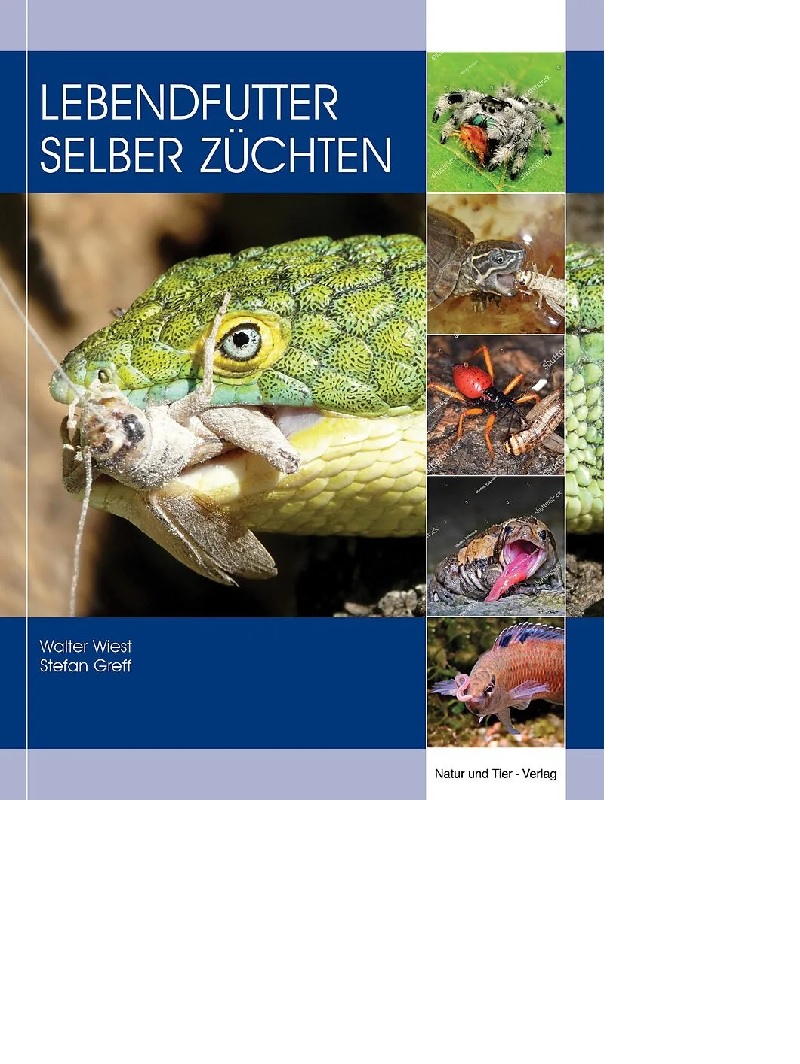
Book "Grow your own live food" - The perfect guide for pet owners
Discover practical and detailed instructions on how you can easily breed food for your reptiles, birds, fish or other animals yourself in the book "Breeding live food yourself". With valuable tips on various food insects, their care and breeding, you can save money and ensure a species-appropriate diet for your pets.
Contents of the book:
Step-by-step instructions for breeding feeder insects
Information on the best types of food for reptiles, birds and fish
Care instructions and breeding conditions for various live food species
Tips for sustainable and cost-effective food production
Why breed your own live food?
Get healthy, fresh food for your animals
Save money and reduce dependence on pet shops
Promote the health and well-being of your animals with species-appropriate food
Whether you are a beginner or an experienced pet owner, this book provides you with everything you need to successfully breed live food yourself.
Marginata 69 - New Guinea tortoises – the genus ElseyaCover storyThe unrecognised beauties: New Guinea tortoises (Andreas S. Hennig)My experiences with Branderhorst's New Guinea tortoise, Elseya (Elseya) branderhorsti (Ouwens, 1914) (Andreas S. Hennig)Keeping and breeding of Rhodin's New Guinea tortoise, Elseya (Hanwarachelys) rhodini Thomson, Amepou, Anamiato & Georges, 2015 (Andreas S. Hennig)PortraitGeoemyda spengleri, Chinese serrated tortoise (Andreas S. Hennig)ReportageMacrochelys temminckii – Experiences and impressions with vulture tortoises part 2 (Reiner Praschag)KeepingAn alternative to year-round keeping of the Egyptian tortoise in the terrarium – my experiences with seasonal outdoor keeping of Testudo kleinmanni (Ricarda Schramm)EtymologySawbacks and living maps part 4: Graptemys gibbonsi, Pascagoula humpback tortoise (Holger Vetter)Classifieds & animal placement
Terraria 50 - Monitor lizards in a terrariumDrinking behaviour of snakesAndaman lizardsContents:Cover story: Monitor lizards and terrariumsMany monitor lizards are among the most sought-after species in the terrarium hobby. Hobby keepers have made a decisive contribution to our knowledge of these charismatic lizards, discovering species and describing their behaviour. Some island monitor lizards are considered endangered and their trade represents a risk factor. At the same time, breeding successes are now also regularly achieved with rare species. In the cover story of the upcoming TERRARIA/elaphe, we will be focussing on the many facets of the mutual relationship between monitor lizards and terraristics.TerritorialHerpetoramaCover storyHistory of keeping monitor lizards in Germany and SchweizerBeat AkeretThe blue monitor lizard. The incredible story of the discovery of Varanus macraeiManfred Reisinger7 years of keeping and breeding the Blue-spotted Tree Monitor (Varanus macraei) at Cologne Zoo: A look back and a look aheadAnna Rauhaus, Lorraine Gutjahr, Johannes Oberreuter & Thomas ZieglerFirst evidence of parthenogenesis in Varanus rainerguentheri, a Pacific monitor lizard from the indicus groupJulian GrabbePanoramaThe Andaman Islands - A little known animal paradiseGernot VogelResearchNew speciesConfusion about new vulture turtlesAxel KwetNew wolf tooth snake from CambodiaAxel KwetAmong researchersA road in the primary rainforest - a small cause with a big effectRudolf MalkmusHerat: We meet again. As a lecturer in a war zonePhilipp WagnersSalamandraTerraristicsLook smart, snake keeper Observations on the drinking behaviour of snakesRalf HöroldAlso in your neighbourhoodNature and species conservationField notesCrow catches grass snakeRalf GramlichGrass frog cannibals in the spawning watersAxel KwetSubscription & ServiceThe introduced wall lizards of KamenzDieter GramentzPreviewIncubator ElvisHeiko Werning
All about Boa Constrictor by Stefan Binder
96 pages
89 photos
2 graphics
1 table
11 distribution maps
Format: 16.8 x 21.8 cm
Contents:
The boa constrictor (Boa constrictor) is the epitome of the giant snake. Contrary to its popular reputation, however, it is neither dangerous to humans, nor does it reach excessive body sizes. Rather, it is an animal that is excellently suited to terrarium keeping, extremely elegant and attractive, and is even recommended for beginners in giant snake keeping. In this book, snake enthusiasts will find everything they need to know for the successful keeping and breeding of these beautiful reptiles:- Physique and sensory abilities- Classification: all subspecies and local forms- All colour and pattern variants- Keeping boas correctly: furnishing and technical equipment of a species-appropriate terrarium- Problem solutions: prophylaxis and therapy of diseases- How to breed your boas; rearing of the young- Brilliant colour photos
Press reviews:
Reviewing this book was a real pleasure for me. When reading it (...) the impression is confirmed that the author can convey the subject clearly and understandably. (...)A book that should not be missing from any (giant snake) keeper's shelf!Bruno Treu in Sauria 25/2 (2003)
Reptilia 98 - Sick due to reptiles? About the [alleged] danger of salmonella
Drosophila food animal breedingUnderwoodisaurus miliiToad-headed tortoises
Contents:
EDITORIALMAGAZINEDATES
AROUND THE WORLD IN 5 YEARSTree creepers instead of flowersA. Pachmann
WESTERN HERP PERSPECTIVES American herp problemsB. Love
REPORTAGEAttack with bioweapons: Salmonella tactics against the terrarium hobbyH. Werning
ReportageSalmonella in amphibians and reptiles. The importance of terrarium animals as sources of infection for humansF. Mutschmann
HerpetofaunaPhrynops. The genus of toad-headed tortoisesH. - D. Philippen
ReportageIn the land of the golden ants. Splendour to the end of the worldM. Freuding
Keeping and breedingThe Australian fat-tailed gecko, Underwoodisaurus miliiS. Arth & S. Baus
Terrarium practiceCursed in the kitchen, loved in the terrarium: fruit fliesU. Dost
Terrarium displaysLa Ferme aux Crocodiles in Pierrelatte/Southern FranceM. Dieckmann
LibraryTest runTips & tricksSUBSCRIPTION & SERVICEALSO NEAR YOU
TRAVELDzanga-Sangha. In search of frogs between elephants and gorillasJ. M. Dehling & D. M. Dehling
PREVIEWBRUTKASTENSpecies protection reportH. Werning
Alles über den Stirnlappenbasilisk von Ingo Kober
64 Seiten
14,8 x 21 cm
zahlreiche Farbfotos
2. Auflage
Autor Ingo Kober
Verlag NTV
Inhalt:
Eindrucksvolle grosse Echsen sind sie, die Stirnlappenbasilisken. Den Betrachter erinnern sie unwillkürlich an drachenartige Fabelwesen. Dabei handelt es sich bei diesen attraktiven Echsen um völlig harmlose und äusserst interessante Tiere, die sich zur Pflege im Terrarium vorzüglich eignen. Ingo Kober beschäftigt sich seit vielen Jahren mit Stirnlappenbasilisken. In diesem Buch geht er auf alle Aspekte rund um die Haltung und artgerechte Pflege dieser spannenden Echsen ein und zeigt Ihnen, wie Sie Ihre Tiere zur Vermehrung bringen, die Eier ausbrüten und die Kleinen aufziehen können.
Systematik und Körperbau
Die faszinierende Biologie: Aus dem Leben der Stirnlappenbasilisken
Alle Informationen zur artgerechten Haltung: Vom geeigneten Terrarium über Einrichtung und Technik bis hin zur Fütterung
Erfolgreich nachzüchten: Paarungsstimulation, Inkubation der Eier und Aufzucht der Jungtiere
Problemlösungen: Wie man die häufigsten Fehler bei der Pflege vermeidet, und wie man kranken Tieren helfen kann
Brillante Fotos
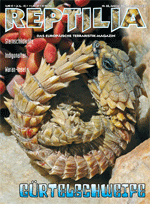
Reptilia 65 - Girdled TailStar tortoiseIndigo snakeMonitor IslandContents:
2 EDITORIAL
3 READER LETTERS
4 MAGAZINE
12 DATES
14 WESTERN HERP PERSPECTIVESA country tripFrom B. Love
16 PHOTO REPORTAGEBelt-tailed lizards – the genus CordylusBy H. Schwier
24 KEEPING AND REPRODUCTIONDwarf Belted Tails: keeping and Breeding of Cordylus tropidosternum(Cope, 1869)From P. Fritz
32 KEEPING AND REPRODUCTIONCordylus mossambicus FitzSimons, 1958A persistent and interesting keeperFrom H.-P. Berghof
40 HERPETOFAUNAThe giant belted skink Cordylus giganteus – unique and mysterious at the same timeFrom H. Schwier
45 REPORTAGEThe radiated tortoise of Madagascar -an armoured beautyFrom J. Hammer
51 PORTRAIT AND POSTERPhilothamnus punctatusFrom M. Dobiey
56 KEEPING AND REPRODUCTIONNewts of the genus Paramesotriton- The Vietnamese and Laotian warty newtsFrom P. Bachhausen
64 KEEPING AND REPRODUCTIONDrymarchon couperi – the Eastern Indigo SnakeFrom N. Miele
72 TRAVELThe island of the monitor lizardsFrom A. Gumprecht
88 FAQ - FREQUENTLY ASKED QUESTIONSCorn snakesBy K. Kunz
92 REPORTAGESerpentário SanmaruFrom M. Junge
95 LIBRARY
104 BRUTKASTEN Chicken heart, be braveBy H. Werning
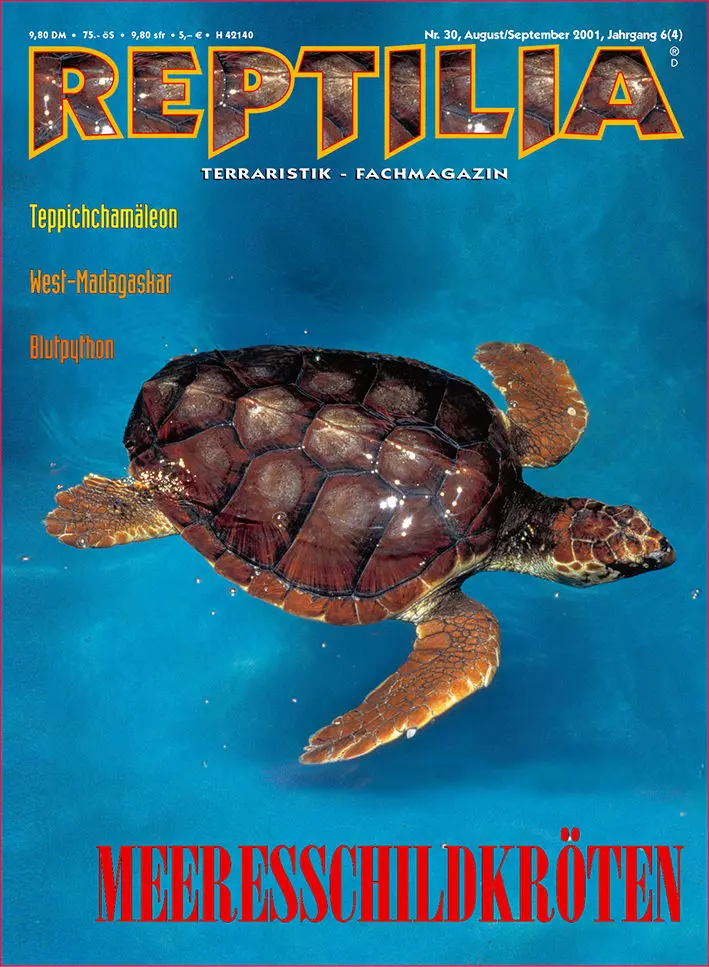
Reptilia 30 - Sea turtlesCarpet chameleonWest MadagascarBlood pythonContents:
2 Editorial
3 letters to the editor
7 Magazine
20 dates
24 Western Herp Perspectives, Hybrid Mania, by B. Love
26 Photo reportage: Sea turtles, by J. Vasconcelos Péres
32 Report: The diving behaviour of sea turtles, A brief overview, by J.D.R. Houghton
36 Report: Encounter with the loggerhead turtle (Caretta caretta) in the southern Aegean
40 Herpetofauna: The species of sea turtles, by J. Vasconcelos Péres
46 Care and Breeding: Forbidden Beauty – On the Spotted, Blood or Short-tailed Python Python curtus (Schöegel 1872), by A. Kirschner
51 Portrait and poster: Pelobates syriacus, by B. Trapp
55 Husbandry and Breeding: Experiences in the care and breeding of the carpet chameleon Furcifer lateralis, by U. & K. Dost
61 Herpetofauna: Luminous tejus? The dwarf tejus of the genus Proctoporus. With notes on luminescent organs in lizards, by U. Schlüter
65 Terraristics: Sitting in a glass house... The greenhouse as an interesting option for keeping snakes, by U. Strathemann
69 Herpetoculture: Devilish, divine snake. Aspects of snake symbolism from a psychological perspective. Part 1: Snake fear, snake cult, the image of the snake in the Bible, by K. Kunz
74 Journey: Journey to the Central West of Madagascar, by K. Liebel & W. Schmidt
88 Classifieds
92 Advice and action
95 Library
104 Glossary, I am a punk band, by H. Werning
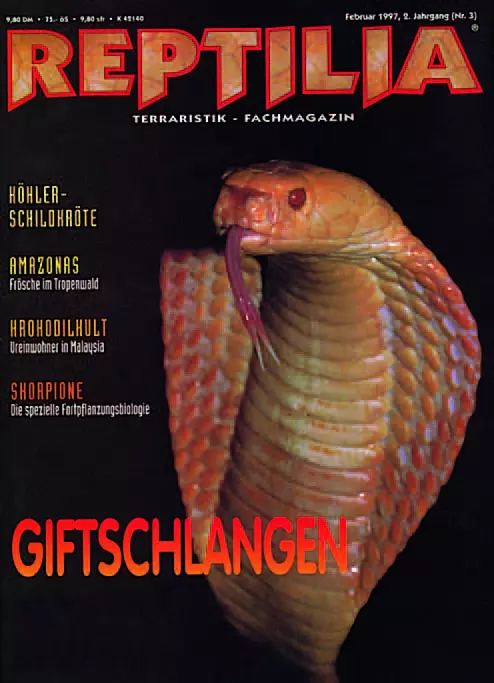
Reptilia 03 - Venomous snakesCave turtleAmazonas - Frogs in the tropical forestCrocodile cult - Aborigines in MalaysiaScorpions - The special reproductive biologyContents:Page 2 - EditorialPage 3 - Letters to the editorPage 6 - MagazinePage 17 - Photo report: Venomous snakes, by E. Barcenas and J. GuañabensPage 24 - Herpetofauna: Crotalus adamanteus, by J. BergadáPage 27 - Terraristics: Keeping venomous snakes, by P. LammersPage 30 - Herpetology and medicine: Venomous effects, by Dr M. Korthals AltesPage 33 – Travel report: Amazonas: In search of Dendrobates galactonotus, by B. PieperPage 39 - Portrait and poster: Salamandra salamandra, by M. Aresté and J. L. FarriolsPage 43 - Herpetofauna: How scorpions ensure their reproduction, by Dr D. MahsbergPage 49 - Herpetology and ecology: Toad migrations by A. de Saint-PaulPage 53 - Herpetofauna: Geochelone carbonaria, by S. MétraillerPage 56 - Herpetofauna: Toad lizards, by B. BaurPage 60 - Species and nature conservation: The extinction of reptiles and amphibians, by M. Viader StaubPage 71 - Herpetology and culture: The crocodile people of Malaysia, by Dr C. López del CastilloPage 74 - Advice and actionPage 75 - LibraryPage 80 - Incubator: Glossary by H. Werning