Product information "Ulmer, SMART Aquatic Turtles"
Ulmer - SMART Water Turtles
62 pages
numerous colour illustrations
3 edition
Author Wolfgang Praschag
This book describes the correct keeping and care of ornamental and decorative turtles. Using the example of the red-eared slider turtle, it shows what is important when keeping aquatic turtles in an aquarium. This book describes the conditions that should be met for keeping aquatic turtles in the home and also in the garden pond, which turtle species are particularly suitable and how they are cared for and kept healthy in an understandable, friendly and easy-to-follow format. A clear introduction for anyone thinking of bringing these attractive aquatic turtles into their home.
Composition
Feeding recommendation
Technical details
Size information
0 of 0 reviews
Give us a rating!
Share your experience with the product with other customers.
Login
No reviews found. Go ahead and share your findings with others.
Handbook of forage plants 2nd revised editionMarion Minch is not only a successful breeder of diverse tortoises for many years, but also an excellent connoisseur of native wild herbs. She founded and runs samenkiste.de, which is well known to many tortoise keepers and nature lovers. Her name is inextricably linked with reptile care and species-appropriate nutrition for tortoises. Her handbook of food plants summarises the most important native food plants for herbivorous and omnivorous reptiles. She not only considers tortoises, but also iguanas, spiny-tailed dragons and even chameleons. From the basics of plant biology to native wild herbs to suitable food plants for hardy tropical reptile species, this comprehensive work provides the basis for species-appropriate keeping. In the expanded and supplemented 2nd edition, the plant section is divided according to flower colour. This makes it even easier to identify wild herbs. The work has also been supplemented with a wealth of additional information and many pictures.
Geckos in the terrarium by Astrid FalkThe book offers a comprehensive introduction to geckos and their species-appropriate keeping in terrariums. It explains what you need to think about before buying a gecko and what preparations should be made. The book describes in detail how the terrarium is technically equipped and set up. The care of the animals, their special features and behaviour, their diet, reproduction and rearing of young animals are described, as well as diseases and husbandry problems with tried and tested suggestions for prevention and treatment. Individual gecko species that are particularly suitable for keeping and breeding in terrariums are portrayed in detail in the second part of the book.
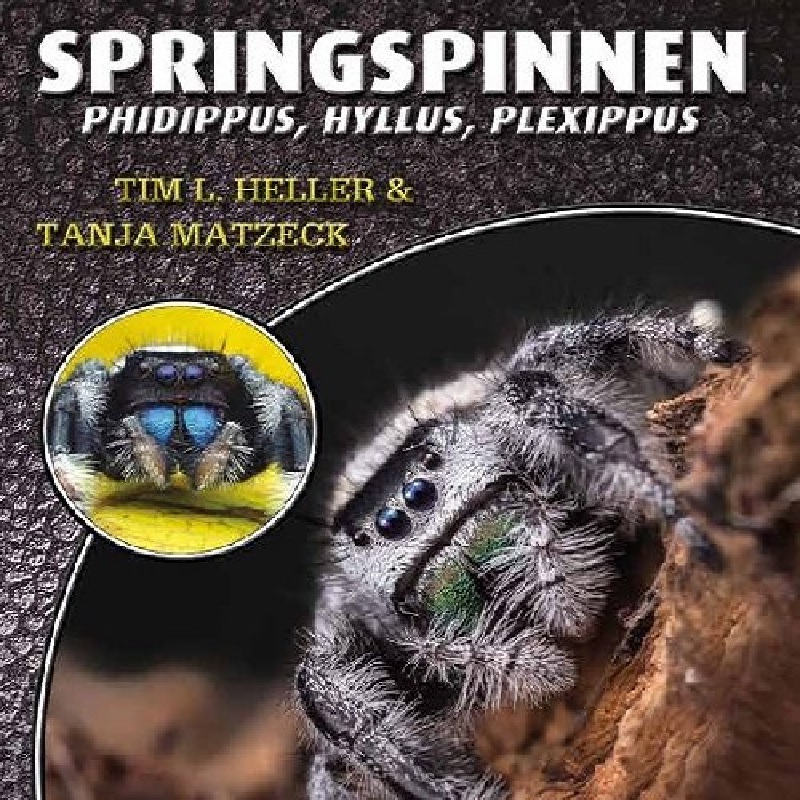
Book Jumping Spiders -
Phidippus, Hyllus & Plexippus
A guide to keeping jumping spiders of the genera Phidippus, Hyllus & Plexippus. Who can resist the charm of jumping spiders? The childlike appearance of their expressive face simply leaves no one cold! In addition, their behavior is extremely exciting to observe, their colors are bright and their requirements for species-appropriate keeping are very easy to meet. No wonder these likeable jumpers are all the rage!
This volume in the "Species by Species" series describes in detail what to look out for when buying and keeping them, introduces the most commonly kept species and color forms and provides plenty of tips on how to keep them successfully - so you can be sure they will breed well!
Species by Species introduces you to the books in this series, which present the most popular terrarium animals. Each volume offers you detailed, practical care instructions and all the information you need to successfully breed your animals.
All important questions from the required tank size to terrarium set-up, technical equipment, species-appropriate nutrition and disease prevention are answered with numerous tricks and tips.
Experienced, long-standing breeders reveal how you can encourage the animals to reproduce and raise healthy young.
All this in full color, generously illustrated and attractively designed - just about your terrarium animal - species by species
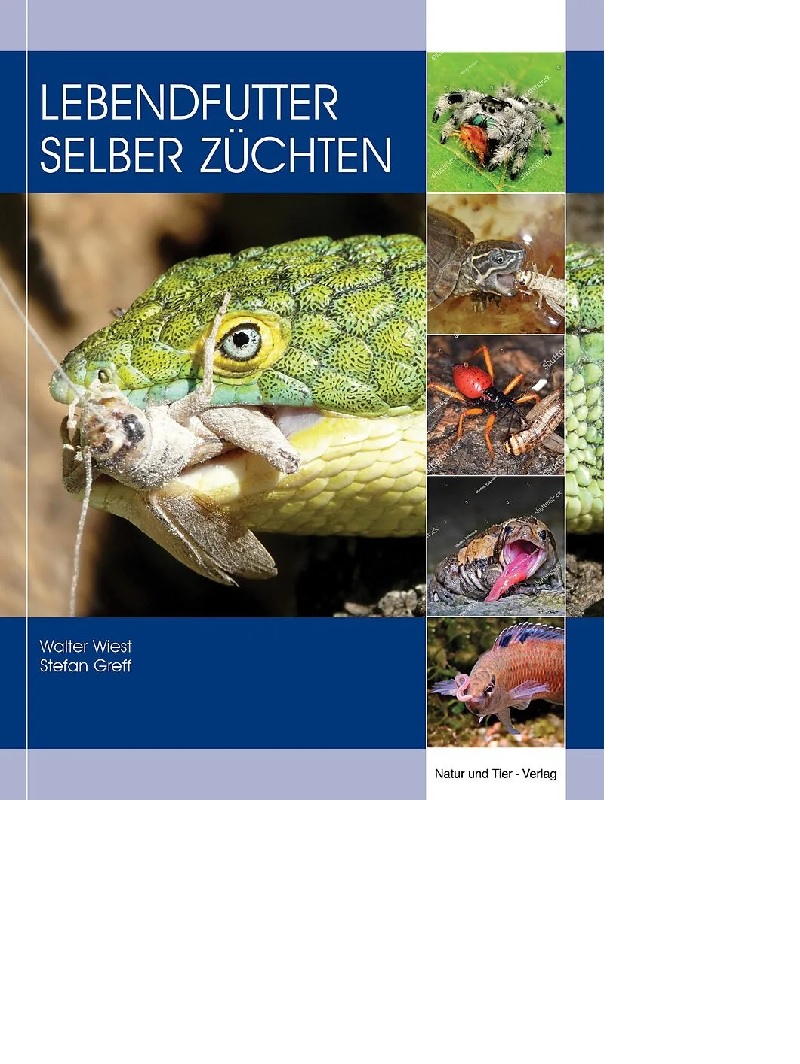
Book "Grow your own live food" - The perfect guide for pet owners
Discover practical and detailed instructions on how you can easily breed food for your reptiles, birds, fish or other animals yourself in the book "Breeding live food yourself". With valuable tips on various food insects, their care and breeding, you can save money and ensure a species-appropriate diet for your pets.
Contents of the book:
Step-by-step instructions for breeding feeder insects
Information on the best types of food for reptiles, birds and fish
Care instructions and breeding conditions for various live food species
Tips for sustainable and cost-effective food production
Why breed your own live food?
Get healthy, fresh food for your animals
Save money and reduce dependence on pet shops
Promote the health and well-being of your animals with species-appropriate food
Whether you are a beginner or an experienced pet owner, this book provides you with everything you need to successfully breed live food yourself.
Marginata 69 - New Guinea tortoises – the genus ElseyaCover storyThe unrecognised beauties: New Guinea tortoises (Andreas S. Hennig)My experiences with Branderhorst's New Guinea tortoise, Elseya (Elseya) branderhorsti (Ouwens, 1914) (Andreas S. Hennig)Keeping and breeding of Rhodin's New Guinea tortoise, Elseya (Hanwarachelys) rhodini Thomson, Amepou, Anamiato & Georges, 2015 (Andreas S. Hennig)PortraitGeoemyda spengleri, Chinese serrated tortoise (Andreas S. Hennig)ReportageMacrochelys temminckii – Experiences and impressions with vulture tortoises part 2 (Reiner Praschag)KeepingAn alternative to year-round keeping of the Egyptian tortoise in the terrarium – my experiences with seasonal outdoor keeping of Testudo kleinmanni (Ricarda Schramm)EtymologySawbacks and living maps part 4: Graptemys gibbonsi, Pascagoula humpback tortoise (Holger Vetter)Classifieds & animal placement
Terraria 24 - Breeding lizards successfully
Breeding of the spotted turtle Snake fauna of the Pantanal
Contents:
In an extensive, excellently researched article, our regular author Uwe Schlüter uses the example of lizards to illustrate the effects of incubation conditions on lizard eggs and the young animals developing in them. A highly interesting topic for all lizard breeders! TERRARIA editor Mike Zawadzki has been involved for many years in the keeping and breeding of pityusic and Balearic lizards; in this issue, he presents his exciting results. Werner and Yvonne Lantermann present their experiences with rearing young pearl lizards.
EditorialMike Zawadzki
Magazine Fire at Instituto Butantan – largest collection of venomous snakes in the world destroyedMarkus Monzel
Legal: Infection of a healthy animal stock by purchased sick animalsDietrich Rössel
Legal: Disturbing animals in the rented flatDietrich Rössel
Calling tadpoles detected for the first timeAlexander Gutsche
Marketplace:Exclusive condominium from 2000,- Euro
Vietnamese geckos of the genus GekkoMirko Barts
TERRAglobal In the forest Maik Dobiey
Cover topic: Breeding lizards successfully Influence of environmental factors on lizard eggs and hatchlings Uwe Schlüter
Keeping and breeding pityusic and Balearic lizards Mike Zawadzki
Notes on the breeding and rearing of young pearl lizards (Timon lepidus)Werner & Yvonne Lantermann
New Zealand stick insects in Cornwall, England – an example of established neozoaHans-Jürgen Luef
Travel The snake fauna of Pouso Alegre – a herpetological highlight in the Pantanal Martin Hallmen, Luiz Vincente Campos & Christine Strüssmann
Spotted jokers. The spotted turtles (Clemmys guttata) of the Cape Cod Peninsula Leo Spinner
The Agusan Valley in Mindanao, Philippines Maren Gaulke
New species Two spectacular monitors from the Philippines and Indonesia Axel Kwet
Among researchers Field research between unicorns and dragons – the amphibians and reptiles of the Cat Tien National Park in South Vietnam Peter Geißler
Eye-catcher Nano terraristics at its finest Kriton Kunz
Near youSubscription & ServicePreview
Incubator 80 mosquitoes for one frog. Part 2 Heiko Werning
Draco 49 - outdoor enclosures for tortoises
Contents:
Editorial
A new home for tortoisesPeter Buchert
Cold frame or greenhouse – the perfect shelter in a tortoise enclosureMichael Wirth
Preparing to lay eggs: It's the mound that counts!Michael Wirth
Always appropriate to size – the successful keeping and rearing of hatchlings and young animals in an outdoor terrariumMichael Wirth
All for the sake of warmth – optimising tortoise enclosuresMichael Wirth
The zoo moat – the invisible enclosure fencingMichael Wirth
Schlangen für EinsteigerMadagaskar-HundskopfboaDendrobates auratus
Inhalt:
Viele Vertreter der Gattung Avicularia zählen dank ihres attraktiven Äußeren und des spannenden Verhaltens zu den absoluten Klassikern im Terrarium. Aber gerade in jüngster Zeit werden auch immer wieder spektakuläre neue Arten dieser baumbewohnenden Vogelspinnen importiert.
Unser Titelthema bietet Ihnen einen Überblick über diese prächtigen Kletterkünstler und porträtiert einzelne Arten.
EditorialMAGAZINBestialische Behandlung indonesischer Großreptilien für westliche LuxusprodukteAndré Koch
MAGAZINUngewöhnlich gefärbter GrasfroschMike Zawadzki
MAGAZINGestohlene Geckos zurückKriton Kunz
MAGAZINFührungswechsel im Exotarium TulaKriton Kunz
MAGAZIN"Crocodile Dundee" gestorbenKriton Kunz
TERMINE
WESTERN HERP PERSPECTIVESIst Herping endlich erwachsen geworden?Bill Love
FOTOSTORYDie Gattung Avicularia Russ Gurley
HALTUNG UND VERMEHRUNGHaltung und Nachzucht von Avicularia metallicaI. Zubillaga
HALTUNG UND VERMEHRUNGDie Rotfußvogelspinne Avicularia aviculariaJ. F. Taylor
HALTUNG UND VERMEHRUNGErnährung nord- und westafrikanischer Warane in der Natur und bei TerrarienhaltungUwe Schlüter
PORTRÄT UND POSTERTerrapene carolina carolina (Linnaeus, 1758). Carolina-DosenschildkröteMichael Wirth
RATGEBERWelche Schlange für mich?Mark Mense
HALTUNG UND VERMEHRUNGSanzinia madagascariensis. Haltung und Zucht der Madagaskar-Hundskopfboa oder des Madagassischen HundskopfschlingersM. Borer
HERPETOFAUNACalumma tarzan. Eine neue Chamäleonart aus Madaskar braucht dringend Hilfe! P.-S. Gehring, M. Pabijan, F. M. Ratsoavina, J. Köhler, K. Mebert & F. Glaw
HERPETOFAUNAGoldbaumsteiger in Kolumbien F. Steinmann
REPORTAGEDer Schulzoo des Collegium Josephinum Bonn M. Uhlhaas & P. Pohlscheid
TIERE UNSERER HEIMATDie MauereidechseRolf Leptien
BIBLIOTHEKBuchbesprechung: Auf Schlangenspuren und KrötenpfadenAxel Kwet
Lizards of the American Southwest. A Photographic Field GuideHeiko Werning
Buchbesprechung: Frösche und andere AmphibienSebastian Wolf
ABO & SERVICEAUCH IN IHRER NÄHEVORSCHAU
BRUTKASTENGrenzgebiete Teil 1Heiko Werning
Reptilia 57 - Leopard geckos
2 - Editorial4 - Magazine15 - Dates18 - Western Herp Perspectives: In the trap, by B. Love20 - Photo report: The leopard gecko (Eublepharis macularius), by D.Duscha30 - Herpetofauna: Behaviour and biology of the leopard gecko (Eublepharis macularius) in Pakistan, by M. Sharif Khan36 - Keeping and reproduction: Colour and pattern variations of the leopard gecko (Eublepharis macularius), by R. Kreutz42 - Journey: In the Magic Kingdom of the Quetzal - Dream journeys through the land of "Eternal Spring", by K. Kunz51 - Portrait and poster: Trimeresurus flavomaculatus, by M. Gaulke56 - Hepertomedicine: Herpesvirus infections in tortoises - disease, diagnosis and prophylaxis options, by S. Fischer & M. Homuth65 - Care and reproduction: Monkeys with orange legs - Care and reproduction of the Chaco macifrog Phyllomedusa hypochondrialis azurea, by E. Biggi72 - Keeping and reproduction: On keeping the ventral viper Maticora bivirgata flaviceps (Cantor, 1839) in the terrarium, by G. Vogel & P. Freed78 - Terrarium technology: Building instructions for a polystyrene terrarium according to Marco Beck, by M. Schicker86 - Classifieds93 - Advice and action95 - Library104 - Incubator: My flat-sharing community, part 2: The Grand Coalition has promised to solve the problems in the country, but once again nobody is showing up, by H. Werning
Reptilia 37 Jackson's chameleons
Kenyaschool vivariumTurtle trade in CambodiaContent:2 EDITORIAL4 READER'S LETTERS6 MAGAZINE12 DATES16 PHOTO REPORTAGEthree-horned chameleonsfrom P. Necas36 HUSBANDRY AND BREEDINGChamaeleo (Trioceros)bitaeniatus and its relatives - With comments on the keeping and reproduction of a representative of the Grupeeby N. Lutzmann44 HERPETOFAUNAChamaeleo (Trioceros)jacksonii and its subspeciesby N. Lutzmann51 PORTRAIT AND POSTEREryx jaculusby B. Trapp55 TRAVELOn Herpeto Safari in Kenyafrom I. Schürkes, V. Wasanga & S. Lötters62 REPORTStudies on the turtle trade in Cambodiaby E. Lehr & R. Holloway71 HUSBANDRY AND BREEDINGOne of Europe's most beautiful lizards in a terrarium: the pearl lizardfrom S. Bania76 WESTERN HERP PERSPECTIVESExotic poisonous snakes - the charm of something specialfrom B. Love79 REPORTThe school vivariumPart 2: Example Franziskaner-Gymnasium Kreuzbergby M. Hallmen90 CLASSIFIEDS95 LIBRARY104 GLOSSEBig autumn extra: you have mail!by H. WerningThe October/November issue of your terraristic magazine REPTILIA makes the hearts of all lizard fans and aesthetes beat faster with the title theme "Threehorned Chameleons": In this photo story, which is even more sumptuous than usual, chameleon expert Petr Necas not only gives a general overview of these fascinating animals from the subgenus Trioceros, but he also introduces you to no less than all species in detail!
Chamaeleo (Trioceros) bitaeniatus and his relatives are then described in detail by the expert par excellence in this field, namely Nicolá Lutzmann. He reports about the biology of the small dragons, brings clarity into the confused systematics and not least describes their keeping and breeding vividly - for all terrarists interested in these beautiful lizards an absolute "must".Just like the next article on the title theme of Nicolá Lutzmann, who deals with the popular Chamaeleo (Trioceros) jacksonii and its relatives. Here, too, the author knows how to write expertly about the field biology of the animals, clears up the subspecies confusion and gives detailed tips for the successful care and breeding of the primeval lizards.We stay in Africa and go on Herpeto Safari in Kenya with I. Schürkes, V. Wasanga and S. Lötters. This dreamlike nature destination has not only the "big five" to offer, but is also herpetologically the very first cream, of which you can convince yourself with brilliant photos and a highly interesting expedition report.Unfortunately, the fatal situation of the Asian turtle fauna is a long runner in the REPTILIA, and if we together with you, dear readers, could contribute significantly to the construction of the conservation breeding station in the all-weather zoo Münster, the situation on site is still dramatic. This is proven by the drastic pictures and shattering experiences that Edgar Lehr and Rohan Hollowy bring back from investigations into the turtle trade in Cambodia.Sandra Bania takes care of one of the most beautiful lizards in Europe in her terrarium: the pearl lizard. Therefore she knows how to describe enthusiastically that these magnificent and trustful animals are not only an optical delight, but also show a very varied and interesting behaviour, which makes the lizards together with their relatively unproblematic keeping to best suitable fosterlings, whose keeping and breeding after the reading of this detailed contribution certainly no problems, but however much joy prepares.In the second part of his report on Das Schulvivarium, Martin Hallmen presents a practical example, namely the vivarium at the Franziskaner-Gymnasium Kreuzberg, which he initiated and praised highly. Here you can learn concretely what you have to consider during the planning and expansion phase and how everyday life with the vivarium works, how it is integrated into lessons and what publicity effect can be achieved with it. Certainly a thing worth imitating!Also in this REPTILIA we offer you of course again the full spectrum of our service: In the magazine, for example, you will read curiosities about a reptilian flower pot and get to know an interesting and up-to-date approach to the labelling of tank lizards. Dates, classifieds and the poster (this time with the Western Sandboa Eryx jaculus) are not missing in the incubator, as is Heiko Werning's infamous gloss: "This time, some people will certainly be very happy about caring mail. Will you also be there?
NTV, Discover the spiders
64 pages
colour photos throughout
Large format: 20.7 x 28 cm
Hardcover
Author Kriton Kunz
Publisher NTV
Contents:
No other group of animals exhibits such diverse and fascinating behaviour as spiders. Their different hunting strategies and their exciting abilities arouse children's curiosity. "Discover the spiders" explains all the secrets of these extraordinary animals in a child-friendly, detailed and entertaining way and has lots of amazing things in store: Can spiders fly? Do spiders also walk on water, perhaps they even dive? What's the story behind the triangle spider's strange web, and why does the spitting spider spit on its prey? Children will find answers to all their questions in this book.A highly valuable educational book with a great fun factor!
Welcome to the world of spiders!
What kind of animals are spiders?
The relatives of spiders
Where you can find spiders everywhere
Lots of spiders
Which spiders are there?
It's enough to make your skin crawl!
The senses of spiders
Bon appétit! How spiders hunt and eat
Enemies of spiders
Camouflage, warning and other tricks
Venomous spiders
Loners and communal creatures
Can spiders communicate with each other?
Reproduction
What do spiders do in winter?
Age and diseases
Can spiders fly?EXTRA:
Observe spiders
Little spider quiz
Thanks
Bugs No. 08 - CentipedeCentipedes are on the rise in terraristics! Christian Kronmüller, a specialist in these fascinating animals and author of a book on the subject, presents these many-legged predators in detail in the next issue of Bugs and reveals tips and tricks on how to keep and breed them.Insights into the way of life of invertebrates in nature provide valuable information on species-appropriate husbandry. Our Colombian author Jorge Cañas-Orozco has compiled exciting details and impressive photos of scorpions of the genus Opisthacanthus.During the hot season, wasps and hornets become a nuisance in some places in this country. In Bugs No. 8, we show you what these insects are used for in the Far East - surprises are guaranteed!Cuba is home to an absolutely spectacular arachnid fauna. Michael Seiter takes you on an expedition in search of flagellate spiders, scorpions and more.In addition, of course, a number of other exciting topics are addressed, so that there will be something for fans of various invertebrate groups. Plus practical tips and news from the world of science and much more ...Table of contentsEditorialFacetsDatesCover storyArmoured hunters and gentle parents - centipedes in the terrariumThe top 10 centipedes for beginnersFlown outIn search of arachnids in Cubareportage Opisthacanthus elatus: Observations from ColombiaKids Corner Colourful hummersreportage Beetle breeding made easy: white rotten wood from sustainable mushroom productionCulture Harvest festival in Japanese - Wasps as a delicacy in the Japanese countrysideBook scorpionAlso in your neighbourhoodService & Imprint