Terraria 24 - Successfully breeding lizards

Article no: terraria24

CHF 12.00

Stock: 0

Ready for dispatch in 1-3 days, delivery time 7 working days

Delivery between Tuesday, 12 May and Wednesday, 13 May
Zahlungsarten
Product information "Terraria 24 - Successfully breeding lizards"

Terraria 24 - Breeding lizards successfully

Breeding of the spotted turtle
Snake fauna of the Pantanal

Contents:

In an extensive, excellently researched article, our regular author Uwe Schlüter uses the example of lizards to illustrate the effects of incubation conditions on lizard eggs and the young animals developing in them. A highly interesting topic for all lizard breeders! TERRARIA editor Mike Zawadzki has been involved for many years in the keeping and breeding of pityusic and Balearic lizards; in this issue, he presents his exciting results. Werner and Yvonne Lantermann present their experiences with rearing young pearl lizards.

Editorial
Mike Zawadzki

Magazine
Fire at Instituto Butantan – largest collection of venomous snakes in the world destroyed
Markus Monzel

Legal: Infection of a healthy animal stock by purchased sick animals
Dietrich Rössel

Legal: Disturbing animals in the rented flat
Dietrich Rössel

Calling tadpoles detected for the first time
Alexander Gutsche

Marketplace:Exclusive condominium from 2000,- Euro

Vietnamese geckos of the genus Gekko
Mirko Barts

TERRAglobal
In the forest
Maik Dobiey

Cover topic: Breeding lizards successfully
Influence of environmental factors on lizard eggs and hatchlings
Uwe Schlüter

Keeping and breeding pityusic and Balearic lizards
Mike Zawadzki

Notes on the breeding and rearing of young pearl lizards (Timon lepidus)
Werner & Yvonne Lantermann

New Zealand stick insects in Cornwall, England – an example of established neozoa
Hans-Jürgen Luef

Travel
The snake fauna of Pouso Alegre – a herpetological highlight in the Pantanal
Martin Hallmen, Luiz Vincente Campos & Christine Strüssmann

Spotted jokers. The spotted turtles (Clemmys guttata) of the Cape Cod Peninsula
Leo Spinner

The Agusan Valley in Mindanao, Philippines
Maren Gaulke

New species
Two spectacular monitors from the Philippines and Indonesia
Axel Kwet

Among researchers
Field research between unicorns and dragons – the amphibians and reptiles of the Cat Tien National Park in South Vietnam
Peter Geißler

Eye-catcher
Nano terraristics at its finest
Kriton Kunz

Near you
Subscription & Service
Preview

Incubator
80 mosquitoes for one frog. Part 2
Heiko Werning

Composition
Feeding recommendation
Technical details
Size information

0 of 0 reviews

Give us a rating!

Share your experience with the product with other customers.


Suggested products

Handbook of food plants for tortoises and other reptiles
Handbook of forage plants 2nd revised editionMarion Minch is not only a successful breeder of diverse tortoises for many years, but also an excellent connoisseur of native wild herbs. She founded and runs samenkiste.de, which is well known to many tortoise keepers and nature lovers. Her name is inextricably linked with reptile care and species-appropriate nutrition for tortoises. Her handbook of food plants summarises the most important native food plants for herbivorous and omnivorous reptiles. She not only considers tortoises, but also iguanas, spiny-tailed dragons and even chameleons. From the basics of plant biology to native wild herbs to suitable food plants for hardy tropical reptile species, this comprehensive work provides the basis for species-appropriate keeping. In the expanded and supplemented 2nd edition, the plant section is divided according to flower colour. This makes it even easier to identify wild herbs. The work has also been supplemented with a wealth of additional information and many pictures.

CHF 46.50

Geckos
Geckos in the terrarium by Astrid FalkThe book offers a comprehensive introduction to geckos and their species-appropriate keeping in terrariums. It explains what you need to think about before buying a gecko and what preparations should be made. The book describes in detail how the terrarium is technically equipped and set up. The care of the animals, their special features and behaviour, their diet, reproduction and rearing of young animals are described, as well as diseases and husbandry problems with tried and tested suggestions for prevention and treatment. Individual gecko species that are particularly suitable for keeping and breeding in terrariums are portrayed in detail in the second part of the book.

CHF 28.50

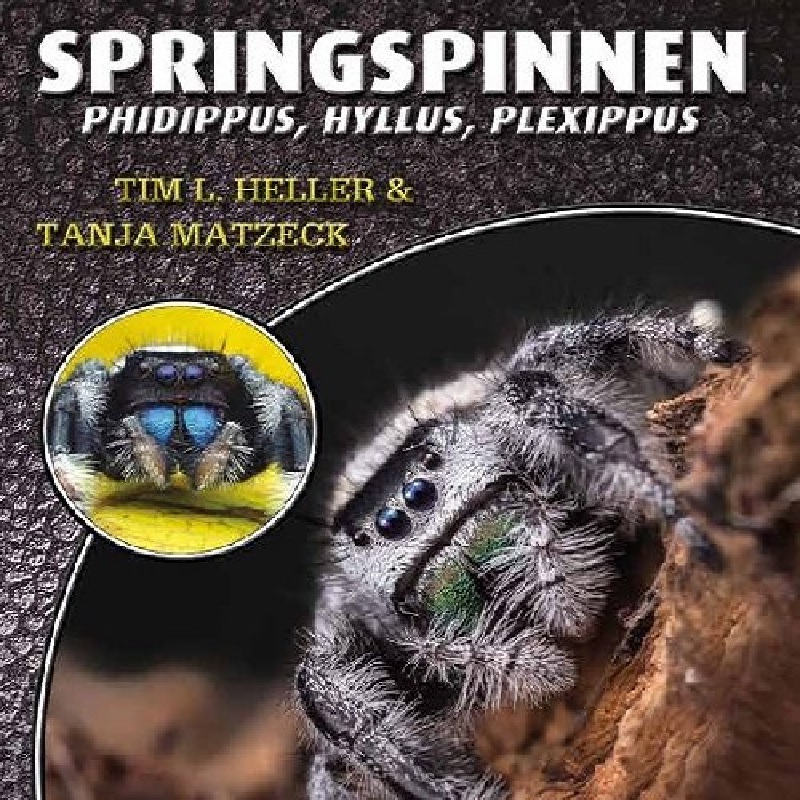
Jumping spiders Phidippus, Hyllus, Plexippus
Book Jumping Spiders - Phidippus, Hyllus & Plexippus A guide to keeping jumping spiders of the genera Phidippus, Hyllus & Plexippus. Who can resist the charm of jumping spiders? The childlike appearance of their expressive face simply leaves no one cold! In addition, their behavior is extremely exciting to observe, their colors are bright and their requirements for species-appropriate keeping are very easy to meet. No wonder these likeable jumpers are all the rage! This volume in the "Species by Species" series describes in detail what to look out for when buying and keeping them, introduces the most commonly kept species and color forms and provides plenty of tips on how to keep them successfully - so you can be sure they will breed well! Species by Species introduces you to the books in this series, which present the most popular terrarium animals. Each volume offers you detailed, practical care instructions and all the information you need to successfully breed your animals. All important questions from the required tank size to terrarium set-up, technical equipment, species-appropriate nutrition and disease prevention are answered with numerous tricks and tips. Experienced, long-standing breeders reveal how you can encourage the animals to reproduce and raise healthy young. All this in full color, generously illustrated and attractively designed - just about your terrarium animal - species by species

CHF 23.90

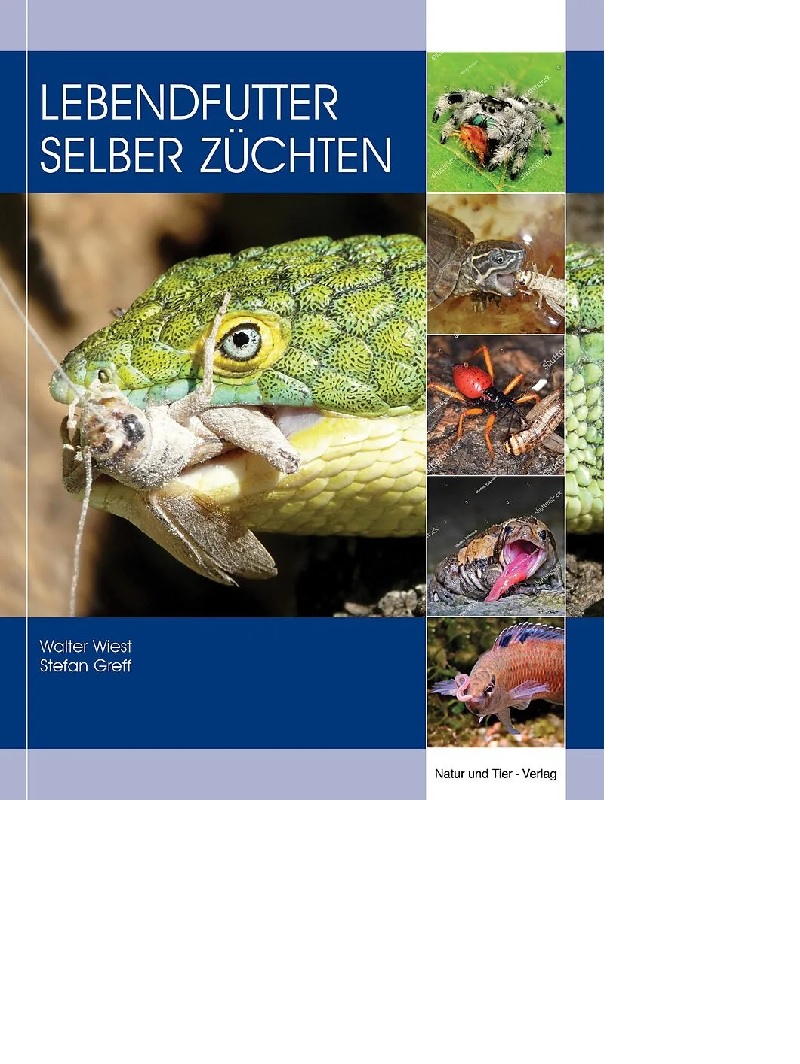
Book Breeding live food yourself
Book "Grow your own live food" - The perfect guide for pet owners Discover practical and detailed instructions on how you can easily breed food for your reptiles, birds, fish or other animals yourself in the book "Breeding live food yourself". With valuable tips on various food insects, their care and breeding, you can save money and ensure a species-appropriate diet for your pets. Contents of the book: Step-by-step instructions for breeding feeder insects Information on the best types of food for reptiles, birds and fish Care instructions and breeding conditions for various live food species Tips for sustainable and cost-effective food production Why breed your own live food? Get healthy, fresh food for your animals Save money and reduce dependence on pet shops Promote the health and well-being of your animals with species-appropriate food Whether you are a beginner or an experienced pet owner, this book provides you with everything you need to successfully breed live food yourself.

CHF 46.50

Marginata 69 - New Guinea tortoises
Marginata 69 - New Guinea tortoises – the genus ElseyaCover storyThe unrecognised beauties: New Guinea tortoises (Andreas S. Hennig)My experiences with Branderhorst's New Guinea tortoise, Elseya (Elseya) branderhorsti (Ouwens, 1914) (Andreas S. Hennig)Keeping and breeding of Rhodin's New Guinea tortoise, Elseya (Hanwarachelys) rhodini Thomson, Amepou, Anamiato & Georges, 2015 (Andreas S. Hennig)PortraitGeoemyda spengleri, Chinese serrated tortoise (Andreas S. Hennig)ReportageMacrochelys temminckii – Experiences and impressions with vulture tortoises part 2 (Reiner Praschag)KeepingAn alternative to year-round keeping of the Egyptian tortoise in the terrarium – my experiences with seasonal outdoor keeping of Testudo kleinmanni (Ricarda Schramm)EtymologySawbacks and living maps part 4: Graptemys gibbonsi, Pascagoula humpback tortoise (Holger Vetter)Classifieds & animal placement

CHF 16.50

Draco 42 - Mediterranean
Draco 42 - Mediterranean Sea Contents: The European Mediterranean region is probably the most popular holiday destination for anyone looking to find reptiles and amphibians in the wild. Here, the family holiday can be perfectly combined with highly interesting herpetological destinations. In our DRACO issue, long-standing and intimate connoisseurs of the region give you an overview of the nature, herpetofauna and exciting destinations for terrarium keepers and reptile enthusiasts. With Benny Trapp, Michael Wirth, Mario Schweiger, Martin Dieckmann, Uwe Schlüter and others, we have been able to assemble an exceptionally competent team of authors. In addition to a general overview, you can expect regional portraits of the Peloponnese, Istria and the islands of Sardinia and Cres. We also present the sand boas, the only European giant snakes, in detail. Look forward to an extraordinary and spectacularly illustrated DRACO issue, just in time for the travelling season! Editorial The Mediterranean region – landscapes and herpetofauna in southern EuropeMichael Wirth The herpetofauna of Gozo, Comino and satellite islandsUwe Schlüter Istria with a difference: arachnological experiencesVolker von Wirth and Anja Leipert The mythical islands: Cres and LošinjMartin & Karin Dieckmann Species marathon in SardiniaBenny Trapp The amphibians and reptiles of the Peloponnese peninsulaTobias Machts A life in hiding – the Western sand boa, Eryx jaculusMichael Wirth

CHF 18.40

Reptilia 85 - Snake-necked tortoises
Reptilia 85 - Snake-necked tortoisesCrocodile-tailed crested lizardBreeding of the king pythonPristidactylus valeriaeContents:The snake-necked turtles include such popular species for the aquaterrarium as the Australian representatives of the genus Chelodina or the pointed-headed turtles of the genus Emydura, but also the bizarre Mata-Mata from the waters of Amazonia or the funny toad-headed turtles of the genus Phrynops. In our cover story, we introduce you to this exciting family of turtles with lots of brilliant photos and portray some particularly interesting species in detail.Table of contentsEDITORIALMAGAZINEEcotourism de luxe: End of the chameleon conservation project in the Peloponnese?H. WerningSancho, the illegal immigrant - what to do when exotic animals are found?S. SchletchSkin-eating blind worms bred for the first timeA. Kupfer & S. ReinhardWESTERN HERP PERSPECTIVESConfusing species protectionBill LovePHOTOSTORY Snake-necked tortoises J. ValverdeKEEPING AND REPRODUCTIONThe Argentine snake-necked tortoise(Hydromedusa tectifera) - observations in biotope and terrarium D. FabiusKEEPING AND REPRODUCTION Keeping and breeding of the broad-breasted snapping turtle, Myuchelys latisternum(Elseya latisternum) H. ProkopTRAVEL Cave dwellers in the PhilippinesM. GaulkePORTRAIT AND POSTER Telescopus fallax (Fleischmann 1831). European cat snakeK. Ehrlich & B. TrappHERPETOFAUNA A conservation project for the Valeria large-headed iguana, Pristidactylus valeriae - with the support of REPTILIA B. CamousseigtKEEPING AND REPRODUCTION Versatile favourites. Experiences with Royal PythonsM. BorerKEEPING AND REPRODUCTION News on sex determination of the crocodile-tailed humpback lizard, Shinisaurus crocodilurus M. ZollwegHERPETOFAUNA Basking sites on mangrove biotopes of Phelsuma robertmertensi Meier, 1980 on the Comorian island of Mayotte P. KrauseANIMALS OF OUR HOMEA snake that is not a snake: the slow wormR. LeptienLIBRARYSUBSCRIPTION & SERVICEALSO NEAR YOUPREVIEWBRUTKASTENBag magicM. ZawadzkiDATESHeiko WerningWESTERN HERP PERSPECTIVESConfusing species protectionB. Love

CHF 12.00

Reptilia 87 - Crocodiles - prehistoric animals in danger
Reptilia 87 - Crocodiles - primeval animals in danger Jewelled box turtleDesign of rainforest terrariumsLong-nosed snake, Rhynchophis boulengeriContents:Cover story: Crocodiles – primeval animals in dangerWhen the great dinosaurs ruled the world, crocodiles were already lurking for prey in the swamps of that era. These reptiles have not changed their design significantly for millions of years – a success story of evolution. It is only today that many species are on the brink of extinction because humans are killing them en masse and, above all, destroying their habitats. With the cover story of the next REPTILIA, a high-calibre team of experts opens a series of articles that shed light on the crucial role that zoos can play in saving these living fossils. Dieter Gramentz also presents the precarious situation of the swamp and saltwater crocodile in Sri Lanka, and Ralf Sommerlad reports on a hopeful project to preserve the extremely rare Siamese crocodile.Endangered crocodiles in Europe's zoological gardens? R. Sommerlad, F. Schmidt & T. Ziegler Table of contents Editorial MAGAZINE DATES WESTERN HERP PERSPECTIVES    “Winter herping” in Florida B. Love PHOTOSTORY Crocodiles – reptile giants in danger R. Sommerlad REPORTAGE Endangered crocodiles in Europe's zoological gardens? R. Sommerlad, F. Schmidt & T. Ziegler REPORTAGE A special conservation project, not only for crocodiles: Danau Mesangat R. Sommerlad REPORTAGE Threats to and "conservation" of the swamp crocodile (Crocodylus  palustris) and the saltwater crocodile (Crocodylus porosus) in Sri Lanka D. Gramentz PORTRAIT AND POSTER Bufo bufo (Linnaeus, 1758). Common toadA. Kwet & J. Fieber PRACTICE Near-natural design of rainforest terrariums    D. Hluschi KEEPING AND REPRODUCTION Information on the care, husbandry and breeding of the  Vietnamese long-nosed snake, Rhynchophis boulengeri Mocquard, 1897 B. Schulz & K.-D. Schulz KEEPING AND REPRODUCTION Care and breeding of the Eastern jewelled box turtle, Terrapene ornata ornata M. Wirth & H. P. Mattern HERPETOFAUNA Black widows. Spiders of the genus Latrodectus C. Nagel & R. Hübers SUBSCRIPTION & SERVICE ALSO NEAR YOU PREVIEW  INCUBATOR Borderlands. Part 2 H. Werning 

CHF 12.00

Reptilia 04 - Bird spiders
Reptilia 04 - Tarantulas SkinkThailandMysticism & superstition Contents: Page 2 - EditorialPage 3 - Letters to the editorPage 6 - MagazinePage 17 - Photo reportage: Tarantulas, by P. KlaasPage 23 - Keeping and reproduction: Keeping and breeding tarantulas, by P. KlaasPage 26 - Terraristics and law: Legal issues in keeping spiders and scorpions, by D. RösselPage 27 - Report: A feast of tarantulas, by R. WestPage 30 - Psychology: Arachnophobia, by L. HogebackPage 33 - Travelogue: Thailand - Mecca of herpetological tourism, by J. BergadáPage 37 - Travelogue: The snake farm of Bangkok, by J. ViaderPage 39 - Portrait and poster: Chondropython viridis, by M. Aresté and J. L. FarriolsPage 43 - Herpetofauna: Skinks, by P. Gassner and A. HauschildPage 50 - Reptilia on the road: Terrarium displays, by H. WerningPage 54 - Terraristics and law: Snake keeping in residential property and tenancy law, by D. RösselPage 57 - Herpetology and Culture: Magic and Superstition, Part 1: Turtles and Amphibians, by L. B. Carissimi-PriorPage 62 - Terraristics: Egg-laying problems with tortoises, by E. MeierPage 69 - Supplement: Venomous snakesPage 74 - Advice and actionPage 76 - LibraryPage 80 - Incubator: Glossary by H. Werning

CHF 9.80

Terraria 57 - Reptiles and amphibians in danger
Terraria 57 - Reptiles and amphibians in danger Breeding rare crocodilesGiant lizards on La Gomera Contents: Cover story: Reptiles and amphibians in danger Reptiles and amphibians are among the most endangered animal groups on the planet. The main reason is that humans are destroying their habitats. But environmental factors that have become unbalanced, diseases, environmental toxins, traffic and hunting are also harming them. Herpetologists and terrarium keepers are fighting a desperate but committed battle against the extinction of many species. We are dedicating this probably most important topic of our field of interest an entire special issue of TERRARIA/elaphe and not only trace the current threat situation, but also present encouraging species conservation projects from scientists, conservationists and terrarium keepers on site, in zoos and in private terrariums. TerritorialHerpetoramaImport ban on salamanders and newts to Switzerland: Why?Cultural followers: Amphibian muralismThorny devil: The gecko beast with the leaf-like flat tailPrivate individuals and zoos protect highly endangered salamanders togetherFirst aid in the wild: Antifungal agent for the Mallorca midwife toad Blattsteiger: Moat 2.0 Cover storyThe biodiversity crisis Amphibians and reptiles in dangerAxel Kwet & Heiko Werning Honeycomb toads from French Guiana.  Observations in the habitat and establishing a conservation breeding projectDavid Massemin & Cédric Libert PanoramaConcern for a small frog. How a project for nose frogs was initiated and continues to growFrank Oberwemmer Research New speciesNewly described, threatened with extinction: the Galápagos giant tortoises of Cerro FatalAxel Kwet Among researchersGreen toads on the island of FehmarnMoritz Ott Current situation and endangerment of Madagascar's amphibiansJörn Köhler, Frank Glaw & Miguel Vences Salamandra Terrarium husbandryPrivate care and breeding of endangered crocodilesAlexander Meurer Nature and species conservation Field notesAquatic turtles with “fur” – observations in GreeceBenny Trapp An unusually coloured Redi viper (Vipera aspis francisciredi) from the Swiss MünstertalJürgen Gebhart The return of the giants from La GomeraSergi Conde Lázaro  Terrarino – the children’s page Cool diversity. Endangered and protectedUte Nüsken & Alexa Sabarth Also in your areaSubscription & ServicePreview Incubator The forest is a villageHeiko Werning

CHF 12.00

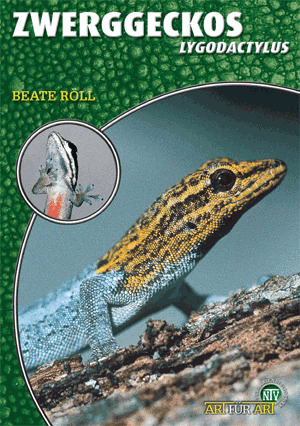
Dwarf geckos Lygodactylus
Beate Röll 64 Seiten 14,8 x 21 cm 49 Farbfotos Inhalt: Sie lieben kleine, agile, attraktiv gefärbte Echsen oder haben nur wenig Platz für ein Terrarium zur Verfügung? Dann werden Sie die munteren, hübschen Zwerggeckos ganz sicher in ihren Bann ziehen. Ihre geringen Ansprüche an die Pflege können auch von unerfahrenen Haltern leicht erfüllt werden, was diese Tiere zu geradezu idealen Pfleglingen macht. Beate Röll kennt sich mit diesen netten Echsen bestens aus und berichtet aus ihrer langjährigen Erfahrung ausführlich und praxisnah über die artgerechte Haltung und Pflege von Zwerggeckos. Außerdem vermittelt sie Ihnen alle Kenntnisse, die Sie benötigen, um Ihre Tiere erfolgreich zur Vermehrung bringen, die Eier ausbrüten und die Kleinen aufziehen zu können. Systematik und Körperbau Die faszinierende Biologie: Aus dem Leben der Zwerggeckos Alle Informationen zur artgerechten Haltung: Vom geeigneten Terrarium über Einrichtung und Technik bis hin zur Fütterung Erfolgreich nachzüchten: Paarungsstimulation, Inkubation der Eier und Aufzucht der Jungtiere Problemlösungen: Wie man die häufigsten Fehler bei der Pflege vermeidet, und wie man kranken Tieren helfen kann Brillante Fotos

CHF 21.90

Reptilia 63 - Small monitor lizards
Reptilia 63 - Small monitor lizards ThailandLizards in the greenhouseRespiratory diseases in tortoises Contents: 2 EDITORIAL 3 MAGAZINE 11 DATES 14 WESTERN HERP PERSPECTIVESThe luxury point of viewBy B. Love 16 PHOTO REPORTAGESmall monitor lizards in the terrariumBy B. Eidenmüller 24 KEEPING AND BREEDINGKeeping and breeding of the spiny-tailedmonitor lizard (Varanus acanthurus)By S. Arth 34 KEEPING AND BREEDINGVaranus boehmei, keeping and first-timebreeding in the terrariumBy M. Reisinger & D. Reisinger-Raweyai 39 KEEPING AND BREEDINGKeeping, care and breeding ofVaranus macraeiBy A. Dedlmar 42 TRAVELThailand - fascination herpetofaunaBy F. Longhitano 51 PORTRAIT AND POSTERLiophis jaegeriBy A. Kwet 56 REPORTAGEFrog societies in South AmericaBy D. Rödder, G. Zeidan, W. Pertel & R. L. Teixeira 64 PRACTICEKeeping lizards in the greenhouseBy D. Prötzel 71 KEEPING AND BREEDING Truly a jewel in the terrarium: Ampulex compressaBy T. Ramann 75 HERPETIC MEDICINERespiratory diseases in tortoises:recognise, treat, preventBy U. Eggenschwiler 80 TERRARIUM EXHIBITIONSThe reptile and amphibian exhibition of the Dusit Zoo in BangkokBy J. Bulian 87 FAQ - FREQUENTLY ASKED QUESTIONSAcquisition of royal pythons (Python regius)By T. Kölpin 91 HERPETOCULTUREThe lion for Bavaria, the bear for Berlin, the chameleon for...?By J. Wolf 94 LIBRARY 104 INCUBATOR specialAt night in the museumBy H. Werning & L. Hogeback

CHF 11.20