Land turtles book

Article no: 14475

CHF 21.90

Stock: 0

Ready for dispatch in 1-3 days, delivery time 14 working days

Delivery between Tuesday, 19 May and Wednesday, 20 May
Zahlungsarten
Product information "Land turtles book"

Landschildkröten-Fibel - Der Schildkrötenfachmann Marco Wagemann beantwortet mit diesem Buch alle wichtigen Fragen über die Haltung und Pflege der Landschildkröten.

  • 96 Seiten
  • 150 Fotos
  • gebunden
  • 1. Auflage 2014
  • Autor Marco Wagemann
  • Verlag Dähne Verlag

Das Fibel ist ein ideales Einsteiger Buch und beantwortet alle wichtigen Fragen über die Haltung und die Pflege der Landschildkröten wie zum Beispiel: Worauf beim Kauf geachtet werden muss, wie sich ein Freigehege anlegen lässt und wie es zu beschaffen ist, über die Ernährung und über eine artgerechte Überwinterung. Es werden auch die wichtigsten europäischen Arten aus den Ländern rund um das Mittelmeer vorgestellt.

Composition
Feeding recommendation
Technical details
Size information

0 of 0 reviews

Give us a rating!

Share your experience with the product with other customers.


Suggested products

Handbook of food plants for tortoises and other reptiles
Handbook of forage plants 2nd revised editionMarion Minch is not only a successful breeder of diverse tortoises for many years, but also an excellent connoisseur of native wild herbs. She founded and runs samenkiste.de, which is well known to many tortoise keepers and nature lovers. Her name is inextricably linked with reptile care and species-appropriate nutrition for tortoises. Her handbook of food plants summarises the most important native food plants for herbivorous and omnivorous reptiles. She not only considers tortoises, but also iguanas, spiny-tailed dragons and even chameleons. From the basics of plant biology to native wild herbs to suitable food plants for hardy tropical reptile species, this comprehensive work provides the basis for species-appropriate keeping. In the expanded and supplemented 2nd edition, the plant section is divided according to flower colour. This makes it even easier to identify wild herbs. The work has also been supplemented with a wealth of additional information and many pictures.

CHF 46.50

Geckos
Geckos in the terrarium by Astrid FalkThe book offers a comprehensive introduction to geckos and their species-appropriate keeping in terrariums. It explains what you need to think about before buying a gecko and what preparations should be made. The book describes in detail how the terrarium is technically equipped and set up. The care of the animals, their special features and behaviour, their diet, reproduction and rearing of young animals are described, as well as diseases and husbandry problems with tried and tested suggestions for prevention and treatment. Individual gecko species that are particularly suitable for keeping and breeding in terrariums are portrayed in detail in the second part of the book.

CHF 28.50

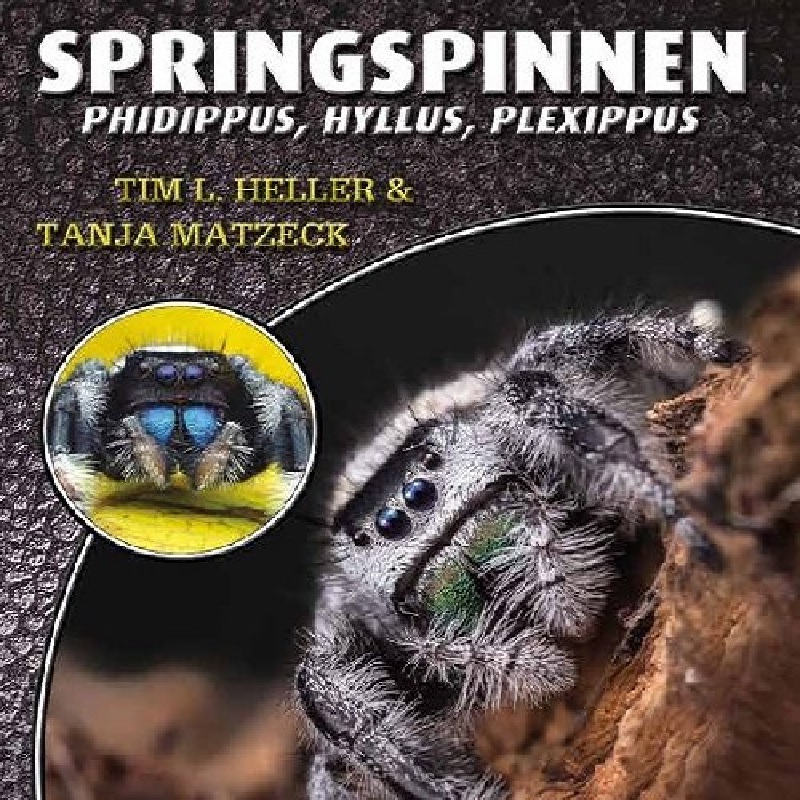
Jumping spiders Phidippus, Hyllus, Plexippus
Book Jumping Spiders - Phidippus, Hyllus & Plexippus A guide to keeping jumping spiders of the genera Phidippus, Hyllus & Plexippus. Who can resist the charm of jumping spiders? The childlike appearance of their expressive face simply leaves no one cold! In addition, their behavior is extremely exciting to observe, their colors are bright and their requirements for species-appropriate keeping are very easy to meet. No wonder these likeable jumpers are all the rage! This volume in the "Species by Species" series describes in detail what to look out for when buying and keeping them, introduces the most commonly kept species and color forms and provides plenty of tips on how to keep them successfully - so you can be sure they will breed well! Species by Species introduces you to the books in this series, which present the most popular terrarium animals. Each volume offers you detailed, practical care instructions and all the information you need to successfully breed your animals. All important questions from the required tank size to terrarium set-up, technical equipment, species-appropriate nutrition and disease prevention are answered with numerous tricks and tips. Experienced, long-standing breeders reveal how you can encourage the animals to reproduce and raise healthy young. All this in full color, generously illustrated and attractively designed - just about your terrarium animal - species by species

CHF 23.90

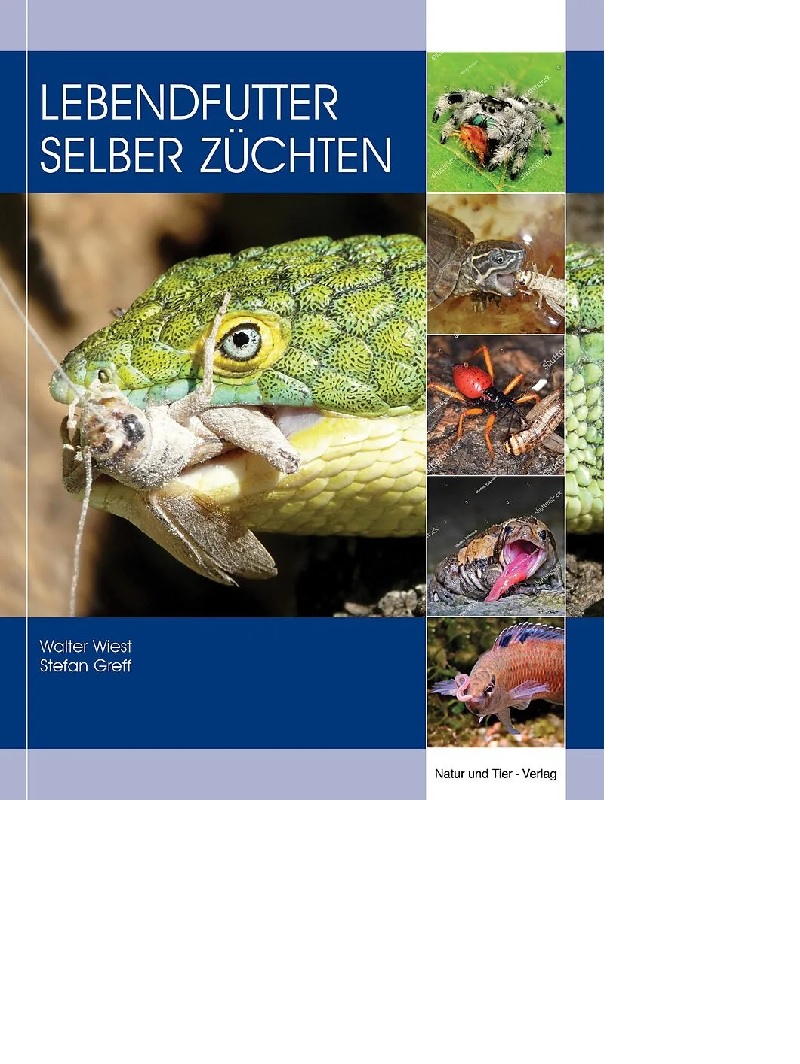
Book Breeding live food yourself
Book "Grow your own live food" - The perfect guide for pet owners Discover practical and detailed instructions on how you can easily breed food for your reptiles, birds, fish or other animals yourself in the book "Breeding live food yourself". With valuable tips on various food insects, their care and breeding, you can save money and ensure a species-appropriate diet for your pets. Contents of the book: Step-by-step instructions for breeding feeder insects Information on the best types of food for reptiles, birds and fish Care instructions and breeding conditions for various live food species Tips for sustainable and cost-effective food production Why breed your own live food? Get healthy, fresh food for your animals Save money and reduce dependence on pet shops Promote the health and well-being of your animals with species-appropriate food Whether you are a beginner or an experienced pet owner, this book provides you with everything you need to successfully breed live food yourself.

CHF 46.50

Marginata 69 - New Guinea tortoises
Marginata 69 - New Guinea tortoises – the genus ElseyaCover storyThe unrecognised beauties: New Guinea tortoises (Andreas S. Hennig)My experiences with Branderhorst's New Guinea tortoise, Elseya (Elseya) branderhorsti (Ouwens, 1914) (Andreas S. Hennig)Keeping and breeding of Rhodin's New Guinea tortoise, Elseya (Hanwarachelys) rhodini Thomson, Amepou, Anamiato & Georges, 2015 (Andreas S. Hennig)PortraitGeoemyda spengleri, Chinese serrated tortoise (Andreas S. Hennig)ReportageMacrochelys temminckii – Experiences and impressions with vulture tortoises part 2 (Reiner Praschag)KeepingAn alternative to year-round keeping of the Egyptian tortoise in the terrarium – my experiences with seasonal outdoor keeping of Testudo kleinmanni (Ricarda Schramm)EtymologySawbacks and living maps part 4: Graptemys gibbonsi, Pascagoula humpback tortoise (Holger Vetter)Classifieds & animal placement

CHF 16.50

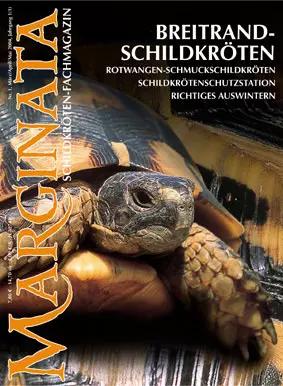
Marginata 01 - Marginated tortoise
Marginata 01 - Broad-shelled tortoises Articulated tortoises Turtle conservation stationCorrect wintering Contents: 2 EDITORIAL 3 ADVISORY BOARD 5 MAGAZINE 10 PHOTO REPORTAGEBroad-shelled tortoises – the most impressive and largest land tortoises in EuropeHans - Dieter Philippen 18 REPORTKeeping and breeding of the broad-shelled tortoiseMatthias Mähn 24 REPORTAGEThe Sardinian population of the broad-shelled tortoiseWolfgang Wegehaupt 31 PORTRAITIndian flapshell softshell turtleMatthias Mähn 36 REPORTAGERemarks on the biology and alternative keeping and breeding of Kinixys belliana nogueyi (LATASTE, 1886)Irmtraud Jasser-Häger and Hans - Dieter Philippen 46 REPORTAGERed-eared slider turtles – Threatening newcomers?Hans - Dieter Philippen 48 REPORTAGEHibernation in European land tortoisesNatural, physiological preparation and “wake-up phase” Markus Baur and R. W. Hoffmann 55 ADVICE & ACTION 56 CLASSIFIEDS 57 REPORTAGEOfficial opening of the International Centre for Turtle Conservation – a look in front of and behind the scenesHans - Dieter Philippen 63 REGIONAL GUIDE 64 AGATHA MARGINATA

CHF 14.70

Reptilia 144 - American Earth Turtles
Reptilia 144- American tortoises Photo storyAmerican tortoises of the genus Rhinoclemmys – from disposables to unicornsBy S. Ettmar REPORTAGEThe American tortoises of ColombiaBy J. Cañas-Orozco Keeping and breedingKeeping and breeding the Guerrero tortoise, Rhinoclemmys pulcherrima pulcherrimaBy C. Godart Keeping and breedingKeeping and breeding the tiger snake (Rhabdophis tigrinus)By A. Walter Keeping and breedingJewellery, supermodel, delicacy: the milkweed bugBy K. Kunz Keeping and breedingThe fascination of sail lizards – keeping and comparing different species of the genus Hydrosaurus Part 2By O. Fischer SERVICEALSO NEAR YOU         JourneyWe're staying at home! Herping in the Corona summer 2020By B. Trapp PREVIEW BRUTKASTEN And it made zoomBy H. Werning  

CHF 13.50

NTV - Water dragons and sail lizards
The author of NTV - Wasseragamen und Segelechsen describes everything about keeping and caring for these interesting terrarium animals. 127 pages 118 colour photos and 6 map drawings Paperback About water dragons and sea lizards Author Heiko Werning The large water dragons of the genus Physignathus are undoubtedly among the most attractive and interesting terrarium animals. Their impressive shape, their primeval appearance reminiscent of mythical creatures and their lively behaviour have fascinated entire generations of terrarium keepers. Unfortunately, the popularity of water dragons has not been sufficiently recognised in the literature to date. This monograph by REPTILIA editor Heiko Werning completely fills this gap. It contains all the important information on the biology, origin and care of these animals. The breeding of the green water dragon Physigathus cocincinus, which the author has already successfully bred many times, is dealt with in particular detail. The author also describes the lesser-known genus Lophognathus in detail. In addition to the water dragons, the anatomy and behaviour of the Hydrosaurus lizards, which are similar in appearance, are also discussed. The book is characterised by Werning's practical approach and detailed knowledge: it is not only an absolute must for all terrarium keepers who are interested in these fascinating lizards, but also has scientific merit.

CHF 35.90

Reptilia 117 - Amphibian Rarities
Reptilia 117 - Amphibian raritiesFlooridaNight lizardIberian adderContents: Cover story: Amphibian raritiesIn all amphibian groups there are species which, for various reasons, are not kept as frequently in terrariums as fire salamanders, dyer frogs etc.: some species are only imported rarely and in small numbers, some have no lobby, others are highly sought after but not easy to breed.In the cover story of this issue of REPTILIA, we present such rarities in detail - with captivating photos and detailed reports on extremely pleasing breeding successes. We also visit a project in South America in which species sought after by terrarists are selectively propagated - and which simultaneously promotes science, nature conservation and environmental education.EditorialMAGAZINEDATES WESTERN HERP PERSPECTIVESThe fate of books, part 1B. LovePhoto storyAmphibian raritiesK. KunzKeeping and breedingCharming little fellows: Keeping and breeding Riobamba pouched frogs (Gastrotheca riobambae)D. SchmidtKeeping and breedingBreeding a Ryabov’s Phantom Moss Frog (Theloderma ryabovi) in a terrariumE. RyboltovskyReportageSustainable marketing of frogs for terraristics in EcuadorS. CondeKeeping and breedingKeeping and breeding the Iberian viper (Vipera seoanei)A. SchmidServicesKeeping and breedingCare and breeding of the night lizard Lepidophyma smithiG. KöhlerReportageTuataras. The living fossils of New ZealandO. DrewesAlso in your neighbourhoodJourneyThe great trek. Part 1: Melting Pot South FloridaH. WerningPreviewIncubatorNobody warns you about this before you have childrenH. Werning

CHF 12.00

Terraria 04 - Strawberry Poison Frog
Terraria 04 - Strawberry Frogs Green water dragonPatagonia Contents: 2 EditorialMatthias SchmidtTOPIC 3 • Diverse like no other: the strawberry frogKarl-Heinz Jungfer 12 • In search of strawberry frogs in Costa Rica and PanamaPeter Janzen 17 • Strawberry frogs and their poison Dietrich Mebs 22 • Keeping and breeding the strawberry frog (Oophaga pumilio)Peter Janzen & Manfred SalewskiSCIENCE 28 New speciesList of new amphibian and reptile species described in 2006Axel Kwet 40 Ornate tortoises – the genus Pseudemys Gray, 1844Part 3: Keeping, reproduction, literatureAndreas S. Hennig 47 Pointed snakes (genus Oxybelis Wagler, 1830) in the terrariumAndreas Hohmeister 54 Keeping and breeding the green water dragon(Physignathus cocincinus)Kerstin Franke 63 Lycosa erythrognatha – Keeping and breeding the red pine tarantulaThomas Bamann68 TRAVELThrough the vastness of PatagoniaHeiko WerningTERRARIUM PRACTICE 81 Test runAlternative terrarium types from the pet tradeKriton Kunz 86 Prelude Keeping and breeding the colourful masked iguana(Leiocephalus personatus)Julius Kramer 89 Eye-catcherKellerkinder – of geckos, turtles and a touch of South AfricaMike Zawadzki 93 Also in your neighbourhood 96 TERRAnetAdders and vipers / African tarantulas 97 TERRAglobalSpectacular frog migration in Kakadu National ParkKarl H. SwitakFatal – the call of the TokehMark Auliya & Chris Shepherd 104 TERRAwinn

CHF 11.20

Marginata 27 - Red-footed tortoise
Marginata 27 - Charcoal-burning tortoise Iranian tortoises: Part 2Sea turtles from SipadanDry resting of pond turtles Contents: EditorialMagazineDates REPORTAGEThe Charcoal-burning tortoise (Chelonoidis carbonaria)Hans - Dieter Philippen REPORTAGECharcoal-burning tortoises (Chelonoidis carbonaria ssp.) observed in the wild in the Lesser AntillesPeter Fehringer BREEDINGAlmost 40 years of keeping and breeding tortoises using the charcoal-burning tortoise as an example Victor Mislin REPORTAGECharcoal-burning tortoises on the island of Barbuda – an unusual experience during a short stayPeter Fehringer REPORTAGEAlbino charcoal-burning tortoises – a common mutationHans – Dieter Philippen POSTERThe Western Malayan pond turtleHans - Dieter Philippen REPORTAGESipadan – the island of sea turtlesPetra Jungnickel & Jens Jungnickel REPORTAGEObservations of freshwater turtles in Iran Part 2: Mauremys caspicaMarkus Auer & Mario Herz REPORTAGEAestivation of European pond turtles in SpainJochen Meyer BREEDINGComments on the breeding of Pyxidea m. mouhotii and P. m. obsti as well as observations on plastron colouration of the juveniles Herbert Becker REPORTAGEAdder eats European pond turtle Michael Wirth Book tipClassifiedsSubscription & ServiceRegional guide

CHF 16.50

Reptilia 90 - Breeding of poison dart frogs
Reptilia 90 - Breeding of poison dart frogs Reptil des Jahres: MauereidechseSchmuckschildkrötenPazifikboa Inhalt: EditorialMAGAZINTERMINEWESTERN HERP PERSPECTIVESSweet (New) Home ArizonaB. LoveFOTOSTORYDie Zucht von PfeilgiftfröschenM. Wirth &  F. RiedelHaltung und Nachzucht Haltung und Nachzucht des Schrecklichen Pfeilgiftfroschs, Phyllobates terribilis M. Wirth & F. RiedelNACHZUCHTDas Einmaleins der QuappenaufzuchtM. SchmidtREISE Eine herbstliche Stippvisite in MontenegroB. TrappPORTRÄT UND POSTERPhrynosoma platyrhinos. WüstenkrötenechseH. WerningHerpetofaunaAuf dem Weg ins All. Die Welt der Buchstaben-Schmuckschildkröte, Trachemys scripta Teil 1A. S. HennigHerpetofaunaDie Mauereidechse – Reptil des Jahres 2011U. Schulte, A. Kwet & A. NöllertHALTUNG UND ZUCHTCandoia paulsoni paulsoni: Haltung und Nachzucht der Pazifikboa M. Borer & L. MeierREPORTAGEMit Schülerpraktikanten in der Iguana-Station auf der Insel Utila, Honduras Teil 1: Eine neue Herausforderung M. HallmenBibliothekABO & SERVICEAUCH IN IHRER NÄHEVORSCHAUBRUTKASTEN Klapperschlangen und Mexikaner Teil 1 H. Werning  

CHF 12.00