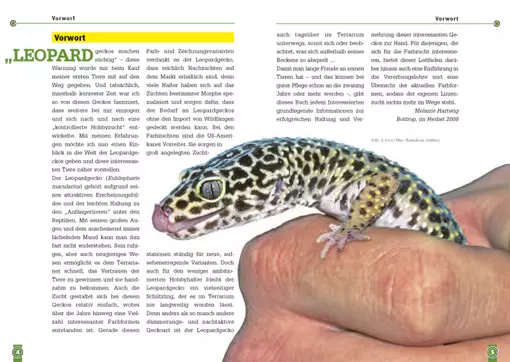
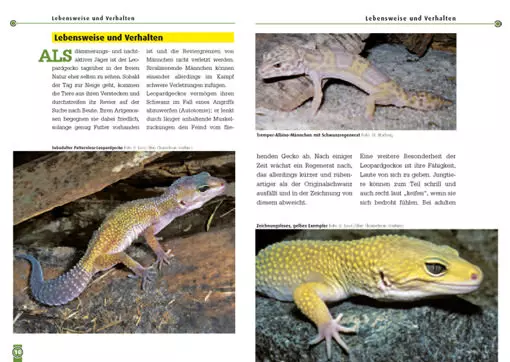

The leopard gecko

Article no: HA-AB10858

CHF 21.90

Stock: 1

Available, delivery time: 1-3 days

Delivery between Tuesday, 5 May and Wednesday, 6 May
Zahlungsarten
Product information "The leopard gecko"

All about the leopard gecko by Melanie Hartwig

  • 64 pages
  • Format: 14.8 x 21 cm
  • 70 colour photos
  • 1 map
  • Paperback
  • Author Melanie Hartwig

Contents:

  • Foreword
  • Description
  • Distribution and natural habitat
  • Lifestyle
  • Legal regulations and acquisition
  • Transport and quarantine
  • Terrarium and technology
  • The terrarium setup
  • Care and diet
  • Hibernation
  • Propagation
  • Rearing the young
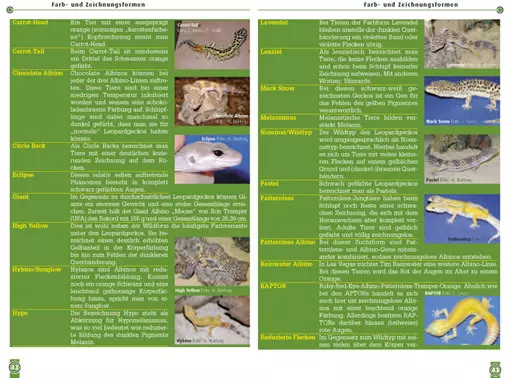
  • Colour and pattern forms
  • Basics of the theory of heredity
  • Diseases
  • Socialisation
  • Further information
  • Thanks
  • Literature used and further reading
Composition
Feeding recommendation
Technical details
Size information

0 of 0 reviews

Give us a rating!

Share your experience with the product with other customers.


Customers also bought

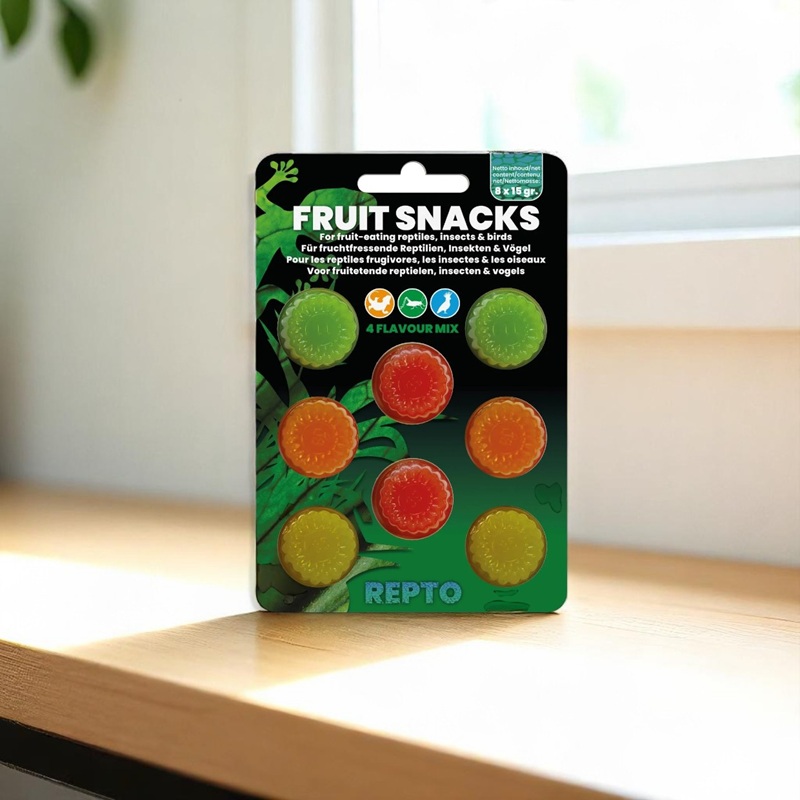
Repto Fruit Mix 8x15g
Repto Fruit Snacks - Fruity treats for reptiles, birds & insectsRepto Fruit Snacks are the ideal supplement for all animals that feed on nectar and fruit in the wild. Whether reptiles, birds or insects - these fruity snacks are enthusiastically accepted and offer a tasty change to the daily menu.Available as a practical mix pack, the snacks provide variety and natural feeding stimuli. For easy feeding, the cups can be combined with the optional snack holder and placed flexibly in the terrarium or bird cage - even in an elevated position. Product benefits: Ideal for: Nectar and fruit eaters such as reptiles, birds & insects Mix pack: with 4 delicious varieties Feeding: Can be placed individually or with a practical holder Application: Perfect for terrariums, bird aviaries & insect habitats

CHF 3.90

Willow bridge from natural wood
Variant: 22x10cm | Variant (1): 22x10cm
Trixie natural wood willow bridge Trixie natural wood willow bridge for small animals, birds and tortoises untreated natural wood Suitable for all small animals, birds and tortoises Flexible Shelter Sizes: 22x10cm, 28x17cm, 51x30cm and 65x40cm The willow bridge can be safely gnawed on by small animals as it is made from untreated natural wood. By offering natural wood and nibbling wood, the small animals' teeth are worn down naturally and do not have to be cut back. The willow bridge is suitable for all small animals, for all birds and also for tortoises as a shelter.

CHF 3.90

Suggested products

Handbook of food plants for tortoises and other reptiles
Handbook of forage plants 2nd revised editionMarion Minch is not only a successful breeder of diverse tortoises for many years, but also an excellent connoisseur of native wild herbs. She founded and runs samenkiste.de, which is well known to many tortoise keepers and nature lovers. Her name is inextricably linked with reptile care and species-appropriate nutrition for tortoises. Her handbook of food plants summarises the most important native food plants for herbivorous and omnivorous reptiles. She not only considers tortoises, but also iguanas, spiny-tailed dragons and even chameleons. From the basics of plant biology to native wild herbs to suitable food plants for hardy tropical reptile species, this comprehensive work provides the basis for species-appropriate keeping. In the expanded and supplemented 2nd edition, the plant section is divided according to flower colour. This makes it even easier to identify wild herbs. The work has also been supplemented with a wealth of additional information and many pictures.

CHF 46.50

Geckos
Geckos in the terrarium by Astrid FalkThe book offers a comprehensive introduction to geckos and their species-appropriate keeping in terrariums. It explains what you need to think about before buying a gecko and what preparations should be made. The book describes in detail how the terrarium is technically equipped and set up. The care of the animals, their special features and behaviour, their diet, reproduction and rearing of young animals are described, as well as diseases and husbandry problems with tried and tested suggestions for prevention and treatment. Individual gecko species that are particularly suitable for keeping and breeding in terrariums are portrayed in detail in the second part of the book.

CHF 28.50

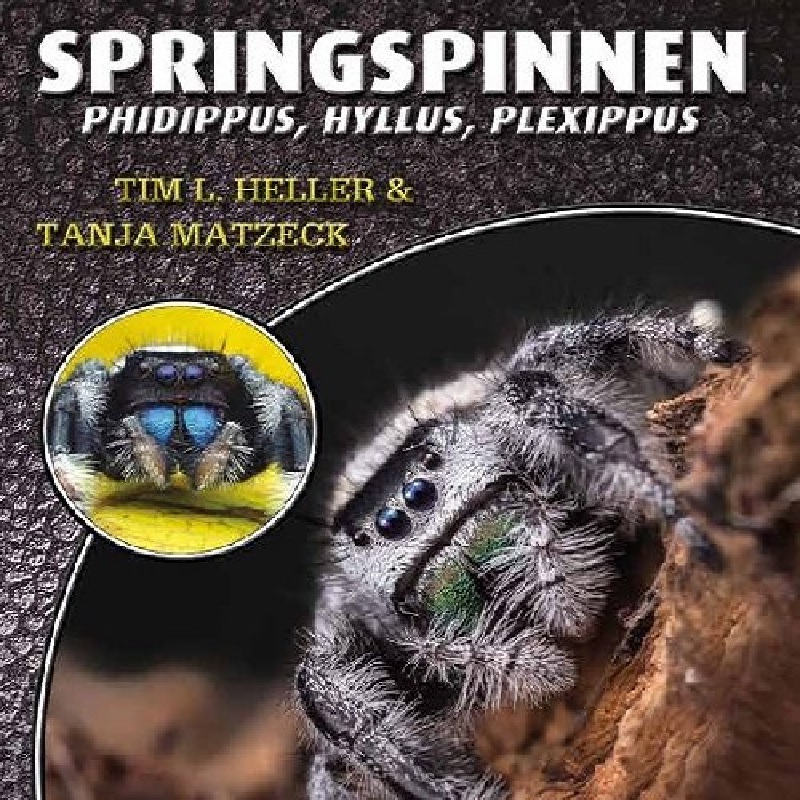
Jumping spiders Phidippus, Hyllus, Plexippus
Book Jumping Spiders - Phidippus, Hyllus & Plexippus A guide to keeping jumping spiders of the genera Phidippus, Hyllus & Plexippus. Who can resist the charm of jumping spiders? The childlike appearance of their expressive face simply leaves no one cold! In addition, their behavior is extremely exciting to observe, their colors are bright and their requirements for species-appropriate keeping are very easy to meet. No wonder these likeable jumpers are all the rage! This volume in the "Species by Species" series describes in detail what to look out for when buying and keeping them, introduces the most commonly kept species and color forms and provides plenty of tips on how to keep them successfully - so you can be sure they will breed well! Species by Species introduces you to the books in this series, which present the most popular terrarium animals. Each volume offers you detailed, practical care instructions and all the information you need to successfully breed your animals. All important questions from the required tank size to terrarium set-up, technical equipment, species-appropriate nutrition and disease prevention are answered with numerous tricks and tips. Experienced, long-standing breeders reveal how you can encourage the animals to reproduce and raise healthy young. All this in full color, generously illustrated and attractively designed - just about your terrarium animal - species by species

CHF 23.90

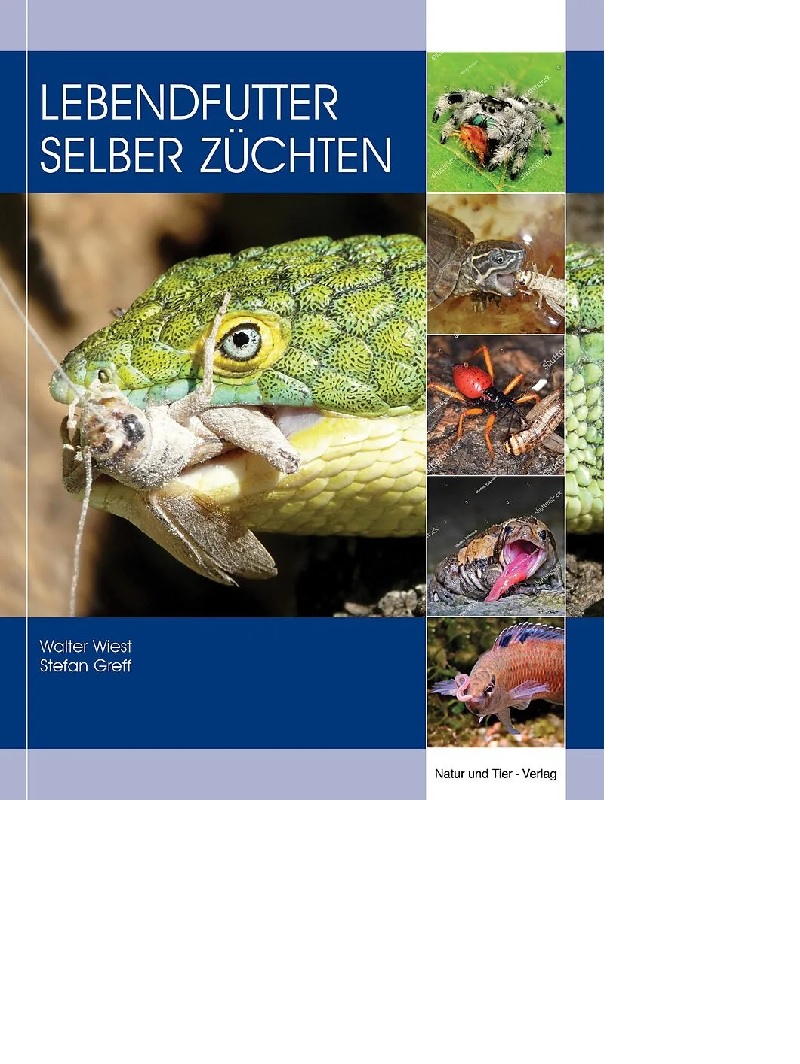
Book Breeding live food yourself
Book "Grow your own live food" - The perfect guide for pet owners Discover practical and detailed instructions on how you can easily breed food for your reptiles, birds, fish or other animals yourself in the book "Breeding live food yourself". With valuable tips on various food insects, their care and breeding, you can save money and ensure a species-appropriate diet for your pets. Contents of the book: Step-by-step instructions for breeding feeder insects Information on the best types of food for reptiles, birds and fish Care instructions and breeding conditions for various live food species Tips for sustainable and cost-effective food production Why breed your own live food? Get healthy, fresh food for your animals Save money and reduce dependence on pet shops Promote the health and well-being of your animals with species-appropriate food Whether you are a beginner or an experienced pet owner, this book provides you with everything you need to successfully breed live food yourself.

CHF 46.50

Marginata 69 - New Guinea tortoises
Marginata 69 - New Guinea tortoises – the genus ElseyaCover storyThe unrecognised beauties: New Guinea tortoises (Andreas S. Hennig)My experiences with Branderhorst's New Guinea tortoise, Elseya (Elseya) branderhorsti (Ouwens, 1914) (Andreas S. Hennig)Keeping and breeding of Rhodin's New Guinea tortoise, Elseya (Hanwarachelys) rhodini Thomson, Amepou, Anamiato & Georges, 2015 (Andreas S. Hennig)PortraitGeoemyda spengleri, Chinese serrated tortoise (Andreas S. Hennig)ReportageMacrochelys temminckii – Experiences and impressions with vulture tortoises part 2 (Reiner Praschag)KeepingAn alternative to year-round keeping of the Egyptian tortoise in the terrarium – my experiences with seasonal outdoor keeping of Testudo kleinmanni (Ricarda Schramm)EtymologySawbacks and living maps part 4: Graptemys gibbonsi, Pascagoula humpback tortoise (Holger Vetter)Classifieds & animal placement

CHF 16.50

The dwarf bearded dragon
All about dwarf bearded dragons by Martin Dieckmann 64 pages Format: 14.8 x 21 cm 55 colour photos Paperback Author Martin Dieckmann Contents: Systematics and body structure  The fascinating biology: From the life of the dwarf bearded dragon All information on species-appropriate keeping: from suitable terrariums to equipment and technology to feeding Successful breeding: Mating stimulation, incubation of eggs and rearing of hatchlings Solutions to problems: How to avoid the most common mistakes in care and how to help sick animals Brilliant photos

CHF 18.50

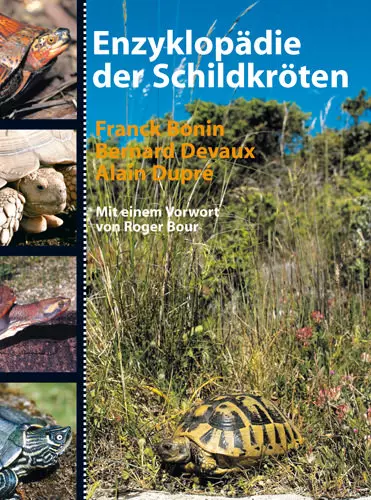
Chimaira, Encyclopedia of turtles
Chimaira, encyclopaedia of turtlesThis encyclopaedia provides a comprehensive overview of recent turtles. For each species, the most important data on appearance and behaviour have been compiled; the authors were able to go into particular detail on remarkable aspects of morphology or biology, explain a recent discovery or a little-known observation. Endangerment and protection of the respective turtle species are dealt with in detail. The protection of species, but also the protection of habitats, which is just as important for the conservation of the species, are key motifs here. In this way, the threats to each species are systematically presented on the one hand, and the laws that have been passed to protect them and the protective measures that have been introduced to conserve them are listed on the other

CHF 63.50

Reptilia 121 - More light - Terrarium lighting for sun-loving reptiles
Reptilia 121 - More lightTerrarium lighting for sun-loving reptiles CubaTerrarium for emerald monitor lizardsPeacock-eyed terrapinsContents:Cover story: More light! – Terrarium lighting for sun-loving reptilesThere are few topics that occupy terrarium keepers as much as the question of the right lighting, especially for sun-loving species. Which lamps give off the most light, how do I ensure that my animals get enough UV rays, what do I need to do to provide the ideal lighting? In our cover story, we take a closer look at this sometimes complex subject and analyse the suitability of HQI spotlights & co. as terrarium lamps. EditorialMAGAZINEDATES WESTERN HERP PERSPECTIVESA political view of today's terrarium challengesB. Love REPORTAGEThe right terrarium lighting for chameleons and other reptilesM. Grimm Terrarium technologyMetal halide lamps in terrariumsU. Geissel Keeping and breedingPeacock-eyed terrapins. The genus SacaliaM. Rogner ReportageA lifelong dream comes true. 40 years Reptile House UnteruhldingenA. Kwet TerraristicsA terrarium for the emerald monitor (Varanus prasinus)S. & S. Leber SERVICE Animals of our homelandThe little water frogR. Leptien ALSO NEAR YOU JourneyCuba all inclusive. Part 2: the centre and the westI. Kober PREVIEW BRUTKASTEN A day with ReinerJ. Bulian

CHF 12.00

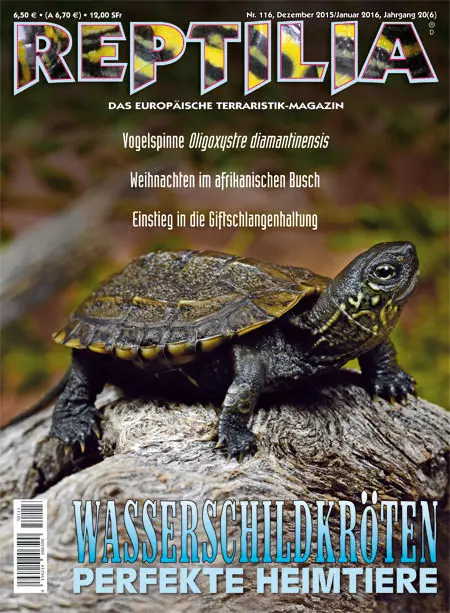
Reptilia 116 - Aquatic turtles - Perfect pets
Reptilia 116 - Aquatic turtles - Perfect pets Tarantula Oligoxystre diamantinensisChristmas in the African bushIntroduction to keeping venomous snakesContents: Cover story: Aquatic turtles – perfect petsAquatic turtles have enjoyed great popularity for decades. For a long time, however, small baby turtles were offered in pet shops for little money and ended up mainly with keepers who were not terrarium keepers and simply had no idea about these animals. The consequences are well known: overgrown red-eared sliders and other aquatic turtles that were abandoned or ended up in rescue centres. As a result, aquatic turtle keeping has fallen into disrepute. However, aquatic turtles are wonderful pets if you look after them properly and acquire the necessary expertise. We offer an overview of the species currently being kept and provide you with the tools you need to enjoy these charming turtles for a long time. EditorialMAGAZINEDATES WESTERN HERP PERSPECTIVESHerp photography goes crazyB. Love Photo storyFrequently kept aquatic turtle species – an overviewA. S. Hennig PracticeYellow stripes again and again …Information on the identification of commonly kept aquatic turtle speciesA. S. Hennig Keeping and breedingLarge salad with insect garnish. Nutritional advice for commonly kept ornamental, decorative and humpback turtlesA. S. Hennig Keeping and breedingFrom a five-mark piece to a soup plate. The successful rearing of aquatic turtlesA. S. Hennig Keeping and breedingNow also poisonous creatures! My introduction to keeping venomous snakesM. Hallmen Keeping and breedingOligoxystre diamantinensis. A gem in the middle of nowhere among the IschnocolinaeB. Rast & I. Wendt ServicesLIBRARYALSO NEAR YOU JourneyChristmas in the bush. Reptiles and more on Makutsi (South Africa)I. Kober PREVIEW BRUTKASTENLike a fish in waterH. Werning

CHF 12.00

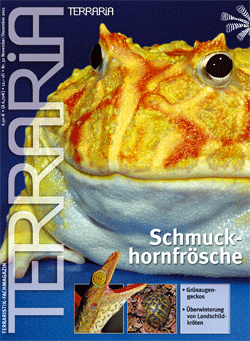
Terraria No. 32 - Ornate Horned Frogs
Terraria 32 - Ornamental horned frogsGreen-eyed geckosHibernation of tortoisesContents:They seem to be all about their mouths: horned frogs do not captivate with delicate forms, but rather, alongside their colourful splendour, simply through their presence. They are frogs with character. These perennial favourites in the terrarium world are now also being bred in diverse, very attractive forms. Whilst the number of species in the terrarium has remained very limited for decades, new and exciting species have finally made their way into the ‘Hobby’ in recent times. In our cover story, we introduce you to the attractive representatives of this genus, describe in detail their care and breeding, and discuss current developments. EditorialAxel KwetMagazineNational Breeders’ Expo in Daytona Beach, Florida/Cannibalism in the tree-dwelling toad-leaved frog, Trachycephalus resinifictrix/Giant catch in the Philippines: the world’s largest crocodile/Rescue from an uncomfortable prison/A tiger python that fasted for four and a half years/Legal notice/Recently, at the zooTERRAglobalBarely described - and already almost extinct? Mirco Solé Cover story Jewelled horn frogs - big mouth and what's behind it!Stefan Hochenegger & Kriton KunzKeeping and breeding the Brazilian horned frog, Ceratophrys aurita Fernando LicitraKeeping and breeding the Argentine horned frog, Ceratophrys ornata Erich HirtenlehnerThe world’s longest insect in a terrarium? Keeping and breeding Phobaeticus serratipes and other large stick insects Timm AdamThe turtle year. Outdoor biology and husbandry of European tortoises over the course of the year Part 5: November/December: Hibernation and hibernation Michael WirthExperiences with Smith’s Green-eyed Gecko, Gekko smithii Ingo KoberCare and breeding of the banded spitting cobra, Naja nigricincta nigricinctaMichael KreuzerJourneyUSA - In search of reptiles in the national parks of the West David PrötzelNew speciesTwo new reptiles from Madagascar: a colourful skink and a bizarre leaf-tailed gecko Axel KwetAmong explorers On the hunt for frogs and toads in the outback of the Australian Kimberley Ligia Pizzatto & Camila BothSubscription & ServiceEye-catcherDesert life in the Allgäu - the "Desert Life" by Susan and Werner Kalopp Heiko WerningNear youPreview IncubatorTouristic in the jungle part 2: Cool editor, cooler frog Heiko Werning

CHF 12.00

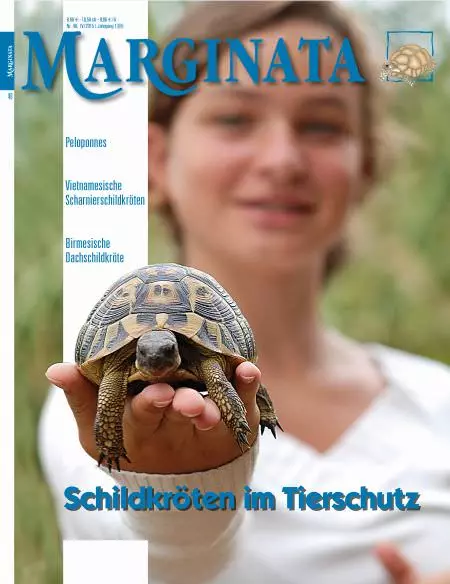
Marginata 48 - Turtles in animal protection
Marginata 48 - Turtles in animal welfarePeloponneseRarities from VietnamEuropean pond turtleTable of contents EditorialMagazineTOPIC"Chelonia" - Germany's largest turtle sanctuaryPatrick BoncourtTOPICSanctuary for tortoises in Stuttgart - a feel-good garden for tortoises Humans and animalsNicole Gehringer & Thomas SchällingTOPICTurtle animal welfare Supersize - the Phoenix Herpetological SocietyHeiko WerningPORTRAITEmys orbicularis (Linnaeus, 1758) European pond turtle, East Mediterranean pond turtleBenny Trapp TRAVELIn search of the "shy beauty" and the "Cave turtles" (2)Torsten Blanck, Sebastian Braun, Timothy McCormack, Hoang Van Ha, Nguyen Tai Thang, Nguyen Van Luc & Minh LeSCIENCETrachemys emolli or T. grayi in Honduras? Alexander GutscheTRAVELMorea - in search of turtles and other reptiles in the West the Peloponnese (2)Axel KwetSubscription & ServiceRegional guide

CHF 16.50

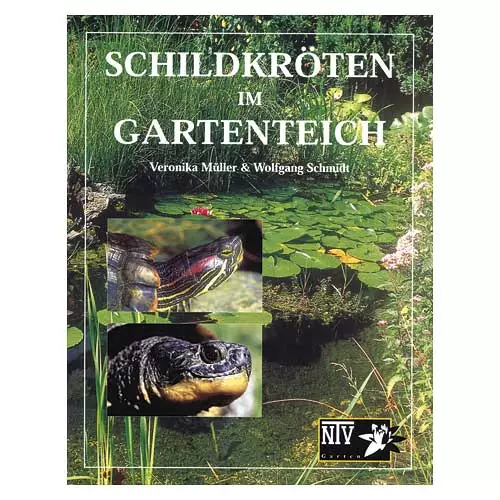
NTV, turtles in the garden pond
NTV, Schildkröten im Gartenteich - Hier werden Wasserschildkröten vorgestellt welche im Gartenteich gehalten werden können. 112 Seiten 88 Abbildungen Format: 16,8 x 21,8 cm Autor Veronika Müller und Wolfgang Schmidt Verlag NTV Inhalt: Schildkröten im Gartenteich? Sicher haben auch Sie sich schon gefragt, ob es nicht möglich ist, eine Schildkröte im Gartenteich zu pflegen. Es ist möglich!In diesem Buch werden u. a. alle Wasserschildkrötenarten vorgestellt, die auch ganzjährig im Garten leben können. Sie finden wertvolle Tips zur Gestaltung des Schildkröten-Biotops, zur Fütterung, zur Vergesellschaftung der Tiere sowie zum Thema Überwinterung. Was tun, wenn Ihre Schildkröte Eier legt? Was geschieht, wenn einmal ein Tier krank wird? Auch auf diese Fragen gehen die Autoren in eigenen Kapiteln ausführlich ein.Es gibt viele Bücher über Schildkröten. Das Buch 'Schildkröten im Gartenteich' befasst sich erstmals ausschliesslich mit den Arten, die auch im Freien gepflegt werden können. Geschrieben für den Natur- und Tierfreund, ist es ein wertvoller Leitfaden für die richtige Pflege von Wasserschildkröten.  

CHF 28.90

Customers also saw

Leopard gecko
The leopard gecko (Eublepharis macularius) Area of origin: Eublepharis macularius occurs in south-east Afghanistan, Pakistan and north-west India. Habitat: The leopard gecko is crepuscular and nocturnal and inhabits steppe-like areas in its native region, but can also be found at altitudes of up to 2100 m. It lives in natural and self-dug burrows, which it leaves at dusk to search for food.The leopard gecko is one of the most popular lizards, as it is a fairly undemanding pet.The various colour variations and its peaceful behaviour also contribute to its popularity.Juveniles show dark cross-bands on their backs, while adult specimens have the dot pattern that gives them their name. The basic colour is a delicate to rich yellow, on which numerous dark spots and dots can be seen. The belly is solid white. The eyes have movable lids and the limbs have strong claws but no adhesive pads on the toes. The leopard gecko can shed its tail if necessary, which then regrows as a so-called turnip tail. Keeping: Keeping a group of 1 - 3 animals requires a terrarium measuring 100x50x50cm.The floor is covered with sand that can be dug into so that the animals can also dig burrows. Sufficient hiding places are also required.A shallow water dish is a must, although the animals only rarely drink from it. The animals tend to lick water from stones and pieces of cork, which are sprayed once a day. Day temperatures between 26 - 28°C, which may drop to 20°C at night, allow the animals to thrive very well. A humidity of around 50 % can be very easily achieved by spraying in the evening. Food: Leopard geckos are not particularly fussy eaters. They eat all kinds of insects they can catch. It is of course important to ensure that there is always enough food of the right size for the animals in the enclosure. A young leopard gecko with a body length of around 12 cm eats an average of 6 medium-sized crickets, while an adult specimen consumes 4 - 5 large grasshoppers. As with all lizards, it is advisable to dust the feeder insects with calcium and sometimes with vitamins before feeding.Before you decide on leopard geckos, you should definitely have read a suitable specialist book.For any animal keeping the following applies: Children must be guided, supervised and monitored by their parents. Children must learn that an animal has its own needs and habits and respect that. Parents should be aware that they are the ones responsible for the animal.Our trained team at Zoo Roco is available for questions and problems. They can advise you professionally on all matters.