NTV, Discover the amphibians

Article no: CZ-AB13790

CHF 17.90

Stock: 0

Ready for dispatch in 1-3 days, delivery time 14 working days

Delivery between Tuesday, 19 May and Wednesday, 20 May
Zahlungsarten
Product information "NTV, Discover the amphibians"

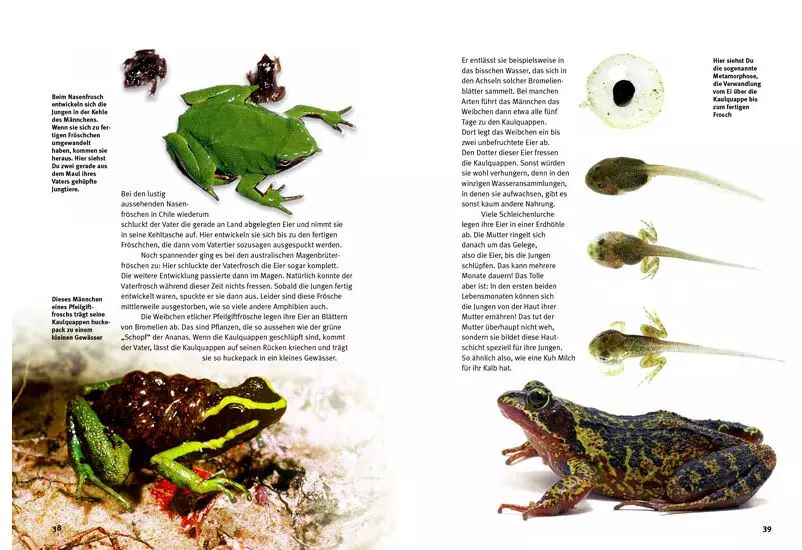
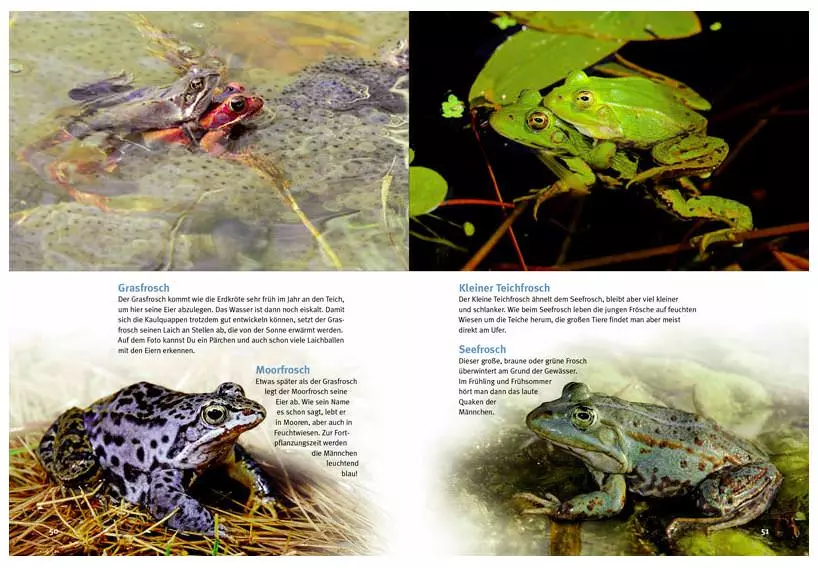
NTV, Discover the amphibians and learn all about these animals.

  • 56 pages
  • colour photos throughout
  • Large format: 20.7 x 28 cm
  • Hardcover
  • Author Kriton Kunz

Contents:

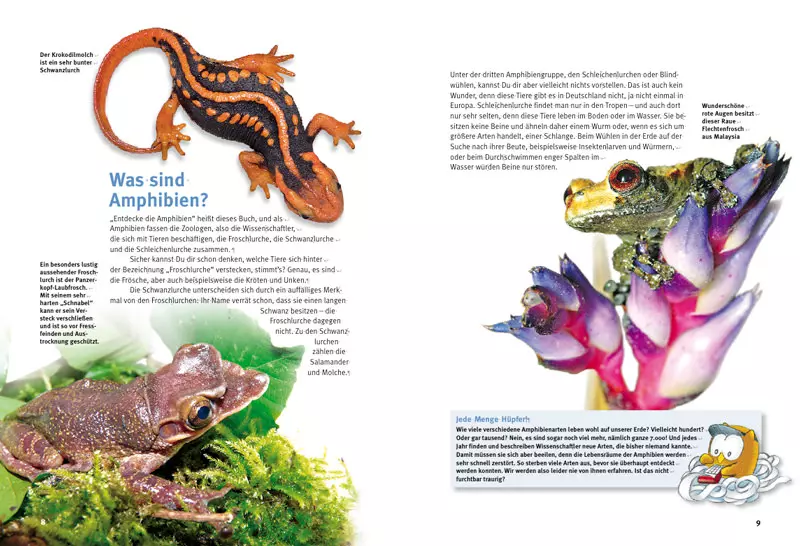
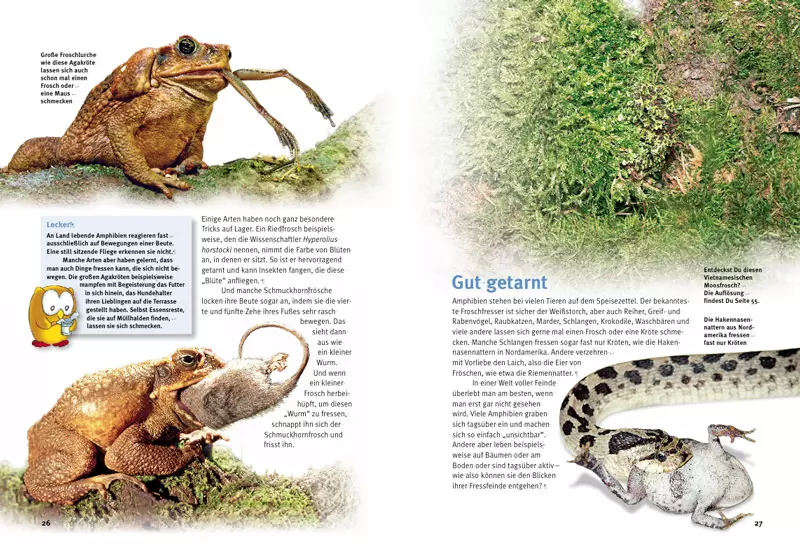
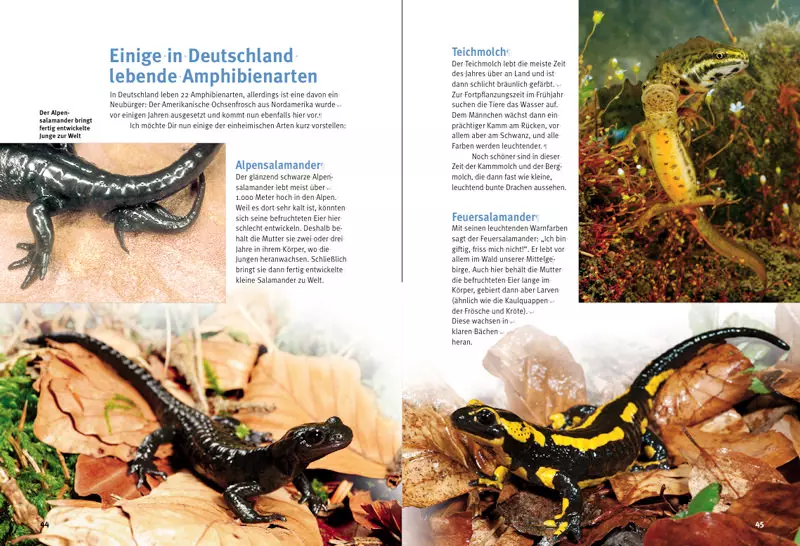
Every child knows a frog that swims around in its pond and croaks cheerfully, or the black and yellow fire salamander. But how do these friendly animals live? What do they eat, how do they survive the winter? How does a tadpole become a small frog? And what other amazing amphibians are there?

"Entdecke die Amphibien" explains what amphibians are, their special features and their incredible abilities in an entertaining and child-friendly way. Fantastic records from the world of frogs, salamanders and the like are included, as well as an exciting quiz about these colourful survival artists.

Including 20 great stickers 

Composition
Feeding recommendation
Technical details
Size information

0 of 0 reviews

Give us a rating!

Share your experience with the product with other customers.


Suggested products

Handbook of food plants for tortoises and other reptiles
Handbook of forage plants 2nd revised editionMarion Minch is not only a successful breeder of diverse tortoises for many years, but also an excellent connoisseur of native wild herbs. She founded and runs samenkiste.de, which is well known to many tortoise keepers and nature lovers. Her name is inextricably linked with reptile care and species-appropriate nutrition for tortoises. Her handbook of food plants summarises the most important native food plants for herbivorous and omnivorous reptiles. She not only considers tortoises, but also iguanas, spiny-tailed dragons and even chameleons. From the basics of plant biology to native wild herbs to suitable food plants for hardy tropical reptile species, this comprehensive work provides the basis for species-appropriate keeping. In the expanded and supplemented 2nd edition, the plant section is divided according to flower colour. This makes it even easier to identify wild herbs. The work has also been supplemented with a wealth of additional information and many pictures.

CHF 46.50

Geckos
Geckos in the terrarium by Astrid FalkThe book offers a comprehensive introduction to geckos and their species-appropriate keeping in terrariums. It explains what you need to think about before buying a gecko and what preparations should be made. The book describes in detail how the terrarium is technically equipped and set up. The care of the animals, their special features and behaviour, their diet, reproduction and rearing of young animals are described, as well as diseases and husbandry problems with tried and tested suggestions for prevention and treatment. Individual gecko species that are particularly suitable for keeping and breeding in terrariums are portrayed in detail in the second part of the book.

CHF 28.50

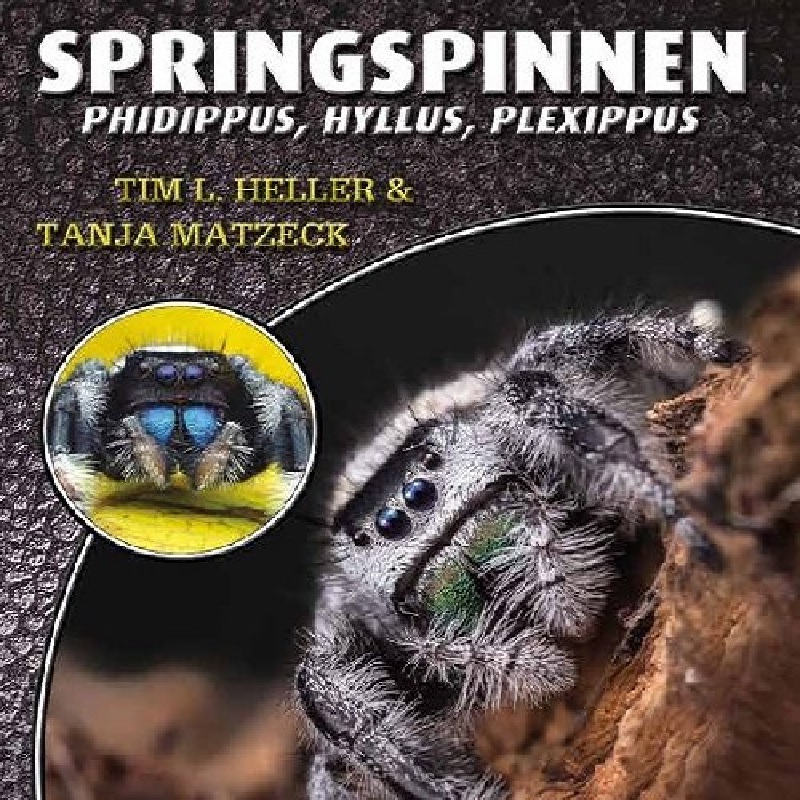
Jumping spiders Phidippus, Hyllus, Plexippus
Book Jumping Spiders - Phidippus, Hyllus & Plexippus A guide to keeping jumping spiders of the genera Phidippus, Hyllus & Plexippus. Who can resist the charm of jumping spiders? The childlike appearance of their expressive face simply leaves no one cold! In addition, their behavior is extremely exciting to observe, their colors are bright and their requirements for species-appropriate keeping are very easy to meet. No wonder these likeable jumpers are all the rage! This volume in the "Species by Species" series describes in detail what to look out for when buying and keeping them, introduces the most commonly kept species and color forms and provides plenty of tips on how to keep them successfully - so you can be sure they will breed well! Species by Species introduces you to the books in this series, which present the most popular terrarium animals. Each volume offers you detailed, practical care instructions and all the information you need to successfully breed your animals. All important questions from the required tank size to terrarium set-up, technical equipment, species-appropriate nutrition and disease prevention are answered with numerous tricks and tips. Experienced, long-standing breeders reveal how you can encourage the animals to reproduce and raise healthy young. All this in full color, generously illustrated and attractively designed - just about your terrarium animal - species by species

CHF 23.90

Book Breeding live food yourself
Book "Grow your own live food" - The perfect guide for pet owners Discover practical and detailed instructions on how you can easily breed food for your reptiles, birds, fish or other animals yourself in the book "Breeding live food yourself". With valuable tips on various food insects, their care and breeding, you can save money and ensure a species-appropriate diet for your pets. Contents of the book: Step-by-step instructions for breeding feeder insects Information on the best types of food for reptiles, birds and fish Care instructions and breeding conditions for various live food species Tips for sustainable and cost-effective food production Why breed your own live food? Get healthy, fresh food for your animals Save money and reduce dependence on pet shops Promote the health and well-being of your animals with species-appropriate food Whether you are a beginner or an experienced pet owner, this book provides you with everything you need to successfully breed live food yourself.

CHF 46.50

Marginata 69 - New Guinea tortoises
Marginata 69 - New Guinea tortoises – the genus ElseyaCover storyThe unrecognised beauties: New Guinea tortoises (Andreas S. Hennig)My experiences with Branderhorst's New Guinea tortoise, Elseya (Elseya) branderhorsti (Ouwens, 1914) (Andreas S. Hennig)Keeping and breeding of Rhodin's New Guinea tortoise, Elseya (Hanwarachelys) rhodini Thomson, Amepou, Anamiato & Georges, 2015 (Andreas S. Hennig)PortraitGeoemyda spengleri, Chinese serrated tortoise (Andreas S. Hennig)ReportageMacrochelys temminckii – Experiences and impressions with vulture tortoises part 2 (Reiner Praschag)KeepingAn alternative to year-round keeping of the Egyptian tortoise in the terrarium – my experiences with seasonal outdoor keeping of Testudo kleinmanni (Ricarda Schramm)EtymologySawbacks and living maps part 4: Graptemys gibbonsi, Pascagoula humpback tortoise (Holger Vetter)Classifieds & animal placement

CHF 16.50

Reptilia 51 - Tree agamas
Reptilia 51 - Tree dragons Drakensberg armadilloGreen night tree snakeChin spotted tortoise Contents: 2 EDITORIAL 6 READER LETTERS 8 MAGAZINE 16 DATES 18 PHOTO REPORTAGE With horns, crests and gliding membranesThe bizarre arboreal dragonsby J. Hallermann 26 KEEPING AND BREEDINGMantheyus phuwuanensis (MANTHEY & NABHITABHATA, 1991) – from capture to breeding in the terrarium by S. & U. Manthey 32 HERPETOFAUNAOn the variability and biology of the Philippine angular-headed dragon Gonocephalus sophiae) by M. Gaulke & A. Demegillo 41 REPORTAGEThe lyre-headed dragon Lyriocephalus scutatus by U. Bartelt, H. & M. de Bitter 51 PORTRAIT AND POSTERCaiman yacareby H. Werning 56 TRAVELPulau Tioman – Pearl in the South China Sea; Part 2 by W. Grossmann & F. Tillack 66 KEEPING AND BREEDINGKeeping and breeding the Drakensberg armadillo lizard (Cordylus melanotus subviridis) by B. Langerwerf 70 KEEPING AND BREEDING Boiga cynodon – The green night tree snakeA rarely kept rear-fanged snake and its breedingby J. Bulian 78 REPORTAGETrachemys callirostris callirostris – Biology, use and protection of the chin spotted tortoise in Colombiaby A. Martínez Silvestre & L. Arias Bernal 86 SMALL ADS 91 WESTERN HERP PERSPECTIVESAliens – not the filmby B. Love 93 RAT & TAT 95 LIBRARY 104 GLOSSELots of waves – disturbing turn of the yearby H. Werning

CHF 11.20

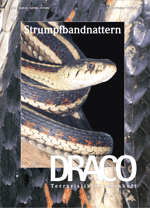
Draco 25 - Garter snakes
Draco 25 - Garter snakes Contents: 2 Editorial 6 Overview of the genus ThamnophisMartin Hallmen & Daniel Grübner 25 Old and new developments regarding the San Francisco garter snake (Thamnophis sirtalis tetrataenia)Martin Hallmen 32 The most common garter snakes in the terrariumDaniel Grübner 40 The garter snakesJan Sonnenberg 50 Aids for distinguishing some subspecies and colour forms of garter snakesPart 1: Thamnophis sirtalis sirtalis “flame” andThamnophis sirtalis sirtalis “speckled flame”Martin HallmenPart 2: The red subspecies of Thamnophis sirtalisJan SonnenbergPart 3: Thamnophis sirtalis similis andThamnophis sirtalis sirtalis “Florida blue”Martin HallmenPart 4: Distinguishing between Thamnophis proximus and Thamnophis sauritus and differentiation fromThamnophis radix and Thamnophis sirtalis sirtalisJan Sonnenberg 60 Garter snakes in scienceJan Gebauer 66 The less frequently recognised garter snakesDaniel Grübner 77 Colour forms of garter snakesDaniel Grübner & Jan Sonnenberg 86 Field observations of garter snakes in North AmericaHerbert Bruchmann 94 Common diseases in garter snakesBirgit Rüschoff, Bettina Christian & Daniel Grübner 102 Garter snakes in outdoor terrariumsMartin Hallmen 114 10 years European Garter Snake AssociationMartin Hallmen 116 Book box 124 Magazine

CHF 18.40

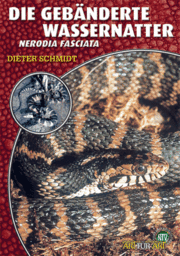
The banded water snake
All about the banded water snake from Dieter Schmidt 64 pages 14.8 x 21 cm numerous color photos Author Dieter Schmidt Content: Watermans have always been one of the most popular terrariums. The Wassernatter, the water-racketeer, shows all the advantages of being a friend of the serpent of his caregiver. It is attractively drawn, easily satisfied with fish as food, is not too large, and has a tempered temperament.Dieter Schmidt, the experienced snake expert, will give you a wealth of experience in this guidebook and explain everything you need to know about the successful keeping and care of this popular species. The author goes into the multiplication of the animals and the rearing of the young - so you will soon be able to celebrate such successes. Systematics and physique The fascinating biology: From the life of the Banded Watercats All information on species-appropriate husbandry: From the appropriate terrarium to equipment and technology to feeding Successfully reproducing: mating stimulation and rearing of the young animals Troubleshooting: How to avoid the most common mistakes in care, and how to help sick animals Brilliant photos

CHF 18.50

Marginata 38 - Hybrids of tortoises
Marginata 38 - Turtle Hybrids Breeding of the radiated three-keeled turtleBreeding of the areolate flat tortoise Part IIITurtle Honour Grove in Kunduz Contents: EditorialMagazineDatesOVERVIEWChecklist of turtle hybrids known to date – natural hybrids as well as those created in human care Hans Volker Karl & Hans - Dieter PhilippenFIELD RESEARCHCentral Vietnam: On the trail of East Asian "stream turtles" and hybridsTorsten Blanck & Sebastian BraunPORTRAITMexican gopher tortoise (Gopherus berlandieri Agassiz, 1854)Hans - Dieter PhilippenREPRODUCTIONMulti-year keeping and breeding of the radiated three-keeled turtle (Geoclemys hamiltonii)Uli BollackREPRODUCTIONExperiences with keeping and breeding the areolate flat tortoise (Homopus areolatus) under different conditions in Namibia and Switzerland. Part 3: Indoor and outdoor terrariumsMarcel Reck & Lydia Reck-RinggenbergPRACTICEIncubation as natural as possibleChristine DworschakREPORTAGEFour-toed tortoises (Agrionemys h. horsfieldii) in northern AfghanistanFrank JoistenOBITUARYIn memoriam Jutta WiechertHans - Dieter PhilippenREPORTAGETurtle sanctuary Playa Ostional in Costa RicaRolf & Angela SommerClassifiedsBook tipSubscription & ServiceRegional guide

CHF 16.50

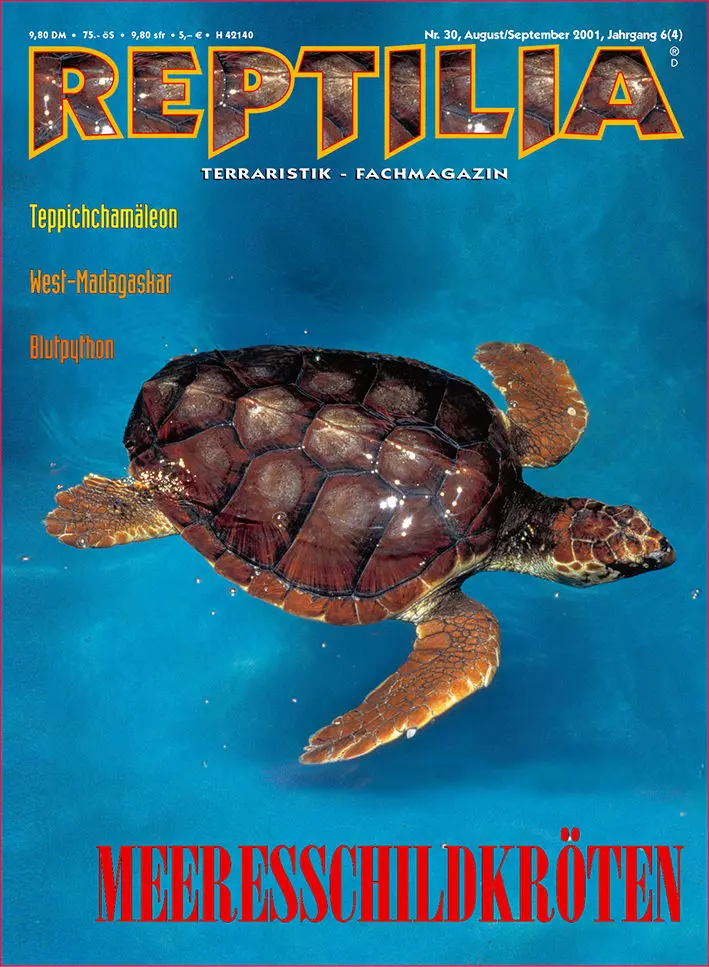
Reptilia 30 - Sea turtles
Reptilia 30 - Sea turtlesCarpet chameleonWest MadagascarBlood pythonContents: 2 Editorial 3 letters to the editor 7 Magazine 20 dates 24 Western Herp Perspectives, Hybrid Mania, by B. Love 26 Photo reportage: Sea turtles, by J. Vasconcelos Péres 32 Report: The diving behaviour of sea turtles, A brief overview, by J.D.R. Houghton 36 Report: Encounter with the loggerhead turtle (Caretta caretta) in the southern Aegean 40 Herpetofauna: The species of sea turtles, by J. Vasconcelos Péres 46 Care and Breeding: Forbidden Beauty – On the Spotted, Blood or Short-tailed Python Python curtus (Schöegel 1872), by A. Kirschner 51 Portrait and poster: Pelobates syriacus, by B. Trapp 55 Husbandry and Breeding: Experiences in the care and breeding of the carpet chameleon Furcifer lateralis, by U. & K. Dost 61 Herpetofauna: Luminous tejus? The dwarf tejus of the genus Proctoporus. With notes on luminescent organs in lizards, by U. Schlüter 65 Terraristics: Sitting in a glass house... The greenhouse as an interesting option for keeping snakes, by U. Strathemann 69 Herpetoculture: Devilish, divine snake. Aspects of snake symbolism from a psychological perspective. Part 1: Snake fear, snake cult, the image of the snake in the Bible, by K. Kunz 74 Journey: Journey to the Central West of Madagascar, by K. Liebel & W. Schmidt 88 Classifieds 92 Advice and action 95 Library 104 Glossary, I am a punk band, by H. Werning

CHF 9.80

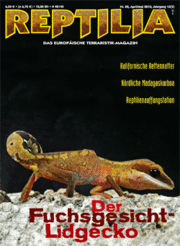
Reptilia 82 - The Fox-faced Lidgecko
Reptilia 82 - The Fox-faced Lidgecko Californian chain snakeNorthern Madagascar boaReptile rescue centre Contents: It is undoubtedly one of the strangest lizards in our terrariums, the Fox-faced Lidgecko (Aeluroscalabotes felinus), with its feline-like silent movements and almost ghostly appearance. And it has had one of the most remarkable terrarium careers in recent times. Just a few years ago, this species was practically unknown and a sensation for specialists, but today it has almost become a fashionable gecko.No wonder, because these easy-to-hold animals captivate with their appearance as well as their behaviour. Siriporn Maier and Thomas Bamann present the keeping and breeding of this exceptional gecko in detail and in a way that is easy to understand, even for beginners. EDITORIAL MAGAZINE DATES WESTERN HERP PERSPECTIVES The China-Connection B. Love PHOTOSTORY Fox-faced geckos – fascinating goblins of the night S. Maier & T. Bamann KEEPING AND REPRODUCTION A wild cat in the terrarium – keeping fox-faced geckos S. Maier & T. Bamann KEEPING AND REPRODUCTION Breeding the fox-faced gecko S. Maier & T. Bamann TRAVEL Mysterious Peru C. Koch PORTRAIT and poster Rhacophorus nigropalmatus J. M. Dehling KEEPING AND REPRODUCTION Keeping and breeding the Californian chain snake, Lampropeltis californiae R. Meierkord REPORTAGE The Berlin Reptile Centre L. Dirksen KEEPING AND REPRODUCTION Acrantophis madagascariensis – keeping and breeding of the Northern Madagascar boaM. Borer HERPETOFAUNA The genus Ambystoma in Mexico G. Casas-Andreu & X. Aguilar-Miguel HERPETOFAUNA Observations on common toads M. Felke ANIMALS OF OUR HOME The grass snake R. Leptien SUBSCRIPTION & SERVICE ALSO NEAR YOU PREVIEW BRUTKASTEN Alone among sheep. Part 2 H. Werning

CHF 12.00

Reptilia 27 - Anolis
Reptilia 27 - Anolis Curly-haired tarantulaCape CobraPhilippines Contents: 2 Editorial 3 letters to the editor 4 Lookup 5 Magazine 10 dates 14 Western Herp Perspectives: The aisle phenomenon, by B. Love 16 Photo reportage: Anolis, by L. Wijffels 22 Herpetofauna: The stretchable throat skin of the Anolis, by L. Wijffels 35 Herpetofauna: On the variation of "Le Roquet", the Anolis of Martinique, by L. Wijffels 44 Report: Anolis blanquillanus and Anolis onca. Two interesting skinks from the islands off Venezuela, by A. Flaschendräger 49 Obituary: In memory of Leo C. M. Wijffels, by A. Flaschendräger 51 Portrait and poster: Ctenosaura flavodorsalis, by T. Eisenberg 55 Journey: A visit to the Philippine rainforest, by Dr M. Gaulke 64 Keeping and breeding: Keeping and breeding the Indian star tortoise, by K. Gärtner 69 Terraristics: Building a snake enclosure, Part 3: Experiences, by M. Hallmen 74 Care and Breeding: The Cape Cobra Naja nivea, Care and Reproduction, by W. Strassmann 77 Herpetofauna: Curly Hair – Lovely Creatures, The tarantula Brachypelma albopilosa in the terrarium, by H. Fischer 82 Reptilia on the road: De Oliemeulen zoo and reptile house in Tilburg/Netherlands, by A. Hauschild 94 Advice and action 96 Library 104 Glossary: Anaconda! (Part 2), by H. Werning

CHF 9.80