Walking leaf

Phyllium Siccifolium

Profile

Home:

South East Asia

Age expectancy:

Female: up to 9 months
Male: approx. 4 months

Diet: Blackberry leaves
Size:

Female up to 10cm
Male up to 6cm

Product information "Walking leaf"

Shifting leaf - Phyllium siccifolium

The shifting leaf lives in the rainforests of South-East Asia. Females reach a final size of approx. 10cm and have a life expectancy of 9 months. Males reach a final size of approx. 6cm and life expectancy is about 4 months.

 
Appearance

The shifting leaves are usually green or brown. The hind body resembles a leaf, hence the name. In blackberry leaves they are barely recognisable.

 
Husbandry

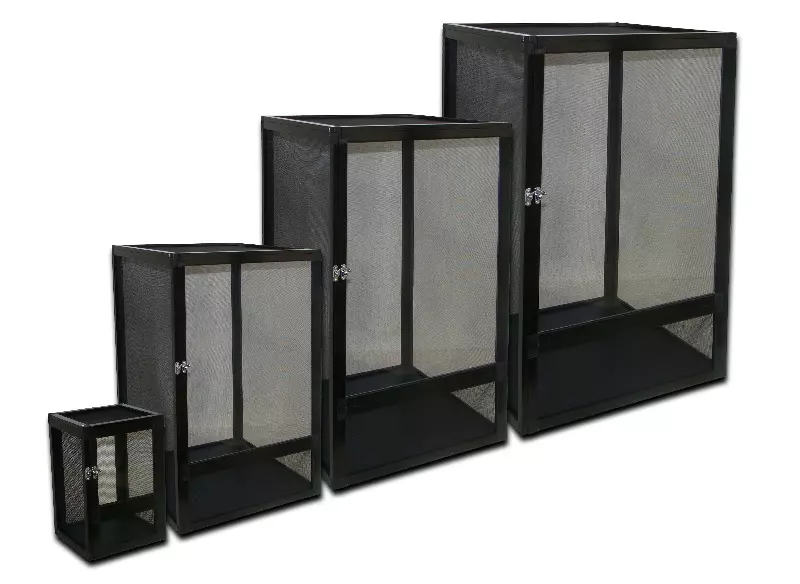
A terrarium with dimensions of 60x40x40cm is ideal for the shifting leaves. Coconut fibre humus or terrarium soil can be used as substrate. Leaves and moss can be scattered over the substrate to improve its appearance. The blackberry leaves should be placed in a vase or cup. The container should be lightly covered so the animals do not fall in. Additional branches should be provided for climbing. The temperature should be between 25-28°C and the humidity should be 70-95%.

The blackberry leaves need to be replaced regularly.

Before you decide on shifting leaves, you should definitely have read a relevant specialist book.

For all animal husbandry: Children (including adolescents) must be instructed, supervised and monitored by their parents. Children must be made aware that animals are not toys!

If you have any questions or problems, our trained team at Zoo Roco is available to assist you. They can provide you with expert advice on all questions.

Composition
Feeding recommendation
Technical details
Size information

0 of 0 reviews

Give us a rating!

Share your experience with the product with other customers.


Suggested products

West African Mantis
West African Mantis Pseudocreobotra ocellata (flower mantis) This West African mantis (flower mantis) lives in West and East Africa. There it is found in scrubland and grassland, where flowering plants also occur. The male lives for approx. 3-5 months after the last moult and the female for up to 10 months. Food The West African mantis feeds mainly on small, flying insects such as Drosophila, houseflies and moths. However, it also eats small crickets, crickets and cockroaches. Care A terrarium measuring 30x30x45cm is required to keep a West African mantis. Terrarium soil is ideal as a substrate. Live plants and branches are essential. The plants improve the climate in the terrarium. The temperature should be between 30-35°C. It can also be warmer directly under the heat lamp. The humidity should be 50-70%. Special features If the mantis is fed regularly and well, it can also be kept in a group. There must be enough plants and hiding places. However, losses are always to be expected.
 
Peruphasma schultei
The velvet stick insect - Peruphasma schultei The velvet stick insect lives in northern Peru in the Cordillera de Condor. The distribution area of the velvet stick insect is only about 5 hectares. It lives in shrubs and feeds on lilac or privet.Female velvet stick insects can live up to 2 years. The males, however, live only about 9 months. Appearance of the velvet stick insect The basic colour of this stick insect is velvety black. Its eyes and antennae are yellow and its wings are red.  Keeping velvet stick insects A terrarium measuring 30x30x40cm is required for keeping velvet stick insects. A suitable substrate is coconut fibre humus or terrarium soil. To make it look visually pleasing, dried leaves or moss can be spread over the substrate. Velvet stick insects do not tolerate waterlogging well. This can be avoided by placing the branches of privet or lilac in a small vase or cup in the terrarium. However, the cup or vase should be lightly covered so that the stick insects cannot fall into the water. In addition to the privet or lilac, further bare branches can be placed in the terrarium. These are gladly accepted for climbing.The temperature should be between 18–24°C and the humidity between 40–60%. The privet or lilac should be replaced regularly.  Special notes The velvet stick insect can spray a secretion from its defence glands. The secretion stings when it comes into contact with mucous membranes. It only burns briefly and is not harmful. Before you decide on velvet stick insects, you should definitely have read a suitable specialist book. For all pet keeping applies: Children (including adolescents) must be guided, supervised and checked by their parents. Children should know that animals are not toys!For questions and problems, our trained team at Zoo Roco is at your disposal. They can advise you professionally on all matters.
 
Peruvian fern stick insect
Origin The fern stick insect (Oreophoetes peruana) is native to Peru and Ecuador. It lives in the undergrowth of mountain forests and prefers to spend the whole day on its food plant. Appearance The females have a black base colour, with yellowish to white longitudinal stripes. The end of the abdomen is usually orange, as are all the joints on the legs.Males have a red or orange base colour. However, this colouring only appears after the imaginal moult*.Only a club-like thickening at the end of the abdomen helps to identify them.Before that, they can hardly be distinguished from the females. Imaginal moult = The final moult leading to the adult insect is known as the imaginal moult. Facts: Females grow to between 75 and 80 millimetres Males grow to between 65 and 70 millimetres Both have no wings Both have very long antennae Both take approx. 4 months to reach the imaginal moult Lifestyle The fern stick insect is very calm and gets along well with other species.During the day, it hides in the ferns; at night, it becomes active. Food It feeds exclusively on various ferns (exotic or native fern).When buying ferns, make sure they are not sprayed and do not contain pesticides. Predators Birds, amphibians, frogs or reptiles that occur in their territory can be a danger. However, it is rarely attacked due to its "unappetising" colour.When threatened, it releases a whitish defensive secretion that smells very unpleasant and pungent. This secretion (water and quinoline) is released in the form of drops or a thin, fast stream.This allows the fern stick insect to spend time comfortably on its food plant without fear of being discovered. Classification In 1868, it was first described by Henri de Saussure Latin name: Oreophoetes peruana Family: Diapheromeridae Care The fern stick insect is easy to keep, but the following points should be observed for species-appropriate care. Terrarium size:  6 - 8 insects should have a terrarium size of 40cm x 40cm x 50cm. Group animal Temperature: 18-24°C Humidity: between 60-80% It is important to spray the terrarium daily, because if a stick insect moults and the humidity is below the optimum value, the nymphs will become stuck during the next moult. Before you decide on a Peruvian fern stick insect, you should definitely have read an appropriate specialist book. For all animal care: children must be guided, supervised and monitored by their parents. Children must learn that an animal has its own needs and habits and respect this. Parents should be aware that it is their responsibility to care for the animal. Our trained team at Zoo Roco is available to assist you with any questions or issues. They can provide you with expert advice on all matters.
 
Ball python
Royal pythonArea of origin:The royal python (Python regius) is a species of snake within the python family and is native to West and Central Africa.Habitat:The royal python is very adaptable in terms of its habitat. They can be found in closed tropical rainforests, savannahs and agricultural areas. Termite burrows are suitable for hiding, moisturising or basking.Facts: Royal pythons are active at night and at dusk. They roam the countryside in search of food and a mate. In the dry season they do not leave their hiding place for weeks. Like all members of the family, it is a non-venomous constrictor. They do not hibernate Care:Everything at a glance:Ground temperature 27-29°C With localised heating up to 38°C Night setback to 20-23°C Humidity 60-80% Rise to over 90% for a short time by spraying The substrate should be loose and absorbent to prevent swallowing.The basic equipment should include climbing facilities, hiding places and a large water container.The dry terrarium has a legal minimum size of 130x65x100 cm for 2 adult animalsFood:This giant snake feeds on small mammals (mice, rats, chicks) and birds.Before you decide on a royal python, you should definitely have read an appropriate specialised book.The following applies to all animal keeping: children must be guided, supervised and controlled by their parents. Children must learn that an animal has its own needs and habits and respect this. Parents should be aware that it is they who are responsible for the animal.Our trained team is available to assist you with any questions or issues at Zoo Roco. They can provide you with expert advice on all matters.
 
Leopard gecko
ProfileArea of origin:The Madagascar day gecko is native to Madagascar and lives in tropical rainforests, forest edges, plantations and tree-rich settlement areas.Species:There are many species of the genus Phelsuma - the Madagascar day gecko is one of the larger representatives. The species frequently offered in the pet trade includePhelsuma madagascariensis (Madagascar day gecko)Phelsuma grandis (giant day gecko)Phelsuma laticauda (Gold-dusted day gecko)Phelsuma standingi (Standing day gecko)Phelsuma klemmeri (Klemmer's day gecko)Keeping:Can be kept in pairs or groups; however, only one male per group Highly structured tropical terrarium with lots of climbing branches, bamboo, plants and cork tubes. Humidity 60-80 % UV-B lighting is absolutely essential. Daily spraying Secure the terrarium well - Phelsuma are very flinFood:Insects: Crickets, crickets, cockroaches, wax maggotsRipe fruit, fruit pureeSpecial day gecko fruit foodSupplement calcium and vitamin supplements regularlySpecial features:Very active and diurnal geckosRequire a lot of climbing space and high humidityBeautiful green colouring with red spotsCan become very fast; need calm handlingSensitive to stress and incorrect temperaturesGood UV exposure is important for health and colour intensityConclusion:The Madagascar day gecko is an impressive, colourful and diurnal terrarium dweller that delights with its activity and behaviour. It is suitable for beginners with basic knowledge of terraristics and requires a high, well-planted tropical terrarium with suitable UV and heat equipment. If kept correctly, it can live for 8-10 years and remains a fascinating eye-catcher.If you have any questions or problems, our trained team at Zoo Roco is here to help. They can provide expert advice on all matters.
 
Greek tortoise
Region of origin: From north-eastern Spain, southern France, central and southern Italy, southern Greece and all the way to the Balkans (2 subspecies).the Greek country-turtle lives mainly in grass plains with shrub vegetation and loose tree-continuance, often also in the hilly terrain steep slopes with stony ground. In the midday-heat, the animals retreat to the "Siesta" in the undergrowth of the bushes. Animals from southern regions and the western subtype are warmer than copies of the eastern subtype from the northern Balkan states. Sex-differences: Males have a longer tail. Attitude: In Switzerland, it is much cooler and more rainy than its natural habitats most of the year. Especially in spring and autumn, but also in wet and cold summers, turtles, especially juveniles, need a heatable, dry container or alternative habitat. But also when keeping adult, well accustomed turtles outdoors, it is advisable to offer the animals a shelter, e.g. a cold frame, with heat radiators in the outdoor enclosure, where they can find a dry, warm place to stay if necessary. As a precaution, the first one to two years of young animals are only put outdoors in dry, warm weather.European tortoises belong in an outdoor enclosure, not on the balcony and certainly not in a room. The fence should consist of a wooden or concrete boarding (at least 10 cm buried, 50 cm high). The enclosure should be placed in such a way that the turtles can sunbathe but also retreat to a shady place. Furnishing of the outdoor enclosure: sleeping place filled with hay flat bowl with water - drinking and bathing facilities hiding places Food: The best food that can be provided to European tortoises (both adult and young) consists of as many grasses as possible. Unfertilized meadows from our climatic region are suitable.In addition and in small quantities, the following feed types promote health: herbs hay egg shells, cuttlebone shells - as lime donor Turtle food - please feed only finished vegetable food (e.g. Agrobs). If there are animal sources in the food, the turtle gets too much protein and grows too fast. Hibernation: As change-warm reptiles from winter cold regions, the European tortoises have a hibernation, which should not be missing in captivity. From the beginning of October the feeding is stopped so that the intestine is emptied before hibernation (water must always be offered, however). From mid to late October (before the first frost), when the animals have already buried themselves or fallen into winter rigidity under tufts of grass, they are placed in a wooden box with slightly damp beech leaves in a cold cellar (2 - 8 degrees Celsius). At the end of March to the middle of April the animals wake up by themselves and can again be transferred to the open-air enclosure. A 15-minute bath in lukewarm water serves the absorption of liquid to enable the animals to balance the water balance more quickly. It is recommended to carry out a shortened hibernation of approx. 2 months even with hatchlings in the first winter, because it corresponds to the natural conditions. Sick animals should not be sent into hibernation. Acquisition: If you want to acquire land turtles, you should heed the following points. Buy Swiss offspring. Holiday souvenirs are first of all illegal and secondly carry the risk of many diseases. If you have little or no experience with tortoises, please buy a book first and then the turtle. Always buy at least two animals; turtles don't like loneliness either. Only buy European tortoises if you have a garden. A balcony or a room is not allowed. Feed your turtle sensibly, otherwise the animals will suffer from health problems. For questions and problems our trained Zoo Roco team is at your disposal. They can advise you professionally in all questions.
 
Rankin's dragon
The dwarf bearded dragon (Pogona henrylawsoni) Area of origin: The origin of the dwarf bearded dragon (Pogona henrylawsoni) is Australia. Habitat: The bearded dragon can be found in semi-deserts, steppes and tree steppes. The bearded dragon is actually quite common in its natural habitat. The bearded dragon likes to live alone. However, its territory in the wild is close to other members of the same species. The males occupy a territory that covers several square metres. They sit and nap frequently. They also like to stay in populated and agricultural areas. The matching camouflage colouring and the spiny scales help the contours of the bearded dragons to disappear in their surroundings. Care: Temperature and humidity are very important when keeping dwarf bearded dragons. The average temperature during the day is 35 °C, at night it may cool down to 20 °C. However, the bearded dragon should have different temperature zones that you can switch between. Stones illuminated by a lamp provide a basking spot. Wood and roots are very attractive and provide the dwarf bearded dragons with the necessary climbing opportunities and sleeping places. It is always important to observe the distance between the lamps and the furniture when setting up the enclosure, as bearded dragons are animals that are alternately warm and cold, they usually realise too late if they are already burnt.The humidity should be between 30 % and 40 % during the day and between 50 % and 60 % at night. Dwarf bearded dragons should be given the opportunity to dig. A thick layer of clay and sand is therefore a suitable substrate. The terrarium should be at least 120 cm x 60 cm x 8 cm for two animals. Food: Bearded dragons are so-called omnivores. They need fresh green food as well as insects. You have to be very careful with too many insects, as this unfortunately leads to them becoming overweight. The older the bearded dragon gets, the more they become vegetarians and sometimes refuse to eat insects altogether. Feeding example:MO: courgette, chicory, chives, carrot, hay, Golliwoog food plantMI: Endive, daisies, dandelion, hay and two insects (crickets, desert locusts or zophobas etc.)FR: Pumpkin, rocket, hazelnut leaves, hay, Golliwoog food plantSO: chicory, dandelion, desert locusts, Argentine cockroaches, hay When feeding green food, care must be taken to ensure that it is not too wet and is cut into bite-sized pieces, as bearded dragons do not often have access to juicy greenery in the wild. Hay is well tolerated as it is dried.If diarrhoea occurs, more hay can be added to the food, it usually disappears after a week, otherwise a vet who is familiar with reptiles should be consulted.
 
European pond turtle
European pond turtleArea of origin:The European pond turtle lives in heavily weeded waters. It can live in estuaries, but also in brackish water. The distribution area extends across Europe, North Africa and the Middle Oster.As a reptile, it is dependent on sufficient warmth, which it achieves by sunbathing extensively on the water and on the shore.Care:In summer, European pond turtles live in a pond in the garden. The pond must be exposed to the sun throughout the day. The deepest point should be at least 100cm. The pond should have different depths and different vegetation zones. A strong structure and hiding places support the well-being of the animals.Sunlight and warmth are the elixir of life for European pond turtles!Marsh or aquatic turtles should not be kept together with tortoises. The fencing must be at least 40 cm high to be escape-proof. Marsh turtles are excellent climbers and are true escape artists. The corners of the enclosure must be particularly well secured.Mesh fencing is not suitable as a fence.Food:The agile and intelligent pond turtles feed mainly on animals. Offer your animals a varied diet: Water insects Earthworms small crayfish Meadow plankton Snails mosquito larvae whole fish (dead) Carrion, like dead fish Commercially available dry food can be fed to pond turtles for variety. However, allow your animals the stimulus of foraging and hunting instincts. Adult animals also eat duckweed and water lily leaves.Do not fatten your animals. Fat animals can no longer fully withdraw into their shell and thus provide a target for quarrelsome rivalsJuveniles: They should be fed in the same way as adult turtles.Hibernation:European pond turtles hibernate in winter. It lasts 4-5 months. Observe your animals even more closely than usual in autumn, as sick animals are not allowed to hibernate. The pond must be at least 100cm deep. The animals hibernate at the bottom of the pond.A closed layer of ice, even for weeks, does not harm the animals.Hatchlings: They hibernate from their first year of life, preferably in a controlled water basin. The water level should be 2 times the width of the carapace.Temperature: +4 to +6 degreesDuration: 4-5 monthsBreeding and rearing:The males are often fierce and defiant partners. They can dominate a pond to such an extent that no other animals dare enter the water. Discuss the possibility of temporarily separating overly active males. Mating takes place very early in the year, usually immediately after hibernation.Egg-laying:This takes place in May, in the warmest part of the land. The egg pit is dug in the late evening hours. The eggs are laid under cover of darkness.Disturbing factors: Lack of egg-laying sites Enclosure change Enclosure overcrowding Deficiency symptoms Deficiency symptoms can lead to egg loss. These females must be examined by a specialist. X-rays are a suitable method of detecting eggs in the abdomen.Incubation: Photo: Fritz Wüthrich  Our outside temperatures are not sufficient for natural hatching. The soft-shelled eggs are incubated in a moist substrate such as vermiculite, seramis or garden soil at temperatures of 24C to 28C or 30C. 29C can lead to hermaphroditism. Young animals must be exposed to natural sunlight. Protect them from predators such as martens, crows and cats. Acquisition:If you want to buy pond turtles, you should take the following points to heart. Buy pond turtles in Schweizer - buy only Swiss-bred turtles If you have little or no experience with turtles, please buy a specialised book first and then the turtle. Always buy at least two animals; even turtles don't like loneliness Only buy European pond turtles if you have a garden. Keeping them on a balcony or indoors is unsuitable. Feed your turtle a sensible diet, otherwise the animals will suffer health problems. Our trained team is available to assist you with any questions or issues at Zoo Roco. They can provide you with expert advice on all matters.Source reference: Fact sheet 3, Schweizer. Swiss interest group
 
Corn snake
Corn snake Probably the most popular snake kept in captivity with an exceptionally high number of breedings, which increase the colour spectrum. Area of origin: Widespread throughout the whole of the southern and eastern USA and in north-eastern Mexico. A few isolated populations are also found outside this area.The corn snake normally lives in woodland areas, overgrown plantations, roadsides and on rocky slopes or old masonry, but can also be found in farmland and cornfields. An excellent climber, but predominantly a ground dweller. The corn snake is diurnal in spring, but active only at dusk in summer. Description: The body is slender with a small distinct head. The colouration of these slender snakes varies greatly, from rust-brown through orange-red to quite brick-red, but usually between orange and grey with clearly marked brown to red spots on the flanks. The pupil is round. It usually has an oblique eye stripe up to the corners of the mouth and on the underside a slate-blue chequerboard pattern on a cream-coloured background. The scales are black keeled. It grows to 60 - 180 cm long. Care: The corn snake is a very popular animal in the terrarium as it is not only persistent but, with good care, easy to breed.Young corn snakes can be raised in a small tank . As the young snakes also grow large, it is advisable to buy a large terrarium straight away. As adults, corn snakes need a medium-sized terrarium of at least 120 cm length, 60 cm depth and 120 cm height (minimum size for 1 pair). However, the container must not have any gaps or leaks, as corn snakes are born escape artists!The substrate is made up of a mixture of sand and peat. The floor should be warmed by a heating mat.  The decoration of the terrarium should consist of hiding places made of stones, pieces of bark or decorative cork, as well as branches and twigs for climbing. A water container is sufficient. Occasional direct sunlight. The day temperature should be between 22 and 28 degrees C, the night temperature can drop to 18 degrees C. If offspring are desired, a period of hibernation at temperatures of 5 - 12 degrees C should be carried out.The terrarium should be sprayed moderately with lukewarm water 2-3 times a week, somewhat more frequently before shedding.If well kept, they reach sexual maturity at 2-3 years and can easily live 12-15 years. Food: The corn snake eats strangled small mammals such as mice and young rats, birds, lizards and frogs. Breeding: If offspring are desired, hibernation (6-8 weeks) is required for corn snakes.After mating in spring (gestation period 40-60 days), 3 - 25 eggs glued together in a clutch are laid from May to July. The best thing to do is to fill a large container with peat as a place to lay eggs. After 8 - 10 weeks, young snakes 20 - 24 cm long hatch. After the first shedding, naked mice are accepted. The young can therefore be raised very easily.Before you decide on  corn snakes  you should definitely have read the relevant literature.For questions and problems our trained team at Zoo Roco is at your disposal. They can provide you with expert advice on all matters.
 
Leopard gecko
The leopard gecko (Eublepharis macularius) Area of origin: Eublepharis macularius occurs in south-east Afghanistan, Pakistan and north-west India. Habitat: The leopard gecko is crepuscular and nocturnal and inhabits steppe-like areas in its native region, but can also be found at altitudes of up to 2100 m. It lives in natural and self-dug burrows, which it leaves at dusk to search for food.The leopard gecko is one of the most popular lizards, as it is a fairly undemanding pet.The various colour variations and its peaceful behaviour also contribute to its popularity.Juveniles show dark cross-bands on their backs, while adult specimens have the dot pattern that gives them their name. The basic colour is a delicate to rich yellow, on which numerous dark spots and dots can be seen. The belly is solid white. The eyes have movable lids and the limbs have strong claws but no adhesive pads on the toes. The leopard gecko can shed its tail if necessary, which then regrows as a so-called turnip tail. Keeping: Keeping a group of 1 - 3 animals requires a terrarium measuring 100x50x50cm.The floor is covered with sand that can be dug into so that the animals can also dig burrows. Sufficient hiding places are also required.A shallow water dish is a must, although the animals only rarely drink from it. The animals tend to lick water from stones and pieces of cork, which are sprayed once a day. Day temperatures between 26 - 28°C, which may drop to 20°C at night, allow the animals to thrive very well. A humidity of around 50 % can be very easily achieved by spraying in the evening. Food: Leopard geckos are not particularly fussy eaters. They eat all kinds of insects they can catch. It is of course important to ensure that there is always enough food of the right size for the animals in the enclosure. A young leopard gecko with a body length of around 12 cm eats an average of 6 medium-sized crickets, while an adult specimen consumes 4 - 5 large grasshoppers. As with all lizards, it is advisable to dust the feeder insects with calcium and sometimes with vitamins before feeding.Before you decide on leopard geckos, you should definitely have read a suitable specialist book.For any animal keeping the following applies: Children must be guided, supervised and monitored by their parents. Children must learn that an animal has its own needs and habits and respect that. Parents should be aware that they are the ones responsible for the animal.Our trained team at Zoo Roco is available for questions and problems. They can advise you professionally on all matters.
 
Bearded dragon
The bearded dragon (Pogona)Area of origin:The native habitat of the bearded dragon (Pogona) is Australia.Habitat:The bearded dragon can be found in semi-deserts, steppes and tree steppes. The bearded dragon is actually quite common in its natural habitat. The bearded dragon likes to live alone. However, their habitat in the wild is close to other members of their species. The males occupy a territory that covers several square metres. They sit and nod frequently. They also like to spend time in populated and agricultural areas.The matching camouflage colouring and the spiny scales help the contours of the bearded dragons to blend in with their surroundings.Keeping:Temperature and humidity are very important when keeping bearded dragons. The average daytime temperature is between 30° and 35 °C. However, the bearded dragon should have different temperature zones between which it can change. At night, the temperature should not be allowed to drop below 20 °C. The optimum humidity is between 30 % and 40 %. Humidity should not exceed 40 % in the long term, as this could lead to fungal skin diseases.What size of terrarium for bearded dragons?As a pet shop, we generally recommend the bigger the better. However, 150 × 60 × 100 cm is the minimum. The higher the better, bearded dragons love to sunbathe.Bearded dragons can be kept very well on their own. Only in sufficiently large and well-structured terrariums is it possible to keep a small harem (one male with 2-3 females) or a pure group of females.Food:Bearded dragons are so-called omnivorous animals. They need fresh green food as well as insects. You have to be very careful with too many insects as this unfortunately leads to obesity. The older the bearded dragon gets, the more they become vegetarians and sometimes refuse insects altogether.Feeding example:MO: courgette, chicory, chives, carrot, hay, Golliwoog food plantMI: Endive, daisies, dandelion, hay and two insects (crickets, desert locusts or zophobas etc.)FR: Pumpkin, rocket, hazelnut leaves, hay, Golliwoog food plantSO:Chicory, dandelion, desert locusts, Argentine cockroaches, hayWhen feeding green food, care must be taken to ensure that it is not too wet and that it is cut into bite-sized pieces. As bearded dragons in the wild rarely have access to juicy, fresh grass, hay helps to make it drier and more digestible.If diarrhoea occurs, more hay can be added to the food, it usually disappears after a week, otherwise a vet who is familiar with reptiles should be consulted.
 
Yemen chameleon
Herkunft: Das Jemenchamäleon ist vorwiegend im Süden der arabischen Halbinsel zu finden. Das Verbreitungsgebiet  erstreckt sich von der Asir-Provinz in Saudi Arabien bis in die Umgebung von Aden (Jemen). Dort werden  recht unterschiedliche Lebensräume besiedelt. Die Tiere leben in den vegetationsreichen Berghängen in Süd Jemen, sowie in der trockenen Hochebene von Jemen. Haltung: Diese Chamäleon Art kann eigentlich nur einzeln gehalten werden. Auch Weibchen vertragen sich meist nicht, obwohl auch schon andere Erfahrungen gemacht wurden. Männchen sollten auf keinen Fall zusammen gehalten werden.Jungtiere müssen unbedingt getrennt werden, bevor die Weibchen geschlechtsreif sind. Werden die Weibchen zu früh gedeckt, sterben sie meistens durch Rachitis oder Legenot.Das Terrarium sollte möglichst geräumig und gut beleuchtet sein.Die Temperatur sollte am Boden um ca. 20C° und in der Mitte des Terrariums um 25-28C°betragen. Im oberen Bereich darf sich die Temperatur mit einer Wärmequelle (lokal) auf  ca. 32C° erwärmen.Das Terrarium sollte mit verschiedenen Klettermöglichkeiten versehen sein. Es kann auch eine grosse Zimmerpflanze ins Terrarium gestellt werden (z.B. Ficus, Zitrusgewächse). Als Bodengrund eignet sich Sand oder Rindenmulch. Die Feuchtigkeit erreicht man mit Besprühen des Terrariums oder mit einer Beregnungsanlage. Ein Terrarium oder eine Voliere  für Jemenchamäleons sollte höher als breit sein. Die Grösse des Terrariums für ein adultes Weibchen beträgt mindestens ein Drittel Kubikmeter für ein Männchen sollte es mindestens doppelt so gross sein. Auch hier, wie bei anderen Tierarten gilt. Je grösser, desto besser!Man kann gerade diese Chamäleon Art auch sehr gut nahezu frei im Zimmer halten. Dazu benötigt man eine grosse belaubte Zimmerpflanze, in die man am besten noch zusätzlich mehrere Äste verschiedener Dicke. Eine in den Baum gehängte hohe glattrandige Futterschale, eine Wasserschale und mehrere unerreichbar angebrachte (z.B. an der Decke aufgehängte) Lichtquellen zum Sonnen vervollständigen den "Wohnbereich". Futter: Jemen-Chamäleons fressen fast alle Futtertiere bis zur Grösse einer halbwüchsigen Maus.Zudem fressen sie auch Pflanzen (auch Sukkulenten), Blüten und Früchte.Wasser reicht man den Tieren in einer Pipette oder einer Hamstertränke. Es wird auch Wasser durch das Auflecken der Tropfen nach dem Einsprühen des Terrariums aufgenommen.Futtertiere reicht man täglich in genügender Menge. Um einen Kalkmangel vorzubeugen, sollten die Futtertiere mit einem Kalk bestäubt werden. Zucht: Die erwachsenen Adulten sind ca. jeden 3. Tag zur Paarung zusammenzubringen. Zeigt das Weibchen ein abwehrendes Verhalten – fauchen u. evtl. ein Angriff auf das Männchen, sind die Tiere sofort wieder zu trennen. Sobald das Weibchen paarungsbereit ist, unterlässt es diese Attacken. Nach der Paarung ist das Weibchen wieder aus dem Behälter zu entfernen. Nun sind die Tiere so oft wie möglich zusammenzubringen um möglichst viele Paarungen zu ermöglichen.Die Weibchen legen ca. 30 - 40 Tage nach der Paarung 30 - 50 Eier. Bei einer Zeitigungstemperatur von 27-28 Grad schlüpfen die Jungtiere nach 5-6 Monaten. Jungtiere: Frischgeschlüpfte und kleinste Jungtiere sind unbedingt täglich mit grossen Mengen an Drosophila und kleinsten Grillen/Heimchen zu füttern. Die Tiere müssen auch täglich die Gelegenheit haben, Wasser aufzunehmen.Je nach Wachstum fressen die Kleinen bereits nach 4-5 Wochen kleinere Grillen und Stubenfliegen.Die Temperatur darf bei Jungtieren bis zu einer Grösse von etwa 25 cm nicht über 27 Grad liegen. Bevor Sie sich für Chamaeleons entscheiden, sollten Sie unbedingt ein entsprechendes Fachbuch gelesen haben.Für jede Tierhaltung gilt: Kinder (auch Jugendliche) müssen von den Eltern angeleitet, beaufsichtigt und kontrolliert werden. Kinder sollen wissen, dass Tiere keine Spielzeuge sind!Für Fragen und Probleme steht Ihnen unser ausgebildetes Team im Zoo Roco zur Verfügung. Es kann Sie in allen Fragen fachgerecht beraten.
 

Customers also saw

West African Mantis
West African Mantis Pseudocreobotra ocellata (flower mantis) This West African mantis (flower mantis) lives in West and East Africa. There it is found in scrubland and grassland, where flowering plants also occur. The male lives for approx. 3-5 months after the last moult and the female for up to 10 months. Food The West African mantis feeds mainly on small, flying insects such as Drosophila, houseflies and moths. However, it also eats small crickets, crickets and cockroaches. Care A terrarium measuring 30x30x45cm is required to keep a West African mantis. Terrarium soil is ideal as a substrate. Live plants and branches are essential. The plants improve the climate in the terrarium. The temperature should be between 30-35°C. It can also be warmer directly under the heat lamp. The humidity should be 50-70%. Special features If the mantis is fed regularly and well, it can also be kept in a group. There must be enough plants and hiding places. However, losses are always to be expected.
 
Yemen chameleon
Herkunft: Das Jemenchamäleon ist vorwiegend im Süden der arabischen Halbinsel zu finden. Das Verbreitungsgebiet  erstreckt sich von der Asir-Provinz in Saudi Arabien bis in die Umgebung von Aden (Jemen). Dort werden  recht unterschiedliche Lebensräume besiedelt. Die Tiere leben in den vegetationsreichen Berghängen in Süd Jemen, sowie in der trockenen Hochebene von Jemen. Haltung: Diese Chamäleon Art kann eigentlich nur einzeln gehalten werden. Auch Weibchen vertragen sich meist nicht, obwohl auch schon andere Erfahrungen gemacht wurden. Männchen sollten auf keinen Fall zusammen gehalten werden.Jungtiere müssen unbedingt getrennt werden, bevor die Weibchen geschlechtsreif sind. Werden die Weibchen zu früh gedeckt, sterben sie meistens durch Rachitis oder Legenot.Das Terrarium sollte möglichst geräumig und gut beleuchtet sein.Die Temperatur sollte am Boden um ca. 20C° und in der Mitte des Terrariums um 25-28C°betragen. Im oberen Bereich darf sich die Temperatur mit einer Wärmequelle (lokal) auf  ca. 32C° erwärmen.Das Terrarium sollte mit verschiedenen Klettermöglichkeiten versehen sein. Es kann auch eine grosse Zimmerpflanze ins Terrarium gestellt werden (z.B. Ficus, Zitrusgewächse). Als Bodengrund eignet sich Sand oder Rindenmulch. Die Feuchtigkeit erreicht man mit Besprühen des Terrariums oder mit einer Beregnungsanlage. Ein Terrarium oder eine Voliere  für Jemenchamäleons sollte höher als breit sein. Die Grösse des Terrariums für ein adultes Weibchen beträgt mindestens ein Drittel Kubikmeter für ein Männchen sollte es mindestens doppelt so gross sein. Auch hier, wie bei anderen Tierarten gilt. Je grösser, desto besser!Man kann gerade diese Chamäleon Art auch sehr gut nahezu frei im Zimmer halten. Dazu benötigt man eine grosse belaubte Zimmerpflanze, in die man am besten noch zusätzlich mehrere Äste verschiedener Dicke. Eine in den Baum gehängte hohe glattrandige Futterschale, eine Wasserschale und mehrere unerreichbar angebrachte (z.B. an der Decke aufgehängte) Lichtquellen zum Sonnen vervollständigen den "Wohnbereich". Futter: Jemen-Chamäleons fressen fast alle Futtertiere bis zur Grösse einer halbwüchsigen Maus.Zudem fressen sie auch Pflanzen (auch Sukkulenten), Blüten und Früchte.Wasser reicht man den Tieren in einer Pipette oder einer Hamstertränke. Es wird auch Wasser durch das Auflecken der Tropfen nach dem Einsprühen des Terrariums aufgenommen.Futtertiere reicht man täglich in genügender Menge. Um einen Kalkmangel vorzubeugen, sollten die Futtertiere mit einem Kalk bestäubt werden. Zucht: Die erwachsenen Adulten sind ca. jeden 3. Tag zur Paarung zusammenzubringen. Zeigt das Weibchen ein abwehrendes Verhalten – fauchen u. evtl. ein Angriff auf das Männchen, sind die Tiere sofort wieder zu trennen. Sobald das Weibchen paarungsbereit ist, unterlässt es diese Attacken. Nach der Paarung ist das Weibchen wieder aus dem Behälter zu entfernen. Nun sind die Tiere so oft wie möglich zusammenzubringen um möglichst viele Paarungen zu ermöglichen.Die Weibchen legen ca. 30 - 40 Tage nach der Paarung 30 - 50 Eier. Bei einer Zeitigungstemperatur von 27-28 Grad schlüpfen die Jungtiere nach 5-6 Monaten. Jungtiere: Frischgeschlüpfte und kleinste Jungtiere sind unbedingt täglich mit grossen Mengen an Drosophila und kleinsten Grillen/Heimchen zu füttern. Die Tiere müssen auch täglich die Gelegenheit haben, Wasser aufzunehmen.Je nach Wachstum fressen die Kleinen bereits nach 4-5 Wochen kleinere Grillen und Stubenfliegen.Die Temperatur darf bei Jungtieren bis zu einer Grösse von etwa 25 cm nicht über 27 Grad liegen. Bevor Sie sich für Chamaeleons entscheiden, sollten Sie unbedingt ein entsprechendes Fachbuch gelesen haben.Für jede Tierhaltung gilt: Kinder (auch Jugendliche) müssen von den Eltern angeleitet, beaufsichtigt und kontrolliert werden. Kinder sollen wissen, dass Tiere keine Spielzeuge sind!Für Fragen und Probleme steht Ihnen unser ausgebildetes Team im Zoo Roco zur Verfügung. Es kann Sie in allen Fragen fachgerecht beraten.
 
Rankin's dragon
The dwarf bearded dragon (Pogona henrylawsoni) Area of origin: The origin of the dwarf bearded dragon (Pogona henrylawsoni) is Australia. Habitat: The bearded dragon can be found in semi-deserts, steppes and tree steppes. The bearded dragon is actually quite common in its natural habitat. The bearded dragon likes to live alone. However, its territory in the wild is close to other members of the same species. The males occupy a territory that covers several square metres. They sit and nap frequently. They also like to stay in populated and agricultural areas. The matching camouflage colouring and the spiny scales help the contours of the bearded dragons to disappear in their surroundings. Care: Temperature and humidity are very important when keeping dwarf bearded dragons. The average temperature during the day is 35 °C, at night it may cool down to 20 °C. However, the bearded dragon should have different temperature zones that you can switch between. Stones illuminated by a lamp provide a basking spot. Wood and roots are very attractive and provide the dwarf bearded dragons with the necessary climbing opportunities and sleeping places. It is always important to observe the distance between the lamps and the furniture when setting up the enclosure, as bearded dragons are animals that are alternately warm and cold, they usually realise too late if they are already burnt.The humidity should be between 30 % and 40 % during the day and between 50 % and 60 % at night. Dwarf bearded dragons should be given the opportunity to dig. A thick layer of clay and sand is therefore a suitable substrate. The terrarium should be at least 120 cm x 60 cm x 8 cm for two animals. Food: Bearded dragons are so-called omnivores. They need fresh green food as well as insects. You have to be very careful with too many insects, as this unfortunately leads to them becoming overweight. The older the bearded dragon gets, the more they become vegetarians and sometimes refuse to eat insects altogether. Feeding example:MO: courgette, chicory, chives, carrot, hay, Golliwoog food plantMI: Endive, daisies, dandelion, hay and two insects (crickets, desert locusts or zophobas etc.)FR: Pumpkin, rocket, hazelnut leaves, hay, Golliwoog food plantSO: chicory, dandelion, desert locusts, Argentine cockroaches, hay When feeding green food, care must be taken to ensure that it is not too wet and is cut into bite-sized pieces, as bearded dragons do not often have access to juicy greenery in the wild. Hay is well tolerated as it is dried.If diarrhoea occurs, more hay can be added to the food, it usually disappears after a week, otherwise a vet who is familiar with reptiles should be consulted.
 
Peruphasma schultei
The velvet stick insect - Peruphasma schultei The velvet stick insect lives in northern Peru in the Cordillera de Condor. The distribution area of the velvet stick insect is only about 5 hectares. It lives in shrubs and feeds on lilac or privet.Female velvet stick insects can live up to 2 years. The males, however, live only about 9 months. Appearance of the velvet stick insect The basic colour of this stick insect is velvety black. Its eyes and antennae are yellow and its wings are red.  Keeping velvet stick insects A terrarium measuring 30x30x40cm is required for keeping velvet stick insects. A suitable substrate is coconut fibre humus or terrarium soil. To make it look visually pleasing, dried leaves or moss can be spread over the substrate. Velvet stick insects do not tolerate waterlogging well. This can be avoided by placing the branches of privet or lilac in a small vase or cup in the terrarium. However, the cup or vase should be lightly covered so that the stick insects cannot fall into the water. In addition to the privet or lilac, further bare branches can be placed in the terrarium. These are gladly accepted for climbing.The temperature should be between 18–24°C and the humidity between 40–60%. The privet or lilac should be replaced regularly.  Special notes The velvet stick insect can spray a secretion from its defence glands. The secretion stings when it comes into contact with mucous membranes. It only burns briefly and is not harmful. Before you decide on velvet stick insects, you should definitely have read a suitable specialist book. For all pet keeping applies: Children (including adolescents) must be guided, supervised and checked by their parents. Children should know that animals are not toys!For questions and problems, our trained team at Zoo Roco is at your disposal. They can advise you professionally on all matters.
 
Paludarium 30x30x60cm
Paludarium from ZooMedTerrariumwith integrated nano aquarium The Zoo Med Paludarium 30 x 30 x 60 cm is the ideal solution for anyone who wants to combine water and land areas in a high-quality terrarium. Thanks to its high design, this paludarium is perfect for tropical plants, amphibians and semi-aquatic reptiles. The robust glass finish, well-designed ventilation areas and convenient front access make it an excellent choice for both beginners and experienced keepers in Switzerland.Combined paludarium for aquatic and terrestrial animalsHigh glass design for plants, climbing animals and waterfall setupsFront doors for easy access and stress-free careHigh-quality finish made from sturdy float glass The Zoo Med Paludarium, measuring 30 x 30 x 60 cm, offers ideal conditions for natural habitats with water and land zones. The height of 60 cm allows for impressive design options with tropical plants, roots, back walls or waterfalls. The front door provides convenient access for feeding, cleaning or planting, while the top ventilation ensures reliable air circulation. The sturdy glass and neat finish stand for the long-lasting quality you would expect from Zoo Med. This paludarium is ideal for keeping small animal species and is ideal for both living spaces and professional breeding or show tanks. Suitable animal species - Small poison dart frogs (dendrobates) - Tree frogs and tree frogs - Small geckos such as Phelsuma or Lygodactylus- Crabs and other semi-aquatic invertebratesTechnology & equipmentThepaludarium can be flexibly combined with lighting, foggers or filters to create near-natural micro-habitats.Zoo Roco tip:Combine the Zoo Med Paludarium with a textured back wall, LED terrarium lighting and an automatic sprinkler system. This creates a stable microclimate and presents your animals and plants in a particularly natural way.

CHF 119.00

Exo Terra Terrarium Mini Fan
Exo Terra Terrarium Mini Fan Quiet, efficient fan for optimal air circulation in the terrarium The Exo Terra Terr arium Mini Fan is a compact, energy-efficient, low-voltage fan specially designed for terrariums. With its virtually silent operation, it ensures optimal ventilation and fresh air circulation, reduces stagnant air and creates a healthy climate for animals and plants. Good air circulation is crucial for the well-being of reptiles, amphibians and tropical plants. The mini fan improves air exchange, prevents condensation and reliably prevents mold and fungal growth.Product features Improved air circulation: Increases the air exchange and ensures continuously fresh, oxygen-rich air in the terrarium. Virtually silent operation: The high-quality 9-blade fan with ball bearing system runs quietly and reliably - ideal for living spaces. Effective humidity regulation: Prevents condensation, reduces stagnant mist and supports a stable humidity level. Natural climate simulation: Can be combined with a timer to realistically simulate day/night cycles and natural humidity fluctuations. Healthy environment: Prevents respiratory infections in animals, prevents anaerobic bacteria from thriving and eliminates unpleasant odors. Plant-friendly: Reduces heat stress, improves nutrient uptake and promotes vigorous plant growth in tropical terrariums. Energy efficient and safe: Only 1 watt power consumption with safe low-voltage operation. Easy to install: Easy to attach to the mesh grille cover with four fixing pins - no tools required. Flexible orientation: Can both direct air into the terrarium and draw it out - depending on the desired climate effect. Durable and versatile: Robust construction and soft silicone cable for flexible positioning. Advantages of the Exo Terra Terrarium Mini FanThe Exo Terra Mini Fan offers numerous advantages for pet owners and plant lovers. It significantly improves the air quality in the terrarium by removing stagnant air and supplying fresh air. The gentle air flow prevents excessive humidity, reduces the risk of mold and ensures a clear view of the terrarium inhabitants. At the same time, it protects animals from respiratory diseases and supports natural behavior through realistic humidity and temperature cycles. Plants also benefit: The even air flow reduces heat stress, promotes growth and boosts vitality. Thanks to its quiet, energy-efficient operation and simple installation, the mini fan is ideal for everyday use - reliable, safe and low-maintenance.Technical data Power: 1 watt Voltage: Low voltage (safe operation) Fan: 9-blade system with ball bearings Noise level: Very quiet Installation: Plug & play with 4 retaining pins Material: High-quality, durable components Connection: Flexible silicone cable, compatible with standard mains adapters

CHF 24.90

Pinguicula Cherry Blossom - carnivorous plant
Carnivorous plant - Pinguicula Cherry Blossomsupplied in an in vitro cupDiameter up to 5.5cmHumidity: 50-80%Temperature: 22-29 °C Purple flowerPinguicula 'Cherry Blossom' is a unique plant that stands out due to its special appearance. It is similar to Pinguicula agnata, but differs in its purple flower. The adult plant reaches a diameter of 5.5 cm. The color of the leaves can vary from light green to pink, depending on the light intensity.Size: The diameter of the rosette can reach up to 5.5 cm. Flowers: Flowering time: Mainly in spring and summer. The cherry blossom-like flowers are usually pink with a white or light-colored throat. The stem is long and slender, with a single flower per stem.Light: Pinguicula Cherry Blossom prefers bright, indirect light with occasional direct sunlight.Substrate: A well-drained mixture often consisting of peat, perlite and sand.Feeding/fertilizing: Avoid fertilizing the substrate! The plant gets all the nutrients it needs from the prey it catches or eats.Humidity: The humidity should be between 50-80%. Temperature: The ideal temperature for this plant is 22-29 °CPropagation: Propagation is by leaf cuttingsThe combination of carnivorous plants with reptiles reptiles in a terrarium can create an aesthetically pleasing and ecologically interesting environment. Carnivorous plants such as Drosera, Nepenthes, Pinguicula and Sarracenia are not only exotic and beautiful, they also they also contribute to a balanced ecosystem by controlling the population of small insects. small insects.

CHF 12.90