Reptilia 78 - Gonatodes - Neotropical Day Geckos August/September 2009

Article no: reptilia78

CHF 12.00

Stock: 0

Ready for dispatch in 1-3 days, delivery time 7 working days

Delivery between Tuesday, 12 May and Wednesday, 13 May
Zahlungsarten
Product information "Reptilia 78 - Gonatodes - Neotropical Day Geckos August/September 2009"

Reptilia 78 - Gonatodes - Neotropical Day Geckos August/September 2009

In the footsteps of Charles Darwin
10 years of experience with an outdoor terrarium
Testudo graeca soussensis

Contents:

The colourful neotropical dwarf geckos of the genus Gonatodes are among the most colourful lizards of all. These tiny creatures not only look breathtakingly beautiful, they are also easy to keep in the smallest of terrariums. Of course, it takes a lot of sensitivity to keep such dwarfs healthy and lively and then to raise the even smaller young. A team from
Gecko friends have come together to show you not only the spectacular appearance of these miniature lizards in clearly enlarged photos, but also to give you important tips on keeping and breeding them.

EDITORIAL
MAGAZINE
DATES
PHOTOSTORY
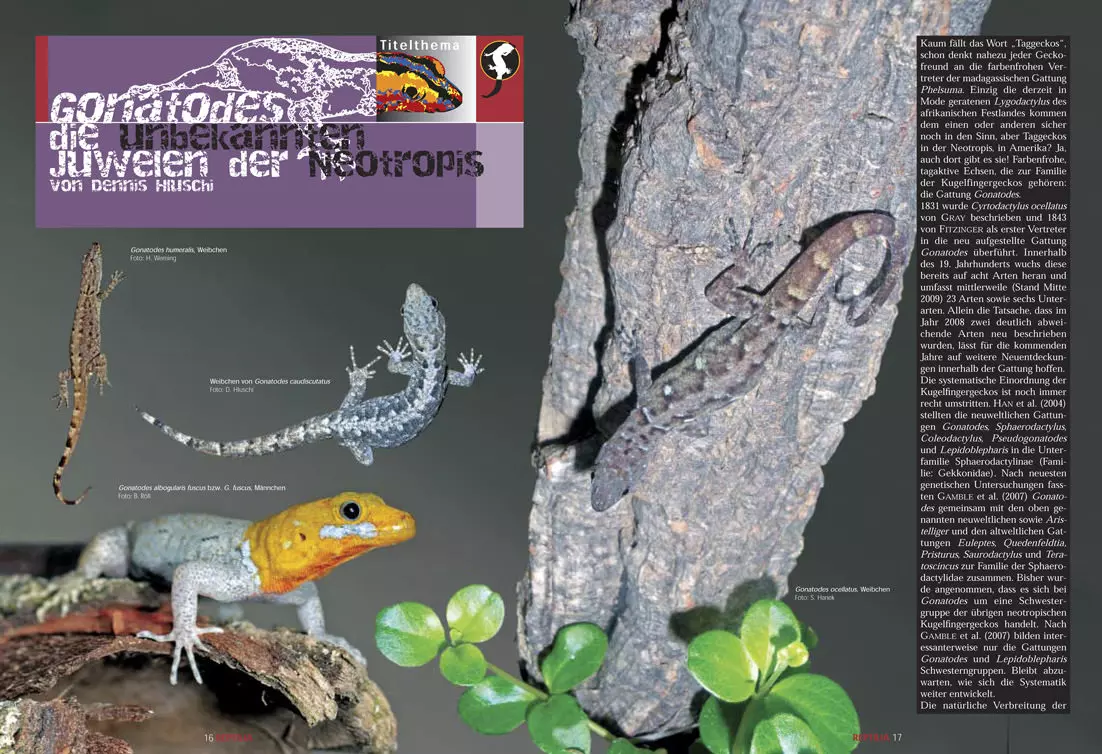
Gonatodes
- the unknown Juwel of the Neotropics
von D. Hluschi

KEEPING AND REPRODUCTION
Keeping and breeding Gonatodes vittatus
by S. Hanig

KEEPING AND REPRODUCTION
Keeping and breeding Gonatodes caudiscutatus
by P. Baldamus

KEEPING AND REPRODUCTION
Keeping and breeding Gonatodes ocellatus
by S. Hanig

TRAVEL
In the footsteps of Darwin through South America
Part 1: From England to Patagonia
by H. Werning

PORTRAIT and poster
Alytes obstetricans
from B. Trapp

REPORTAGE
10 years of outdoor terrariums for snakes -
an experience report
by M. Hallmen

REPORTAGE
An obituary on the first anniversary of the death of
Bert Langerwerf. The "Lizard Man
by H. Werning

KEEPING AND REPRODUCTION
Desert iguanas(Dipsosaurus dorsalis) and their reproduction in the terrarium
von B. Langerwerf

HERPETOFAUNA
Soussland tortoise(Testudo graeca soussensis) in its natural habitat
by U. Schlüter

WESTERN HERP PERSPECTIVES
The forgotten ones
from B. Love

SUBSCRIPTION & SERVICE
ALSO NEAR YOU
PREVIEW
BRUTKASTEN 
The animals of our homeland
by H. Werning
Composition
Feeding recommendation
Technical details
Size information

0 of 0 reviews

Give us a rating!

Share your experience with the product with other customers.


Suggested products

Handbook of food plants for tortoises and other reptiles
Handbook of forage plants 2nd revised editionMarion Minch is not only a successful breeder of diverse tortoises for many years, but also an excellent connoisseur of native wild herbs. She founded and runs samenkiste.de, which is well known to many tortoise keepers and nature lovers. Her name is inextricably linked with reptile care and species-appropriate nutrition for tortoises. Her handbook of food plants summarises the most important native food plants for herbivorous and omnivorous reptiles. She not only considers tortoises, but also iguanas, spiny-tailed dragons and even chameleons. From the basics of plant biology to native wild herbs to suitable food plants for hardy tropical reptile species, this comprehensive work provides the basis for species-appropriate keeping. In the expanded and supplemented 2nd edition, the plant section is divided according to flower colour. This makes it even easier to identify wild herbs. The work has also been supplemented with a wealth of additional information and many pictures.

CHF 46.50

Geckos
Geckos in the terrarium by Astrid FalkThe book offers a comprehensive introduction to geckos and their species-appropriate keeping in terrariums. It explains what you need to think about before buying a gecko and what preparations should be made. The book describes in detail how the terrarium is technically equipped and set up. The care of the animals, their special features and behaviour, their diet, reproduction and rearing of young animals are described, as well as diseases and husbandry problems with tried and tested suggestions for prevention and treatment. Individual gecko species that are particularly suitable for keeping and breeding in terrariums are portrayed in detail in the second part of the book.

CHF 28.50

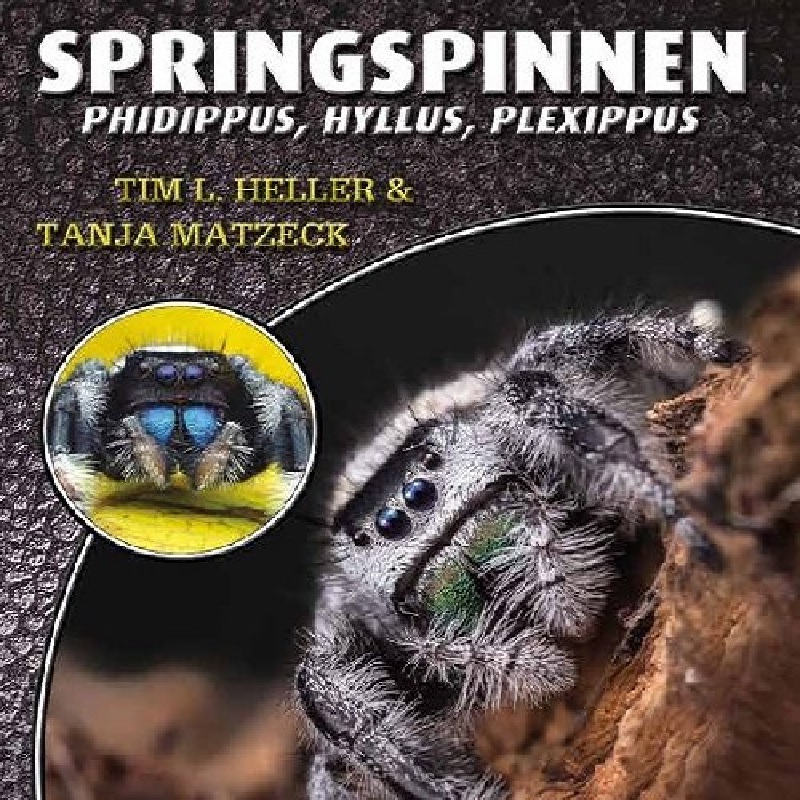
Jumping spiders Phidippus, Hyllus, Plexippus
Book Jumping Spiders - Phidippus, Hyllus & Plexippus A guide to keeping jumping spiders of the genera Phidippus, Hyllus & Plexippus. Who can resist the charm of jumping spiders? The childlike appearance of their expressive face simply leaves no one cold! In addition, their behavior is extremely exciting to observe, their colors are bright and their requirements for species-appropriate keeping are very easy to meet. No wonder these likeable jumpers are all the rage! This volume in the "Species by Species" series describes in detail what to look out for when buying and keeping them, introduces the most commonly kept species and color forms and provides plenty of tips on how to keep them successfully - so you can be sure they will breed well! Species by Species introduces you to the books in this series, which present the most popular terrarium animals. Each volume offers you detailed, practical care instructions and all the information you need to successfully breed your animals. All important questions from the required tank size to terrarium set-up, technical equipment, species-appropriate nutrition and disease prevention are answered with numerous tricks and tips. Experienced, long-standing breeders reveal how you can encourage the animals to reproduce and raise healthy young. All this in full color, generously illustrated and attractively designed - just about your terrarium animal - species by species

CHF 23.90

Book Breeding live food yourself
Book "Grow your own live food" - The perfect guide for pet owners Discover practical and detailed instructions on how you can easily breed food for your reptiles, birds, fish or other animals yourself in the book "Breeding live food yourself". With valuable tips on various food insects, their care and breeding, you can save money and ensure a species-appropriate diet for your pets. Contents of the book: Step-by-step instructions for breeding feeder insects Information on the best types of food for reptiles, birds and fish Care instructions and breeding conditions for various live food species Tips for sustainable and cost-effective food production Why breed your own live food? Get healthy, fresh food for your animals Save money and reduce dependence on pet shops Promote the health and well-being of your animals with species-appropriate food Whether you are a beginner or an experienced pet owner, this book provides you with everything you need to successfully breed live food yourself.

CHF 46.50

Marginata 69 - New Guinea tortoises
Marginata 69 - New Guinea tortoises – the genus ElseyaCover storyThe unrecognised beauties: New Guinea tortoises (Andreas S. Hennig)My experiences with Branderhorst's New Guinea tortoise, Elseya (Elseya) branderhorsti (Ouwens, 1914) (Andreas S. Hennig)Keeping and breeding of Rhodin's New Guinea tortoise, Elseya (Hanwarachelys) rhodini Thomson, Amepou, Anamiato & Georges, 2015 (Andreas S. Hennig)PortraitGeoemyda spengleri, Chinese serrated tortoise (Andreas S. Hennig)ReportageMacrochelys temminckii – Experiences and impressions with vulture tortoises part 2 (Reiner Praschag)KeepingAn alternative to year-round keeping of the Egyptian tortoise in the terrarium – my experiences with seasonal outdoor keeping of Testudo kleinmanni (Ricarda Schramm)EtymologySawbacks and living maps part 4: Graptemys gibbonsi, Pascagoula humpback tortoise (Holger Vetter)Classifieds & animal placement

CHF 16.50

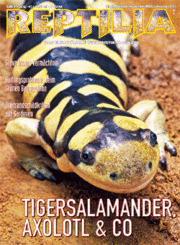
Reptilia 67 - Tiger Salamander, Axolotl & Co.
Reptilia 67 - Tiger Salamander, Axolotl & Co.Steve Irwin's legacyHusbandry problems with the green tree pythonBroad-shelled turtles in SardiniaContents: 2EDITORIAL 3MAGAZINE 11TERMINE 14WESTERN HERP PERSPECTIVESRevive the old passionFrom B. Love 6 PHOTO REPORTAGEAmbystomatidae Gray, 1850 ?transverse-toothed newtsBy T. Blanck 22HERPETOFAUNAThe cross-toothed newts, family Ambystomatidae Gray, 1850An overview of the speciesBy T. Blanck 36 KEEPING AND REPRODUCTIONKeeping and breeding the banded tiger salamander Ambystoma mavortiumBy T. Blanck & M. Braun 41HERPETOCULTUREThe axolotl in religion, magic and mythBy F. Cupul 45LETTERS11 years ReptiliaVisiting Bill LoveBy H. Werning 51PORTRAIT AND POSTERZamenis longissimusFrom A. Kwet 56 KEEPING AND REPRODUCTIONFringed-fingered lizards (Acanthodactylus) in the wild and in the terrariumPart 2: Basics of terrarium keeping and reproductive biologyBy U. Schlüter 67HERPETOFAUNATestudo marginata - A view of SardiniaBy E. Cimatti 77KEEPING AND REPRODUCTIONThe most common husbandry problems with the green tree python (Morelia viridis)By G. Maxwell 82TERRARIUM SHOW PLANTSCrickey! - A visit to Australia ZooBy K. Grießhammer 90FAQ - FREQUENTLY ASKED QUESTIONSGarter snakesBy M. Hallmen 94LIBRARY 104BROOD BOX The Silence of the Nose Frogs, Part 2 By H. Werning

CHF 11.20

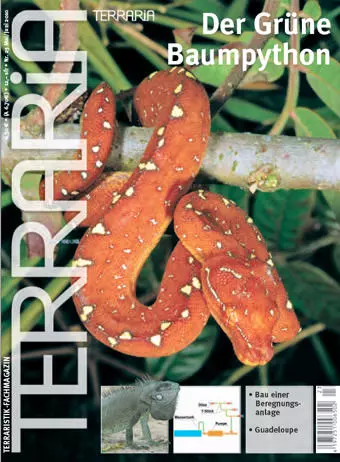
Terraria 23 - The green tree phyton
Terraria 23 - The Green Tree Python Construction of an irrigation systemGuadeloupe Contents: Hardly any other snake enjoys as much reverent enthusiasm as Morelia viridis, the Green Tree Python. Even die-hard snake haters can hardly escape the aesthetic fascination radiated by the beautifully green-coloured, elegantly “coiled” pythons on a branch. And then there are the brightly red, yellow or green coloured juveniles! This snake is correspondingly popular in terraristics, and although it is still not an easy species to keep, it has made an impressive triumphant advance in our terrariums in recent years. A good two decades ago, breeding itself was considered a sensation, but today a wide variety of targeted colour breeds are already circulating. The cover story of the upcoming TERRARIA reports on the latest developments in this giant snake – you can look forward to previously unpublished information as well as magnificent photos! Editorial Magazine El Niño to blame for snake bites?/Male toad on wrong routes/Legal matters/Snake conference/Marketplace TERRAglobal Camping in the Páramo Maik Dobiey Cover StoryThe Green Tree Python – Terrarium Set-up and Technology by Michèl Kroneis Outdoor enclosures for Morelia viridis by Joachim Bulian “And the further rearing went smoothly …”. Some notes on the rearing of the Green Tree Python (Morelia viridis) by Joachim Bulian A simple irrigation system for “small” money by Peter Maria Müller Between rubbish and mines: the Dalmatian tortoise Testudo hermanni hercegovinensis. Part 2 by Michael Wirth Butterflies in the house by Hans-Günther Kaiser Travel Herpetological impressions searching for iguanas in the French Antilles: Guadeloupe by Stefanie Schönecker & Patrick Schönecker New species New from New Guinea: two species and genera of narrow-mouthed frogs by Axel Kwet Two new species of agamas in the genera Pseudocalotes and Bronchocela by Jakob Hallermann Among researchers Biodiversity and species decline in Bolivia by Steffen Reichle Eye-catcher In the desert paradise – tortoises and iguanas among columnar cacti. A visit to Robert Blome in Arizona  by Heiko Werning Near you Subscription & Service Preview Incubator 80 mosquitoes for one frog. Part 1 by Heiko Werning

CHF 12.00

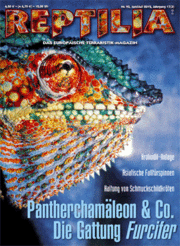
Reptilia 95 - Chameleon & Co. The genus Furcifer
  Krokodil-AnlageAsiatische FalltürspinnenHaltung von Schmuckschildkröten Inhalt: Das Pantherchamäleon, Furcifer pardalis, gehört zu den beliebtesten Echsen überhaupt. Diese extrem farbenprächtigen, imposanten Chamäleons aus Madagaskar werden inzwischen in verschiedenen Lokalformen erfolgreich und dauerhaft in unseren Terrarien nachgezüchtet. Die Gattung Furcifer hält aber noch viele weitere hochinteressante Arten bereit – freuen Sie sich auf ein in jeder Hinsicht buntes Titelthema mit viel Praxisbezug! EDITORIALMAGAZINTERMINEIN 5 JAHREN UM DIE WELTBrüllaffen, Klappschildkröten und VulkaneA. PachmannWESTERN HERP PERSPECTIVESAuf Reptiliensuche in AustralienB. LoveFOTOSTORYChamäleons der Gattung FurciferP. NecasHERPETOFAUNAAbenteuer Komorenchamäleon – auf der Suche nach Furcifer cephalolepisR. LeptienPORTÄTIm Porträt: das Teppichchamäleon, Furcifer lateralis P. NecasIm Porträt: das Pantherchamäleon, Furcifer pardalisP. NecasZUCHTDie Entstehung einer neuen Designermorphe der Kornnatter (Pantherophis guttatus)A. SchmidHALTUNG UND VERMEHRUNGPhilippinenkrokodile (Crocodylus mindorensis) im Aquarium des Kölner Zoos. Teil 2: Bau einer Schauanlage für eine der am stärksten bedrohten Krokodilarten der Welt T. Ziegler, R. Sommerlad, W. Brass, K. van der Straeten, D. Karbe & A. RauhausHERPETOFAUNAAuf dem Weg ins All. Die Welt der Buchstaben-Schmuck-schildkröte, Trachemys scripta. Teil 5: Haltung und Vermehrung von Buchstaben-SchmuckschildkrötenA. S. HennigWIRBELLOSEAußergewöhnliche Falltürspinnen aus Asien: die Gattung Cyclocosmia F. Schneider, B. F. Striffler & I. WendtABO & SERVICETerrarienschauanlagen international Der „Rimba Reptile Park“ auf Bali M. HallmenTiere unserer Heimat Die ErdkröteR. LeptienBibliothekTipps & TricksTestlaufAUCH IN IHRER NÄHEREISEZwischen Anolis und Cycluren: Unterwegs auf Puerto RicoH. WerningVORSCHAUBRUTKASTENIguana chilena, Teil 2 H. Werning  

CHF 12.00

Marginata No. 30 - Under the spell of the turtle - joy and suffering of turtle research
  Schildkrötenschutz auf SumatraZucht der Rotwangen-KlappschildkröteSchildkröten im Schulunterricht Inhalt: EditorialLESERBRIEFEMagazinTermineREPORTAGEJenseits von Afrika – ein Forschungsaufenthalt in MadagaskarJutta HammerREPORTAGESchildkrötenforschung in Vietnam Inga Fischer, Sarah Wahl und Sandra WeimerHALTUNG UND ZUCHT„Kambodscha – ein Königreich der Wunder“. Feldherpetologische Arbeit an Indotestudo elongataFlora IhlowPOSTERDie Turkana-See-Klappbrustschildkröte (Pelusios broadleyi)Hans - Dieter PhilippenZUCHTHaltung und Nachzucht der Madagassischen Strahlenschildkröte Teil 2Michael Wirth und Peter FritzReportageDie Ernährung europäischer Landschildkröten in der freien Wildbahn Wolfgang WegehauptBuchtippKleinanzeigenAbo & ServiceRegionalführer  

CHF 16.50

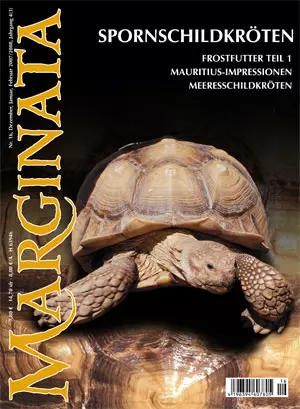
Marginata 16 - African spurred tortoises
Marginata 16 - Spur-thighed tortoises Frozen food part 1Mauritius impressionsSea turtles Contents: 2 EDITORIAL 3 READER LETTERS 4 MAGAZINE 8 DATES 10 REPORTAGEThe spur-thighed tortoise - the largest tortoise of the African mainlandHans - Dieter Philippen 18 BREEDING IN HUMAN CAREBreeding of the spur-thighed tortoise(Centrochelys sulcata) at Pilsen Zoo, Czech RepublicVeronika Kodymová and Jan Konás 24 REPORTAGE A house for spur-thighed tortoises part 1Hilko Funsch 31 PORTRAITArgentine snake-necked turtles (Hydromedusa tectifera Pope, 1820)Hans - Dieter Philippen 35 REPORTAGEFrozen food part 1Hans - Dieter Philippen 40 BREEDING IN HUMAN CAREKeeping and breeding the Australian snake-necked turtle (Chelodina longicollis) part 2Stefan Thierfeldt & Sabine Höfler-Thierfeldt 48 REPORTAGEA visit to the giant tortoises in the "La Vanille Crocodile Park" of MauritiusPetra and Jens Jungnickel 54 REPORTAGEThe conservation status of the loggerhead sea turtle (Caretta caretta): an introduction to the current issuesJosé C. Báez, Raimundo Real & Juan A. Caminas 60 BOOK TIP 61 CLASSIFIEDS 62 REGIONAL GUIDE

CHF 14.70

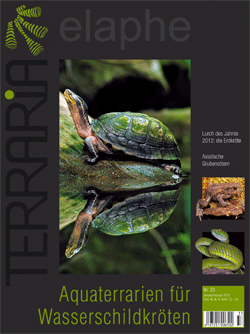
Terraria No. 33 - Aqua terrariums for turtles
Terraria No. 33 - Aqua terrariums for turtles Lurch des Jahres 2012: die ErdkröteAsiatische Grubenottern Inhalt: Wasserschildkröten gehören zu den beliebtesten Reptilien, die häufig auch von Tierhaltern gepflegt werden, die mit Terraristik nichts weiter zu tun haben. Doch aus den häufig in Zoogeschäften und Baumärkten angebotenen eurostückgroßen Babys wachsen schnell kräftige Schildkröten heran, die nach einer angemessenen Unterbringung verlangen. In unserem Titelthema stellen wir die grundlegenden Anforderungen an Aquaterrarien für Wasserschildkröten und ihre Einrichtung vor und zeigen, wie Sie sicher und sinnvoll ganze Anlagen für diese sympathischen Panzerträger errichten.TerritorialHerpetoramaTitelthemaAquaterrarien für WasserschildkrötenAndreas S. HennigSchildkröten im Regal. Vom Bau einer Kompaktanlage zur Haltung von WasserschildkrötenAndreas S. HennigEinrichtungsvorschläge für WasserschildkrötenbeckenSebastian NicklAquaterrarien – Beispiele aus der PraxisAndreas S. HennigTerraglobalSeltenen Schildkröten Namibias auf der SpurAlfred SchleicherWeil ich meinen Eltern nicht gehorcht habeFabio CupulÜberraschendes Arabien 2.0Wolfgang Grossmann, Thomas Kowalski & Hans-Jürgen ZilgerUnter ForschernZerstören für den Aufschwung: Ist es das wirklich wert? Fallstudie aus BrasilienBreno HamdanNeue ArtenDoppelt publiziert hält besser: ein „neues Nilkrokodil“Axel KwetAktuelles zur Taxonomie und Systematik asiatischer GrubenotternAndreas GumprechtStadtkröten vs. LandkrötenSabrina KarlSalamandraTerraristikKlassiker. Der AxolotlAlexander GutscheDie „unscheinbaren Taggeckos“ Oder doch Juwelen aus dem Süden Madagaskars? Phelsuma modesta in Biotop und TerrariumThomas HofmannEuropäische Landschildkröten im WinterMichael WirthHomerange. Vom Vereinsabend zur Reptilienwohnung. Zu Besuch bei Sandra Baus und Steven Arth im SaarlandHeiko WerningNatur- und ArtenschutzFeldnotizen. Fünfbeiniger AlpensalamanderAxel KwetRingelnatter frisst WasserschneckeUrs und Heidi HostDie Erdkröte (Bufo bufo) – Der Lurch des Jahres 2012Axel Kwet & Arno GeigerVermisst. Südliche Florida-Regenbogennatter (Farancia erytrogramma seminola)Alexander GutscheAbo & ServiceAuch in Ihrer NäheGalerie 2012 – Das Jahr des DrachenKriton KunzVorschauBrutkastenBetriebsprüfungHeiko Werning  

CHF 12.00

Marginata 37 - Pancake tortoise
Marginata 37 - Slaty turtles Common musk turtleTwo-headed turtles Contents: EditorialMagazineDates Cover storyAn extraordinary species: the split-shell tortoise (Malacochersus tornieri)Hans-Dieter Philippen FIELD RESEARCHA collection stop for split-shelled turtles – what does it do?Reginald Theodor Mwaya PortraitDumeril’s box turtle, Peltocephalus dumerilianus (Schweigger, 1812)Hans-Dieter Philippen ReportageSearch dogs for turtle researchSarah Wahl & Tim McCormack REPRODUCTIONExperiences with the care and breeding of the Common Musk Turtle (Sternotherus odoratus)Thomas Hofmann ReportageTwo-headed turtles – a not so rare phenomenon?Hans–Dieter Philippen ReportageTurtle Watch on Watamu beach. Volunteer work on the east coast of KenyaNadja Schaubhut Book tipClassifiedsSubscription & ServiceRegional guide

CHF 16.50