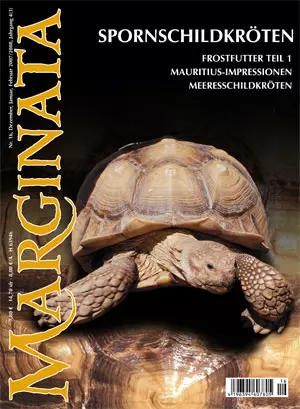
35 REPORTAGE Frozen food part 1 Hans - Dieter Philippen
40 BREEDING IN HUMAN CARE Keeping and breeding the Australian snake-necked turtle (Chelodina longicollis) part 2 Stefan Thierfeldt & Sabine Höfler-Thierfeldt
48 REPORTAGE A visit to the giant tortoises in the "La Vanille Crocodile Park" of Mauritius Petra and Jens Jungnickel
54 REPORTAGE The conservation status of the loggerhead sea turtle (Caretta caretta): an introduction to the current issues José C. Báez, Raimundo Real & Juan A. Caminas
60 BOOK TIP
61 CLASSIFIEDS
62 REGIONAL GUIDE
Composition
Feeding recommendation
Technical details
Size information
0 of 0 reviews
Give us a rating!
Share your experience with the product with other customers.
Login
No reviews found. Go ahead and share your findings with others.
Handbook of forage plants 2nd revised editionMarion Minch is not only a successful breeder of diverse tortoises for many years, but also an excellent connoisseur of native wild herbs. She founded and runs samenkiste.de, which is well known to many tortoise keepers and nature lovers. Her name is inextricably linked with reptile care and species-appropriate nutrition for tortoises. Her handbook of food plants summarises the most important native food plants for herbivorous and omnivorous reptiles. She not only considers tortoises, but also iguanas, spiny-tailed dragons and even chameleons. From the basics of plant biology to native wild herbs to suitable food plants for hardy tropical reptile species, this comprehensive work provides the basis for species-appropriate keeping. In the expanded and supplemented 2nd edition, the plant section is divided according to flower colour. This makes it even easier to identify wild herbs. The work has also been supplemented with a wealth of additional information and many pictures.
Geckos in the terrarium by Astrid FalkThe book offers a comprehensive introduction to geckos and their species-appropriate keeping in terrariums. It explains what you need to think about before buying a gecko and what preparations should be made. The book describes in detail how the terrarium is technically equipped and set up. The care of the animals, their special features and behaviour, their diet, reproduction and rearing of young animals are described, as well as diseases and husbandry problems with tried and tested suggestions for prevention and treatment. Individual gecko species that are particularly suitable for keeping and breeding in terrariums are portrayed in detail in the second part of the book.
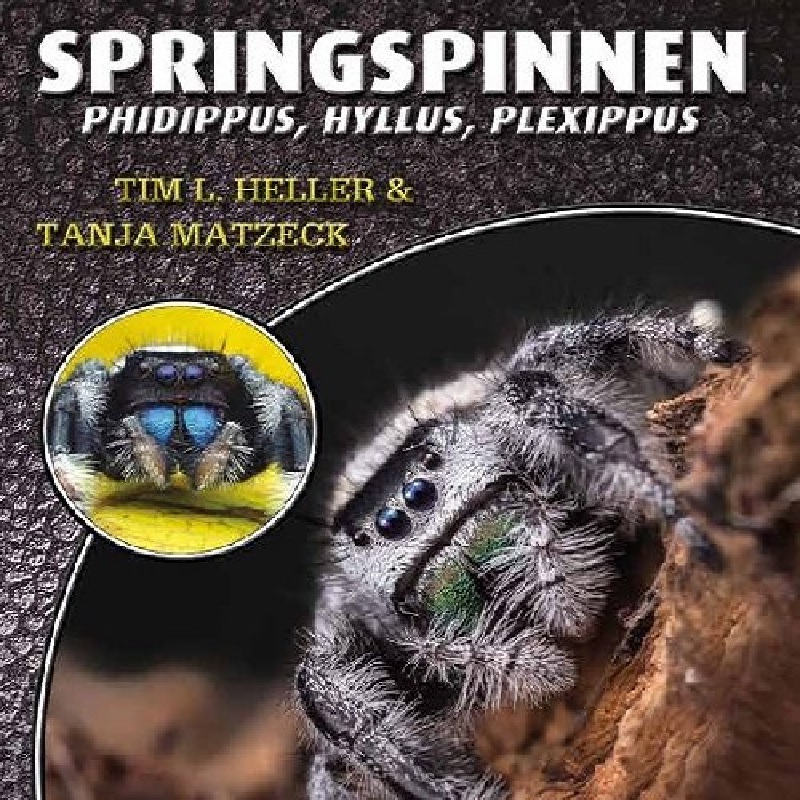
Book Jumping Spiders -
Phidippus, Hyllus & Plexippus
A guide to keeping jumping spiders of the genera Phidippus, Hyllus & Plexippus. Who can resist the charm of jumping spiders? The childlike appearance of their expressive face simply leaves no one cold! In addition, their behavior is extremely exciting to observe, their colors are bright and their requirements for species-appropriate keeping are very easy to meet. No wonder these likeable jumpers are all the rage!
This volume in the "Species by Species" series describes in detail what to look out for when buying and keeping them, introduces the most commonly kept species and color forms and provides plenty of tips on how to keep them successfully - so you can be sure they will breed well!
Species by Species introduces you to the books in this series, which present the most popular terrarium animals. Each volume offers you detailed, practical care instructions and all the information you need to successfully breed your animals.
All important questions from the required tank size to terrarium set-up, technical equipment, species-appropriate nutrition and disease prevention are answered with numerous tricks and tips.
Experienced, long-standing breeders reveal how you can encourage the animals to reproduce and raise healthy young.
All this in full color, generously illustrated and attractively designed - just about your terrarium animal - species by species
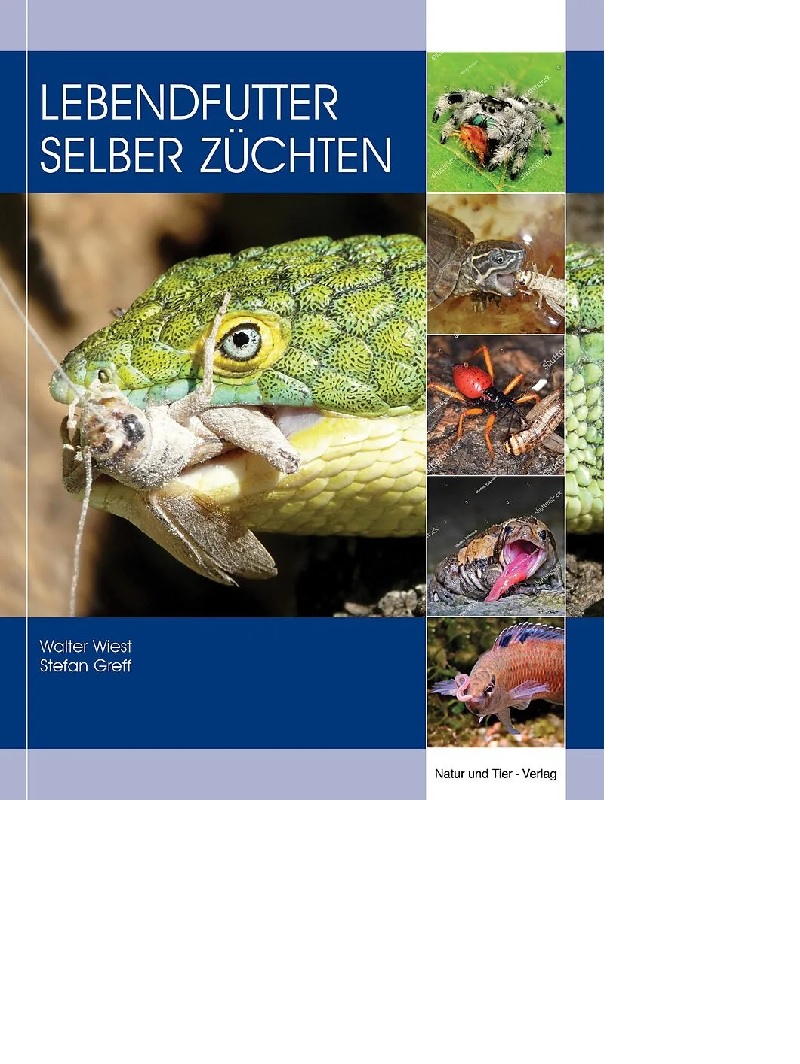
Book "Grow your own live food" - The perfect guide for pet owners
Discover practical and detailed instructions on how you can easily breed food for your reptiles, birds, fish or other animals yourself in the book "Breeding live food yourself". With valuable tips on various food insects, their care and breeding, you can save money and ensure a species-appropriate diet for your pets.
Contents of the book:
Step-by-step instructions for breeding feeder insects
Information on the best types of food for reptiles, birds and fish
Care instructions and breeding conditions for various live food species
Tips for sustainable and cost-effective food production
Why breed your own live food?
Get healthy, fresh food for your animals
Save money and reduce dependence on pet shops
Promote the health and well-being of your animals with species-appropriate food
Whether you are a beginner or an experienced pet owner, this book provides you with everything you need to successfully breed live food yourself.
Marginata 69 - New Guinea tortoises – the genus ElseyaCover storyThe unrecognised beauties: New Guinea tortoises (Andreas S. Hennig)My experiences with Branderhorst's New Guinea tortoise, Elseya (Elseya) branderhorsti (Ouwens, 1914) (Andreas S. Hennig)Keeping and breeding of Rhodin's New Guinea tortoise, Elseya (Hanwarachelys) rhodini Thomson, Amepou, Anamiato & Georges, 2015 (Andreas S. Hennig)PortraitGeoemyda spengleri, Chinese serrated tortoise (Andreas S. Hennig)ReportageMacrochelys temminckii – Experiences and impressions with vulture tortoises part 2 (Reiner Praschag)KeepingAn alternative to year-round keeping of the Egyptian tortoise in the terrarium – my experiences with seasonal outdoor keeping of Testudo kleinmanni (Ricarda Schramm)EtymologySawbacks and living maps part 4: Graptemys gibbonsi, Pascagoula humpback tortoise (Holger Vetter)Classifieds & animal placement
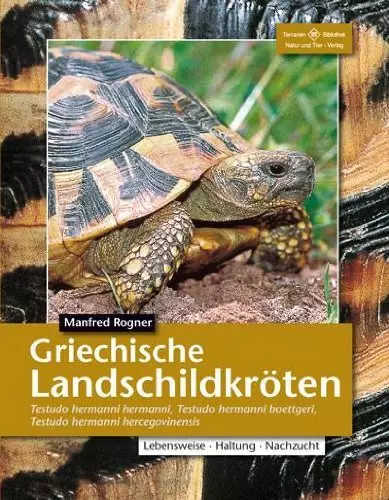
Book Greek tortoises
The Greek tortoise is a true classic of terraristics.
167 pages
with numerous mostly coloured illustrations and maps
Paperback
Author Manfred Rogner
Publisher NTV
Their attractive appearance and friendly character mean that they are rightly at the top of the list of favourites among tortoise lovers. For decades, the experienced terrarium keeper Manfred Rogner has been caring for and breeding this attractive species with great success, which he has also observed in their habitat.In this guide, he describes everything you need to know about the species-appropriate keeping and breeding of your armoured pets in a clear and practical way.
Draco 54 - Nutrition of European tortoises
Contents:
EditorialModelled on nature: The diet of European tortoises in their natural habitatMichael Wirth Tortoise nutrition, but species-appropriate – a practical guideMichael Wirth Herb collecting made easy – an introduction to identifying and collecting wild plants Michael Wirth The 1x 1 of meadow herbs Michael Wirth Hay in tortoise nutrition – valuable and vital Michael Wirth Ten questions about tortoise nutrition Markus Baur Bibliography In your neighbourhood Services
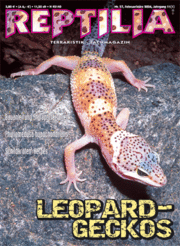
Reptilia 57 - Leopard geckos
2 - Editorial4 - Magazine15 - Dates18 - Western Herp Perspectives: In the trap, by B. Love20 - Photo report: The leopard gecko (Eublepharis macularius), by D.Duscha30 - Herpetofauna: Behaviour and biology of the leopard gecko (Eublepharis macularius) in Pakistan, by M. Sharif Khan36 - Keeping and reproduction: Colour and pattern variations of the leopard gecko (Eublepharis macularius), by R. Kreutz42 - Journey: In the Magic Kingdom of the Quetzal - Dream journeys through the land of "Eternal Spring", by K. Kunz51 - Portrait and poster: Trimeresurus flavomaculatus, by M. Gaulke56 - Hepertomedicine: Herpesvirus infections in tortoises - disease, diagnosis and prophylaxis options, by S. Fischer & M. Homuth65 - Care and reproduction: Monkeys with orange legs - Care and reproduction of the Chaco macifrog Phyllomedusa hypochondrialis azurea, by E. Biggi72 - Keeping and reproduction: On keeping the ventral viper Maticora bivirgata flaviceps (Cantor, 1839) in the terrarium, by G. Vogel & P. Freed78 - Terrarium technology: Building instructions for a polystyrene terrarium according to Marco Beck, by M. Schicker86 - Classifieds93 - Advice and action95 - Library104 - Incubator: My flat-sharing community, part 2: The Grand Coalition has promised to solve the problems in the country, but once again nobody is showing up, by H. Werning
Reptilia 37 Jackson's chameleons
Kenyaschool vivariumTurtle trade in CambodiaContent:2 EDITORIAL4 READER'S LETTERS6 MAGAZINE12 DATES16 PHOTO REPORTAGEthree-horned chameleonsfrom P. Necas36 HUSBANDRY AND BREEDINGChamaeleo (Trioceros)bitaeniatus and its relatives - With comments on the keeping and reproduction of a representative of the Grupeeby N. Lutzmann44 HERPETOFAUNAChamaeleo (Trioceros)jacksonii and its subspeciesby N. Lutzmann51 PORTRAIT AND POSTEREryx jaculusby B. Trapp55 TRAVELOn Herpeto Safari in Kenyafrom I. Schürkes, V. Wasanga & S. Lötters62 REPORTStudies on the turtle trade in Cambodiaby E. Lehr & R. Holloway71 HUSBANDRY AND BREEDINGOne of Europe's most beautiful lizards in a terrarium: the pearl lizardfrom S. Bania76 WESTERN HERP PERSPECTIVESExotic poisonous snakes - the charm of something specialfrom B. Love79 REPORTThe school vivariumPart 2: Example Franziskaner-Gymnasium Kreuzbergby M. Hallmen90 CLASSIFIEDS95 LIBRARY104 GLOSSEBig autumn extra: you have mail!by H. WerningThe October/November issue of your terraristic magazine REPTILIA makes the hearts of all lizard fans and aesthetes beat faster with the title theme "Threehorned Chameleons": In this photo story, which is even more sumptuous than usual, chameleon expert Petr Necas not only gives a general overview of these fascinating animals from the subgenus Trioceros, but he also introduces you to no less than all species in detail!
Chamaeleo (Trioceros) bitaeniatus and his relatives are then described in detail by the expert par excellence in this field, namely Nicolá Lutzmann. He reports about the biology of the small dragons, brings clarity into the confused systematics and not least describes their keeping and breeding vividly - for all terrarists interested in these beautiful lizards an absolute "must".Just like the next article on the title theme of Nicolá Lutzmann, who deals with the popular Chamaeleo (Trioceros) jacksonii and its relatives. Here, too, the author knows how to write expertly about the field biology of the animals, clears up the subspecies confusion and gives detailed tips for the successful care and breeding of the primeval lizards.We stay in Africa and go on Herpeto Safari in Kenya with I. Schürkes, V. Wasanga and S. Lötters. This dreamlike nature destination has not only the "big five" to offer, but is also herpetologically the very first cream, of which you can convince yourself with brilliant photos and a highly interesting expedition report.Unfortunately, the fatal situation of the Asian turtle fauna is a long runner in the REPTILIA, and if we together with you, dear readers, could contribute significantly to the construction of the conservation breeding station in the all-weather zoo Münster, the situation on site is still dramatic. This is proven by the drastic pictures and shattering experiences that Edgar Lehr and Rohan Hollowy bring back from investigations into the turtle trade in Cambodia.Sandra Bania takes care of one of the most beautiful lizards in Europe in her terrarium: the pearl lizard. Therefore she knows how to describe enthusiastically that these magnificent and trustful animals are not only an optical delight, but also show a very varied and interesting behaviour, which makes the lizards together with their relatively unproblematic keeping to best suitable fosterlings, whose keeping and breeding after the reading of this detailed contribution certainly no problems, but however much joy prepares.In the second part of his report on Das Schulvivarium, Martin Hallmen presents a practical example, namely the vivarium at the Franziskaner-Gymnasium Kreuzberg, which he initiated and praised highly. Here you can learn concretely what you have to consider during the planning and expansion phase and how everyday life with the vivarium works, how it is integrated into lessons and what publicity effect can be achieved with it. Certainly a thing worth imitating!Also in this REPTILIA we offer you of course again the full spectrum of our service: In the magazine, for example, you will read curiosities about a reptilian flower pot and get to know an interesting and up-to-date approach to the labelling of tank lizards. Dates, classifieds and the poster (this time with the Western Sandboa Eryx jaculus) are not missing in the incubator, as is Heiko Werning's infamous gloss: "This time, some people will certainly be very happy about caring mail. Will you also be there?
Reptilia 118 - MoreliaMadagascarHumpback turtlesProfessional reptile breeding Contents:Cover story: Morelia - tree python, diamond python & Co.Everyone knows the green tree python. The animals are admired for their colouring and their favourite position, curling up over a branch, almost symbolises our idea of a tree-dwelling snake. This species has been successfully kept and bred in terrariums for a long time. However, the other pythons of the Morelia genus are also very popular. We offer an overview of these exceptionally beautiful giant snakes, describe new ways of setting up a terrarium for Morelia viridis in a naturalistic way and look at the keeping and breeding of a species that is still little known, the python with a scaly scales, Morelia carinata.EditorialMAGAZINEDATESWESTERN HERP PERSPECTIVESThe fate of books part 2B. LovePhoto storyPython beauties from the other side of the world: Morelia, the tree and diamond pythonsM. MenseKeeping and breedingKeeping a green tree python in a naturally designed large terrariumR. StallingerKeeping and breedingMorelia carinata – The Python with a Difference!O. JugReportageRare exhibition animal: Morelia bredli at Frankfurt ZooD. RösselKeeping and breedingHumpback turtles – The genus GraptemysM. RognerKeeping and breedingProfessional breeding of terrarium animals for the pet tradeSimone P. ReportageUnder the spell of the big telescopic eyes: jumping spiders on the lookoutU. & J. SchimmelpfennigAnimals of our homelandThe sand lizardR. LeptienSERVICELIBRARYALSO NEAR YOUJourneySearching for reptiles in MadagascarC. SchneiderPREVIEWBRUTKASTEN Why do pigeons of all things have to be the symbol of peace?H. Werning
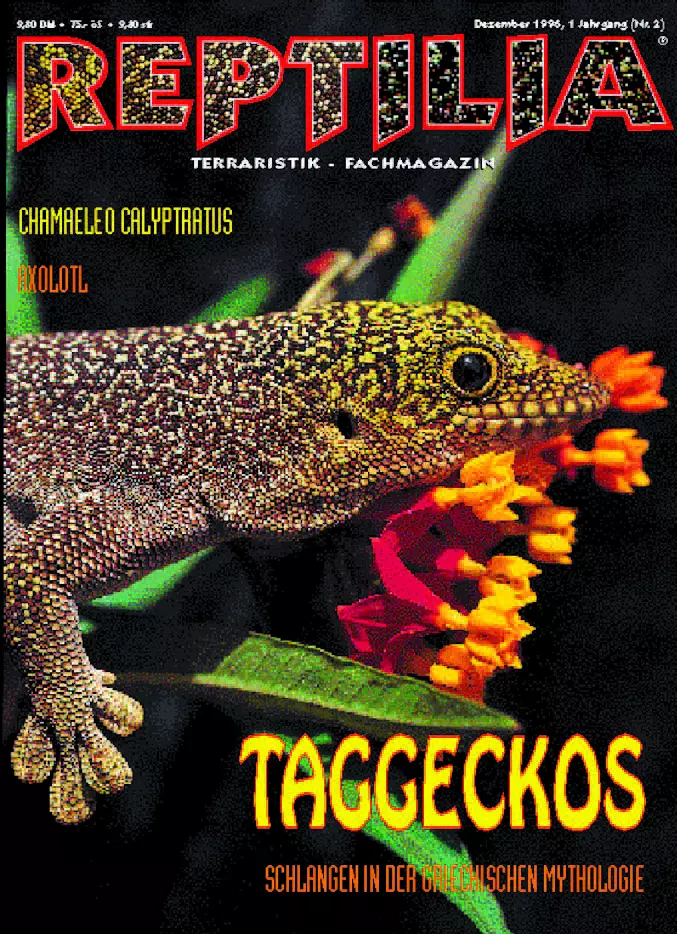
Reptilia 02 - Day geckosChameleo caylptratusAxolotlSnakes in Greek mythologyContents:Page 2 - EditorialPage 3 - Letters to the editor and discussionPage 7 - MagazinePage 17 - Photo report: Phelsuma, by J. KrügerPage 23 - Keeping and reproduction: Phelsuma standingi, by G. HallmannPage 26 - Report: Phelsuma and species conservation: The Round Island project, by G. HallmannPage 29 - Herpetofauna: Diurnal geckos, by Dr M. MeyerPage 33 - Travelogue: Baja California Part 2: The island world in the Gulf of California, by H. WerningPage 39 - Portrait and poster: Anolis marmoratus marmoratus, by M. SchmidtPage 43 - Keeping and breeding: Axolotl, by J. WistubaPage 47 - Terraristics: Sex determination in reptiles, by Dr M. Bachs TabernerPage 47 - Terraristics: Sexual dimorphism in African spurred tortoises, by A. Romairone / I. Iglesias IzquierdoPage 53 - Herpetofauna: Horned frogs, by M. BatllePage 56 - Herpetology and culture: Mythology: The snakes of Olympus, by L. B. Carissimi-PrioriPage 61 - Keeping and reproduction: Chamaeleo calyptratus, by W. SchmidtPage 69 - Veterinary medicine: Internal parasites in reptiles and amphibians, by Dr C. López del CastilloPage 73 - LibraryPage 75 - Advice and actionPage 80 - Incubator: Glossary by H. Werning
Draco 05 - Giant snakesContents:
Page content
2 Editorial
4 On the systematics and biology of giant snakes (Boidae), by Dr L. Dirksen & M. Auliya
20 Quo vadis, keeping boids in human hands, by Dr H. D. Lehmann
26 record specimens and man-eaters, by Dr L. Dirksen
32 Notes on the green tree python Morelia viridis(SCHLEGEL 1872) - population-related variants, care and breeding, by A. Kirschner & H. Abend
40 Quo vadis, Boa regia, by A. Kirschner
43 The King Python (SHAW 1802), by A. Kirschner
48 Destination: Down under - The giant snakes of Australia, by V. Franz
56 KLeine Riesenschlangen - Care and breeding of sand boas in the terrarium, by H. Seufer
68 Experiences with rarely kept Corallus species Corallus annulatus annulatus, Corallus hortulanus hortulanus and Corallus hortulanus ruschenbergeria, by S. Wirz
78 Book box
93 Magazine
CHF 16.80
❅
❆
❅
❆
❅
❆
❅
❆
❅
❆
❅
❆
This website uses cookies to ensure the best experience possible. More information...