Handbook of forage plants 2nd revised editionMarion Minch is not only a successful breeder of diverse tortoises for many years, but also an excellent connoisseur of native wild herbs. She founded and runs samenkiste.de, which is well known to many tortoise keepers and nature lovers. Her name is inextricably linked with reptile care and species-appropriate nutrition for tortoises. Her handbook of food plants summarises the most important native food plants for herbivorous and omnivorous reptiles. She not only considers tortoises, but also iguanas, spiny-tailed dragons and even chameleons. From the basics of plant biology to native wild herbs to suitable food plants for hardy tropical reptile species, this comprehensive work provides the basis for species-appropriate keeping. In the expanded and supplemented 2nd edition, the plant section is divided according to flower colour. This makes it even easier to identify wild herbs. The work has also been supplemented with a wealth of additional information and many pictures.
Geckos in the terrarium by Astrid FalkThe book offers a comprehensive introduction to geckos and their species-appropriate keeping in terrariums. It explains what you need to think about before buying a gecko and what preparations should be made. The book describes in detail how the terrarium is technically equipped and set up. The care of the animals, their special features and behaviour, their diet, reproduction and rearing of young animals are described, as well as diseases and husbandry problems with tried and tested suggestions for prevention and treatment. Individual gecko species that are particularly suitable for keeping and breeding in terrariums are portrayed in detail in the second part of the book.
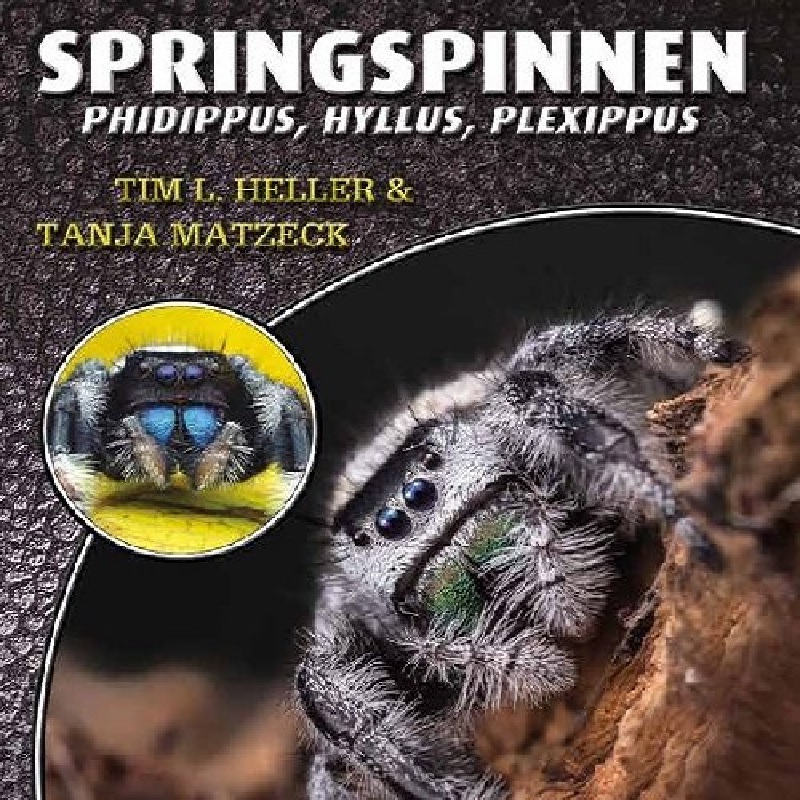
Book Jumping Spiders -
Phidippus, Hyllus & Plexippus
A guide to keeping jumping spiders of the genera Phidippus, Hyllus & Plexippus. Who can resist the charm of jumping spiders? The childlike appearance of their expressive face simply leaves no one cold! In addition, their behavior is extremely exciting to observe, their colors are bright and their requirements for species-appropriate keeping are very easy to meet. No wonder these likeable jumpers are all the rage!
This volume in the "Species by Species" series describes in detail what to look out for when buying and keeping them, introduces the most commonly kept species and color forms and provides plenty of tips on how to keep them successfully - so you can be sure they will breed well!
Species by Species introduces you to the books in this series, which present the most popular terrarium animals. Each volume offers you detailed, practical care instructions and all the information you need to successfully breed your animals.
All important questions from the required tank size to terrarium set-up, technical equipment, species-appropriate nutrition and disease prevention are answered with numerous tricks and tips.
Experienced, long-standing breeders reveal how you can encourage the animals to reproduce and raise healthy young.
All this in full color, generously illustrated and attractively designed - just about your terrarium animal - species by species
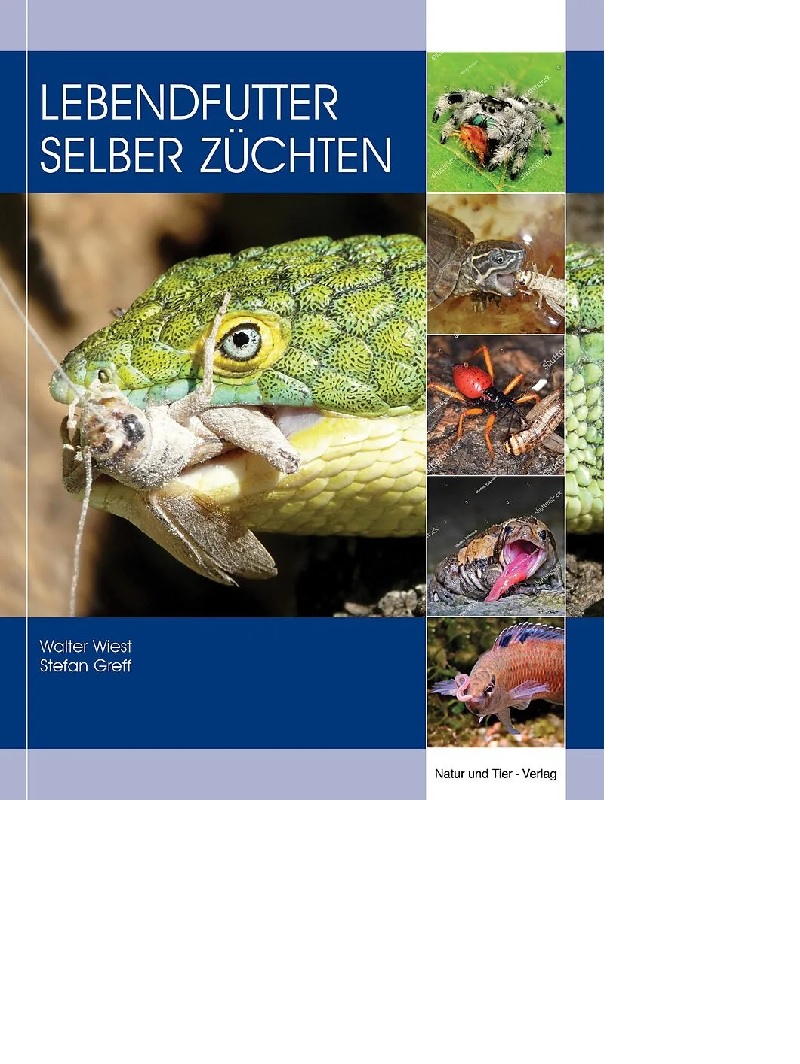
Book "Grow your own live food" - The perfect guide for pet owners
Discover practical and detailed instructions on how you can easily breed food for your reptiles, birds, fish or other animals yourself in the book "Breeding live food yourself". With valuable tips on various food insects, their care and breeding, you can save money and ensure a species-appropriate diet for your pets.
Contents of the book:
Step-by-step instructions for breeding feeder insects
Information on the best types of food for reptiles, birds and fish
Care instructions and breeding conditions for various live food species
Tips for sustainable and cost-effective food production
Why breed your own live food?
Get healthy, fresh food for your animals
Save money and reduce dependence on pet shops
Promote the health and well-being of your animals with species-appropriate food
Whether you are a beginner or an experienced pet owner, this book provides you with everything you need to successfully breed live food yourself.
Marginata 69 - New Guinea tortoises – the genus ElseyaCover storyThe unrecognised beauties: New Guinea tortoises (Andreas S. Hennig)My experiences with Branderhorst's New Guinea tortoise, Elseya (Elseya) branderhorsti (Ouwens, 1914) (Andreas S. Hennig)Keeping and breeding of Rhodin's New Guinea tortoise, Elseya (Hanwarachelys) rhodini Thomson, Amepou, Anamiato & Georges, 2015 (Andreas S. Hennig)PortraitGeoemyda spengleri, Chinese serrated tortoise (Andreas S. Hennig)ReportageMacrochelys temminckii – Experiences and impressions with vulture tortoises part 2 (Reiner Praschag)KeepingAn alternative to year-round keeping of the Egyptian tortoise in the terrarium – my experiences with seasonal outdoor keeping of Testudo kleinmanni (Ricarda Schramm)EtymologySawbacks and living maps part 4: Graptemys gibbonsi, Pascagoula humpback tortoise (Holger Vetter)Classifieds & animal placement
Terraria 18 - Building Large Terrariums
In the rainforests of MadagascarGiant salamander
Contents:
2 Editorial Mike ZAWADZKI4 Magazine Remarkable import: Grave frogs of the genus Calluella/DGHT once again a member of the BNA – Opening of a new BNA- training centre in Hambrücken/ 24th Terraristikbörse Karlsruhe in new hall/Legal/Reference/Vegetarian cravings of a garter snake?/Marketplace12 TERRAglobal All beginnings are difficult Maik DOBIEY The forgotten "insufficient data" species Mirco SOLÉ Cover story: Building Large Terrariums16 17 square metres of rainforest Wolfgang DAHM26 When they grow larger – the relocation of the caimans Matthias SCHMIDT35 A terrarium wall for tropical tortoises (Testudinidae) Erica HAMERS & Hans – Dieter PHILIPPEN40 Construction of a large wooden terrarium for diamond pythons Sascha ESSER43 The Kárpathos water frog (Rana cerigensis or Pelophylax cerigensis): Taxonomic change and acute endangerment Hans-Jürgen LUEF50 Giant salamanders of the genus Andrias – a Japanese-Chinese relationship Lutz DIRKSEN58 To the knowledge of an unknown: Cricosaura typica, the Cuban night lizard Ansel FONG G. & Irelis BIGNOTTE-GIRÓ64 Journey Silky sifakas and flat-tailed geckos – the Marojejy National Park Peter KRAUSE & Sebastian WOLF77 New species The smallest frog of the South American Andes Axel KWET A “feather-tailed gecko” from the south-western Angola Mirko BARTS New tree frogs in Europe Axel KWET80 Among researchers The diversity of amphibian species in a lowland rainforest in Borneo Alexander KELLER83 A visit to the Museo da Historia Natural de Asunción, Paraguay Uwe SCHLÜTER88 Near you91 Subscription & Service94 Preview96 Incubator The lizard wall Mike ZAWADZKI
All about keeping water turtles
128 Seiten
116 Farbfotos
Format: 16,8 x 21,8 cm
Autor Andreas S. Hennig
Inhalt:
Der erfahrene Terrarianer Andreas S. Hennig gibt in diesem neuen Ratgeber eine umfassende Einführung in die Haltung von Wasserschildkröten.Er stellt Biologie, Pflege- und Nachzuchtbedingungen der beliebten urtümlichen Tiere ausführlich und praxisnah vor und zeigt auf, worauf man für eine erfolgreiche Haltung und Vermehrung von Anfang an achten muss und wie man Probleme erst gar nicht aufkommen lässt.Kompakte Information, bestechende Bilder - ein Muss für alle Schildkrötenfans!
Terraria 24 - Breeding lizards successfully
Breeding of the spotted turtle Snake fauna of the Pantanal
Contents:
In an extensive, excellently researched article, our regular author Uwe Schlüter uses the example of lizards to illustrate the effects of incubation conditions on lizard eggs and the young animals developing in them. A highly interesting topic for all lizard breeders! TERRARIA editor Mike Zawadzki has been involved for many years in the keeping and breeding of pityusic and Balearic lizards; in this issue, he presents his exciting results. Werner and Yvonne Lantermann present their experiences with rearing young pearl lizards.
EditorialMike Zawadzki
Magazine Fire at Instituto Butantan – largest collection of venomous snakes in the world destroyedMarkus Monzel
Legal: Infection of a healthy animal stock by purchased sick animalsDietrich Rössel
Legal: Disturbing animals in the rented flatDietrich Rössel
Calling tadpoles detected for the first timeAlexander Gutsche
Marketplace:Exclusive condominium from 2000,- Euro
Vietnamese geckos of the genus GekkoMirko Barts
TERRAglobal In the forest Maik Dobiey
Cover topic: Breeding lizards successfully Influence of environmental factors on lizard eggs and hatchlings Uwe Schlüter
Keeping and breeding pityusic and Balearic lizards Mike Zawadzki
Notes on the breeding and rearing of young pearl lizards (Timon lepidus)Werner & Yvonne Lantermann
New Zealand stick insects in Cornwall, England – an example of established neozoaHans-Jürgen Luef
Travel The snake fauna of Pouso Alegre – a herpetological highlight in the Pantanal Martin Hallmen, Luiz Vincente Campos & Christine Strüssmann
Spotted jokers. The spotted turtles (Clemmys guttata) of the Cape Cod Peninsula Leo Spinner
The Agusan Valley in Mindanao, Philippines Maren Gaulke
New species Two spectacular monitors from the Philippines and Indonesia Axel Kwet
Among researchers Field research between unicorns and dragons – the amphibians and reptiles of the Cat Tien National Park in South Vietnam Peter Geißler
Eye-catcher Nano terraristics at its finest Kriton Kunz
Near youSubscription & ServicePreview
Incubator 80 mosquitoes for one frog. Part 2 Heiko Werning
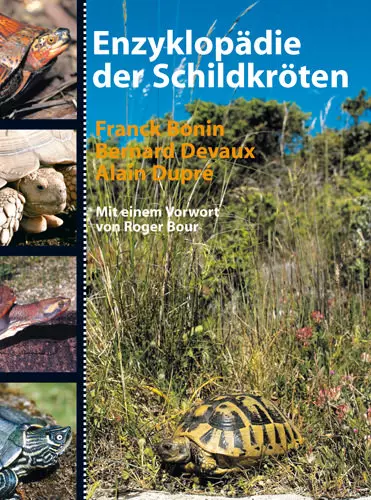
Chimaira, encyclopaedia of turtlesThis encyclopaedia provides a comprehensive overview of recent turtles. For each species, the most important data on appearance and behaviour have been compiled; the authors were able to go into particular detail on remarkable aspects of morphology or biology, explain a recent discovery or a little-known observation. Endangerment and protection of the respective turtle species are dealt with in detail. The protection of species, but also the protection of habitats, which is just as important for the conservation of the species, are key motifs here. In this way, the threats to each species are systematically presented on the one hand, and the laws that have been passed to protect them and the protective measures that have been introduced to conserve them are listed on the other
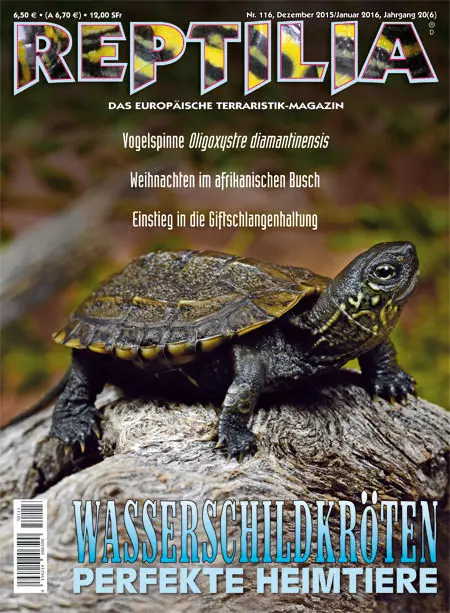
Reptilia 116 - Aquatic turtles - Perfect pets
Tarantula Oligoxystre diamantinensisChristmas in the African bushIntroduction to keeping venomous snakesContents: Cover story: Aquatic turtles – perfect petsAquatic turtles have enjoyed great popularity for decades. For a long time, however, small baby turtles were offered in pet shops for little money and ended up mainly with keepers who were not terrarium keepers and simply had no idea about these animals. The consequences are well known: overgrown red-eared sliders and other aquatic turtles that were abandoned or ended up in rescue centres. As a result, aquatic turtle keeping has fallen into disrepute. However, aquatic turtles are wonderful pets if you look after them properly and acquire the necessary expertise. We offer an overview of the species currently being kept and provide you with the tools you need to enjoy these charming turtles for a long time.
EditorialMAGAZINEDATES
WESTERN HERP PERSPECTIVESHerp photography goes crazyB. Love
Photo storyFrequently kept aquatic turtle species – an overviewA. S. Hennig
PracticeYellow stripes again and again …Information on the identification of commonly kept aquatic turtle speciesA. S. Hennig
Keeping and breedingLarge salad with insect garnish. Nutritional advice for commonly kept ornamental, decorative and humpback turtlesA. S. Hennig
Keeping and breedingFrom a five-mark piece to a soup plate. The successful rearing of aquatic turtlesA. S. Hennig
Keeping and breedingNow also poisonous creatures! My introduction to keeping venomous snakesM. Hallmen
Keeping and breedingOligoxystre diamantinensis. A gem in the middle of nowhere among the IschnocolinaeB. Rast & I. Wendt
ServicesLIBRARYALSO NEAR YOU
JourneyChristmas in the bush. Reptiles and more on Makutsi (South Africa)I. Kober
PREVIEW
BRUTKASTENLike a fish in waterH. Werning
Reptilia 57 - Leopard geckos
2 - Editorial4 - Magazine15 - Dates18 - Western Herp Perspectives: In the trap, by B. Love20 - Photo report: The leopard gecko (Eublepharis macularius), by D.Duscha30 - Herpetofauna: Behaviour and biology of the leopard gecko (Eublepharis macularius) in Pakistan, by M. Sharif Khan36 - Keeping and reproduction: Colour and pattern variations of the leopard gecko (Eublepharis macularius), by R. Kreutz42 - Journey: In the Magic Kingdom of the Quetzal - Dream journeys through the land of "Eternal Spring", by K. Kunz51 - Portrait and poster: Trimeresurus flavomaculatus, by M. Gaulke56 - Hepertomedicine: Herpesvirus infections in tortoises - disease, diagnosis and prophylaxis options, by S. Fischer & M. Homuth65 - Care and reproduction: Monkeys with orange legs - Care and reproduction of the Chaco macifrog Phyllomedusa hypochondrialis azurea, by E. Biggi72 - Keeping and reproduction: On keeping the ventral viper Maticora bivirgata flaviceps (Cantor, 1839) in the terrarium, by G. Vogel & P. Freed78 - Terrarium technology: Building instructions for a polystyrene terrarium according to Marco Beck, by M. Schicker86 - Classifieds93 - Advice and action95 - Library104 - Incubator: My flat-sharing community, part 2: The Grand Coalition has promised to solve the problems in the country, but once again nobody is showing up, by H. Werning
Reptilia 37 Jackson's chameleons
Kenyaschool vivariumTurtle trade in CambodiaContent:2 EDITORIAL4 READER'S LETTERS6 MAGAZINE12 DATES16 PHOTO REPORTAGEthree-horned chameleonsfrom P. Necas36 HUSBANDRY AND BREEDINGChamaeleo (Trioceros)bitaeniatus and its relatives - With comments on the keeping and reproduction of a representative of the Grupeeby N. Lutzmann44 HERPETOFAUNAChamaeleo (Trioceros)jacksonii and its subspeciesby N. Lutzmann51 PORTRAIT AND POSTEREryx jaculusby B. Trapp55 TRAVELOn Herpeto Safari in Kenyafrom I. Schürkes, V. Wasanga & S. Lötters62 REPORTStudies on the turtle trade in Cambodiaby E. Lehr & R. Holloway71 HUSBANDRY AND BREEDINGOne of Europe's most beautiful lizards in a terrarium: the pearl lizardfrom S. Bania76 WESTERN HERP PERSPECTIVESExotic poisonous snakes - the charm of something specialfrom B. Love79 REPORTThe school vivariumPart 2: Example Franziskaner-Gymnasium Kreuzbergby M. Hallmen90 CLASSIFIEDS95 LIBRARY104 GLOSSEBig autumn extra: you have mail!by H. WerningThe October/November issue of your terraristic magazine REPTILIA makes the hearts of all lizard fans and aesthetes beat faster with the title theme "Threehorned Chameleons": In this photo story, which is even more sumptuous than usual, chameleon expert Petr Necas not only gives a general overview of these fascinating animals from the subgenus Trioceros, but he also introduces you to no less than all species in detail!
Chamaeleo (Trioceros) bitaeniatus and his relatives are then described in detail by the expert par excellence in this field, namely Nicolá Lutzmann. He reports about the biology of the small dragons, brings clarity into the confused systematics and not least describes their keeping and breeding vividly - for all terrarists interested in these beautiful lizards an absolute "must".Just like the next article on the title theme of Nicolá Lutzmann, who deals with the popular Chamaeleo (Trioceros) jacksonii and its relatives. Here, too, the author knows how to write expertly about the field biology of the animals, clears up the subspecies confusion and gives detailed tips for the successful care and breeding of the primeval lizards.We stay in Africa and go on Herpeto Safari in Kenya with I. Schürkes, V. Wasanga and S. Lötters. This dreamlike nature destination has not only the "big five" to offer, but is also herpetologically the very first cream, of which you can convince yourself with brilliant photos and a highly interesting expedition report.Unfortunately, the fatal situation of the Asian turtle fauna is a long runner in the REPTILIA, and if we together with you, dear readers, could contribute significantly to the construction of the conservation breeding station in the all-weather zoo Münster, the situation on site is still dramatic. This is proven by the drastic pictures and shattering experiences that Edgar Lehr and Rohan Hollowy bring back from investigations into the turtle trade in Cambodia.Sandra Bania takes care of one of the most beautiful lizards in Europe in her terrarium: the pearl lizard. Therefore she knows how to describe enthusiastically that these magnificent and trustful animals are not only an optical delight, but also show a very varied and interesting behaviour, which makes the lizards together with their relatively unproblematic keeping to best suitable fosterlings, whose keeping and breeding after the reading of this detailed contribution certainly no problems, but however much joy prepares.In the second part of his report on Das Schulvivarium, Martin Hallmen presents a practical example, namely the vivarium at the Franziskaner-Gymnasium Kreuzberg, which he initiated and praised highly. Here you can learn concretely what you have to consider during the planning and expansion phase and how everyday life with the vivarium works, how it is integrated into lessons and what publicity effect can be achieved with it. Certainly a thing worth imitating!Also in this REPTILIA we offer you of course again the full spectrum of our service: In the magazine, for example, you will read curiosities about a reptilian flower pot and get to know an interesting and up-to-date approach to the labelling of tank lizards. Dates, classifieds and the poster (this time with the Western Sandboa Eryx jaculus) are not missing in the incubator, as is Heiko Werning's infamous gloss: "This time, some people will certainly be very happy about caring mail. Will you also be there?
CHF 11.20
❅
❆
❅
❆
❅
❆
❅
❆
❅
❆
❅
❆
This website uses cookies to ensure the best experience possible. More information...