Airedale Terrier

FCI standard number: 7

Country of origin: Great Britain

Classification: FCI Group 3 (Terrier), Section 1 (large & medium sized terriers)

Height at withers female: approx. 56-59 cm

Height at withers male: approx. 58-61 cm

Weight bitch: approx. 18-21 kg

Weight male: approx. 22-27 kg

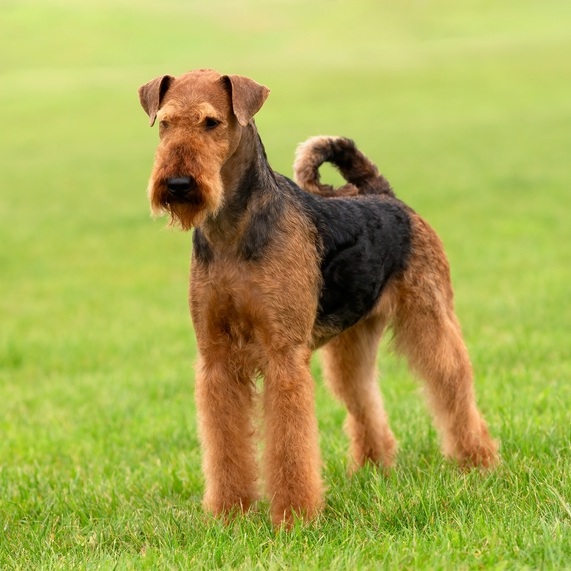
Coat colour: black or grizzle "saddle" (back) + tan/tan on head/legs/underside; a few white hairs between the front legs tolerated Coat texture: hard, dense, wiry; outer coat is straight/tight, undercoat shorter and softer (not curly, not soft)

Neck circumference: roughly 40.6-50.8 cm (guideline; best to measure)

Product information "Airedale Terrier"

The Airedale Terrier


History of the Scottish Terrier

The Airedale Terrier comes from Yorkshire (Great Britain) and got its name, among other things, from shows/the "Airedale" reference. It was used in a variety of ways (including as a hunting/utility dog, later also for tracking, in war, in the police/army).


Appearance

Body shape: sturdy, muscular, active, appearing ‘compact’ (without being high-legged or elongated).

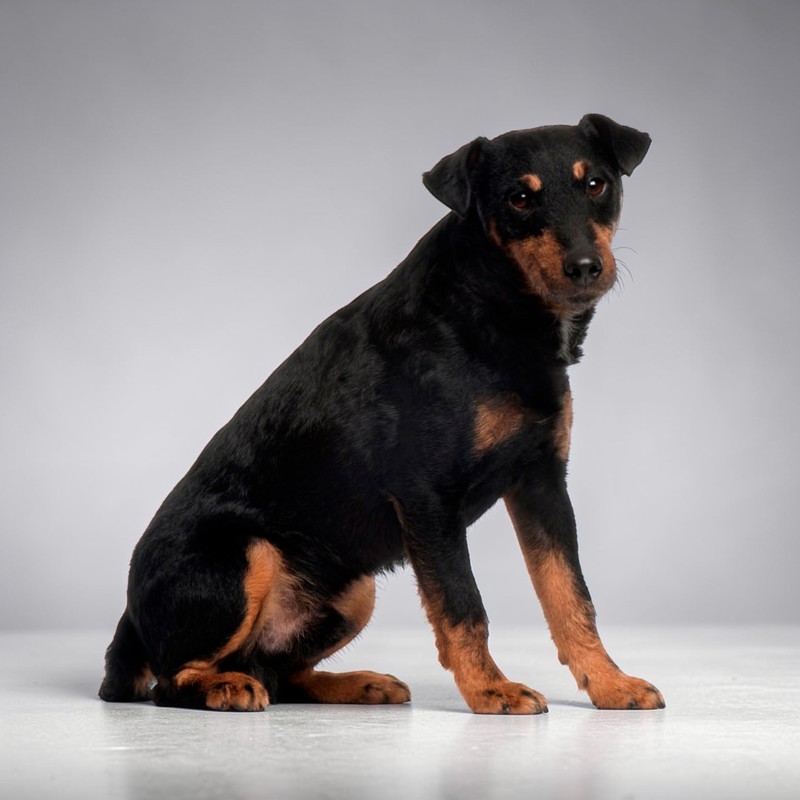
Coat: typical wiry terrier coat with a distinctive beard and ‘leg fringes’, with a dark saddle-coloured patch across the back.


Nature/character

Self-confident, friendly, courageous, intelligent and very alert - not aggressive according to the standard, but fearless.


Grooming

Relatively high (typical of a terrier): Brushing/combing: approx. 2-3× per week (otherwise felt/tangles, especially beard/legs). Trimming/hand-stripping or clipping: for the "classic" Airedale look usually every 6-8 weeks; hand-stripping often maintains structure/colour better. Everyday life: Ears, claws, teeth should be groomed regularly (as with all breeds).


Health

Frequently mentioned topics (not every dog gets this - but it is "typical to keep an eye on"): Hip dysplasia Gastric torsion/GDV (severe form of "bloat") - risk present in larger dogs; favoured by hasty eating or romping immediately after eating, among other things. Underactive thyroid (hypothyroidism) is also described.


Education

An Airedale is clever, but also independent (terrier!). Works best: clear rules + consistent routine plenty of mental exercise (nose work, tricks, retrieving games) fair, positive training methods (and good socialisation at an early age).


Special features of the breed

"King of Terriers": largest terrier, very versatile, robust. Combination of alertness + athleticism + brains → needs a task, otherwise he looks for one (digging, "rubbish", hunting).


Suitable for first-time dog owners?

Conditional. It can work if you are really keen on training, leadership and regular grooming. Without activity/consequence, he quickly becomes "boss in the ring" and does terrier things.


Family dog or not?

Can be a good family dog if it is kept busy and children treat the dog with respect (no roughhousing). Due to his size/power, he is more suitable for families who like to be outside and like rules/structure.

Composition
Feeding recommendation
Technical details
Size information

0 of 0 reviews

Give us a rating!

Share your experience with the product with other customers.


Suggested products

Maltese
The MalteseHistory of the Scottish TerrierThe Maltese is a very old small breed of companion dog from the central Mediterranean region. According to the FCI, its name does not necessarily mean that it originates from the island of Malta. Historically, its ancestors were kept in harbour towns and coastal regions of the Mediterranean, where they also fought mice and rats in camps and on ships. Later, the Maltese was valued above all as an elegant companion dog. AppearanceBody shape: The Maltese is a small, elegant dog with a slightly elongated body. Despite its delicate appearance, it appears lively, well-proportioned and proud in its bearing. Its expression is alert and friendly.Coat: The coat is the breed’s most striking feature. It is very long, smooth, flowing and silky. A pure white coat is typical, giving the Maltese its elegant appearance.Nature/characterThe Maltese is considered to be affectionate, friendly, lively and very people-orientated. It is usually attentive, playful and closely orientated towards its caregivers. Despite its small size, it often has a surprisingly self-confident demeanour and wants to be taken seriously. GroomingGrooming is time-consuming and requires regularity. The long coat should be brushed and combed frequently to prevent matting. Eyes, ears, paws, claws and teeth should also be checked regularly. Good dental care is particularly important for small long-haired dogs. HealthThe Maltese is generally regarded as a rather robust and often long-lived small breed. Nevertheless, care should be taken to ensure responsible breeding. As with other small dogs, dental problems, patella problems, eye problems or skin issues can play a role, depending on the line. Regular veterinary checks, good weight management and a reputable breeding base are important. EducationTraining is often successful because the Maltese is smart, attentive and people-orientated. It needs friendly, clear and consistent leadership. Despite its small size, it should not be coddled, because even a small dog needs rules and guidance. With early socialisation and loving consistency, the Maltese usually develops into a pleasant everyday companion. What are the special features of this breed?What is special about this breed is the combination of its noble appearance, very close relationship with people and small size. The Maltese is no mere lap dog, but often an attentive, cheerful and present companion. In addition, its long, white coat makes it instantly recognisable, but also requires a lot of grooming.Suitable for first-time dog owners?Yes, the Maltese is often well suited to first-time dog owners. They are usually friendly, eager to learn and closely attached to their humans. However, you should not underestimate the amount of care required, the necessary consistency in training and the sensitivity of a small dog. Family dog or not?Yes, the Maltese can be a good family dog. He is affectionate, friendly and likes to live close to his humans. It is particularly well suited to families or households that treat a small dog with respect and have time to care for and bond with it. Care should be taken with very small children due to its small size.
 
Jack Russell Terrier
The Jack Russell Terrier History The Jack Russell Terrier goes back to the breeding work of the English reverend John Russell in the early 19th century. The aim was to create a small, hard-working terrier that could keep up with foxhounds and go to the den. These lines later developed into two similar but differently built types: the larger Parson Russell Terrier and the smaller, longer Jack Russell Terrier. The FCI lists Great Britain as the country of origin and Australia as the developing country of the breed. Appearance Body shape: The Jack Russell Terrier is a strong, active and rectangularly built working terrier. It should be agile, persistent and compact without appearing clumsy. Its good substance, lively charisma and functional build for working above and below ground are typical. Coat: The coat is weatherproof and can be smooth, rough or spiky. Typical is the predominantly white base colour with black or tan markings. The coat is functional and should protect the dog well at work. Nature/Character The Jack Russell Terrier is considered to be clever, smart, lively and very self-confident. He is alert, courageous and often surprisingly fearless for his size. At the same time, he is described as friendly and calm. His temperament, his eagerness to work and his typical terrier independence are typical. Grooming The grooming requirements are usually manageable. Smooth-haired dogs are particularly easy to care for, while rough-haired and spiky-haired varieties require a little more attention and often regular trimming. Ears, claws, teeth and paws should also be checked. Health The Jack Russell Terrier is generally regarded as a robust and hardy breed. Nevertheless, as with any breed, attention should be paid to responsible breeding, a healthy body weight and regular veterinary checks. Depending on the line, joint, eye or skin problems can occur. Training Training should be clear, fair and consistent. The Jack Russell Terrier is very intelligent and learns quickly, but also tests boundaries and has a strong mind of its own. Early socialisation, impulse control and appropriate exercise are particularly important. Harsh methods are unsuitable because they often create counter-pressure. What are the special features of this breed? What makes this breed special is its enormous energy in a small space. The Jack Russell Terrier is not a cosy small dog, but a real working terrier with a lot of temperament, courage and passion for hunting. He is often very resourceful, fast, persistent and mentally alert. It is this mixture of size, self-confidence and activity that makes him so distinctive. Suitable for first-time dog owners? Conditional. A committed and well-informed first-time dog owner can get on well with a Jack Russell Terrier if they have enough time, consistency and enjoy being active. However, the breed is not easy because it is temperamental, independent and quickly underchallenged. Family dog or not? Yes, the Jack Russell Terrier can basically be a good family dog. They are friendly, lively and often bond closely with their humans. However, they are best suited to active families who set clear rules and keep them physically and mentally busy. Without sufficient activity, he can quickly become exhausting in everyday life.
 
Appenzell Mountain Dog
The Appenzell Mountain DogHistory of the Appenzell Mountain DogOriginally a Swiss farm, herding and herding dog (also a guard dog) from the Appenzell region; bred primarily for utility.AppearanceBody shape: medium-sized, strong and well-proportioned, very agile; tail set high and curled over the back (typical).Coat: short, dense double coat; striking, clearly defined tricolor markings.Temperament/characterLively, spirited, self-confident and fearless; watchful and often rather suspicious of strangers (with pleasure in reporting/barking possible).GroomingRather moderate: regular brushing (at least weekly, more often when changing coat) is usually sufficient because the coat is short and dense.HealthThe breed standard focuses on function and robustness; however, as with many medium-sized, active breeds, orthopaedic issues can occur (e.g. hip/elbow) and eye problems are sometimes mentioned. Health checks during breeding (HD/ED, eyes if necessary) and appropriate growing up (not too fast/too heavy) make sense.EducationIntelligent and eager to work, but not a "sofa dog": training works best with clear rules, meaningful activity and early socialization, so that alertness does not turn into constant alertness.What special features does this breed have?Working mode: needs daily exercise + mental work (e.g. nose work, trick training, agility, driving ball). Alert and signaling behavior: can be a plus, but must be controlled (calm signal, visitor training). Not ideal for "just a walk": happiest with active people with a task/structure.Suitable for first-time dog owners?Conditionally. If you are sporty, have a desire for training/structure and really keep him busy, it can work well. If you are looking for an "uncomplicated companion", it will often fail due to energy, alertness and demands.Family dog or not?Yes - in active families. The VDH describes him as a great family dog if you spend a lot of time with him; at the same time, he is alert and rather reserved towards strangers. It usually works well with children if rules and respectful behavior are in place (and there is enough exercise).
 
Flat Coat Retriver
The Flat Coat RetriverHistory of the Flat Coated RetrieverThe Flat-Coated Retriever was developed in Great Britain as a versatile hunting and retrieving dog. It originated in the 19th century from various retriever and water dog types and was particularly valued for retrieving feathered game on land and from the water.AppearanceThe Flat-Coated Retriever is medium-sized, elegant, powerful and never heavy. The standard describes him as alert, with an intelligent expression and a flowing, harmonious silhouette. Body shape: Strong, but not bulky; with a deep chest, short broad loin and balanced proportions. He should appear athletic, agile and able to work. Coat: The coat is weatherproof, elegant and relatively easy to care for, but requires more attention than the Labrador due to the feathering. Ears, legs, chest and tail in particular should be regularly checked and brushed.Nature/characterThe Flat-Coated Retriever is considered to be cheerful, active, people-oriented and very playful. The VDH describes him as alert and lively; the Royal Kennel Club calls him an active retriever with a natural aptitude for work. Its often youthful temperament is typical.GroomingRegular brushing, especially of the feathered areas, is usually sufficient. Exercise, retrieving, nose work and mental activity are more important than extensive grooming. The Royal Kennel Club recommends more than 2 hours of exercise per day for this breed.HealthWith the Flat-Coated Retriever, particular attention should be paid to serious breeding and health examinations. Among other things, cancer, hip dysplasia, patellar luxation and eye issues are mentioned; depending on the country, breed clubs list examinations of hips, eyes, patella and sometimes gonioscopy. The British Breed Health and Conservation Plan also reports an increased risk of various tumor diseases and mentions a median age of death of around 10 years in the data evaluated there.UpbringingThe Flat-Coated Retriever is usually easy to train, but is often temperamental and late to mature. It needs friendly, clear and consistent training without harshness. Impulse control, recall and sensible exercise are particularly important in order to channel their energy into good channels.What are the special features of this breed?Its greatest characteristic is its mixture of willingness to work, sensitivity and often very youthful and playful nature. The Flat-Coat is not often described as the "Peter Pan" of retrievers for nothing. He is usually very people-oriented and loves to be active together, but is often livelier and "goofier" than many imagine a retriever to be.Suitable for first-time dog owners?Conditionally yes. It can be a good fit for active beginners with time, a willingness to train and a love of activity. For people looking for a calm, uncomplicated companion, it is usually less suitable due to its energy level.Family dog or not?Yes, basically very good. The Flat-Coated Retriever is considered to be friendly, good-natured and family-oriented. As a family dog, it is particularly well suited to active households that keep it not only physically but also mentally busy.
 
Malinois - Belgian Shepherd Dog
The MalinoisHistory of the MalinoisThe Malinois is one of the four varieties of the Belgian Shepherd Dog, along with the Groenendael, Tervueren and Laekenois. The breed originated in Belgium and was developed as a versatile herding and working dog. The Malinois has made a name for itself as a hard-working, powerful and resilient variety and is now also used worldwide in service dog work, protection service and in many areas of work. AppearanceBody shape: The Malinois is medium-sized, harmonious, dry-muscled and squarely built. It should appear neither heavy nor clumsy, but elegant, powerful and enduring. Its upright posture, alert appearance and overall very functional build are typical.Coat: The coat is short, dense and weatherproof. It lies close to the body and is complemented by a good undercoat. Typical for the Malinois is the fawn base color with black cloudiness and a distinct black mask.Nature/characterThe Malinois is considered to be very alert, spirited, eager to work and intelligent. It is alert, quick to react and usually highly motivated to cooperate with humans. At the same time, it has a lot of energy, sensitivity and a strong need for tasks and leadership. Fear or unprovoked aggression do not correspond to the desired nature.GroomingGrooming is generally rather uncomplicated. Regular brushing is usually sufficient to remove loose hair and dirt. The Malinois sheds more during the shedding season, when more frequent brushing is advisable. Ears, claws, teeth and paws should also be checked regularly. Due to its high level of activity, it also makes sense to check for minor injuries after training or work. HealthThe Malinois is generally considered to be a robust and efficient variety of Belgian Shepherd Dog. Nevertheless, attention should be paid to responsible breeding. As with other medium-sized to large, athletic dogs, hip or elbow problems and other hereditary diseases can play a role, depending on the line. Controlled training during growth, good weight management and a reputable breeding base are also important. TrainingTraining the Malinois requires experience, consistency and a lot of time. He learns quickly and often works with enormous intensity, but needs clear, fair and reliable leadership. Early socialization, impulse control and a very good everyday structure are particularly important. Underchallenging or unclear leadership can quickly lead to problematic behavior in this breed. What are the special features of this breed?What is special about this breed is its extreme willingness to work. The Malinois is not a normal companion dog, but a high-performance working dog with enormous energy, speed of reaction and resilience. It is therefore often used as a police, military, protection, rescue and sporting dog. It is precisely this intensity that makes him impressive, but also very demanding in everyday life.Suitable for first-time dog owners?No, as a rule the Malinois is not suitable for first-time dog owners. Its high motivation to work, sensitivity, strength and speed require a lot of experience, very good leadership and suitable exercise. In the wrong hands, this breed can quickly become overwhelmed or misguided. This assessment is a professional classification based on the breed characteristics described.Family dog or not?Conditionally. A well-managed and sensibly utilized Malinois can be very loyal and closely bonded within its family. However, it is not suitable as an uncomplicated family dog for every household. He is more suited to very active, experienced people who take his working disposition seriously and can offer him a structured life with a real task.
 
Scottish Terrier
The Scottish TerrierHistory of the Scottish TerrierThe Scottish Terrier originates from Great Britain and is one of the old terrier breeds of Scotland. The current breed type developed in the 19th century and the Scottish Terrier Club was founded in 1882, shortly after the first standards for the breed were established. Originally, the small, slow-running terrier was bred for construction work.AppearanceBody shape: The Scottish Terrier is sturdy, compact and low-set. Despite its short legs, it appears very agile, alert and surprisingly powerful for its size. Typical features include a long head in proportion to its body size, a solid build and an overall robust appearance. Coat: The coat is dense, wiry and weather-resistant. It protects the dog well and, together with the beard, bushy eyebrows and distinctive silhouette, is one of the breed’s most striking features. The recognised colours are black, brindle and wheaten. Nature/characterThe Scottish Terrier is considered to be loyal, dignified, independent, reserved and at the same time courageous and very intelligent. He is usually loyal and affectionate towards his family, but tends to be reserved towards strangers. His large personality in a small space is typical. The standard describes him as bold, but never aggressive. GroomingGrooming is more time-consuming than you might expect for a small dog. The wiry coat should be brushed regularly and usually also trimmed to maintain the typical coat structure. In addition, ears, claws, teeth and paws should be checked regularly. HealthThe Scottish Terrier is generally regarded as a robust breed, but care should be taken to ensure responsible breeding. As with many terrier breeds, certain hereditary diseases can play a role depending on the line. Regular veterinary checks, good weight management and a reputable breeding base are important. EducationTraining should be friendly, clear and consistent. The Scottish Terrier is intelligent, but often independent and not simply eager to please. They therefore need early socialisation, reliable rules and calm leadership. Harsh methods do not suit this self-confident breed with its strong character. What are the special features of this breed?What is special about this breed is the mixture of small size and big personality. The Scottish Terrier often appears serious, dignified and independent, but is closely attached to his family. It also has a very typical appearance with a beard, bushy brows and striking silhouette. It is precisely this combination of strength of character and distinctiveness that makes him so special.Suitable for first-time dog owners?Conditional. A calm, consistent and well-informed first-time dog owner can get on well with a Scottish Terrier. However, the breed is not completely uncomplicated because it can be independent, self-confident and sometimes a little stubborn when it comes to training. Family dog or not?Yes, in principle the Scottish Terrier can be a good family dog. They are particularly well suited to households that respect their independence and give them clear rules. He usually lives closely with his family, but is not an overly affectionate or constantly pleasing dog. In a suitable, calm environment, he is often a loyal and charming companion.
 
Large Münsterländer
The Great Munsterlander History of the Scottish Terrier According to the FCI, the historical development of the Grosser Münsterländer can be traced back to the white-coloured bird and pickling dog of the Middle Ages, via the rummaging and guard dog to the pointing dog of the 19th century. After the German Longhair Club excluded the black colour from breeding in 1909, the targeted pure breeding of the black and white longhair type began in 1919, from which the Grosse Münsterländer emerged. Scheduled breeding began in 1922. Appearance Body shape: The Großer Münsterländer is strong, muscular and yet sleekly built. It appears intelligent and noble, with a clean outline and well-balanced proportions. Body length and height at the withers should be as equal as possible. Coat: The coat is long, dense and close-fitting. It is significantly longer and densely feathered, particularly on the forelegs and hind legs, the tail and the ears. On the head, the hair is short and close-fitting. Nature/character The most important characteristics include docility, docility and reliable hunting ability, especially after the shot. The character is lively, but not nervous. The VDH also describes him as lovable, eager to work and a pleasant family member if sufficiently exercised. Grooming The long coat needs regular brushing to prevent matting and to keep it clean. The feathering on the legs, tail and ears in particular should be groomed. As the breed likes to work in fields, woods and water, it is also important to check paws, ears and coat after outings. Overall, the breed is considered easy to care for if the coat is groomed consistently. Health The Grosser Münsterländer is generally regarded as a robust and hardy breed. Nevertheless, breeding organisations pay attention to genetic health, in particular HD and ED. Ears should also be checked regularly, as long-haired dogs with drooping ears are more likely to suffer from inflammation. Education Training should be consistent, fair and meaningful. The Grosser Münsterländer is intelligent, willing to learn and eager to work, but needs tasks that suit his abilities. Because he is a strong hunting dog, pure exercise is usually not enough; he also needs mental exercise and clear leadership. What are the special features of this breed? Its versatility as a hunting dog is special. According to the standard, it should be usable for work in the field, in the forest and in the water before and after the shot. Added to this are his close bond with humans, his great willingness to work and his love of water. He is therefore not a pure companion dog, but a dog with a clear task and working dog disposition. Suitable for first-time dog owners? Rather only to a limited extent. Although he is docile and docile, he is also a real hunting dog with a lot of energy, willingness to work and a need for meaningful exercise. It is more suitable for beginners if they are very active, well prepared and can really keep the dog busy. Family dog or not? Yes, basically yes, but not for every family. With sufficient exercise, he can be a friendly, patient and pleasant family dog. However, without suitable activity, his strong working and hunting instincts can quickly become a problem. He is therefore best suited to active families who do a lot with him and do not underchallenge him.
 
Labrador Retriever
The Labrador RetrieverHistoryThe Labrador Retriever originates from Great Britain, but its early ancestors came from the island of Newfoundland. There, similar dogs were used by fishermen and later as reliable retrieving dogs. In Great Britain, the breed was systematically developed further and finally consolidated as an independent retriever breed. To this day, the Labrador is one of the best-known hunting, family and working dogs in the world. AppearanceBody shape: The Labrador Retriever is strong, compact and harmoniously built. It has a broad skull, a deep chest and strong, well-muscled hindquarters. Another typical feature is the so-called otter tail, which is very thick at the base and gradually becomes thinner towards the tip. Overall, it appears athletic, robust and agile without appearing clumsy. Coat: The coat is short, dense and weatherproof. It should be hard to the touch and have a dense undercoat so that the dog remains efficient even in wet and cold conditions. The recognised colours are black, yellow and liver or chocolate brown. Nature/CharacterThe Labrador Retriever is considered friendly, even-tempered, people-orientated and eager to work. They are particularly known for their strong willingness to co-operate with people. Many Labradors are attentive, eager to learn and resilient without appearing sharp or suspicious. It is this mixture of good-naturedness, activity and willingness to co-operate that makes the breed so popular. GroomingGrooming is generally uncomplicated. Regular brushing helps to remove loose hair and keep the coat clean. Labradors often shed much more during the shedding season, so more frequent brushing is advisable. In addition, ears, claws, teeth and paws should be checked regularly. Due to their love of water and activity, it is also worth checking their skin and ears after trips into the water or off-road. HealthThe Labrador Retriever is generally regarded as a robust and capable breed. Nevertheless, attention should be paid to responsible breeding. As with many medium-sized to large dogs, hip dysplasia, elbow dysplasia, eye problems and a tendency to be overweight can play a role. Labradors in particular often eat with a big appetite, which is why exercise and weight management are particularly important.TrainingThe Labrador Retriever is usually easy to train because it enjoys working with its owner. He learns quickly and usually responds well to friendly, clear and consistent leadership. Early socialisation, impulse control and a sensible combination of exercise, nose work and mental work are important. Despite his friendly nature, he should not be underestimated, as an underchallenged Labrador can become very tempestuous and imaginative. What special features does this breed have?What is special about this breed is the combination of a love of work, friendliness and high suitability for everyday life. The Labrador Retriever is not only a popular family dog, but also a versatile hunting, assistance, therapy and rescue dog. Its great love of retrieving, love of water and strong bond with people are typical. It is precisely this so-called Will to Please that makes it particularly easy to handle in many areas. Suitable for first-time dog owners?Yes, in principle the Labrador Retriever is often very suitable for first-time dog owners. It is usually friendly, co-operative and easy to train. However, its urge to move, its strength and its tendency to be overweight should not be underestimated. Those who are prepared to invest time in training, activity and consistent everyday rules will often find it to be a very pleasant beginner's dog. Family dog or not?Yes, the Labrador Retriever is basically a very good family dog. It is usually friendly, affectionate and resilient and enjoys living closely with its people. It is particularly well suited to families or households who enjoy joint exercise, activity and clear leadership. Its friendly nature makes it very popular, but it still needs training and suitable exercise. 
 
American Bulldog
The American BulldogHistory of the American BulldogHistorically used as a farm and working dog in the USA (e.g. as a "utility dog" around the farm/livestock).AppearanceBody shape: strong, muscular, athletic; in the UKC "Standard/Scott type" (more athletic) and "Bully/Johnson type" (bulkier) are described.Coat: short, easy to groom - but skin/"wrinkles" may need care.Nature/characterLoyal, courageous, often watchful/protective, at the same time friendly and family-oriented if well socialized. Early socialization is particularly important.GroomingCoat: little effort (short coat, occasional brushing). Skin/folds: keep clean and dry (otherwise some dogs risk skin irritations/infections).HealthFrequently mentioned points (not every dog has this, but "keep an eye on it"): Hip and elbow dysplasia. Allergies / skin issues (incl. recurring skin/ear problems). Rarer: ichthyosis (scaly, itchy skin; genetic).EducationNeeds consistent, fair leadership, clear rules and regular exercise. Learn well through positive reinforcement and benefit greatly from early socialization.What special features does this breed haveLots of strength + athleticism: can be "clownish", but is physically strong - training/leash management is worthwhile. Protective/guarding nature: without socialization/training, insecurity can turn into problem behaviour. Variety of types (bulky vs. athletic type).Suitable for first-time dog owners?Rather only to a limited extent. Many sources emphasize: training, experience and time are important because of strength, energy and protective behavior. With good guidance (dog school/trainer) it can work - "on the side" rather not.Family dog or not?Can be a good family dog if socialized early, trained consistently and given sufficient exercise/activity. It is described that well-trained and socialized dogs often get along with children and other pets.
 
English Pointer
The English PointerHistory of the English PointerThe pointer is a classic British pointing dog. According to the FCI, it originated in Great Britain; the Royal Kennel Club describes it as a traditional hunting dog, which was particularly prized in the 18th and 19th centuries for its stylish field work.AppearanceThe English Pointer is an athletic, elegant and at the same time powerful dog. The standard describes it as symmetrical, well-built and full of flowing lines - strong but not heavy. Typical features are the dry head, the slightly concave muzzle ("dish-face") and the athletic overall appearance.Body shape: Athletic, deep-chested, dry-muscled and built for endurance. He is bred for long-distance searches in the field and accordingly shows a lot of gallop, resilience and reach.Coat: The coat is easy to care for, short and functional. It protects well in everyday life, but does not require extensive grooming. Due to the short coat, the skin, ears and paws must nevertheless be checked regularly after long tours through the terrain.Nature/characterThe Pointer is considered friendly, balanced and dignified. In everyday life he is often gentle and people-oriented, but outdoors he is very passionate, fast and highly motivated to hunt. The PDSA describes him as mild in temperament, but with a high energy requirement; the VDH calls him a muscular athlete with strength and elegance.GroomingGrooming is simple; brushing once a week is usually sufficient. More important are exercise, nose work and sufficient free running opportunities in a safe environment. The Royal Kennel Club recommends more than 2 hours of exercise per day for the breed.HealthThe English Pointer is generally considered to be a fairly robust breed, but some issues are mentioned: Hip dysplasia, gastric torsion/GDV, progressive retinal atrophy, hypothyroidism, entropion, cataracts and in some cases Wobbler syndrome. The Pointer Club also refers to health surveys and breeding health plans for the breed.TrainingHe needs calm, fair and very consistent training. Recall, impulse control and good management of hunting behavior are particularly important. The Pointer is sensitive and learns well, but usually responds better to clear positive guidance than to harshness.What are the special features of this breed?Its most distinctive feature is its classic pointing work: the pointer searches over a wide area, picks up scent and "points", i.e. freezes in a typical posture in the direction of game. The Royal Kennel Club therefore calls it a prime example of a dog that is perfectly suited to its original task. In addition, he has an enormous willingness to run, a fine nose and a lot of style when moving.Suitable for first-time dog owners?Rather only to a limited extent. His nature is often friendly and not unnecessarily sharp, but his need for exercise and his hunting instinct are demanding. For beginners without experience with hunting-motivated, very active dogs, it is usually not an easy choice. For sporty, willing to learn people with good training and suitable exercise, it can work.Family dog or not?Yes, basically yes - in the right family. PDSA describes Pointers as mild and suitable for families with good socialization; the Royal Kennel Club classifies them as good companions. However, it is crucial that the family is really active and does not underchallenge the dog. They are usually less suitable for a quiet, less active everyday life.
 
Vizsla
Magyar VizslaHistory of the Magyar VizslaThe Magyar Vizsla is an old Hungarian hunting dog whose roots go back a long way. It was bred as a versatile pointing dog for field, forest and water and was intended to work closely with humans. Its development was systematically continued in Hungary until today's elegant, powerful shorthaired Vizsla was established as an independent type.AppearanceBody shape: The Magyar Vizsla is a medium-sized, elegant hunting dog with a noble expression. Its build is rather light, dry and lean, yet powerful and capable. The body is slightly longer than tall, and overall it appears harmonious, athletic and enduring.Coat: The coat is short, dense and close to the body. It should be robust and functional, without feathering or longer sections as in long-haired hunting dogs. Typical is the uniform semmel yellow color, which makes the dog very distinctive.Nature/characterThe Magyar Vizsla is considered to be lively, friendly, balanced and very people-oriented. One of its most important characteristics is its pronounced willingness to make contact with people. They are usually sensitive, easy to train and eager to work. It does not tolerate harsh treatment well and should not be aggressive or shy.GroomingGrooming is generally uncomplicated. The short coat only needs regular brushing to remove loose hair and dirt. Ears, claws, teeth and paws should also be checked. Due to its activity and use in the field, it makes sense to check the dog for minor injuries, ticks or dirt after walks or hunting. HealthThe Magyar Vizsla is generally considered to be a robust and efficient breed. Nevertheless, attention should be paid to responsible breeding. As with many medium-sized to large hunting dogs, hip problems, eye problems or other hereditary diseases can play a role, depending on the line. Good weight management, appropriate exercise and careful rearing during growth are also important. TrainingTraining is often successful because the Magyar Vizsla works very closely with its owner and usually wants to please. He needs friendly, clear and consistent leadership without harshness. Early socialization, recall training and a sensible combination of exercise, nose work and mental activity are particularly important. An underchallenged Vizsla can quickly become restless or unbalanced. What are the special features of this breed?A special feature of this breed is its close bond with humans. The Magyar Vizsla is usually not a dog that just runs alongside, but actively seeks contact and cooperation. Added to this are its versatility as a hunting dog, its love of water and its eye-catching, uniform, semi-melange color. He combines elegance, sensitivity and a love of work in a very typical way.Suitable for first-time dog owners?Conditionally. A committed and well-informed first-time dog owner can get on well with a Magyar Vizsla if there is enough time, exercise and activity. However, the breed is not always easy because it is very sensitive, needs a lot of closeness and wants to be kept busy both physically and mentally. If you are looking for an uncomplicated dog with little activity, this breed is usually not the ideal choice. Family dog or not?Yes, in principle the Magyar Vizsla can be a very good family dog. They are usually friendly, affectionate and very attached to their humans. However, it is best suited to active families or households that have plenty of time for exercise, occupation and joint activities. Without sufficient exercise, this sensitive and hard-working dog often becomes unbalanced in everyday life.
 
Bearded Collie
Bearded Collie profileHistory of the Bearded CollieThe Bearded Collie is a Scottish herding dog that was bred for driving and herding sheep and cattle. The FCI standard mentions that the modern type was strongly influenced by the breeding work of G. Olive Willison from around 1940.AppearanceBody shape: medium size, strong and agile, slightly longer rather than tall, with plenty of stamina for long distance work. Coat: luxuriant, long and weatherproof, with typical "beard" and lots of hair on head and legs.Nature and characterYou will usually meet a cheerful, active and people-oriented dog that likes to "think along" and seeks a lot of closeness to its family. At the same time, he needs clear guidance and tasks so that his energy does not spill over into restlessness or herding activities in everyday life.GroomingThe coat requires regular grooming: brushing and combing several times a week helps to prevent felting (especially on the ears, armpits, "pants" and belly). Many owners also plan occasional grooming at the groomer, especially if the coat is worn very long.HealthIssues to keep an eye on include hip dysplasia and thyroid problems (hypothyroidism); eye diseases are also common, which is why health checks are advisable when breeding.TrainingThe Bearded Collie needs friendly consistency, clear rules and reward-based training. Early socialization, reliable everyday rituals and sufficient mental exercise (e.g. nose work, trick training, herding dog sports) are important so that the dog can also learn to be calm.What special features does this breed haveThe Bearded Collie is a real workhorse: he is very eager to move, learns quickly and prefers to stay "in a team" with you. At the same time, the lush coat is a trademark, but also the biggest grooming factor in everyday life.Suitable for first-time dog owners?Rather limited: If you are sporty, like to exercise and reliably schedule grooming, it may be a good fit. If you are looking for a "low-maintenance" dog or a quiet runner, it will be difficult. This dog wants to work.Family dog or not?In many cases, yes: with active families, the Bearded Collie is often very friendly and playful. However, you should make time for activity and grooming so that the dog remains balanced in everyday family life and calm at home.