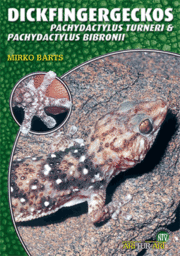

Fat-fingered geckos have been on the rise for years. Their attractive appearance, their endearing nature and the low demands they place on keeping in the terrarium have quickly boosted their popularity. The experienced and successful terrarium keeper Mirko Barts covers in this book of the “Species by Species” series the species-appropriate keeping and care of fat-fingered geckos in every detail, from correct housing to healthy feeding. And of course, this guide also tells you how to breed your geckos, incubate the eggs and raise the tiny young.
Systematics and body structure
The fascinating biology: From the life of the fat-fingered geckos
All information on species-appropriate keeping: from suitable terrarium to equipment and technology to feeding
Successful breeding: Mating stimulation, incubation of the eggs and raising the young
Problem solving: How to avoid the most common mistakes in care and how to help sick animals
Brilliant photos
Composition
Feeding recommendation
Technical details
Size information
0 of 0 reviews
Give us a rating!
Share your experience with the product with other customers.
Login
No reviews found. Go ahead and share your findings with others.
Powder for the production of a food mash for geckosin three flavorsapricot, strawberry and figfor mixing with water
completely covers the nutritional requirements
guarantees healthy growth and development prevents metabolic bone disease (MBD)
A multi-component, completely balanced
balanced feed in various flavors in powder form
for the preparation of a mousse for crown geckos, gargoyle geckos,
moss geckos, giant geckos, all types of Phelsuma and other fruit- and insect-eating reptiles.
insect-eating reptiles. It contains: 40% fruit, 25% insects, 12% bee products, calcium and vitamin D3.For example for the following animals:Crowned gecko
(Correlophus ciliatus), Gargoyle gecko (Rhacodactylus auriculatus),
giant gecko (Rhacodactylus leachianus), lichen gecko (Mniarogekko
chahoua), Madagascar day gecko (Phelsuma madagascariensis), Phelsuma
klemmeri, Phelsuma standingi, Williams' dwarf gecko (Lygodactylus
williamsi), mourning gecko (Lepidodactylus lugubris), eastern blue-tongue
blue-tongued skink (Tiliqua scincoides), Argentine teju (Salvator
merianae).
Product description a completely balanced food in powder form for mixing with water ideal for crown geckos, gargoyle geckos, moss geckos, phelsuma and other fruit- and insect-eating reptiles nutritious and aromatic thanks to the wealth of natural ingredients high level of high quality animal protein with a complete amino acid profile contains 40% freeze-dried fruits (apricot, banana, pineapple), full of fresh taste, aroma and nutrients insects
in the composition (black soldier fly larvae, silkworms,
mealworms) make the food particularly attractive to the animals taste and health-promoting properties are influenced by the addition of honey and bee pollen Adequate
high content of vitamins and minerals, including valuable vitamins
vitamins D3 and K as well as calcium, prevents
metabolic bone disease (MBD) covers the nutritional requirements of growing animals and pregnant females Tropical tipsCrowned geckos,
Gargoyle geckos, lichen geckos, giant geckos, Phelsuma and many other reptiles
other reptiles feed on various small invertebrates,
pollen and flower sap as well as ripe, sweet fruits, or more precisely
their juice and sweet pulp. They do not eat the fruit entirely due to the lack of strong jaws.Gecko Cream
with its balanced, rich composition is an excellent alternative to
excellent alternative to feeder insects and homemade pastes made
made from fresh fruit. It does not require additional supplementation with vitamin and mineral supplements.Use of Gecko Cream in practice You can prepare the mousse by mixing 1 part of the powder with 2 parts of water at room temperature. At first the mixture may seem too loose, but it will thicken after a few minutes. If you need a thicker mousse consistency, use less water. You can prepare a larger portion and store in the refrigerator in a tightly sealed container for up to 5 days. Feed adult animals 3-4 times a week. Feed young animals and breeding females daily at will. For nocturnal species feed in the afternoon and evening, for diurnal species feed in the morning. Remove all uneaten food after 24 hours.
JBL TerraControl - Thermometer and hygrometer incl. suction cup
Easy check thermometer for the relative humidity and the temperature in terrariums
Temperature range: -30 to +60 degrees
Humidity values: from 0 to 100% in steps of 10%
Area between 20 and 35 is marked as "optimal“
Package contents: 1 thermometer and hygrometer, Terra Control, incl. suction cup.
Easy monitoringDepending on the origin and species the terrarium animals need specific humidity and temperature conditions for their ideal keeping. They easily can be monitored with Terra Control.Terra ControlThe Terra Control thermometer and hygrometer allows monitoring over a temperature range -30 to +60 degrees. The humidity is displayed in 10 % steps from 0 to 100 %. The range between 20 and 35 is marked.
Rep Calcium +D3
Nekton Rep Calcium + D3 is a high-quality calcium supplement for reptiles and amphibians that supports optimal bone and muscle development. Enriched with vitamin D3, it promotes the absorption of calcium in the body and thus contributes to a healthy skeletal structure and an intact metabolism. Especially for reptiles kept in terrariums, a regular supply of calcium and vitamin D3 is crucial to avoid deficiency symptoms such as bone softening or deformities.
The powder is easy to dose and can be sprinkled directly over the food or added to the drinking water. Nekton Rep Calcium + D3 is an ideal supplement for all reptile species that have an increased need for calcium, such as tortoises, geckos and agamas.
Advantages:
Optimum calcium supply: Promotes healthy bone and skeletal development and supports the muscular system.
Enriched with vitamin D3: Improves calcium absorption in the body and ensures optimum utilization.
Prevents deficiency symptoms: Reduces the risk of calcium deficiencies that can lead to health problems.
Easy to use: The powder is easy to dose and can be added directly to the feed or drinking water.
High-quality composition: Specially developed for the needs of reptiles and amphibians.
Zoo Roco tips:
Correct dosage: Pay attention to the recommended dosage depending on the species and age of the animal to avoid overdosing.
Combine with UVB lighting: Vitamin D3 needs UVB radiation to be optimally processed. So provide good UVB lighting in the terrarium to maximize the effect of Nekton Rep Calcium + D3.
Feeding frequency: Sprinkle the calcium supplement 2-3 times a week on the food or in the drinking water, depending on the animal's needs.
Combination with other supplements: In some cases, it may be useful to combine Nekton Rep Calcium + D3 with other nutrients your pet needs, especially if a special diet is required.
Handbook of forage plants 2nd revised editionMarion Minch is not only a successful breeder of diverse tortoises for many years, but also an excellent connoisseur of native wild herbs. She founded and runs samenkiste.de, which is well known to many tortoise keepers and nature lovers. Her name is inextricably linked with reptile care and species-appropriate nutrition for tortoises. Her handbook of food plants summarises the most important native food plants for herbivorous and omnivorous reptiles. She not only considers tortoises, but also iguanas, spiny-tailed dragons and even chameleons. From the basics of plant biology to native wild herbs to suitable food plants for hardy tropical reptile species, this comprehensive work provides the basis for species-appropriate keeping. In the expanded and supplemented 2nd edition, the plant section is divided according to flower colour. This makes it even easier to identify wild herbs. The work has also been supplemented with a wealth of additional information and many pictures.
Geckos in the terrarium by Astrid FalkThe book offers a comprehensive introduction to geckos and their species-appropriate keeping in terrariums. It explains what you need to think about before buying a gecko and what preparations should be made. The book describes in detail how the terrarium is technically equipped and set up. The care of the animals, their special features and behaviour, their diet, reproduction and rearing of young animals are described, as well as diseases and husbandry problems with tried and tested suggestions for prevention and treatment. Individual gecko species that are particularly suitable for keeping and breeding in terrariums are portrayed in detail in the second part of the book.
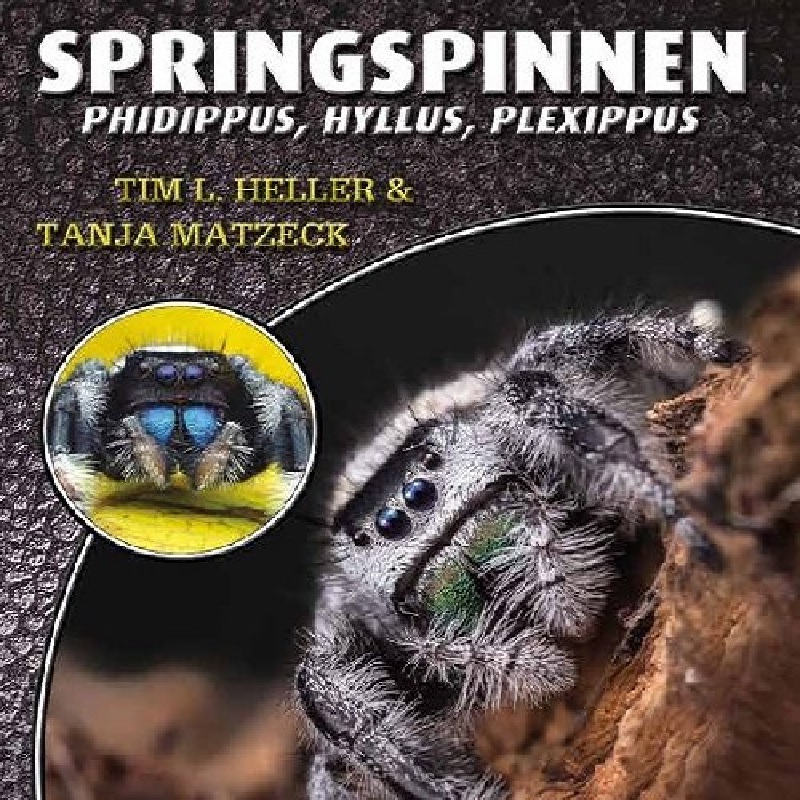
Book Jumping Spiders -
Phidippus, Hyllus & Plexippus
A guide to keeping jumping spiders of the genera Phidippus, Hyllus & Plexippus. Who can resist the charm of jumping spiders? The childlike appearance of their expressive face simply leaves no one cold! In addition, their behavior is extremely exciting to observe, their colors are bright and their requirements for species-appropriate keeping are very easy to meet. No wonder these likeable jumpers are all the rage!
This volume in the "Species by Species" series describes in detail what to look out for when buying and keeping them, introduces the most commonly kept species and color forms and provides plenty of tips on how to keep them successfully - so you can be sure they will breed well!
Species by Species introduces you to the books in this series, which present the most popular terrarium animals. Each volume offers you detailed, practical care instructions and all the information you need to successfully breed your animals.
All important questions from the required tank size to terrarium set-up, technical equipment, species-appropriate nutrition and disease prevention are answered with numerous tricks and tips.
Experienced, long-standing breeders reveal how you can encourage the animals to reproduce and raise healthy young.
All this in full color, generously illustrated and attractively designed - just about your terrarium animal - species by species
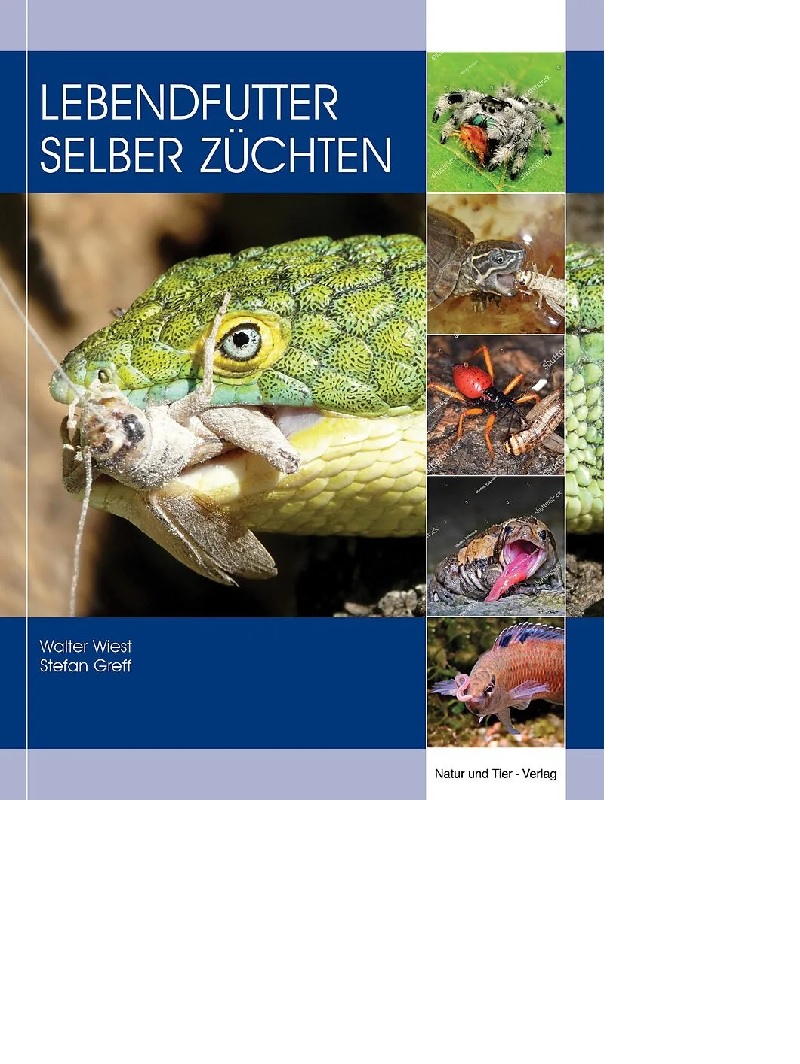
Book "Grow your own live food" - The perfect guide for pet owners
Discover practical and detailed instructions on how you can easily breed food for your reptiles, birds, fish or other animals yourself in the book "Breeding live food yourself". With valuable tips on various food insects, their care and breeding, you can save money and ensure a species-appropriate diet for your pets.
Contents of the book:
Step-by-step instructions for breeding feeder insects
Information on the best types of food for reptiles, birds and fish
Care instructions and breeding conditions for various live food species
Tips for sustainable and cost-effective food production
Why breed your own live food?
Get healthy, fresh food for your animals
Save money and reduce dependence on pet shops
Promote the health and well-being of your animals with species-appropriate food
Whether you are a beginner or an experienced pet owner, this book provides you with everything you need to successfully breed live food yourself.
Marginata 69 - New Guinea tortoises – the genus ElseyaCover storyThe unrecognised beauties: New Guinea tortoises (Andreas S. Hennig)My experiences with Branderhorst's New Guinea tortoise, Elseya (Elseya) branderhorsti (Ouwens, 1914) (Andreas S. Hennig)Keeping and breeding of Rhodin's New Guinea tortoise, Elseya (Hanwarachelys) rhodini Thomson, Amepou, Anamiato & Georges, 2015 (Andreas S. Hennig)PortraitGeoemyda spengleri, Chinese serrated tortoise (Andreas S. Hennig)ReportageMacrochelys temminckii – Experiences and impressions with vulture tortoises part 2 (Reiner Praschag)KeepingAn alternative to year-round keeping of the Egyptian tortoise in the terrarium – my experiences with seasonal outdoor keeping of Testudo kleinmanni (Ricarda Schramm)EtymologySawbacks and living maps part 4: Graptemys gibbonsi, Pascagoula humpback tortoise (Holger Vetter)Classifieds & animal placement
Marginata No. 33 - Softshell Turtles - Wonderful, but hardly known
Warum stranden Meeresschildkröte?Schildkrötenforschung in AndalusienHaltung und Zucht von Astrochelys radiata Teil 5
Inhalt:
Editorial
Magazin
Termine
HALTUNG UND ZUCHT
Erfolgreiche Haltung und Aufzucht junger Weichschildkröten
Hans-Dieter Philippen
REPORTAGE
Thermoregulation bei Weichschildkröten
Dieter Gramentz
REPORTAGE
Bemerkungen zum Wanderverhalten von Weichschildkröten
Dieter Gramentz
Porträt
Kuba-Schmuckschildkröte (Trachemys decussata)
Hans-Dieter Philippen
HALTUNG UND NACHZUCHTHaltung und Nachzucht der Madagassischen Strahlenschildkröte Teil 5
Michael Wirth und Peter Fritz
REPORTAGEStrandende Meeresschildkröten an der andalusischen KüsteJuan J. Bellido & José C. Baez
REPORTAGEMaurische Landschildkröten (Testudo graeca) in Andalusien
Anneliese Pioch
Buchtipp
Kleinanzeigen
Abo & Service
Regionalführer
Everything about keeping stick insects by Ingo Fritzsche
64 pages
Format: 14.8 x 21 cm
with numerous colour photos
Author Ingo Fritzsche
Publisher NTV
Contents:
Foreword
Distribution and habitat
Relationship and body structure
The eggs
The terrariums
• Glass terrariums
• Gazeterrariums
• Plastic terrariums
The substrate
• Earth
• Sand
• Vermiculite and perlite
• Peat and coco substrates
• Paper
Further accessories
Lighting
Care measures
Egg laying and incubation
Climate
Food plants
Handling the food plants
Where do I buy my stick insects?
Transport and quarantine
Reproduction
Growth
What to do with the offspring?
Defence behaviour
Species section
Thanks
Further information
Literature used and further reading
Marginata 22 - North American Tropical TurtlesGreek tortoisesSea turtlesOldest Aldabra giant tortoiseContents:2 EDITORIAL3 READER LETTERS4 MAGAZINE8 DATES10 REPORTAGE Wetlands as islands of tranquillity and happiness - experiences from Long-term studies on Clemmys guttata in Canada Jacqueline D. Litzgus20 BREEDING IN HUMAN CARE Long-standing offspring of the dropback turtle (Clemmys guttata) Ingo Schaefer28 REPORTAGE Experiences with outdoor keeping of the Spotted Turtle (Clemmys guttata) Georg Storms & Hans - Dieter Philippen31 POSTER The Argentine tortoise (Chelonoidis chilensis) Hans - Dieter Philippen36 REPORTAGE By Greek Tortoises Testudo boettgeri Mojsisovics, 1889 in Greece. Part 2 Michael Wirth, Peter Fritz & Johann Meier46 REPORT Threats to, protection and utilisation of Sea turtles - Part 2: Costa Rica Gerald & Christa Benyr54 REPORTAGE The respiratory system of turtles - helpful for taxonomy and systematics? Markus Lambertz57 REPORTAGE Esmeralda - the oldest living Aldabra Giant tortoise (Dipsochelys dussumieri) of the world Jürgen Hellwing58 BOOK TIP60 CLASSIFIEDS61 SUBSCRIPTION & SERVICE63 REGIONAL GUIDE
Reptilia 60 - Nose frogs
Aquatic turtles in the outdoor terrariumAustralian spiny-tailed skinkMauritius
Contents:
4 EDITORIAL
5 MAGAZINE
12 DATES
15 PHOTO REPORTAGEFrom Darwin's treasure trove: Nose frogs By H. Werning
22 KEEPING AND BREEDINGThe breeding of the nose frogRhinderma darwinii for more than twodecadesBy K. Busse
30 REPORTAGEThe REPTILIA project "Nose Frogs":Field studies on Rhinodermadarwinii, the Darwin's frogBy P. Ulmer
39 REPORTAGEHalf-swimmers in sight? The search for Rhinoderma rufum continues.By M. Solé
43 TRAVELMauritius for beginnersBy M. Rogner
51 PORTRAIT AND POSTERMontivipera xanthinaBy N. Stümpel & B. Trapp
55 KEEPING AND BREEDINGOn keeping and breeding the Australianspiny-tailed skink Egernia stokesii stokesii (Gray, 1845), with notes on feeding-management. Part 1By S. Knauf
62 PRACTICEUse of a conservatory as a terrarium-location for a desert terrariumPart 2: The inhabitants: Tympanocryptis tetra-porophora (Lucas & Frost, 1895)By T. Ackermann
68 PRACTICE North American aquatic turtles in the outdoor terrarium Part 1: General remarksBy A. S. Hennig
72 HERPETOFAUNASand lovers - The psammophilous snakesof North AfricaBy U. Schlüter
86 FAQ - FREQUENTLY ASKED QUESTIONSAcquisition of tarantulasBy K. Kunz
90 LIBRARY
100 WESTERN HERP PERSPECTIVESAlterna feverBy B. Love
104 INCUBATOR"How do you even get something like this"?By H. Werning
The Dyer Frog by Dirk Wagner
64 pages
Format: 14.8 x 21 cm
67 colour photos
Contents:
Foreword
Relationship
Description
Distribution, habitat and way of life
Colour forms
Care
Socialisation
Poison
Species protection
Acquisition
Transport and quarantine
The terrarium
Terrarium technology
Light
Warmth
Water and humidity
Furnishing and planting
Food
Care work
Health
Breeding
Further information
Literature
Draco 32 - Mediterranean tortoises
Contents:
2 Editorial
4 Mediterranean tortoises Alexander Pieh & Hans - Dieter Philippen
35 The natural outdoor enclosure for species-appropriate keeping Mediterranean tortoises Peter Buchert
42 Construction and operation of a small greenhouse for keeping Mediterranean tortoises Thomas Wilms & Beate Löhr
47 A rare ectoparasite infestation: snake mites (Ophionyssus natricis) among Greek tortoises of the subspecies Testudo hermanni boettgeri Jutta Wiechert
50 The tortoises of IranPersian populations of the Moorish tortoise Markus Auer & Mario Herz
56 The tortoises of IranSteppe tortoises in Persia Mario Herz & Markus Auer
61 Species-appropriate husbandry and reproduction of the Greek tortoise Peter Kern
74 The Egyptian Tortoise (Testudo kleinmanni)Very popular and critically endangered Henk Zwartepoorte
79 Behind the scenes at a Slovenian tortoise farm Hans - Dieter Philippen
88 Book box
96 Magazine
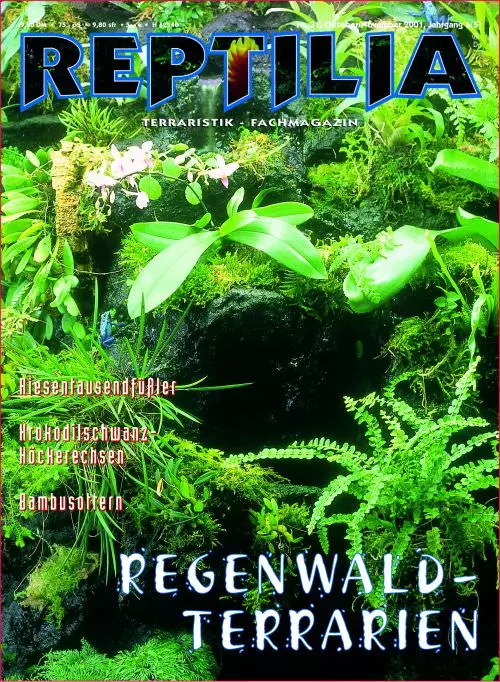
Reptilia 31 rainforest terrariums
Giant millipedesCrocodile-tailed crested lizardsBamboo otters
Contents:
2 EDITORIAL
3 READER LETTERS
5 MAGAZINE
12 DATES
18 WESTERN HERP PERSPECTIVES: Reptile Television, By B. Love
20 PHOTOREPORTAGE: Rainforest terrariums, By M. Schmidt
28 REPORTAGE: Rain for the rainforest – Mist and irrigation in the rainforest terrarium, By P. Nowark
32 REPORTAGE: Materials for back wall design in rainforest terrariums, By T. Doussier
37 REPORTAGE: Plants in the rainforest terrarium, By B. & W. Schwarz
43 TRAVEL: The herpetofauna of south-west Morocco, By U. Schlüter
51 PORTRAIT AND POSTER: Natrix natrix, By H. P. Eckstein & B. Trapp
55 KEEPING AND BREEDING: On the lifestyle, keeping, care and reproduction of the crocodile-tailed humpback lizard Shinisaurus crocodilurus, By M. Rogner
62 HERPETOFAUNA: Information on the lifestyle and husbandry of the bamboo otter Trimeresurus kanburiensis, By J. Bulian
67 REPORTAGE: Saving the giant tortoises on Galápagos, By H. W. Köhler
74 KEEPING AND BREEDING: Tropical giant millipedes, By F. Gast
77 HERPETOCULTURE: Devilish, divine snake. Aspects of snake symbolism from a psychological perspective Part 2: Psychological foundations, the snake as a symbol of the unconscious, ambivalence of the snake symbol, By K. Kunz
87 CLASSIFIED ADS
91 ADVICE AND ACTION
93 LIBRARY
104 GLOSSE: An autumn morning dream, By L. Hogeback