Handbook of forage plants 2nd revised editionMarion Minch is not only a successful breeder of diverse tortoises for many years, but also an excellent connoisseur of native wild herbs. She founded and runs samenkiste.de, which is well known to many tortoise keepers and nature lovers. Her name is inextricably linked with reptile care and species-appropriate nutrition for tortoises. Her handbook of food plants summarises the most important native food plants for herbivorous and omnivorous reptiles. She not only considers tortoises, but also iguanas, spiny-tailed dragons and even chameleons. From the basics of plant biology to native wild herbs to suitable food plants for hardy tropical reptile species, this comprehensive work provides the basis for species-appropriate keeping. In the expanded and supplemented 2nd edition, the plant section is divided according to flower colour. This makes it even easier to identify wild herbs. The work has also been supplemented with a wealth of additional information and many pictures.
Geckos in the terrarium by Astrid FalkThe book offers a comprehensive introduction to geckos and their species-appropriate keeping in terrariums. It explains what you need to think about before buying a gecko and what preparations should be made. The book describes in detail how the terrarium is technically equipped and set up. The care of the animals, their special features and behaviour, their diet, reproduction and rearing of young animals are described, as well as diseases and husbandry problems with tried and tested suggestions for prevention and treatment. Individual gecko species that are particularly suitable for keeping and breeding in terrariums are portrayed in detail in the second part of the book.
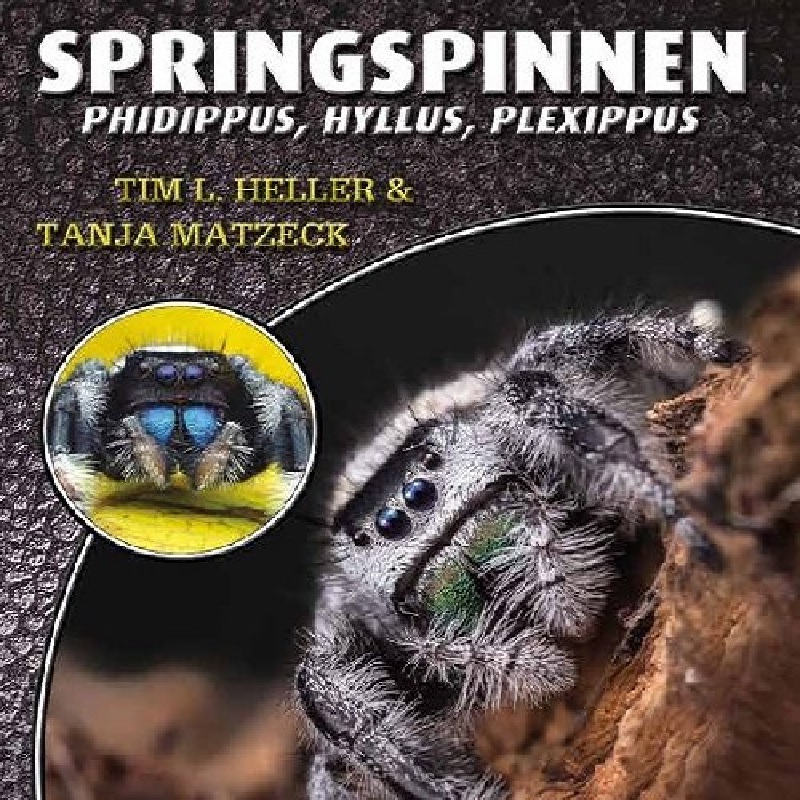
Book Jumping Spiders -
Phidippus, Hyllus & Plexippus
A guide to keeping jumping spiders of the genera Phidippus, Hyllus & Plexippus. Who can resist the charm of jumping spiders? The childlike appearance of their expressive face simply leaves no one cold! In addition, their behavior is extremely exciting to observe, their colors are bright and their requirements for species-appropriate keeping are very easy to meet. No wonder these likeable jumpers are all the rage!
This volume in the "Species by Species" series describes in detail what to look out for when buying and keeping them, introduces the most commonly kept species and color forms and provides plenty of tips on how to keep them successfully - so you can be sure they will breed well!
Species by Species introduces you to the books in this series, which present the most popular terrarium animals. Each volume offers you detailed, practical care instructions and all the information you need to successfully breed your animals.
All important questions from the required tank size to terrarium set-up, technical equipment, species-appropriate nutrition and disease prevention are answered with numerous tricks and tips.
Experienced, long-standing breeders reveal how you can encourage the animals to reproduce and raise healthy young.
All this in full color, generously illustrated and attractively designed - just about your terrarium animal - species by species
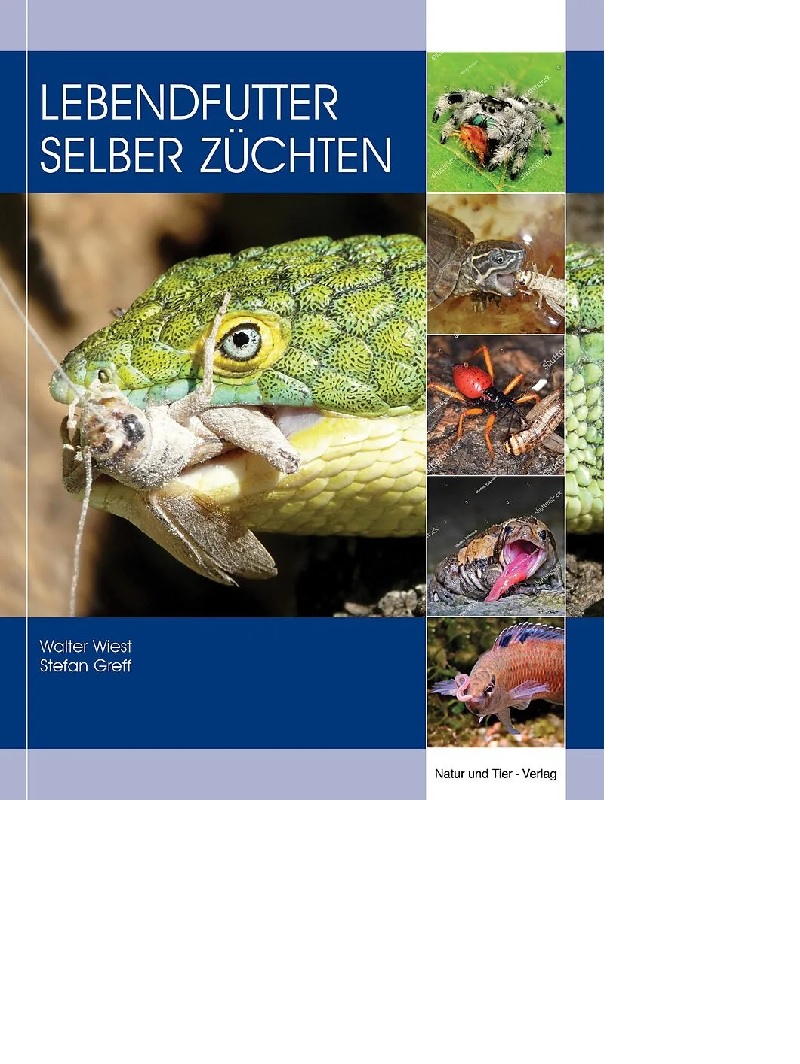
Book "Grow your own live food" - The perfect guide for pet owners
Discover practical and detailed instructions on how you can easily breed food for your reptiles, birds, fish or other animals yourself in the book "Breeding live food yourself". With valuable tips on various food insects, their care and breeding, you can save money and ensure a species-appropriate diet for your pets.
Contents of the book:
Step-by-step instructions for breeding feeder insects
Information on the best types of food for reptiles, birds and fish
Care instructions and breeding conditions for various live food species
Tips for sustainable and cost-effective food production
Why breed your own live food?
Get healthy, fresh food for your animals
Save money and reduce dependence on pet shops
Promote the health and well-being of your animals with species-appropriate food
Whether you are a beginner or an experienced pet owner, this book provides you with everything you need to successfully breed live food yourself.
Marginata 69 - New Guinea tortoises – the genus ElseyaCover storyThe unrecognised beauties: New Guinea tortoises (Andreas S. Hennig)My experiences with Branderhorst's New Guinea tortoise, Elseya (Elseya) branderhorsti (Ouwens, 1914) (Andreas S. Hennig)Keeping and breeding of Rhodin's New Guinea tortoise, Elseya (Hanwarachelys) rhodini Thomson, Amepou, Anamiato & Georges, 2015 (Andreas S. Hennig)PortraitGeoemyda spengleri, Chinese serrated tortoise (Andreas S. Hennig)ReportageMacrochelys temminckii – Experiences and impressions with vulture tortoises part 2 (Reiner Praschag)KeepingAn alternative to year-round keeping of the Egyptian tortoise in the terrarium – my experiences with seasonal outdoor keeping of Testudo kleinmanni (Ricarda Schramm)EtymologySawbacks and living maps part 4: Graptemys gibbonsi, Pascagoula humpback tortoise (Holger Vetter)Classifieds & animal placement
Draco 17 - Snakes
Contents:
2 Editorial
4 In a nutshell: All about snakesDieter Preißler
22 On the reproduction of snakes in the terrarium.Tasks, facts, problemsDieter Schmidt
37 Basics of keeping venomous snakesBeat Akeret
54 Snake symbolism in the Egyptian Book of the DeadKriton Kunz
64 To drive you out of your skin – observations on adder shirtsMartin Hallmen
68 Infrared detection in snakesLars Wartenberg
74 Snake skins – does the length of the tanned skin really not allow any conclusions to be drawn about that of the living animal?Karlheinz & Manuel Fuchs
82 Book box
94 Magazine
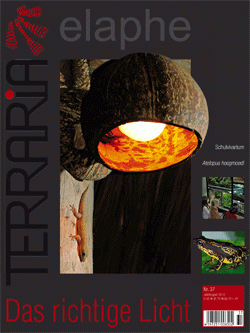
Terraria 37 - The right lightSchool vivariumAtelopus hoogmoediContents:Cover story: The right lightHardly any other topic in terraristics is as important and at the same time as intensively discussed as the right terrarium lighting. What do you need to look out for to ensure that your pets get the best possible replacement for sunlight in their terrarium? What do you think of new lighting technologies such as LEDs? And: How do reptiles actually perceive light? The cover story of the next issue attempts to provide some answers. TerritorialHerpetoramaTOPICThe fluorescent tube - a classic newly illuminatedSteven ArthThe use of UV measuring devices in terraristicsSarina WunderlichColour temperature and colour rendering index: Useful parameters in terraristicsSarina WunderlichPANORAMATerraglobal: Close to death, part 2Joachim BulianSince when do agamas eat peanuts - and crocodile bread?Alfred SchleicherThe school vivarium at the Edith-Stein-Schule in Erfurt - much more than just animals at schoolRica Kepter & Achim KempterRESEARCHNew species: The frog and the prince - splendid tree frogs from EcuadorAxel KwetAmong researchers: Inhabitants of the elfin forest: Herpetofauna at Picu La Picucha in the Sierra de Angalta National Park, HondurasAlexander GutscheNews from Indochina: The amphibians and reptiles of the Cat Thien National Park in South VietnamPeter GeisslerSalamandraTERRARISTICSClassic: The DreicksnatterExperiences in rearing spiny-edged soft-shelled turtles (Apalone spinifera)Sebastian NicklFirst successful breeding of the short-toed toad Atelopus hoohmoedi at the Aquazoo/Löbbecke Museum in DüsseldorfSandra Honigs, Marc Messing & Beate PelzerSome additional information on the article about the mysterious death of hatchlings of the green tree pythonJoachim BulianNATURE AND SPECIES CONSERVATIONField notes: Toad under iceStefan MeyerLate reproduction of the fire-bellied toad in SaxonyWolf-Rüdiger Grosse & Andreas NöllertTwo examples of accidental anthropogenic displacement of lizards due to their flight behaviourAndreas ArnoldMissing: Pinta giant tortoise (Chelonoides abingdonii)Also in your neighbourhoodSubscription & ServiceGALERIAKomodo’s Centenarian DragonsPreviewBRUTKASTENCrocodile alarm at the swimming lake: human tragedy narrowly avertedJakob Hein
Book Terrarium Technology - Ingo Kober & Uwe Geissel
248 pages
numerous illustrations
Format: 17.5 x 23.2 cm, hardcover
Contents:
A comprehensive book on all aspects of terrarium technology, from lighting and UV irradiation to heating mats and sprinkler systems.Practical, easy to understand, up-to-date. For all those seeking guidance in the large market of terrarium equipment. Written by two scientists who work in technical professions and can therefore professionally present the complex interrelationships, but who are passionate terrarium keepers as a hobby and know exactly what is important when caring for your animals.
What are LED lamps good for?
Which light do terrarium animals prefer?
How do I ensure the UV supply?
How many lamps do I need for which terrariums?
How do I operate a waterfall?
When should I use nebulisers?
Foreword Environmental requirements of terrarium animals Terrarium animals are wild animals in human care Environmental parameters Basic considerations on terrarium technology Terrarium types Dry terrariums General considerations Terrestrial care animals Arboreal care animals Rock wall-dwelling care animals Nocturnal pets Humid terrariums General considerations Soil-dwelling caretakers of the forest interior Tree and forest edge dwellers Bank and water dwellers Variations on a theme Terrariums for highland dwellers General considerations Highland rainforest/cloud forest terrarium Highland dry terrarium Light The origin of light Temperature radiators Luminescence Fluorescence Gas discharge The different types of light: invisible and visible light Infrared light (IR) (wavelength µm– nm) Visible light (VIS) (– nm) Ultraviolet light (UV) Types of light spectrum Continuous spectrum Line spectrum The technical parameters of light Orientation of light sizes towards humans Parameters for describing light Luminous flux Light intensity Luminance of a light source Luminance of an object that is not self-luminous Illuminance (brightness) Colour temperature (light temperature) Colour rendering Light propagation Point-shaped light sources Rod-shaped light sources Sunlight The alteration of light by the atmosphere Consequences for the alteration of light colour during the day Consequences for the alteration of UV radiation during the day Night light or moonlighting The subjective perception of light Colour sensation White balance Colour saturation and contrast Sensation of brightness Colour perception Flickering Conclusion Basics of lighting technology Use of reflectors Beam angle: spot and flood Degree of reflection Light distribution Luminaire efficiency Mounting the luminaires Alignment Uniformity of lighting – the difference between natural sunlight and artificial lighting Power consumption The relationship between power consumption and heat Saving energy by sensibly selecting the lighting Luminaires and lamps Protection types Light efficiency Markings on lighting equipment Light sources at a glance Incandescent bulbs Halogen lamps Fluorescent lamps Energy-saving lamps and compact fluorescent lamps Mercury vapour lamps Metal halide lamps Mixed light lamps LEDs Lamps for the terrarium Temperature radiators Incandescent bulbs Halogen lamps Halogen-IRC lamps Low-voltage halogen High-voltage halogen Halogen work lamps Discharge lamps A brief overview of the various types of discharge lamps Ballasts: EVG, VVG, KVG Mercury vapour lamps Metal halide lamps Mixed light lamps Fluorescent lamps Compact fluorescent lamps and energy-saving lamps LEDs All light sources at a glance Light and vitamins What are vitamins? A vitamin with a special role Terrarium technology and vitamin D synthesis Which and how much UV-B does my terrarium animal need? How long must irradiation last? Safety net: supplementation with vitamin D UV lamps and UV emitters UV lamps for short-term irradiation or for large terrariums UV lamps for all-day irradiation Do-it-yourself UV emitters UV incandescent or UV neodymium lamps UV-C emitters Heating of terrariums Heat Heat radiation (infrared radiation) Heat transfer Cold and cold radiation Thermal conductivity Heat capacity Sensation of warmth Insulation Heat balance in the terrarium Where is heat lost in the terrarium? Cooling speed in the evening Heating technology for the terrarium Heating by thermal conduction Heating cables and heating mats Heating stones Heating with ballasts Heating with radiant heat Infrared heaters Low-light radiant heaters - inexpensive DIY Terrarium heater Heat wave heating Heat radiation of other light sources Water in the terrarium Spraying systems General preliminary considerations Irrigation systems from the pet store Irrigation systems from the garden centre DIY Fog systems General considerations Mininebler or room humidifier? Which fogger for which purpose? Mounting Operation and maintenance Drainage Waterfalls and streams General considerations Complete systems DIY Centrifugal pumps Flow pumps Air lifters Aquarium air pumps Filters for the water section in the terrarium Nitrate filter Vodka filter Sulphur filter Filter substrates DIY filters The use of ozone in larger water sections Air humidity in the flat – mould and correct ventilation Measuring, controlling, regulating Control of temperature, humidity and brightness in the terrarium Measuring temperature Types of thermometers Measuring humidity Measuring brightness Measuring UV light Controlling and regulating in the terrarium Timers Regulation of the technology in the terrarium The optimal terrarium regulation Saving with terrarium technology Saving energy in the terrarium Buying used equipment Electrical devices Luminaires Safety Electrical safety Residual current device (RCD) – FI switch Fire detector Further information Bibliography
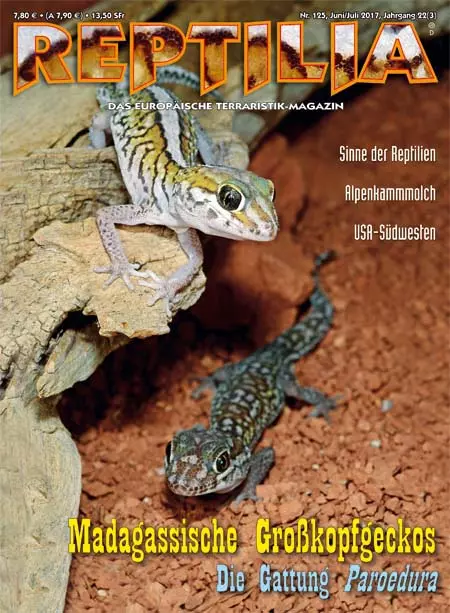
Reptilia 125 - Madagascan big-headed geckos - the genus Paroedura
Contents:
Cover story: Madagascan big-headed geckos – the genus Paroedura
The charming Madagascan big-headed gecko Paroedura picta is one of the most popular lizards in the terrarium hobby, having been consistently captive-bred here for over thirty years. Another success story of the terrarium hobby. We provide a detailed guide to keeping and breeding this popular species and show that the genus Paroedura still has many surprises in store.
EditorialMAGAZINEDATES
Photo story
The Madagascan big-headed geckos of the genus Paroedura
P. Schoenecker
KEEPING AND BREEDING
The Madagascan big-headed gecko Paroedura picta in the terrarium. Part 1: General and behaviour
By T. & A. Dark
Biology
An amusing observation in the habitat of Paroedura picta
H.-P. Berghof
KEEPING AND BREEDING
Paroedura stellata. A rare star in the terrarium firmament
K.-U. Volta & H.-P. Berghof
Biology
The incredible and fascinating sensory abilities of reptiles
M. Allerstorfer
Also in your neighbourhood
WESTERN HERP PERSPECTIVES
Alien invaders – 100% evil?
B. Love
Animals of our homeland
The alpine crested newt
R. Leptien
SERVICE
Journey
The great trek.Part 4: Smoke on the Mountains
H. Werning
PREVIEW
INCUBATOR
The sensation
H. Werning
Draco 44 - Giant SnakesContents:EditorialReproduction and breeding of giant snakesDieter SchmidtMating triggers in giant snakesMichaela & Marco SchulzeA few thoughts on feeding giant snakesErich Koerber & Christian BittnerPregnancy and confinement of boas - initial care of offspring and possible complicationsHermann & Erika StöcklAn aberrant form of Boa constrictor longicauda – the ‘Zeros’Hermann & Erika StöcklThe green tree python - success through natural breedingMichèl KroneisKeeping and breeding the Jungle carpet python, Morelia spilota cheyneiSteven Arth & Sandra BausKeeping and breeding the Woma, Aspidites ramsayiManuel Uhlhaas & Philipp Pohlscheid
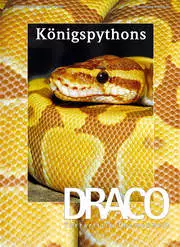
Draco 35 - King SphytonsContents:Editorial 2The king python - a snake with many faces Thomas Kölpin 4Keeping, care and breeding of the royal python in the terrarium Melanie Hartwig 18Professional king python breeding and the development cycle of the follicles Stefan Broghammer 30Design and set-up options for king python terrariums using the example of a private enclosureRené Bonke 34Rack keeping: pros and consFrank Bick 39Selective colour breeding of king pythons using the example of of the "Maze" lineHans-Jörg Winner 43Colour variations of the king pythonThomas Kölpin 48The utilisation of snakes and the associated economic and ecological consequences - the example of the king python in West AfricaJohannes Penner, Christain A.S. Toudonou, Brice Sinsin & Mark-Oliver Rödel 64Ranching the king python Stefan Broghammer 69Common diseases of the royal python in terrarium practice Dr med. vet. Frank Mutschmann 74Book box 87
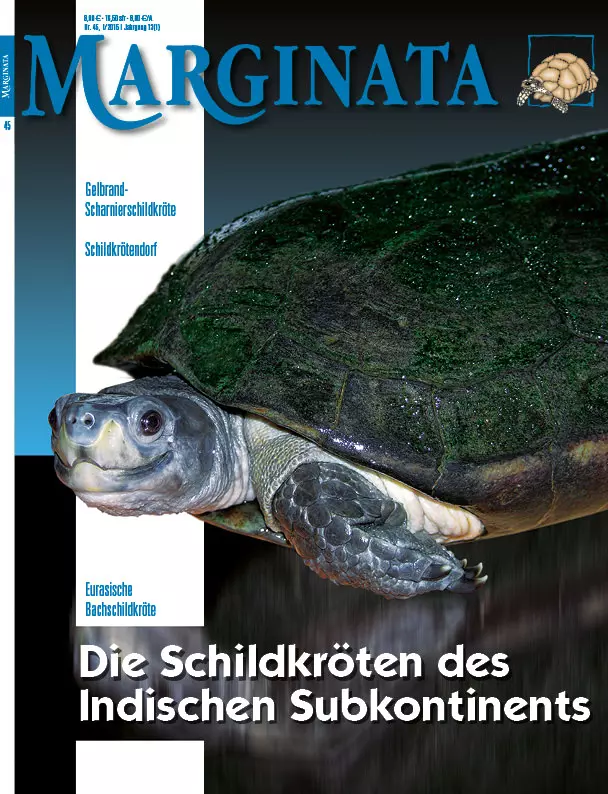
Marginata 45 - The Turtles of the Indian Subcontinent
Yellow-margined Box TurtleTurtle villageEurasian pond turtle
Contents:
EditorialMagazineTOPICThe turtles of the Indian subcontinentSebastian NicklTOPICTurtles in IndiaBernd WolffTOPICA journey to the turtles of Sri LankaHerbert and Regina BeckerTOPICKeeping and breeding the black-bellied terrapin (Melanochelys trijuga thermalis) in the terrariumSebastian NicklPORTRAITMauremys rivulata Valenciennes, 1833. Eurasian pond turtleBenny TrappREPORTAGEThe turtle village in the Mauren massif Martin DieckmannKEEPING AND BREEDINGThe Yellow-margined Box Turtle (Cuora flavomarginata) Part 2: Breeding in the terrarium and endangerment in the wildUlrich HennenSubscription & ServiceRegional guide
Essigaelchen - live food for small ornamental fish
Vinegar lakes are suitable for any type of fry.But especially fish with small mouths such as small guppies, characins or danios, this is an optimal starter food.
Suitable for the smallest fryFast growth and vital fish – due to high nutrient contentFast reproduction of the vinegar liceswim freely and live long in the aquariumvery easy maintenance, as breeding stock can stand for several months
The batch contains:
200 ml sealable PET culture bottleVery many acetic lattices in about 150 ml of culture liquid (enough to quickly make 1 liter of mixtures yourself)Cultivation instructionsHow do I grow and feed the vinegar lice?
Mix the fruit vinegar/apple cider vinegar with water in a 1:1 ratioa piece of sugar cube and a little dry yeast serve as food (already included in the breeding mixture).
Lid may only rest on the opening, because the acetic lice need oxygen.For feeding, carefully add the culture liquid with the
Essigälchen up to about 3 cm below the edge in a
Schnapps bottle/Erlenmeyer flask with a thin neck. Insert cable ties and
filter floss so that the floss is just covered by the liquid.
is covered. Fill with normal water and wait 1 day.Aspirate the vinegar dish with the pipette over the absorbent cotton and feed directly.Put liquid from the liquor bottle back into the breeding bottle.
CHF 11.90
❅
❆
❅
❆
❅
❆
❅
❆
❅
❆
❅
❆
This website uses cookies to ensure the best experience possible. More information...