Sterbas armoured catfish

Hoplisoma sterbai

available for sale


Profile orangefin armoured catfish


Sterba's armoured catfish is a schooling fish and should be kept in groups of at least 6–8 animals. In larger groups, it displays its natural and peaceful behaviour particularly well.

Family: armoured catfish (Callichthyidae)
Home: South America – especially Brazil and Bolivia, in the upper Rio Guaporé and Rio Madeira.
Synonyms: Corydoras sterbai, Sterba's armoured catfish
First introduction: Established in the aquarium hobby since the 1960s
Size: 5–6 cm, rarely slightly larger
Sexual differences: Females are stronger and broader. Males remain somewhat smaller and slimmer. Sexual differences are best recognised from above.
Diet: Bottom-orientated omnivore, flake food (make it sink), tablet and substrate food, fresh and frozen food: Artemia, mosquito larvae, Tubifex Likes a varied diet
Temperature: 22–28 °C
Tank size: At least 80 litres, fine sandy bottom required
Water values:  pH: 6.0–7.5/GH: 2–12 °dGH
Product information "Sterbas armoured catfish"

Sterbas armoured catfish


Area of origin:

Corydoras sterbai originates from the border region between Brazil and Bolivia and lives there in softer, clear to slightly murky waters with a sandy bottom.


Species:

Sterbas armoured catfish is one of over 170 Corydoras species. The species frequently offered in the pet trade include

  • Corydoras sterbai
  • Corydoras paleatus
  • Corydoras aeneus (golden form, albino)
  • Corydoras panda
  • Corydoras julii / trilineatus Sterbai is one of the most popular species due to its attractive dot and line pattern.


Social behaviour:

Very peaceful, sociable and active on the bottom. Forms small groups that dig together. Very compatible with other peaceful fish. Non-aggressive and ideal for community aquariums.


Keeping conditions:

  • Fine sandy soil is mandatory, as hard gravel edges injure the barbels
  • Well-structured tank with roots, plants and shaded areas
  • Clean, well-filtered water 
  • Gentle current
  • Regular water changes
  • Never insert by hand - sensitive fin spines


Breeding:

Rather easy compared to other armoured catfish. Spawn after water changes with slightly cooler water. Females stick eggs to discs and plants. Parents often have to be removed as eggs are eaten. Juveniles require fine powdered food and Artemia nauplii.


Special features:

  • Very robust and ideal for beginners 
  • Must be kept in groups
  • Barbels require soft substrate for protection 
  • Beautiful pattern with white spots on a dark body
  • Tolerates higher temperatures - ideal for discus tanks


Conclusion:

Sterbas armoured catfish is a peaceful, attractive and easy to care for bottom dweller that provides lively, social behaviour in groups. With fine sand, clean water conditions and a varied diet, it remains healthy and active for a long time. An ideal companion fish for almost any peaceful community aquarium - and particularly popular in warm tanks.


If you have any questions or problems, our trained team at Zoo Roco is here to help. They can provide expert advice on all matters.

Composition
Feeding recommendation
Technical details
Size information

0 of 0 reviews

Give us a rating!

Share your experience with the product with other customers.


Suggested products

Eubranchipus grubii
Fairy shrimps (spring gillfoot) Fairy shrimps (spring gillfoot) are very common. Fairy shrimps are gilled crustaceans that have been found on our planet since prehistoric times in salt lakes, drying waters or polar waters.Only animals from Asia or America that live in a water temperature of 20-30°C are suitable for keeping in an aquarium. These species (Branchinella thailandensis and Dendrocephalus brasiliensis) live in waters that regularly dry out and are only filled with rainwater. The water is therefore very soft. Appearance The animals have 11 pairs of leaf feet. These leaf-shaped limbs serve not only for locomotion but also for breathing – which has led to the term "gilled-foot crustacean". There are sometimes minor differences in colour. They are found in colours ranging from orange to reddish-brown and may have greenish to bluish hues at the joints and at the boundaries of the segments.Both sexes have two short thread-like antennae. However, another pair of antennae differ in both shape and according to sex. Males have lobe-shaped appendages that can be curled up. Adult females are mainly distinguished by the ventrally located brood sacs, which are filled with eggs, and the ends of the female's tail are translucently light. Systematics Phylum: Arthropoda / ArthropodsSubphylum: Crustacea / CrustaceansClass: Anostraca – Gill-feetFamily: BranchipodidaeGenus: Branchipus / Eubranchipus /Tanymastix etc. Care Depending on the species, fairy shrimps live for 6-12 weeks and the size of adult animals varies from 1-3cm.Can Triops and fairy shrimps be kept together?yes, they can Aquarium size: Initially, a Faunarium box size 230 x 155 x 170 mm is quite sufficient From a body length of 1.5cm, they can be gradually accustomed to larger tanks Basic lighting: Sunlight or aquarium lighting is sufficientAeration: An air pump with a stone and very little air flow is sufficient for keepingSetup:Only water and breeding substrate in the breeding/starting container. A little fine aquarium sand can be used as substrate (but this is not absolutely necessary)Decorations can be used, but are only for our eyes and not of importance to the fairy shrimps.Fairy shrimps are free-swimmers – so they need enough free swimming space in the breeding container.If the animals swim around freely, you can also add a little aquarium moss to the water. To ensure the water is soft, it is best to use 2/3 distilled water and 1/3 mineral water (non-carbonated).Water temperature: Fluctuations in temperature of +/- 5° C are not dramatic.The ideal breeding temperature is 26°.Start:The larvae only hatch when they are completely surrounded by water. Therefore, place the eggs on adhesive tape and then put this in the water – so the eggs are not washed to the edge and always remain in contact with water.After 1-3 days the larvae hatch. The larvae grow quickly and can reach sexual maturity after up to 40 moults in one to two weeks. The males hold the females with their jaw pincers shortly before and also during mating. After mating, the eggs develop in the egg sacs on the females’ abdomens. They fall to the bottom of the water and can survive for several years of prolonged drought in the substrate.When the fairy shrimps have died, the water can be drained off and the substrate with the eggs left completely dry. The larvae can only hatch again if the eggs were completely dry.Once this is dried out, a new batch can be started.If no substrate is used, you can also siphon off the eggs with a thin hose. Let the water containing the eggs run through a fine net or a coffee filter – this way you can collect the eggs.Important: The animals do not tolerate large water changes. If fairy shrimps are to be moved to a larger home, it is best to place the animals together with the breeding water into the new home or tank and slowly fill up the container with conditioned tap water. Feeding The larvae are fed from the 3rd day after hatching.The larvae can be fed with algae powder or JBL Artemio fluid. For all animal husbandry: Children must be guided, supervised and monitored by their parents. Children must learn that an animal has its own needs and habits and they must respect this. Parents should be aware that they are responsible for the animal. For questions and problems our trained team at Zoo Roco is at your disposal. They can advise you professionally on all matters.
 
Purple Matano crab
Violet matano crab The violet matano crab is a species of snail-eating crab that lives purely in the water and does not require a land part. Home: Sulawesi Keeping: The violet matano crab can be kept in aquariums from 100 litres and grows up to 10 cm in size (carapace)The matano crab does not eat plants and can therefore be kept in a planted aquarium without any problems.The water values should be in the hard range, the pH value around 7.0 – 8.5The water temperature between 20-28°C Food: Snails, or as an alternative also crab and shrimp food Description and appearance: The basic colouring is purple / violet and a characteristic of this crab species is a rather square body as well as spikes on the edges of the body. Socialisation: The violet matano crab can easily be socialised with shrimps as well as fish.If there are snails in the aquarium, they will not survive living together.
 
Siamese trunk barb
Profile of the Siamese trunk barbArea of originRunning waters and weedy river sections in Southeast Asia. Clear, oxygen-rich water with a moderate current.SpeciesThere are several similar species within the genus Crossocheilus, which are often confused: The species frequently offered in the pet trade includeCrossocheilus siamensis / oblongus (true Siamese trunk barb)Crossocheilus langei (often confused, but less effective against algae)Gyrinocheilus aymonieri (Chinese algae eater - NOT to be confused!)The real SAE can be recognised by: a continuous black stripe up to the caudal fin Transparent fins without dark areas small barbelsSocial behaviourPeaceful, active and social. Less shy in groups. More territorial towards conspecifics when older. Ideal for community tanks with other robust fish. Eager to jump → cover requiredKeeping conditionsPlenty of swimming space. Light to medium current. Lots of plants and roots. Very good oxygen supply. Cover important. Stable water conditions. Excellent for controlling algae, especially filamentous and brush algaeBreedingExtremely rare in the aquarium. Presumably free spawners. Spawning behaviour hardly documented in captivity. Mostly bred commercially by hormone stimulation. Natural breeding in the hobby is considered almost impossible.Special featuresOne of the few species that eat brush algae. Very industrious algae eaters. Frequent mix-ups in the trade → look out for characteristics. Slightly less algae-eating with age, but still beautiful behaviour. Does not tolerate high nitrate and dirt levelsConclusionThe Siamese barb is an extremely useful, peaceful and lively aquarium inhabitant. As an excellent algae eater - especially of stubborn brush algae - it is ideal for larger community aquariums. With good care, plenty of space and group keeping, it remains active, robust and a valuable helper in the tank.If you have any questions or problems, our trained team at Zoo Roco is here to help. They can provide expert advice on all matters.
 
Glowlight tetra
Herkunftsgebiet: Endemisch im Essequibo-Fluss, Guyana. Soziales Verhalten: Friedlicher Schwarmfisch für jedes gut gepflegte Gesellschaftsbecken Hälterungsbedingungen: Dieser Fisch kommt erst im Schwarm und bei gedämpftem Licht (Torffilterung, Schwimmpflanzendecke) richtig zur Geltung. Zucht: Bei 28° C zwischen feinfiedrigen Pflanzen im Schwarm oder als Einzelpaar im Zuchtbecken bei weichem, torfgefiltertem Wasser Besonderheiten: Einer der schönsten kleinbleibenden Salmler, der dem Neonfisch nicht nachsteht. Quellennachweis: Mergus Atlas Band 1Für Fragen und Probleme steht Ihnen unser ausgebildetes Team im Zoo Roco zur Verfügung. Es kann Sie in allen Fragen fachgerecht beraten.
 
Butterfly cichlid
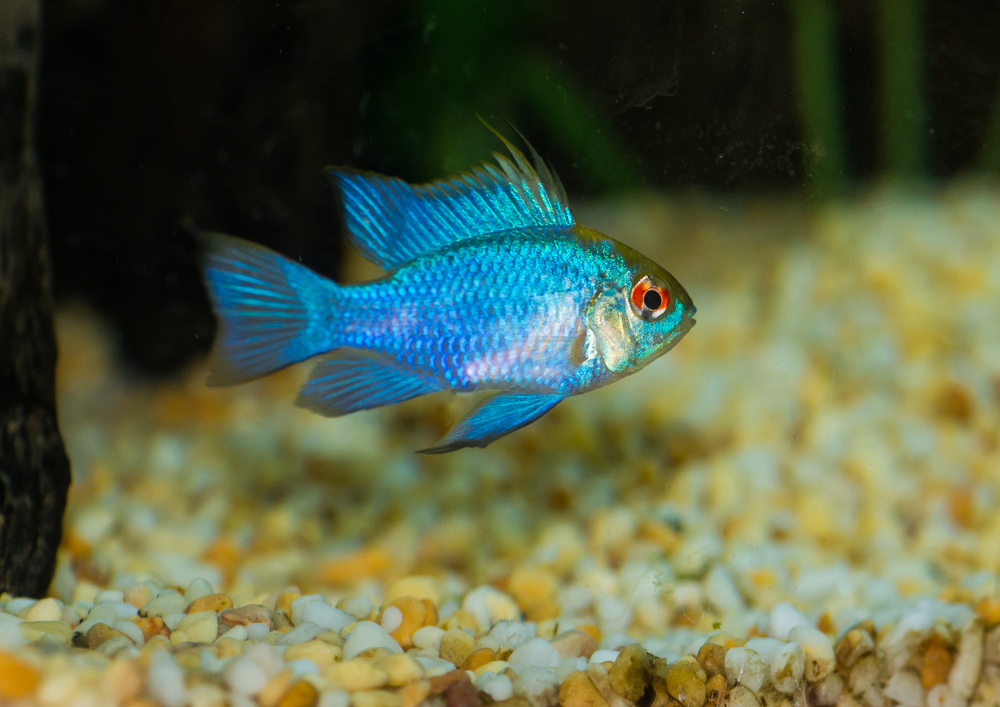
Butterfly cichlidArea of origin:The butterfly cichlid (Mikrogeophagus ramirezi) originates from the warm, slow-flowing waters of Venezuela and Colombia. There it lives in densely overgrown bank zones with soft, slightly acidic water.Species:The species frequently offered in pet shops includeMicrogeophagus ramirezi - the classic butterfly cichlidMicrogeophagus ramirezi "Gold" - gold-coloured breeding formMicrogeophagus ramirezi "Electric Blue" - intense blue colour variantMicrogeophagus ramirezi "German Blue" - brightly coloured standard breeding forSocial behaviour:Butterfly cichlids are peaceful dwarf cichlids and can be kept well in the company of calm species. They show pronounced social behaviour within the pair, while males can rival each other in aquaria that are too small.Keeping conditions:The butterfly cichlid prefers warm temperatures of 26-30 °C, soft to medium-hard water and a slightly acidic pH value. Fine sandy soil, lots of plants and quiet hiding places create ideal conditions. Good water quality is particularly important for this species.Breeding:The animals form pair bonds and usually spawn on flat stones or leaves. Both parents take care of the brood, fan the eggs and later lead the fry. Successful breeding is best achieved in a separate breeding tank with very good water quality.Special features:Butterfly cichlids are among the most colourful dwarf cichlids around. Although their requirements are moderate, they are sensitive to poor water values. High-bred forms can be more sensitive than the wild form.Conclusion:The butterfly cichlid is an attractive, peaceful dwarf cichlid that is a joy to keep under the right conditions. It is an enrichment for aquaria with calm tankmates and good care.If you have any questions or problems, our trained team at Zoo Roco is always available to help. We’re happy to provide expert advice!
 
Purple splendour perch
Profile purple splendour perchArea of originThe purple perch originates from soft, slightly acidic rivers and streams in West Africa. It prefers densely overgrown bank zones and areas with roots, stones and caves.SpeciesThe purple splendour perch belongs to the genus Pelvicachromis, which also includes other well-known species: The species frequently offered in the pet trade include Pelvicachromis pulcher (purple splendour perch)Pelvicachromis taeniatusPelvicachromis subocellatus Various location and colour variants ("Nigeria Red", "Moliwe" etc.)Social behaviourVery peaceful towards most tankmates. Becomes territorial during the breeding season, but not overly aggressive. Exhibits wonderful pair and brood care behaviour. Easy to socialise in a well-structured aquarium.Keeping conditionsWell-planted aquarium with caves (flower pots, coconut caves, roots). Fine sandy bottom for burrowing. Low to moderate light. Regular water changes. Choose calm tankmates (no fin biters)BreedingVery easy - ideal for beginners in cichlid breeding. Cave breeder Female usually takes care of the brood. After hatching, the pair will care for the offspring together. Fry accept Artemia nauplii and fine food without any problems. High survival rateSpecial featuresOne of the most peaceful dwarf cichlids around. Shows extremely beautiful colours during mating. Ideal for smaller community tanks. Robust and easy to care for. Very good parents - exemplary breeding behaviour.ConclusionThe purple splendour perch is a beautiful, peaceful and extremely robust cichlid that is ideal for beginners and advanced keepers. Its fascinating mating and breeding behaviour as well as its intense colouring make it a highlight in any community aquarium.If you have any questions or problems, our trained team at Zoo Roco is here to help. They can provide expert advice on all matters.
 
Coolie loach
Herkunftsgebiet: Südostasien: Thailand, Westmalaysia, Singapur, Sumatra, Java, Borneo. Soziales Verhalten: Einzelgängerisch lebende, dämmerungs- bzw. nachtaktive Fische, die tagsüber ein verstecktes Leben führen. Hälterungsbedingungen: Weicher Bodengrund, dieser kann auch mit dünner Mulm- oder Torfschicht bedeckt sein. Dichte Bepflanzung mit feinfliedrigen Pflanzen. feinfiedrige Pflanzen aber nur , wenn keine Mulmschicht vorhanden ist . Verstecke aus Wurzeln und Steinen. Schwimmpflanzen zur Dämpfung des Lichtes. Wasser kalkarm (weich) und torfsauer . Pangio-Arten sind wärmebedürftig. Zucht: Im Aquarium nur in Ausnahmefällen gelungen. Diese Erfolge sind aber meist dem Zufall zu verdanken. Die Eier werden unter der Wasseroberfläche abgegeben. Sie kleben an den Wurzeln der Schwimmpflanzen oder bleiben dort hängen. Die Eier haben eine hellgrüne Färbung und sind sehr klein. Besonderheiten: Diese Art spaltet sich in zwei Unterarten, Pangio kuhlii kuhlii (VAL., 1846) und P. kuhlii sumatranus, FRASER-BRUNNER ,1940 ( Sumatra Dornauge) . Diese Unterart wurde zuerst eingeführt.(1909), aber erst 1940 als Unterart beschrieben. Beide Unterarten unterscheiden sich nur durch Färbung und Zeichenmuster. Nach KLAUSEWITZ gehört P. myersi ebenfalls in diese Gruppe und hieße dann P. kuhlii myersi. Quellennachweis: Mergus Atlas Band 1Für Fragen und Probleme steht Ihnen unser ausgebildetes Team im Zoo Roco zur Verfügung. Es kann Sie in allen Fragen fachgerecht beraten.
 
Platy
ProfileArea of origin:Platies originally come from small rivers, streams and lagoons in Central America, often in densely overgrown bank areas.Species:The platies available in pet shops are usually breeding forms of two species:Xiphophorus maculatus (Southern Platy)Xiphophorus variatus (Variatus platy)Often hybridised. The species frequently offered in pet shops include (cultivated forms and colour variants)Red PlatySun platyTuxedo PlatyWagtail PlatyBlue platyVariatus PlatyKoi-PlatyHighfin PlatySocial behaviour:Platies are very peaceful and extremely sociable. They are ideal for community tanks with other calm species. Males can occasionally harass females, which is why a preponderance of females is recommended.Keeping conditions:A well-planted aquarium with free swimming space is ideal. Platies like hard to medium-hard water and a moderate current. Regular water changes and a balanced diet ensure vitality and colourfulness.Breeding:Platies are viviparous. Females give birth every 4-6 weeks. Dense planting increases the survival rate of the young, as adult platies can sometimes stalk. Breeding is also easy in a community tank.Special features:Very robust and beginner-friendly. Wide variety of colours and shapes. Fits perfectly in community tanks. Breeds easily and regularlyConclusion:The Platy is a colourful, active and uncomplicated aquarium fish that is ideal for beginners and community aquariums. With stable water values, varied food and a small group, it shows its full potential and ensures lively activity in the aquarium.If you have any questions or encounter any problems, our trained team at Zoo Roco is here to help. They can provide expert advice on all matters.
 
Hillstream loaches
Herkunftsgebiet: Asien Soziales Verhalten: Es sind sehr  friedliche, nachtaktive Fische. Sie mögen die dunklen Ecken und besonders den Strom, in dem sie übergehen, meistens geklebt gegen eine Scheibe oder einer glatten Oberfläche. Hälterungsbedingungen: Flossensauger sind Fische, die sehr empfindlich auf die Qualität des Wassers und besonders auf seine Temperatur  reagieren. Eine Temperatur über 25°C beginnt bereits, sie zu stressen, und eine 27°C Temperatur kann sogar tödlich sein.Der Sauerstoffsatz ist auch sehr wichtig. Man hält sie am besten in einem gut gefilterten und bepflanzten Aquarium. Dépigmentation der Haut kann ein Zeichen von zu hoher Temperatur sein. Zucht: Keine Informationen Bemerkungen: Andere FlossensaugerGastromyzon borneensis = hellbraun  mit schwarzen PunktenGastromyzon punctulatus = dunkelbraun  mit hellen Punkten.Pseudogastromyzon myersi = hellbraun  mit Bändern Besonderheiten: Saugen sich auf glatten Flächen mit ihren Bauch- und Afterflossen fest (sie bilden zusammen einen grossen Saugnapf).Für Fragen und Probleme steht Ihnen unser ausgebildetes Team im Zoo Roco zur Verfügung. Es kann Sie in allen Fragen fachgerecht beraten.
 
Angelfish
Profile angelfishArea of origin:Angelfish originate from the tropical Amazon basin in Brazil, Peru and Colombia. They live in stagnant or slow-flowing waters with dense vegetation and root structures.Species:The genus Pterophyllum includes:Pterophyllum scalare (common angelfish, often found in the trade)Pterophyllum altum (Altum angelfish – more demanding, significantly larger)Pterophyllum leopoldi (smallest species)The species frequently offered in pet shops include: (breeding and colour forms)Silver angelfish (wild form)Marbled angelfish Koi angelfishVeiled angelfish  Black angelfish  Gold angelfish  Zebra angelfish  Platinum angelfish Social behaviour:Angelfish are social and form hierarchies within the group. They are peaceful towards calm species, but can eat smaller fish (neons, guppies). With increasing pair formation, angelfish defend breeding territories vigorously.Keeping conditions:High aquariums with plants, roots and quiet corners.  Free space for swimming required.  Very good water quality, regular water changes.  Not too strong a current Ideal companionship with larger characins, catfish, calm barbsBreeding:Angelfish form monogamous pairs Spawn on broad leaves, roots or vertical surfaces.  Parents provide brood care: fanning the eggs and guarding the young.  For successful breeding: calm species tank, stable water values, slightly acidic waterSpecial features:Impressive body height and elegant swimming style.  Sensitive to stress and poor water quality.  Particularly beautiful colour variants available.  Become tame and show individual behaviour.Conclusion:The angelfish is a majestic, peaceful cichlid that reveals its full beauty in tall, well-structured aquariums. With good care, stable water conditions and suitable socialisation, it is a highlight for any large freshwater aquarium.If you have any questions or problems, our trained team at Zoo Roco is here to help. They can provide expert advice on all matters.
 
Zebra catfish
Zebra catfish profileArea of origin:The zebra catfish originates exclusively from the Rio Xingu in Brazil - a warm, clear, fast-flowing river with lots of rocks and crevices. It lives in current areas between rocks and requires appropriate conditions in the aquarium.Species:Hypancistrus zebra is a separate species. Other similar Hypancistrus species: Hypancistrus sp. L066 (King Tiger) Hypancistrus sp. L333 Hypancistrus sp. L260 (Queen Arabesque) The true L046 is, however, the rarest and most sought-after species.The species frequently offered in pet shops includeHypancistrus zebra (L046) - mostly captive bredHypancistrus sp. L260Hypancistrus sp. L333Hypancistrus sp. L066Social behaviour:The zebra catfish is quiet, peaceful and likes to hide. It is nocturnal, but comes out regularly when conditions are calm. Territorial behaviour is particularly pronounced among males during breeding.Keeping conditions:Warm, oxygen-rich water. Strong current desirable. Many stone structures, narrow passages, tubes. Very clean water - sensitive to nitrite/nitrate. Subdued light, shadow zones. Only socialise with calm species (ideally species tanks)Breeding:Breeding in the aquarium is possible and often the only way to preserve the species. Cave breeders Male guards clutch until hatching. Young initially eat fine frozen and live food. Very soft, acidic water promotes breeding success. Patience required - breeding takes a long time.Special features:Very rare and protected in the wild. Often expensive due to the difficult origin and strict export regulations. Absolute warm water species. Very sensitive to poor water quality. Ideal for advanced aquarists. Beautiful black and white markings - unmistakable!Conclusion:The zebra catfish is an impressive, highly rare aquarium fish with unique markings and unusual behaviour. It requires warm, very clean water, lots of caves and a quiet environment. For experienced aquarists, it is a real treasure that can even be successfully bred with the right care.If you have any questions or problems, our trained team at Zoo Roco is here to help. They can provide expert advice on all matters.
 
Siamese fighting fish
The Siamese fighting fish (Betta splendens) Area of origin: The Siamese fighting fish is a world-famous aquarium inhabitant, originally from Thailand, or more precisely from Southeast Asia. Habitat: Fighting fish live in small warm puddles, ponds, lakes, in rice fields as well as floodplains and lagoons.The fighting fish use the dense vegetation to protect themselves from predators. Care: The fighting fish aquarium has a volume of 20 to 25 litres and therefore falls into the category of nano aquariums.When choosing a tank, you should also make sure that the height does not exceed 40 cm, as the fighting fish does not have the strength to swim very high to get air.As fighting fish are very calm and slow animals, it is not advisable to install a strong-flowing pump. Fighting fish need little to no current. Some of today's cultivated forms have fins so large that the fighting fish cannot swim for long at a time as they quickly become exhausted.The male fighting fish must be kept individually, as the name suggests: they fight, and that to the death. The females, on the other hand, can be kept in groups. Breeding fighting fish, in turn, is more difficult, as even there quarrels can occur.Fighting fish should be fed as variedly as possible. It is advisable to offer live and frozen food from time to time, such as mosquito larvae, water fleas and artemia. They occupy a territory, which they regularly swim around. If the territory is too large, a fighting fish does not feel comfortable as it quickly loses track. It is not advisable to keep them with other fish, as fighting fish feel stressed or receive too little food. They are best kept with snails. Fighting fish like tanks that are heavily planted, as this offers hiding places and the fighting fish can also rest among the plants. It is important that not the whole water surface is covered with plants, as the fighting fish is a labyrinth fish and breathes air at the water surface. Food: The fighting fish are pure carnivores. Ornamental fish food with plant-based ingredients can make the fighting fish ill, so a flake food consisting only of meat is highly recommended. When feeding the fighting fish, the following applies: regularly, but in small quantities.